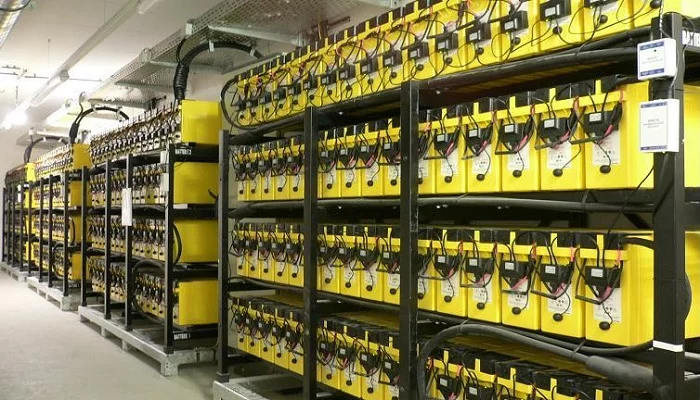
Answer First
The 6-DMF-52 is a 12 V, 52 Ah sealed VRLA AGM block rated at the C3 rate, and the point in the CHISEN 12 V VRLA line where cabinet footprint stops being the limiting constraint. Published dimensions are 224 × 135 × 175 mm, weight 13.7 ± 0.2 kg, maximum charge current 10.4 A, float 13.5 V, equalise 14.1 V and cut-off 1.75 V/cell, all from the manufacturer model page.
Procurement teams get a traceable setpoint package: 2.25 V/cell float, 2.35 V/cell equalise, ≤3 %/month self-discharge at 25 °C and a −15…50 °C working envelope, so UPS and telecom projects in Chennai, Lagos, Mombasa or Karachi can be commissioned against written numbers. One parameter is not published and must be requested in writing before a tender: the design float life, since the published 350–600 cycles at 50–80 % DoD is a cycle figure, not a calendar figure. See this model page.
Key Takeaways
- The 6-DMF-52 is a 12 V 52 Ah VRLA AGM block rated at C3, published at 224 × 135 × 175 mm and 13.7 ± 0.2 kg.
- Float and equalise are published, not negotiated: 13.5 V float, 14.1 V equalise, or 2.25 V and 2.35 V per cell.
- Charge acceptance is bounded at 10.4 A, so a borrowed charger needs a rectifier check.
- Cut-off is 1.75 V/cell, the figure your discharge models and alarms should be written against.
- Cycle life is published as 350–600 cycles at 50–80 % DoD; design float life is not published and must be confirmed in writing.
§1 — 6-DMF-52 Quick Specifications
Every row is transcribed from the manufacturer model page for the 6-DMF-52; where a figure is not published it is marked rather than estimated.
| Parameter | Published value | Source |
|---|---|---|
| Nominal voltage | 12 V | Model page |
| Nominal capacity | 52 Ah at C3 | Model page |
| Capacity rate | C3 | Model page |
| Dimensions (L × W × H) | 224 × 135 × 175 mm | Model page |
| Weight | 13.7 ± 0.2 kg | Model page |
| Terminal | φ11.8-M6 | Model page |
| Float voltage | 13.5 V (2.25 V/cell) | Model page |
| Equalise voltage | 14.1 V (2.35 V/cell) | Model page |
| Cycle life | 350–600 cycles (DoD 50–80 %) | Model page |
| Maximum charge current | 10.4 A | Model page |
| Cut-off voltage | 1.75 V/cell | Model page |
| Self-discharge | ≤3 %/month at 25 °C | Model page |
| Working temperature | −15…50 °C | Model page |
| Design life | not published — to be requested from the factory | Model page |
Two entries change how the 6-DMF-52 is quoted: the capacity rate is C3, the three-hour discharge rate for standby duty, so a runtime figure quoted at C10 is not comparable, and the 10.4 A maximum charge current is exactly one tenth of the 52 Ah rating.
§2 — The Pain: Why UPS Battery Procurement Goes Wrong Before the Invoice
The recurring failure in data-centre and telecom battery buying is a documentation failure, not a technical one. It surfaces eighteen months later, during an audit or a warranty argument, when nobody can say which supplier printed the datasheet.
The first version is the paraphrased datasheet. A distributor’s PDF shows a nominal capacity of 52 Ah but drops the rate letter, so 52 Ah at C3 and 52 Ah at C10 are indistinguishable on paper. The consequence is a runtime model built on the wrong curve: the bank looks adequate and collapses at the first load step. The 6-DMF-52 is published at C3, so insist on the rate letter in writing.
The second version is setpoint drift. If float is left at the factory default of 13.5 V and the string is never equalised at 14.1 V, a partially discharged bank spends its life in a shallow cycle regime that erodes usable capacity. The 1.75 V/cell cut-off matters equally: protection set above it truncates usable capacity, protection set below it drives cells into deep discharge. Buy against published numbers, verify them on arrival, record what was measured.
§3 — The Choice: Selecting a 12 V VRLA Block That Survives the Tender
Four filters narrow the decision for UPS and telecom projects, in order.
Filter one — voltage architecture. Most small UPS cabinets and telecom power shelves run on 12 V strings, which rules out 2 V tubular product and keeps the shortlist inside the VRLA block line of the 6-DZF, 6-DMF and 6-EVF series.
Filter two — required Ah. Work backwards from the load. A cabinet that must deliver 25 A for 30 minutes needs 25 A × 0.5 h = 12.5 Ah at the cut-off, which describes no bank. Add your ageing margin, then redundancy, then choose a capacity. The 6-DMF-52 at 52 Ah C3 is the middle point where 38 Ah is thin and 60 Ah will not fit the rack.
Filter three — setpoint conformity. The published float of 13.5 V and equalise of 14.1 V match most modern UPS chargers. Confirm the charger can be configured to them, and confirm the equalise stage is enabled or disabled by the equipment manufacturer, because a 14.1 V equalise on a charger that cannot manage it overheats the terminals.
Filter five — supply channel. Compare the 12 Ah to 150 Ah blocks on equal terms through the full product range, and use the sibling model page as the reference point for the 38 Ah C3 block below this one. Treat any figure that is not on the model page as a request to the factory, and the 6-DMF-52 survives the filters when the project needs more than 45 Ah inside a 224 mm bay.
§4 — The Framework: A Sizing and Commissioning Method You Can Audit
A worked method, not a formula. Run it once per project and keep the arithmetic on file.
Step 1 — establish the cell count. The 6-DMF-52 is a 12 V assembly, so cell count = 12 V ÷ 2.00 V per cell = 6 cells. Scaled by six: float bus = 6 × 2.25 V = 13.50 V; equalise bus = 6 × 2.35 V = 14.10 V; end-of-discharge bus = 6 × 1.75 V = 10.50 V. Write 10.50 V into the discharge alarm, not 10.8 V.
Step 2 — compute the energy reserve. Nominal energy per block = 52 Ah × 12 V = 624 Wh, so a two-block 24 V string holds 2 × 624 Wh = 1,248 Wh nominal.
Step 3 — size the runtime honestly. Published capacity is 52 Ah at C3. For a 25 A cabinet load, theoretical hours = 52 Ah ÷ 25 A = 2.08 h, about 2 h 05 min. Apply your ageing margin — at 20 %, usable capacity = 52 × 0.8 = 41.6 Ah, so delivered time = 41.6 Ah ÷ 25 A = 1.66 h, about 1 h 40 min. Quote the second number.
Step 4 — check the charger. The published maximum charge current is 10.4 A, which is 10.4 ÷ 52 = 0.2 × C10, the ten-hour convention. Minimum absorb time at that ceiling = 52 Ah ÷ 10.4 A = 5 h. A lower charger current is fine; a higher demand needs written factory confirmation.
Step 5 — account for standby loss. Self-discharge is ≤3 %/month at 25 °C, so a three-month standby period costs 52 Ah × 3 % × 3 = 4.68 Ah, and the acceptance sheet in Q7 closes the handover.
§5 — Where the 6-DMF-52 Sits in the CHISEN 12 V VRLA Line
All values below are transcribed from the manufacturer model page.
| Model | Capacity / rate | Dimensions (mm) | Weight | Terminal | Max charge current | Float / equalise | Cycle life | Design life | Source |
|---|---|---|---|---|---|---|---|---|---|
| 6-DZF-20 | 20 Ah / C2 | 180 × 76 × 170 | 6.1 ± 0.2 kg | φ8.8-M5 | 4.0 A | 13.5 V / 14.1 V | 350–600 | 2–5 years | Model page |
| 6-DMF-38 | 38 Ah / C3 | 224 × 106 × 175 | 10.45 ± 0.2 kg | φ9.8-M5 | 7.6 A | 13.5 V / 14.1 V | 350–600 | not published | Model page |
| 6-DMF-45 | 45 Ah / C3 | 224 × 121 × 175 | 12.3 ± 0.2 kg | φ11.8-M5 | 9.0 A | 13.5 V / 14.1 V | 350–600 | 2–5 years | Model page |
| 6-DMF-52 | 52 Ah / C3 | 224 × 135 × 175 | 13.7 ± 0.2 kg | φ11.8-M6 | 10.4 A | 13.5 V / 14.1 V | 350–600 | not published | Model page |
| 6-EVF-50 | 50 Ah / C3 | 230 × 140 × 180 | 15.25 ± 0.2 kg | φ11.8-M6 | 10.0 A | 13.5 V / 14.1 V | 350–600 | 2–5 years | Model page |
| 6-EVF-60 | 60 Ah / C3 | 258 × 170 × 160 | 18.8 ± 0.2 kg | φ14-M6 | 12.0 A | 13.5 V / 14.1 V | 350–600 | 2–5 years | Model page |
Two comparisons deserve a note. The 6-DMF-45 and the 6-DMF-52 share the same 224 mm length, 175 mm height and setpoints, so they drop into the same bay; the wider 135 mm case of the 6-DMF-52 buys 7 Ah more for 1.4 kg.
§6 — The Trust: Who Manufactures the 6-DMF-52 and How It Reaches Your Site
The 6-DMF-52 is manufactured by CHISEN Battery in Hangzhou, China, a factory with 8 production bases, 70 million kVAh annual capacity and CE, ISO 9001, ISO 14001, UL and IEC certifications, building flooded tubular OPzS2, gel tubular OPzV2 and 12 V VRLA blocks in the 6-DZF, 6-DMF and 6-EVF series.
Scale matters for one practical reason: batch consistency. A distributor who sources a 52 Ah block from one plant run and a replacement block from another is buying a different product with the same label. Sourcing the whole string from one factory, with one setpoint package and one acceptance sheet, removes that variable.
Logistics are straightforward, because the 6-DMF-52 is a standard 12 V AGM case at 13.7 ± 0.2 kg. Export shipments move mainly from Ningbo and Shanghai into distributor networks in India, Nigeria, Kenya, Vietnam, the Philippines, Brazil, Egypt and Mexico, with container consolidation also serving Dubai, Karachi, Mombasa and Colombo. The export desk answers specification, certification and sample requests in English, and confirms in writing any figure that is not published, including design float life.
§7 — FAQ
Q1: What are the published nominal voltage and capacity of the 6-DMF-52? The published nominal voltage is 12 V and the published nominal capacity is 52 Ah at the C3 rate, the three-hour discharge rate used for standby telecom and UPS duty. Both figures come from the manufacturer model page, and the C3 rate should be confirmed on any quotation, because a rating quoted without its rate letter cannot be used for runtime modelling.
Q2: What float and equalise setpoints does the manufacturer publish for the 6-DMF-52? Float is published at 13.5 V and equalise at 14.1 V for the 12 V assembly, which is 2.25 V per cell on float and 2.35 V per cell on equalise across the six cells. Both values belong in the commissioning sheet, together with the decision on whether the charger enables the equalise stage.
Q3: What is the maximum charging current for the 6-DMF-52? The published maximum charging current is 10.4 A, equal to 0.2 times the 52 Ah rating under the ten-hour convention, and it implies a minimum absorb time of 52 Ah ÷ 10.4 A = 5 hours at that ceiling. A charger with a lower output is acceptable; any charger above the published ceiling needs written factory confirmation.
Q4: What are the case dimensions and weight of the 6-DMF-52? Published case dimensions are 224 × 135 × 175 mm and published weight is 13.7 ± 0.2 kg, both from the manufacturer model page. Because the weight carries a tolerance, use 13.9 kg for handling and 13.7 kg for the shelf load calculation.
Q5: What terminal type and torque does the 6-DMF-52 use? The published terminal type is φ11.8-M6, an insert moulded around an M6 stud with an 11.8 mm collar. The manufacturer publishes no tightening torque for this model, so torque must be requested in writing from the factory and recorded on the commissioning sheet.
Q6: What is the published design float life of the 6-DMF-52 and at what temperature? The design float life for the 6-DMF-52 is not published on the model page and must be requested from the factory before a framework tender is signed. Published are a cycle life of 350–600 cycles at 50–80 % depth of discharge, self-discharge of ≤3 %/month at 25 °C, and a working range of −15…50 °C.
Q7: How should an importer verify the 6-DMF-52 on delivery? Five checks: read the label and confirm model, 12 V, 52 Ah and the C3 rate; check the terminal against the published φ11.8-M6; weigh a random sample against 13.7 ± 0.2 kg; measure open-circuit voltage on every block; file the production date with the delivery note.
Q8: How do I request a quotation or samples for the 6-DMF-52? Send the requirement to the CHISEN export desk at sales@chisen.cn or jack@chisen.cn with quantity, destination port, delivery window and sample needs. Ask for written confirmation of design float life, terminal tightening torque and the certifications required by the destination country.
Expert Summary
The 6-DMF-52 is a 12 V, 52 Ah C3 VRLA AGM block from CHISEN, published at 224 × 135 × 175 mm and 13.7 ± 0.2 kg with 13.5 V float, 14.1 V equalise, a 1.75 V/cell cut-off, a 10.4 A maximum charge current, ≤3 %/month self-discharge at 25 °C and a −15…50 °C working envelope. It closes the gap between the 38 Ah and 60 Ah options without changing the bay depth, shares the 6-DMF-45 dimensions, and delivers a documented C3 rating instead of a nominal number, so buy it against published setpoints and confirm the two unpublished figures in writing.
Contact CHISEN — 24-Hour Response
CHISEN Battery, Hangzhou, China — 8 production bases, 70 million kVAh annual capacity, CE / ISO 9001 / ISO 14001 / UL / IEC.
- Export desk: sales@chisen.cn
- General manager: jack@chisen.cn
- WhatsApp: +86 131 6622 6999
- Website: www.chisen.cn
Send your 6-DMF-52 requirement with quantity, destination port and delivery window, and the export desk returns published specifications, certificates and a quotation within 24 hours.
Related CHISEN Buyer Guides
- 12V 50Ah Motorcycle Battery: Choosing Between the 6-EVF-50, 6-DMF-45 and 6-DMF-52 (2026)
- 12V 100Ah LiFePO4 vs Lead Acid Battery: Cycle Life, Published 6-EVF-100 Specs and Where Ea
- 2V 1000Ah Battery Buyer Guide 2026: Telecom, UPS, and Solar Storage Sourcing
- 6-EVF-120 12V120Ah UPS Battery: Complete Buyer Guide for Data Centres and Telecom
- 6-EVF-150 12V150Ah AGM Battery: Published Specs, Parallel String Sizing and EVF Range Comp
