Answer First
If you are qualifying a 12V 50Ah battery for a single-cabinet UPS or telecom power shelf, the CHISEN 6-EVF-50 is the size most buyers land on: 12 V nominal, 50 Ah at the C3 rate, 230 × 140 × 180 mm, 15.25 ± 0.2 kg, and a 6-cell monobloc case. The published charge control values are float 13.5 V (2.25 V/cell), equalise 14.1 V (2.35 V/cell), maximum charge current 10.0 A, and an end-of-discharge cut-off of 1.75 V/cell. Cycle life is published as 350–600 cycles at 50–80 % depth of discharge, with a design life of 2–5 years in float service. Full published data is on this model page.
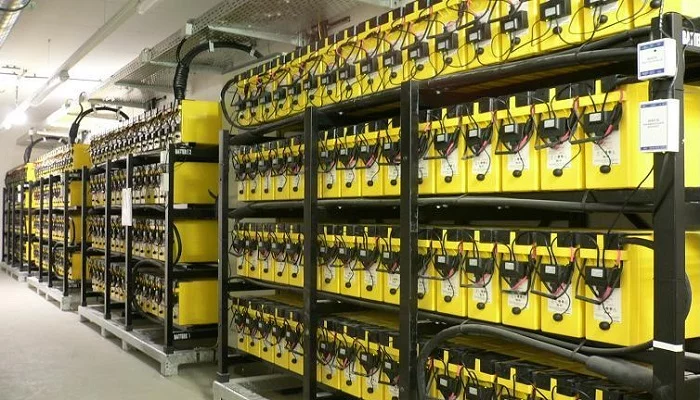
The arithmetic that matters for a UPS tender: nominal energy per battery is 12 V × 50 Ah = 600 Wh; per cell it is 2.0 V × 50 Ah = 100 Wh, and six cells give 12 V again. Specific energy therefore works out at 600 Wh ÷ 15.25 kg ≈ 39.3 Wh/kg, and usable capacity is normally taken as 80 % of nominal, or 40 Ah per unit. Worked example: a 2 kVA cabinet at 60 % load and 0.8 power factor presents 960 W at the output, 960 ÷ 0.92 = 1,043 W at the battery bus, and 1,043 ÷ 12 V = 87 A — so two 12V 50Ah battery strings in parallel are required, each carrying 43.5 A and holding roughly 55 minutes of runtime.
Selection logic is short. A single string of 6-EVF-50 units should stay at or below 25 A continuous discharge, which gives 40 Ah usable ÷ 25 A ≈ 1.6 hours of runtime at 25 °C. If two strings are paralleled, the load per string halves, redundancy is restored, and the charger must supply 2 × 10 A = 20 A. Full published options for adjacent capacities are listed in the full product range, and the next step up in the same series is described on the sibling model page.
Key Takeaways
- Published specification: 12 V, 50 Ah at C3, 230 × 140 × 180 mm, 15.25 ± 0.2 kg, φ11.8-M6 terminal, all from the manufacturer model page.
- Charge control: float 13.5 V, equalise 14.1 V, maximum charge current 10.0 A, cut-off 1.75 V/cell, self-discharge ≤3 %/month at 25 °C.
- Energy arithmetic: 12 V × 50 Ah = 600 Wh nominal per battery; 600 Wh ÷ 15.25 kg ≈ 39.3 Wh/kg.
- String design: six cells per monobloc, 13.5 V float bus, 14.1 V equalise bus, 10.5 V end-of-discharge bus (6 × 1.75 V).
- Runtime planning: 50 Ah nominal = 40 Ah usable at an 80 % factor, so one string runs about 1.6 h at 25 A, 2.4 h at 16.7 A (C3) and 8 h at 5 A.
- Commercial position: CE, ISO 9001, ISO 14001, UL and IEC certification, 8 production bases, 70 million kVAh annual capacity, shipped to distributors and OEM programmes across Asia, Africa, the Middle East and Latin America.
§1 — 6-EVF-50 Quick Specifications
Every line below is a published factory value for the 6-EVF-50, not an estimate. Where a figure is an arithmetic derivation it is marked as such.
| Parameter | Published value | Source |
|---|---|---|
| Nominal voltage | 12 V | Model page |
| Nominal capacity | 50 Ah | Model page |
| Capacity rate | C3 | Model page |
| Dimensions L×W×H | 230 × 140 × 180 mm | Model page |
| Weight | 15.25 ± 0.2 kg | Model page |
| Terminal | φ11.8-M6 | Model page |
| Float voltage | 13.5 V (2.25 V/cell) | Model page |
| Equalise voltage | 14.1 V (2.35 V/cell) | Model page |
| Cycle life | 350–600 cycles (DoD 50–80 %) | Model page |
| Maximum charge current | 10.0 A | Model page |
| Discharge cut-off | 1.75 V/cell | Model page |
| Self-discharge | ≤3 %/month at 25 °C | Model page |
| Working temperature | −15 °C to 50 °C | Model page |
| Design life (float) | 2–5 years | Model page |
| Nominal energy | 600 Wh (12 V × 50 Ah) | Arithmetic |
| Specific energy | ≈39.3 Wh/kg (600 Wh ÷ 15.25 kg) | Arithmetic |
| End-of-discharge bus voltage | 10.5 V (6 × 1.75 V) | Arithmetic |
§2 — The Pain: Where 12V 50Ah Battery Procurement Usually Breaks
Most failures on a 12V 50Ah battery tender are not chemistry failures. They are specification failures that surface after the container has been unloaded.
The catalogue-value trap. Sizing sheets are quoted at 25 °C and at the C10 discharge rate, while a UPS specification is written at 0.8–1.0 kVA per kW and often at a 30-minute discharge window. Moving from the 25 °C rating to a real cabinet at 35 °C, and from C10 to the C3 rate, cuts the usable figure well below the label. Buyers who sign off on “50 Ah” without a rate and a temperature end up with a string that is short at commissioning.
The one-string assumption. A single string of 12V 50Ah battery units has no redundancy at all. If one cell fails, the bus goes down, and the entire load transfers to a battery set that is not there. Data-centre and telecom buyers who specify N+1 strings treat this as a non-negotiable, and it doubles the float charge current requirement because each string draws up to 10 A.
Cable and terminal drift. The 6-EVF-50 uses a φ11.8-M6 terminal. Cabinets specified for smaller posts arrive with pre-terminated ring lugs that do not fit, and installers then substitute an unfavourable adapter, which adds contact resistance exactly where discharge current is highest.
No inbound verification. The most common after-sales conversation we have with importers is about a shipment where the packing list said the right thing but the delivered units did not match the published specification. Without a documented inspection step before the container is cleared, the importer carries the cost.
Lifecycle priced as calendar. Cycle life of 350–600 cycles and a design life of 2–5 years describe two different duty patterns. A telecom cabinet on float standby and a solar-backed site that cycles the pack daily will consume the same nominal 50 Ah in very different ways, and quoting them with one number is how replacement forecasts go wrong.
§3 — The Choice: Matching the 6-EVF-50 to the Real Load Profile
The right way to choose a 12V 50Ah battery is to start from the load, not from the footprint.
Step 1 — write the load down. Convert the cabinet load to amps at the battery bus. A 2 kVA UPS with a 0.8 power factor drawing 60 % of rated load presents 2,000 × 0.6 × 0.8 = 960 W at the output; at 92 % inverter efficiency and a 12 V bus that is 960 ÷ 0.92 ÷ 12 = 87 A. That number, not the kVA figure, drives everything else.
Step 2 — fix the autonomy window. A 12V 50Ah battery holds 50 Ah nominal, and 50 Ah × 0.80 = 40 Ah is the usable figure used for planning. Runtime per string is therefore 40 Ah ÷ the string current: 43.5 A gives 55 minutes, 25 A gives 96 minutes, 16.7 A gives 2.4 hours. If the specification asks for 30 minutes at 87 A, one string is not enough and two parallel strings are the answer.
Step 3 — count strings for redundancy. Two strings in parallel give 100 Ah and 1,200 Wh nominal, halve the per-string discharge current, and keep a spare path if one string is compromised. The charge side must then be rated for 2 × 10 A = 20 A, which is a cabinet setting a specifier must confirm with the charger supplier.
Step 4 — decide float standby or cyclic service. For float standby in a data centre or telecom room, the 13.5 V float and 14.1 V equalise setpoints with a 1.75 V/cell cut-off are the correct published set. For a site where the pack is cycled regularly, check the 350–600 cycle rating against the actual depth of discharge before committing.
Step 5 — check the thermal envelope. The published working range is −15 °C to 50 °C. Cabinets in hot climates, including many deployments in the Middle East and South Asia, need forced ventilation or a de-rated string count, because the 50 Ah figure assumes 25 °C.
Step 6 — confirm the mechanical and electrical interface. 230 × 140 × 180 mm and 15.25 ± 0.2 kg per unit sets the shelf load, and the φ11.8-M6 terminal sets the cable lug. Both are fixed before the order is placed, and both are published values rather than assumptions.
§4 — The Framework: A Sizing Method You Can Audit Line by Line
This is the calculation we use internally before a quotation is issued, written out so a buyer can check it against their own load sheet.
Line 1 — DC load. I_load = (UPS output watts ÷ inverter efficiency) ÷ nominal bus voltage. For the 2 kVA cabinet at 60 % load, 0.8 power factor and 92 % inverter efficiency: 2,000 × 0.6 × 0.8 = 960 W; 960 ÷ 0.92 = 1,043 W; 1,043 ÷ 12 V = 87 A. One 50 Ah string cannot carry 87 A, so two strings are used.
Line 2 — usable capacity. Usable Ah = published Ah × 0.80 = 50 × 0.80 = 40 Ah per 12V 50Ah battery, which is 40 Ah × 12 V = 480 Wh of usable energy per unit.
Line 3 — runtime per string. t = usable Ah ÷ string current. Two strings share the 87 A, so each carries 87 ÷ 2 = 43.5 A and t = 40 ÷ 43.5 = 0.92 h, about 55 minutes per string against a 30-minute target.
| String current | Load share of one string | Runtime per string (40 Ah ÷ I) |
|---|---|---|
| 5 A | 0.1 × C10 | 8.0 h |
| 10 A | 0.2 × C10 | 4.0 h |
| 16.7 A | C3 rate (50 Ah ÷ 3 h) | 2.4 h |
| 25 A | 0.5 × C10 | 1.6 h |
| 43.5 A | two-string 87 A cabinet | 0.9 h |
| 50 A | 1.0 × C10 | 0.8 h |
Line 4 — strings and charge. N = ceil(I_load × autonomy factor ÷ I_per_string), with the charge requirement checked against 10 A per string. Two parallel strings therefore need 20 A of float charging capacity.
Line 5 — thermal and mechanical check. Apply the temperature envelope of −15 °C to 50 °C, the shelf load of 15.25 ± 0.2 kg per unit, the 230 × 140 × 180 mm footprint and the φ11.8-M6 terminal before the drawing is released.
§5 — Where the 6-EVF-50 Sits in the 12 V VRLA Line-up
The numbers below are published model-page values for each model, so a buyer can move up or down in capacity without guessing.
| Model | V | Capacity | Rate | L×W×H mm | Weight | Terminal | Float | Equalise | Charge current | Cut-off | Cycle life | Design life | Source |
|---|---|---|---|---|---|---|---|---|---|---|---|---|---|
| 6-DMF-45 | 12 | 45 Ah | C3 | 224×121×175 | 12.3 ± 0.2 kg | φ11.8-M5 | 13.5 V | 14.1 V | 9.0 A | 1.75 V/cell | 350–600 | 2–5 years | Model page |
| 6-EVF-50 | 12 | 50 Ah | C3 | 230×140×180 | 15.25 ± 0.2 kg | φ11.8-M6 | 13.5 V | 14.1 V | 10.0 A | 1.75 V/cell | 350–600 | 2–5 years | Model page |
| 6-DMF-52 | 12 | 52 Ah | C3 | 224×135×175 | 13.7 ± 0.2 kg | φ11.8-M6 | 13.5 V | 14.1 V | 10.4 A | 1.75 V/cell | 350–600 | not published | Model page |
| 6-EVF-60 | 12 | 60 Ah | C3 | 258×170×160 | 18.8 ± 0.2 kg | φ14-M6 | 13.5 V | 14.1 V | 12.0 A | 1.75 V/cell | 350–600 | 2–5 years | Model page |
| 6-EVF-80 | 12 | 80 Ah | C3 | 259×170×218 | 25.7 ± 0.2 kg | φ16-M6 | 13.5 V | 14.1 V | 16.0 A | 1.75 V/cell | 350–600 | 2–5 years | Model page |
| 6-EVF-100 | 12 | 100 Ah | C3 | 330×170×218 | 31.5 ± 0.2 kg | φ20-M8 | 13.5 V | 14.1 V | 20.0 A | 1.75 V/cell | 350–600 | 2–5 years | Model page |
Read the table as three decisions. Capacity: 50 Ah is the middle point where one string still handles a sub-1 kVA cabinet with margin, while 60–100 Ah lets a single string serve larger cabinets without more strings. Charge current: 10.0 A for the 6-EVF-50 sets the charger size for a single string, and 20.0 A for a 6-EVF-100 sets it for one. Footprint: the EVF case is 230 × 140 × 180 mm at 15.25 ± 0.2 kg, so a two-string shelf needs 30.5 kg of battery mass and 230 mm of depth.
§6 — The Trust: How the 6-EVF-50 Is Documented and Delivered
Buying a 12V 50Ah battery across a border is mostly a documentation exercise, so the credibility of the supplier is measured in the records it can produce, not in the adjectives on the box.
Factory scale. CHISEN operates 8 production bases with an annual capacity of 70 million kVAh. The 12 V VRLA range that includes the 6-EVF-50 covers the 6-DZF, 6-DMF and 6-EVF series, and the wider portfolio extends to flooded tubular OPzS2, gel tubular OPzV2 and solar storage systems. Scale matters here for one specific reason: continuity of supply for a multi-year replacement programme.
Certification. The factory holds CE, ISO 9001, ISO 14001, UL and IEC certification, and the test reports and certificates are issued against the company rather than against a trading intermediary, so an importer’s own quality audit can be closed in one visit.
Data discipline. Every specification quoted in this guide comes from the published model page for the 6-EVF-50, and every derived figure is marked as arithmetic. Where the factory has not published a value, this guide says so rather than estimating. One point worth flagging plainly: the design life is published as 2–5 years and cycle life as 350–600 cycles at 50–80 % depth of discharge, and the exact number in a given contract depends on the float voltage, temperature and depth of discharge of the installation, so it is to be requested from the factory for a specific site.
Export delivery. CHISEN Battery is based in Hangzhou, China, and finished goods move through the export ports of Ningbo, Shanghai and Shenzhen. Distribution partners in India, Nigeria, Kenya, Vietnam, the Philippines and Brazil receive regular container shipments, with further programmes in Egypt, Mexico, Indonesia, Pakistan, the UAE, Turkey, South Africa and Thailand. Buyers in Europe typically route through Dubai, Hamburg, Rotterdam or Antwerp, and South American orders move through Santos and Callao. All freight terms, warranty periods and documentation sets are confirmed on the quotation rather than assumed.
Counterfeit control. For a product sold on published numbers, the safest verification is to check the delivered units against the model-page values: the label rating of 12 V 50 Ah, the case size of 230 × 140 × 180 mm, the terminal of φ11.8-M6, and the weight of 15.25 ± 0.2 kg per unit. A batch that misses the label data is not a 12V 50Ah battery, whatever the packing list says.
§7 — FAQ
Q1: What are the published nominal voltage and capacity of the 6-EVF-50? The manufacturer publishes 12 V nominal and 50 Ah at the C3 rate for the 6-EVF-50 (Source: Model page). Nominal energy derived from those two figures is 12 V × 50 Ah = 600 Wh (Source: Arithmetic).
Q2: What float and equalise setpoints does the manufacturer publish for the 6-EVF-50? Float 13.5 V and equalise 14.1 V for the complete six-cell 12 V battery, which is 2.25 V/cell at float and 2.35 V/cell at equalise (Source: Model page). A string charger should be programmed to these values.
Q3: What is the maximum charging current for the 6-EVF-50? 10.0 A per battery (Source: Model page). A two-string configuration therefore needs a charger able to deliver 2 × 10 A = 20 A (Source: Arithmetic).
Q4: What are the case dimensions and weight of the 6-EVF-50? 230 × 140 × 180 mm (L × W × H) and 15.25 ± 0.2 kg per unit (Source: Model page). Two units on a shelf give 30.5 kg of battery mass (Source: Arithmetic), which the cabinet structure must carry.
Q5: What terminal type and torque does the 6-EVF-50 use? The published terminal is φ11.8-M6 (Source: Model page). The manufacturer does not publish a torque figure on the model page, so the recommended tightening value is to be requested from the factory, and cable lugs must be sized to match the post diameter.
Q6: How many cells does a 12V50Ah string contain and what bus voltage does it give? The 6-EVF-50 is a six-cell 12 V monobloc, so a string made of these units has a 13.5 V float bus, a 14.1 V equalise bus and a 10.5 V end-of-discharge bus (6 × 1.75 V) (Source: Model page for the setpoints, Arithmetic for the string voltage).
Q7: What is the published design float life of the 6-EVF-50 and at what temperature? Design life is published as 2–5 years in float service, with cycle life of 350–600 cycles at 50–80 % depth of discharge (Source: Model page). The rated capacity is specified at 25 °C, and the working temperature envelope is −15 °C to 50 °C; the site-specific life figure is to be requested from the factory.
Q8: How should an importer verify the 6-EVF-50 on delivery? Check the label rating of 12 V 50 Ah, the case dimensions of 230 × 140 × 180 mm, the terminal of φ11.8-M6 and the unit weight of 15.25 ± 0.2 kg against the published model-page values before the shipment is cleared, and photograph the labels and the pallet count for the file.
Q9: Which certifications does the CHISEN factory behind the 6-EVF-50 hold? The factory holds CE, ISO 9001, ISO 14001, UL and IEC certification, with eight production bases and an annual capacity of 70 million kVAh (Source: Company facts). Certificates and test reports are issued against CHISEN Battery, Hangzhou, China.
Q10: How do I request a quotation or samples for the 6-EVF-50? Send the target quantity, the destination port and the required certification set to the export desk at sales@chisen.cn or jack@chisen.cn, or message the WhatsApp line +86 131 6622 6999. Samples for a 12V 50Ah battery evaluation can be arranged with the technical data sheet attached.
Expert Summary
The 6-EVF-50 is a 12 V 50 Ah VRLA battery built for UPS, data-centre and telecom cabinets, and every number in this guide is published or arithmetically derived: 230 × 140 × 180 mm, 15.25 ± 0.2 kg, φ11.8-M6 terminal, 13.5 V float, 14.1 V equalise, 10.0 A maximum charge current, 1.75 V/cell cut-off, 350–600 cycles at 50–80 % DoD, 2–5 years design life, −15 °C to 50 °C working range and ≤3 %/month self-discharge at 25 °C. Nominal energy is 600 Wh per unit and ≈39.3 Wh/kg, and planning at 80 % usable capacity gives 40 Ah, so runtime per string is simply 40 Ah divided by the string current — 0.9 h at 43.5 A, 1.6 h at 25 A, 2.4 h at 16.7 A. A 2 kVA cabinet at 60 % load and 0.8 power factor draws 87 A at the 12 V bus, which is why two parallel strings with 20 A of charger capacity is the standard arrangement for a 12V 50Ah battery installation. CHISEN supplies these cells from 8 production bases with 70 million kVAh annual capacity under CE, ISO 9001, ISO 14001, UL and IEC certification, and ships them to distributors and OEM programmes from Ningbo, Shanghai and Shenzhen to buyers in India, Nigeria, Kenya, Vietnam, the Philippines, Brazil, Egypt, Mexico, Indonesia, Pakistan, the UAE, Turkey, South Africa, Thailand and across Europe through Dubai, Hamburg, Rotterdam and Antwerp.
Contact CHISEN — 24-Hour Response
- Email: sales@chisen.cn | jack@chisen.cn
- WhatsApp: +86 131 6622 6999
- Website: www.chisen.cn
Related CHISEN Buyer Guides
- 12V 100Ah LiFePO4 vs Lead Acid Battery: Cycle Life, Published 6-EVF-100 Specs and Where Ea
- 2V 1000Ah Battery Buyer Guide 2026: Telecom, UPS, and Solar Storage Sourcing
- 6-DMF-52 12V52Ah UPS Battery: Complete Buyer Guide for Data Centres and Telecom
- 6-EVF-120 12V120Ah UPS Battery: Complete Buyer Guide for Data Centres and Telecom
- 6-EVF-150 12V150Ah AGM Battery: Published Specs, Parallel String Sizing and EVF Range Comp
