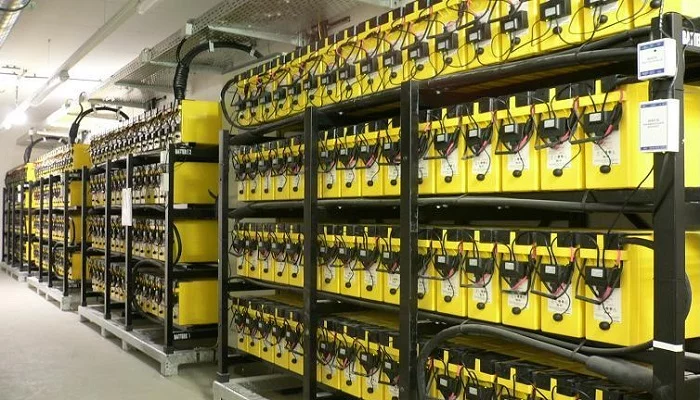
Answer First
The 6-EVF-60 12V60Ah is a 12 V, 60 Ah sealed VRLA (AGM) battery rated at the C3 rate, sized for the mid-tier of the UPS market: small data centre rows, telecom power rooms, network cabinets and control panels where a 50 Ah block is tight and a 100 Ah block is dead weight in the rack. Every figure quoted here comes from the published CHISEN model page — nominal 12 V and 60 Ah, case dimensions 258×170×160 mm, weight 18.8 ± 0.2 kg, float 13.5 V, equalise 14.1 V, maximum charge current 12.0 A, cutoff 1.75 V/cell, self-discharge ≤3 %/month at 25 °C, working range −15…50 °C, and a published cycle life of 350–600 cycles at 50–80 % depth of discharge.
Three numbers do most of the arithmetic work. Stored energy is 12 V × 60 Ah = 720 Wh per block. Float and equalise translate directly into cell voltage: 13.5 V ÷ 6 cells = 2.25 V/cell and 14.1 V ÷ 6 cells = 2.35 V/cell, exactly what a 6-cell 12 V VRLA string expects. Specific energy is 720 Wh ÷ 18.8 kg = 38.3 Wh/kg, a useful check when a cabinet has a fixed weight limit. Full data for the 6-EVF-60 12V60Ah is on this model page.
Key Takeaways
- Published specification set: 12 V, 60 Ah, C3 rate, 258×170×160 mm, 18.8 ± 0.2 kg, φ14-M6 terminal — taken from the factory model page, not estimated.
- Charge regime is traceable: float 13.5 V (2.25 V/cell across 6 cells), equalise 14.1 V (2.35 V/cell), maximum charge current 12.0 A, which equals 0.20 × the 60 Ah C10 rating. Energy per block is 720 Wh (12 V × 60 Ah); four blocks in parallel deliver 240 Ah / 2,880 Wh and weigh 75.2 kg (4 × 18.8 kg).
- Service envelope: −15…50 °C operating range, self-discharge ≤3 %/month at 25 °C, cutoff 1.75 V/cell, cycle life 350–600 cycles at 50–80 % DoD. The full 12 V VRLA line from 12 Ah to 150 Ah is listed in the full product range.
§1 — 6-EVF-60 Quick Specifications
The table reproduces the published data for the 6-EVF-60 12V60Ah exactly as it appears on the factory model page; only the cell count and bus voltage are derived.
| Parameter | Value | Source |
|---|---|---|
| Nominal voltage | 12 V | Model page |
| Capacity | 60 Ah | Model page |
| Discharge rate | C3 | Model page |
| Dimensions (L×W×H) | 258×170×160 mm | Model page |
| Weight | 18.8 ± 0.2 kg | Model page |
| Terminal | φ14-M6 | Model page |
| Float voltage | 13.5 V | Model page |
| Equalise voltage | 14.1 V | Model page |
| Cycle life | 350–600 cycles | Model page |
| Maximum charge current | 12.0 A | Model page |
| Cut-off voltage | 1.75 V/cell | Model page |
| Self-discharge | ≤3 %/month | Model page |
| Working temperature | −15…50 °C | Model page |
| Design life | 2–5 years | Model page |
Derivation, marked as arithmetic rather than a published line: a 12 V VRLA battery contains 6 lead-acid cells in series, because 12 V ÷ 2.0 V per cell = 6 cells. Applying the same division to the published setpoints gives 13.5 V ÷ 6 = 2.25 V/cell float and 14.1 V ÷ 6 = 2.35 V/cell equalise, so a 6-EVF-60 12V60Ah string sits exactly on the standard VRLA profile without charger adjustment beyond the 13.5 V / 14.1 V preset. Torque figures for the φ14-M6 terminal and the float temperature compensation curve are not published; request them with your quotation.
Two figures are often mis-stated in tenders. The 350–600 cycle rating is a cycle rating at 50–80 % depth of discharge, separate from the 2–5 year design float life; and the −15…50 °C working range describes operation, while float life is quoted at 25 °C and shortens in a hotter cabinet.
§2 — The Pain: Why 12 V VRLA Sizing Fails in the Field
Most procurement problems with 12 V VRLA blocks are specification-transfer problems: a quotation is written from a datasheet column, the string is built, and the cabinet behaves differently than the paper promised. Four failure modes cover almost all of them, each with a published number attached to the 6-EVF-60 12V60Ah.
The nameplate capacity is not the usable capacity. A 60 Ah block rated at C3 is validated at a 20 A discharge (60 Ah ÷ 3 h). A UPS that delivers a large boost current during a deep discharge pulls energy faster than the C10 point used for catalogue figures, and the delivered runtime drops.
Voltage drift, not capacity, ends most strings. With the cutoff published at 1.75 V/cell and float at 13.5 V, the usable window on a 6-cell string is 10.5 V at cutoff (6 cells × 1.75 V) rising to 13.5 V in float. A string sitting below the float setpoint for long periods ages from chronic undercharge, not from cycling alone.
Temperature is the silent derating factor. The working range is −15…50 °C, but float life is quoted at 25 °C, and every 10 °C above 25 °C roughly halves the expected life of a VRLA float string — which is why a 2–5 year design life becomes a 1.5–2.5 year expectation in a hot cabinet without active cooling.
Mixed batches age unevenly. Blocks of different ages and discharge histories do not share a load equally; the weakest block sets the string’s runtime and drags the others with it. The fix is batch discipline: same model, same production window, same float history, verified on arrival.
For the 6-EVF-60 12V60Ah the second point carries extra weight: with a case of 258×170×160 mm and 18.8 ± 0.2 kg, the block fits the same footprint range as the neighbouring 50 Ah and 80 Ah units but not the same rack pitch, so check the drawing before the order rather than after the pallet arrives.
§3 — The Choice: Matching the 60 Ah Block to the Application
Choosing between the 12 Ah, 20 Ah, 38 Ah, 45 Ah, 52 Ah, 60 Ah, 80 Ah, 100 Ah, 120 Ah and 150 Ah options inside the 12 V VRLA line is a question of how many blocks sit in parallel and how long the load must be carried, not of which number sounds better on the invoice.
- Start from the load, not the battery. Multiply UPS kVA by power factor for real watts, then divide by the 13.5 V float bus for the current the string must carry.
- Convert watts to ampere-hours. Required Ah = required watts × required runtime in hours ÷ 13.5 V. Add the margin agreed in the contract, not one invented by the supplier.
- Divide the required Ah by 60 Ah to get the number of 6-EVF-60 12V60Ah blocks in parallel, then round up to a whole string.
- Check the mechanical and thermal envelope. Each block is 18.8 ± 0.2 kg and 258×170×160 mm; confirm shelf loading and that the cabinet holds its aisle temperature.
- Confirm the charger. The published maximum charge current is 12.0 A per block; a charger below the total string current extends recharge time and leaves the string undercharged at the next event.
Worked example, arithmetic only. A 20 kVA UPS at 0.9 power factor draws 20 kVA × 0.9 = 18,000 W. At the 13.5 V float bus this is 18,000 W ÷ 13.5 V = 1,333 A. A single 6-EVF-60 12V60Ah block contributes 60 Ah; four in parallel contribute 4 × 60 Ah = 240 Ah, and 240 Ah × 13.5 V = 3,240 Wh, of which 80 % depth of discharge gives 3,240 Wh × 0.8 = 2,592 Wh. Runtime before the 1.75 V/cell cutoff is reached is therefore 2,592 Wh ÷ 18,000 W = 0.144 h ≈ 8.6 minutes for four blocks, and 1,333 A ÷ 4 blocks = 333 A per block — far above the 20 A C3 validation point, which is exactly why the C3 rating on this model matters and why the discharge rate must be confirmed with the factory before the string is committed.
In a telecom power room the arithmetic rarely changes but the environment does: cabinet temperatures are higher, the load is steadier, and the same 6-EVF-60 12V60Ah block is usually specified in larger parallel strings with a shorter backup target. The sibling model page shows the adjacent 50 Ah option, often the right answer when backup time is short and cabinet space is tight.
§4 — The Framework: A Five-Step Acceptance and Sizing Routine
A 6-EVF-60 12V60Ah purchase should pass through five documented steps before the invoice is paid and the string is commissioned.
Step 1 — Freeze the requirement in published numbers. Write the requirement using only verifiable figures: 12 V, 60 Ah, C3, 258×170×160 mm, 18.8 ± 0.2 kg, φ14-M6, float 13.5 V, equalise 14.1 V, charge current 12.0 A, cutoff 1.75 V/cell, self-discharge ≤3 %/month, −15…50 °C, cycle life 350–600, design life 2–5 years. Anything the factory has not published belongs in the requirement as “to be requested from the factory”, not as an assumed value.
Step 2 — Fix the string arithmetic on paper. Compute the string size, the per-block current and the expected runtime in advance and keep the calculation sheet with the purchase file. Repeat the arithmetic at three levels: 13.5 V float, 12 V nominal, and 10.5 V cutoff (6 cells × 1.75 V). If the numbers change when the string is assembled, the design was not finished.
Step 3 — Verify on arrival, before installation. Check the model marking, case dimensions against 258×170×160 mm, gross weight against 18.8 ± 0.2 kg, the φ14-M6 terminal pattern and the manufacture date on the case label; measure open-circuit voltage per block and reject any block below the factory’s stated shipping value; confirm the supplied certificate matches the ordered model.
Step 4 — Commission with a recorded charge profile. Set the charger to the published 13.5 V float / 14.1 V equalise profile, confirm the string recharge current stays within the 12.0 A per block limit, log float current and voltage at 24 hours and 72 hours, and record the string voltage at the 1.75 V/cell cutoff during the first discharge test. That log becomes the baseline for every annual inspection.
Step 5 — Install the inspection calendar. Set the service interval from the 2–5 year design float life at 25 °C, shortened for cabinet temperatures above 25 °C, and from the 350–600 cycle rating at 50–80 % DoD if the site discharges frequently. Each inspection repeats string voltage at float, per-block deviation, terminal torque check, cleanliness and float current against the commissioning baseline.
Three traps for the project team. Setting the charger below the published 12.0 A limit and then wondering why the string recovers slowly: four blocks can absorb 4 × 12.0 A = 48 A, so a 20 A charger needs roughly 2.4 times longer to restore full charge. Mixing blocks of different production windows into one string, which produces uneven current sharing and premature failure of the oldest block. Quoting a cycle rating as a float life: 350–600 cycles at 50–80 % DoD and a 2–5 year float life are different numbers with different test conditions.
§5 — Where the 6-EVF-60 Sits in the 12 V VRLA Range
All values below come from the factory model pages; the commentary under the table is arithmetic, not published data.
| Model | Capacity | Rate | L×W×H (mm) | Weight | Charge current | Design life | Source |
|---|---|---|---|---|---|---|---|
| 6-DZF-12 | 12 Ah | C2 | 151×99×99 | 3.6 ± 0.2 kg | 2.4 A | 2–5 years | Model page |
| 6-DZF-20 | 20 Ah | C2 | 180×76×170 | 6.1 ± 0.2 kg | 4.0 A | 2–5 years | Model page |
| 6-DMF-52 | 52 Ah | C3 | 224×135×175 | 13.7 ± 0.2 kg | 10.4 A | not published | Model page |
| 6-EVF-50 | 50 Ah | C3 | 230×140×180 | 15.25 ± 0.2 kg | 10.0 A | 2–5 years | Model page |
| 6-EVF-60 | 60 Ah | C3 | 258×170×160 | 18.8 ± 0.2 kg | 12.0 A | 2–5 years | Model page |
| 6-EVF-80 | 80 Ah | C3 | 259×170×218 | 25.7 ± 0.2 kg | 16.0 A | 2–5 years | Model page |
| 6-EVF-100 | 100 Ah | C3 | 330×170×218 | 31.5 ± 0.2 kg | 20.0 A | 2–5 years | Model page |
| 6-EVF-120 | 120 Ah | C3 | 407×170×240 | 40 ± 0.2 kg | 24.0 A | 2–5 years | Model page |
Three observations follow. The weight step from the 50 Ah to the 60 Ah block is 18.8 kg − 15.25 kg = 3.55 kg per unit, so a four-block string grows by 3.55 × 4 = 14.2 kg — 75.2 kg for four 6-EVF-60 blocks against 61.0 kg for four 6-EVF-50 blocks, a real constraint in a space-limited cabinet. The charge current scales with capacity: 12.0 A on the 60 Ah block is exactly 2 × 6.0 A, where 6.0 A is the C10 discharge current of a 60 Ah block (60 Ah ÷ 10 h), so the published limit is 0.20 × C10 and can be checked against any charger proposal. The height jump from 170 mm at the 50 Ah unit to 218 mm at the 80 Ah unit is where a rack layout must be re-drawn; the 6-EVF-60 12V60Ah sits below that step at 160 mm.
§6 — The Trust: Factory Evidence Behind the Published Numbers
A buyer guide is only useful if the numbers behind it can be traced. For the 6-EVF-60 12V60Ah the chain runs from the CHISEN model page to the factory: CHISEN Battery operates 8 production bases with an annual capacity of 70 million kVAh and holds CE, ISO 9001, ISO 14001, UL and IEC certification, with a product line that includes flooded tubular OPzS2, gel tubular OPzV2 and the 12 V VRLA 6-DZF / 6-DMF / 6-EVF series this model belongs to. The export desk sits in Hangzhou, China.
That footprint determines what happens when a string fails outside warranty. The 6-EVF-60 12V60Ah is not a bonded cell assembled from bought-in parts and left to a trading company: it is a finished VRLA product from a manufacturer running its own plants, which is why the model page carries a specific case size, terminal pattern and charge-current ceiling rather than a generic “12 V 60 Ah” description. Buyers who need the same block reproduced two years later — for a string extension, a sister site or a phased build-out — can point to the same 8 bases and the same 70 million kVAh annual output.
Delivery is organised from the Chinese export ports. Blocks are typically consolidated and shipped from Shanghai, Ningbo or Shenzhen to distributors and installers in India, Nigeria, Kenya, Vietnam, the Philippines, Brazil, Egypt and Mexico, with onward routing through Jebel Ali and Dubai for Gulf destinations, Mombasa and Dar es Salaam for East Africa, Lagos for West Africa, Karachi and Chennai for South Asia, Colombo for the Indian Ocean trade, and Hamburg and Rotterdam for European projects. A first article or a pre-shipment inspection can be booked at the plant.
Request before the first purchase order: the current model-page datasheet with the revision date, the ISO 9001 and ISO 14001 certificates, the UL and IEC conformity documents for the model, the material safety data sheet and transport compliance documents for the destination country, the warranty terms with the float-life conditions attached, and a sample lot for pre-installation testing. A sample set is the most effective risk reduction in this category — a 6-EVF-60 12V60Ah sample lot lets the buyer measure real case dimensions against the drawing, verify the terminal pattern on the actual cabinet and run a load test on the intended charger profile before a full container is committed.
One honesty point that protects both sides. The published cycle life of 350–600 cycles applies at 50–80 % depth of discharge; the published design life of 2–5 years applies to float service; and the −15…50 °C working range describes operating limits rather than a guarantee of life at the upper bound. A quotation that repeats those three figures without their test conditions is incomplete; a quotation that repeats them with the conditions attached is the one worth ordering against.
§7 — FAQ
Q1: What are the published nominal voltage and capacity of the 6-EVF-60? 12 V nominal and 60 Ah at the C3 discharge rate, as listed on the CHISEN model page. A 12 V VRLA battery contains six series cells, so each cell is rated 2.0 V nominally and the string is a standard six-cell 12 V unit (source: Model page).
Q2: What float and equalise setpoints does the manufacturer publish for the 6-EVF-60? Float 13.5 V and equalise 14.1 V for the complete 12 V battery, which equals 2.25 V/cell float and 2.35 V/cell equalise across the six cells (13.5 ÷ 6 = 2.25; 14.1 ÷ 6 = 2.35). These are the standard VRLA setpoints for this 12 V VRLA series (source: Model page).
Q3: What is the maximum charging current for the 6-EVF-60? 12.0 A per block (source: Model page). That equals 0.20 × C10 for a 60 Ah block, because the C10 discharge current is 60 Ah ÷ 10 h = 6.0 A and 12.0 A ÷ 6.0 A = 2. Charger settings and string absorption limits should be checked against this figure before commissioning.
Q4: What are the case dimensions and weight of the 6-EVF-60? Case dimensions 258×170×160 mm (L×W×H) and weight 18.8 ± 0.2 kg (source: Model page). Both should be checked against the cabinet drawing and the shelf load rating, since four blocks in parallel weigh 4 × 18.8 kg = 75.2 kg (arithmetic).
Q5: What terminal does the 6-EVF-60 use, and how should a buyer verify it on delivery? The published terminal is φ14-M6 (source: Model page); a torque value for the M6 terminal is not published and should be requested with the order. On delivery, check the model marking, measure the case against 258×170×160 mm, weigh the block against 18.8 ± 0.2 kg, inspect the φ14-M6 terminals for transport damage, confirm the manufacture date on the case label, measure open-circuit voltage per block against the factory’s stated shipping value, and match the supplied certificate to the ordered model.
Q6: What is the published design float life of the 6-EVF-60 and at what temperature? The published design life is 2–5 years and the published cycle life is 350–600 cycles at 50–80 % depth of discharge (source: Model page). Float life is normally quoted at 25 °C; the published working range is −15…50 °C, and service life shortens as cabinet temperature rises above 25 °C (stated as a condition rather than a published curve).
Q7: Which certifications does the CHISEN factory behind the 6-EVF-60 hold? CE, ISO 9001, ISO 14001, UL and IEC, with 8 production bases and an annual capacity of 70 million kVAh (source: company fact sheet, §D). Certificates for the specific model can be provided on request at quotation stage.
Q8: How do I request a quotation or samples for the 6-EVF-60? Send the model, quantity, destination port, target delivery date and any required certification documents to the CHISEN export desk at sales@chisen.cn or jack@chisen.cn, or via WhatsApp +86 131 6622 6999. Sample lots of the 6-EVF-60 12V60Ah can be arranged for pre-installation verification, and the full model documentation is listed on the full product range.
Expert Summary
The 6-EVF-60 12V60Ah is the 12 V VRLA block at the centre of the CHISEN 6-EVF series: 60 Ah nominal at the C3 rate, 258×170×160 mm, 18.8 ± 0.2 kg, φ14-M6 terminals, float 13.5 V, equalise 14.1 V, 12.0 A maximum charge current, 1.75 V/cell cut-off, self-discharge ≤3 %/month at 25 °C, operation from −15…50 °C, 350–600 cycles at 50–80 % depth of discharge and a 2–5 year design float life (source: Model page). Every figure above is a published line; every derived number is arithmetic on those lines — six cells × 2.0 V = 12 V bus, 13.5 ÷ 6 = 2.25 V/cell float, 14.1 ÷ 6 = 2.35 V/cell equalise, 12 V × 60 Ah = 720 Wh per block, 720 ÷ 18.8 = 38.3 Wh/kg, 60 ÷ 3 = 20 A at C3, and 12.0 A = 0.20 × C10. Four blocks in parallel give 240 Ah, 2,880 Wh, a 10.5 V floor at cut-off, 75.2 kg and 48 A of charger absorption. Factory evidence sits in Hangzhou — 8 production bases, 70 million kVAh annually, CE, ISO 9001, ISO 14001, UL and IEC — with export shipments from Shanghai, Ningbo and Shenzhen to distributor networks in India, Nigeria, Kenya, Vietnam, the Philippines, Brazil, Egypt, Mexico, the Gulf, East Africa and Europe. Full data is on this model page, the adjacent 50 Ah option on the sibling model page, and the complete 12 V VRLA line on the full product range.
Contact CHISEN — 24-Hour Response
CHISEN Battery, Hangzhou, China — 8 production bases, annual capacity 70 million kVAh, certified to CE, ISO 9001, ISO 14001, UL and IEC.
- Email: sales@chisen.cn / jack@chisen.cn
- WhatsApp: +86 131 6622 6999
- Website: www.chisen.cn
Related CHISEN Buyer Guides
- 12V 100Ah LiFePO4 vs Lead Acid Battery: Cycle Life, Published 6-EVF-100 Specs and Where Ea
- 2V 1000Ah Battery Buyer Guide 2026: Telecom, UPS, and Solar Storage Sourcing
- 6-DMF-52 12V52Ah UPS Battery: Complete Buyer Guide for Data Centres and Telecom
- 6-EVF-120 12V120Ah UPS Battery: Complete Buyer Guide for Data Centres and Telecom
- 6-EVF-150 12V150Ah AGM Battery: Published Specs, Parallel String Sizing and EVF Range Comp
