Answer First
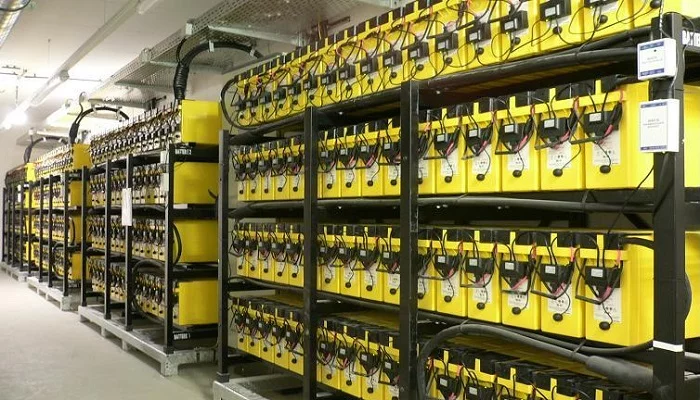
The 6-EVF-120 is CHISEN’s published 12 V 120 Ah VRLA (AGM) battery for UPS strings in data centres, telecom exchange rooms and critical-load cabinets. Its published row: 12 V nominal, 120 Ah at the C3 rate, case 407 × 170 × 240 mm, weight 40 ± 0.2 kg, φ20-M8 terminal, float 13.5 V, equalise 14.1 V, maximum charging current 24.0 A, cut-off 1.75 V per cell, self-discharge no more than 3 % per month at 25 °C, working temperature −15…50 °C, cycle life 350–600 at 50–80 % DoD, and design life 2–5 years in float service. Values the factory has not released are marked “not published” rather than estimated.
Three numbers decide most tenders. The string holds six cells (12 V ÷ 2.00 V per cell), so the float bus is 13.5 V (6 × 2.25 V) and the equalise bus 14.1 V (6 × 2.35 V). Rated discharge current is 40 A (120 Ah ÷ 3 h at C3) — the figure compared with UPS load current when counting strings. Nominal stored energy is 1,440 Wh (12 V × 120 Ah), or 36.0 Wh/kg on the published 40 kg (1,440 ÷ 40).
Key Takeaways
- Six cells per 12 V string: float 13.5 V (6 × 2.25 V), equalise 14.1 V (6 × 2.35 V).
- Rated discharge current 40 A (120 Ah ÷ 3 h at C3) — the basis for string counting.
- Nominal energy 1,440 Wh (12 V × 120 Ah) and 36.0 Wh/kg (1,440 ÷ 40 kg).
- Maximum charging current 24.0 A = 0.2 C (24.0 ÷ 120 Ah) — set the charger here.
- Case 407 × 170 × 240 mm at 40 ± 0.2 kg, footprint 0.0692 m².
- Self-discharge ≤3 %/month = 3.6 Ah per month on a 120 Ah unit.
§1 — 6-EVF-120 Quick Specifications
| Parameter | Value | Source |
|---|---|---|
| Nominal voltage | 12 V | Model page |
| Nominal capacity | 120 Ah | Model page |
| Rated capacity rate | C3 | Model page |
| Dimensions (L × W × H) | 407 × 170 × 240 mm | Model page |
| Weight | 40 ± 0.2 kg | Model page |
| Terminal | φ20-M8 | Model page |
| Float voltage | 13.5 V | Model page |
| Equalising voltage | 14.1 V | Model page |
| Cycle life | 350–600 cycles (DoD 50–80 %) | Model page |
| Maximum charging current | 24.0 A | Model page |
| Cut-off voltage | 1.75 V per cell | Model page |
| Self-discharge | ≤3 %/month at 25 °C | Model page |
| Working temperature | −15…50 °C | Model page |
| Design life | 2–5 years (float) | Model page |
| Terminal torque | not published | — |
§2 — The Pain: Five Traps in 120 Ah UPS Tenders
Most 6-EVF-120 orders fail for one of five reasons, and none of them is the chemistry.
Trap 1 — capacity quoted without a rate. “12 V 120 Ah” is ambiguous until you know whether it is the C3 or a 10-hour figure. The 6-EVF-120 publishes 120 Ah at C3, so 120 Ah ÷ 3 h = 40 A is the rated discharge current; a unit published at C10 carries the same 120 Ah at only 12 A.
Trap 2 — strings counted from load current alone. Load current ÷ 40 A gives only the minimum string count; it says nothing about redundancy during maintenance or the ride-through promised in the SLA.
Trap 3 — float and equalise left to the charger default. Published bus values are 13.5 V float and 14.1 V equalise. A charger shipped at 13.6 V float runs 0.1 V per cell high — a permanent 2.2 % over-charge, and the lowest-cost line on the commissioning sheet to correct.
Trap 4 — heat and airflow ignored at 40 kg. A 6-EVF-120 weighs 40 ± 0.2 kg, so a three-unit section is 120 kg of cells plus the cabinet, every cell producing heat up to the published 50 °C limit.
Trap 5 — undocumented fields left open. Terminal torque for the φ20-M8 post and internal resistance at 25 °C are not published; both are to be requested from the factory with the order rather than assumed on a drawing.
§3 — The Choice: Sizing the 6-EVF-120 Against Its Published Neighbours
The 6-EVF-120 sits mid-range in the published 12 V VRLA AGM line-up. The full product range covers 3.6 kg 12 Ah units through 48.5 kg 150 Ah units, and the choice turns on three published facts: rated discharge current (40 A), case width (170 mm, shared with the 6-EVF-80 and 6-EVF-100) and case height (240 mm, the same as the 6-EVF-150).
- A shelf set at 240 mm takes both the 6-EVF-120 and the 6-EVF-150, so capacity can rise later without rebuilding the rack.
- The 6-EVF-80, 6-EVF-100 and 6-EVF-120 are all 170 mm wide — three capacity steps, one cabinet width.
- Below a 40 A load, one 6-EVF-120 is the smallest published step clearing the C3 rating; under that, the sibling model page for the 6-EVF-50 is the honest answer, since two 6-EVF-120 strings on a 30 A load double the maintenance surface for no benefit.
Full specifications are on this model page; §5 sets the 6-EVF-120 against its published neighbours.
§4 — The Framework: A Four-Step Sizing Method With the Arithmetic Shown
This framework uses only the published figures in §1; where CHISEN has not published a value — temperature derating curves, internal resistance, terminal torque — it says so and stops.
Step 1 — State the duty. Write down the UPS load current I and the required ride-through t. Step 2 — Convert the duty into ampere-hours: Ah = I × t. For an 80 A load on a 30-minute ride-through: 80 A × 0.5 h = 40 Ah.
Step 3 — Compare with the published C3 figure. The 6-EVF-120 is published at 120 Ah at C3, i.e. 40 A for 3 hours, so 40 Ah ÷ 120 Ah = 33 % of published capacity: one unit carries the 80 A / 30-minute load down to the published 1.75 V per cell cut-off (6 × 1.75 V = 21.0 V bus). Published capacity is measured at 25 °C, and the manufacturer has not published temperature or age derating curves — to be requested from the factory. For hot sites (Lagos, Dubai, Mumbai, Chennai in summer), settle the derating basis before the cabinet order is released.
Step 4 — Count strings, then add the reserve. At 40 A rated discharge current, strings by current: 80 A ÷ 40 A = 2 strings minimum. If one string must stay isolated (N+1), install 3 units: 3 × 120 Ah = 360 Ah and 3 × 1,440 Wh = 4,320 Wh installed, while the load energy of 480 Wh (80 A × 0.5 h) is 480 ÷ 4,320 = 11.1 % of installed energy. Floor load is 3 × 40 kg = 120 kg, footprint 3 × 0.0692 m² = 0.208 m².
Charger settings, from the same published row. Maximum charging current is 24.0 A per unit, i.e. 0.2 C (24.0 A ÷ 120 Ah). Two parallel strings draw at most 2 × 24.0 A = 48 A, so set the common charger limit to 48 A and confirm sharing keeps each string below 24.0 A. Bus settings are 13.5 V float and 14.1 V equalise, and the published 1.75 V per cell cut-off belongs in the UPS configuration.
§5 — Comparison: The 6-EVF-120 Against Its Published Siblings
The table uses the published figures for the 12 V VRLA AGM models published by CHISEN; the final column is calculated from those same published numbers.
| Model | Capacity | L × W × H (mm) | Weight | Terminal | Charge current | Wh/kg (Arithmetic) |
|---|---|---|---|---|---|---|
| 6-EVF-60 | 60 Ah | 258 × 170 × 160 | 18.8 ± 0.2 kg | φ14-M6 | 12.0 A | 720 ÷ 18.8 = 38.3 |
| 6-EVF-80 | 80 Ah | 259 × 170 × 218 | 25.7 ± 0.2 kg | φ16-M6 | 16.0 A | 960 ÷ 25.7 = 37.4 |
| 6-EVF-100 | 100 Ah | 330 × 170 × 218 | 31.5 ± 0.2 kg | φ20-M8 | 20.0 A | 1,200 ÷ 31.5 = 38.1 |
| 6-EVF-120 | 120 Ah | 407 × 170 × 240 | 40 ± 0.2 kg | φ20-M8 | 24.0 A | 1,440 ÷ 40 = 36.0 |
| 6-EVF-150 | 150 Ah | 483 × 170 × 240 | 48.5 ± 0.2 kg | φ20-M8 | 30.0 A | 1,800 ÷ 48.5 = 37.1 |
Source for the published columns: Model page. Source for the Wh/kg column: Arithmetic from the published capacity, voltage and weight in the same rows. All five models are published at the C3 rate and share float 13.5 V, equalise 14.1 V, cut-off 1.75 V per cell, self-discharge ≤3 %/month at 25 °C, working temperature −15…50 °C and cycle life 350–600 at 50–80 % DoD.
- The charger rule does not change across the range. Every published charge current is exactly 0.2 C — 16.0 A ÷ 80 Ah, 20.0 A ÷ 100 Ah, 24.0 A ÷ 120 Ah, 30.0 A ÷ 150 Ah — so one commissioning instruction carries to the next capacity step.
- Width is constant for three steps, height for two. The 6-EVF-80, 6-EVF-100 and 6-EVF-120 are all 170 mm wide, and the 6-EVF-120 and 6-EVF-150 are both 240 mm tall.
- The terminal steps up at 100 Ah. φ16-M6 on the 6-EVF-80 becomes φ20-M8 on the 6-EVF-100 and stays φ20-M8 on the 6-EVF-120, so busbars, lugs and interconnects sized for the smaller terminal must be redrawn.
§6 — The Trust: Factory Capacity, Documentation and Delivery Verification
CHISEN Battery is based in Hangzhou, China, with 8 production bases, 70 million kVAh of annual capacity and CE, ISO 9001, ISO 14001, UL and IEC certifications. Its lines cover flooded tubular OPzS2, gel tubular OPzV2 and the 12 V VRLA AGM series (6-DZF / 6-DMF / 6-EVF) to which the 6-EVF-120 belongs.
Delivery runs from Chinese ports: containers leave Shanghai and Ningbo for distributor networks in India, Nigeria, Kenya, Vietnam, the Philippines, Brazil, Egypt, Indonesia, Pakistan and South Africa, commonly routed through Mumbai, Lagos, Mombasa, Colombo, Karachi, Jebel Ali, Durban and Hamburg. A 40 kg unit loses 3.6 Ah for every month it waits in storage, so a delayed vessel shortens the first-year ride-through.
Four checks on arrival keep the order verifiable:
- Mass. Each unit should read 40 ± 0.2 kg, a tolerance of ±0.5 % on the published figure.
- Terminals. Confirm undamaged φ20-M8 posts with interconnects fitted for the φ20-M8 busbar size.
- Documents. Request the factory test record for float 13.5 V, equalise 14.1 V, the 24.0 A charge limit and the 1.75 V per cell cut-off.
- Unpublished values. Terminal torque and internal resistance at 25 °C are not published; request them with the order so the commissioning file is complete at handover.
§7 — FAQ
Q1: What are the published nominal voltage and capacity of the 6-EVF-120? 12 V nominal, 120 Ah at the C3 rate (Model page). Rated discharge current 40 A (120 Ah ÷ 3 h, Arithmetic); nominal energy 1,440 Wh (12 V × 120 Ah, Arithmetic).
Q2: What float and equalise setpoints does the manufacturer publish for the 6-EVF-120? Float 13.5 V and equalise 14.1 V (Model page) — 2.25 V and 2.35 V per cell across six cells (Arithmetic). Both belong in the commissioning sheet.
Q3: What is the maximum charging current for the 6-EVF-120? 24.0 A (Model page), equal to 0.2 C (24.0 A ÷ 120 Ah, Arithmetic). Two parallel strings draw at most 48 A.
Q4: What are the case dimensions and weight of the 6-EVF-120? 407 × 170 × 240 mm and 40 ± 0.2 kg (Model page). Footprint is 0.0692 m² (0.407 m × 0.170 m, Arithmetic); mass tolerance is ±0.5 %.
Q5: What terminal type and torque does the 6-EVF-120 use? The published terminal is φ20-M8 (Model page). Torque is not published and is to be requested from the factory; lug and busbar sizes must suit the φ20-M8 post.
Q6: How many cells does a 12V120Ah string contain and what bus voltage does it give? Six cells (12 V ÷ 2.00 V per cell, Arithmetic), giving a 13.5 V float bus, a 14.1 V equalise bus and a 21.0 V cut-off bus (6 × 1.75 V).
Q7: What is the published design float life of the 6-EVF-120 and at what temperature? Design life 2–5 years in float service, working temperature −15…50 °C (Model page). Cycle life is 350–600 cycles at 50–80 % DoD; derating curves are not published.
Q8: How should an importer verify the 6-EVF-120 on delivery? Weigh each unit against the published 40 ± 0.2 kg, count pallets against the packing list, inspect the φ20-M8 terminals, and request the factory test record for 13.5 V float, 14.1 V equalise and 24.0 A.
Q9: Which certifications does the CHISEN factory behind the 6-EVF-120 hold? CE, ISO 9001, ISO 14001, UL and IEC, with 8 production bases and 70 million kVAh annual capacity. The 6-EVF-120 belongs to the 12 V VRLA AGM series (6-DZF / 6-DMF / 6-EVF) built in Hangzhou, China.
Q10: How do I request a quotation or samples for the 6-EVF-120? Send quantity, destination port, delivery date and the string configuration to sales@chisen.cn; technical questions to jack@chisen.cn; WhatsApp +86 131 6622 6999 for drawing checks and samples.
Expert Summary
The 6-EVF-120 is a published 12 V 120 Ah VRLA AGM unit from CHISEN: 407 × 170 × 240 mm, 40 ± 0.2 kg, φ20-M8 terminal, float 13.5 V, equalise 14.1 V, cut-off 1.75 V per cell, charge current 24.0 A (0.2 C), self-discharge ≤3 %/month at 25 °C, working temperature −15…50 °C, design life 2–5 years, with terminal torque, internal resistance and derating curves to be requested from the factory. Six cells give a 13.5 V float bus and a 21.0 V cut-off bus; 120 Ah at C3 gives a 40 A rated discharge current; 12 V × 120 Ah = 1,440 Wh nominal, or 36.0 Wh/kg on the published mass. Buy it as a six-cell string unit: confirm the 40 A rating against load current, count parallel strings from 40 A plus the redundancy the SLA demands, hold the charger at 24.0 A per unit, and put the 13.5 V / 14.1 V setpoints into the commissioning sheet.
Contact CHISEN — 24-Hour Response
- Sales and quotations: sales@chisen.cn
- Technical and project enquiries: jack@chisen.cn
- WhatsApp (fast answers): +86 131 6622 6999
- Website: www.chisen.cn
Related CHISEN Buyer Guides
- 12V 100Ah LiFePO4 vs Lead Acid Battery: Cycle Life, Published 6-EVF-100 Specs and Where Ea
- 2V 1000Ah Battery Buyer Guide 2026: Telecom, UPS, and Solar Storage Sourcing
- 6-EVF-150 12V150Ah AGM Battery: Published Specs, Parallel String Sizing and EVF Range Comp
- 6-EVF-50 12V50Ah UPS Battery: Complete Buyer Guide for Data Centres and Telecom
- 6-EVF-60 12V60Ah UPS Battery: Complete Buyer Guide for Data Centres and Telecom
