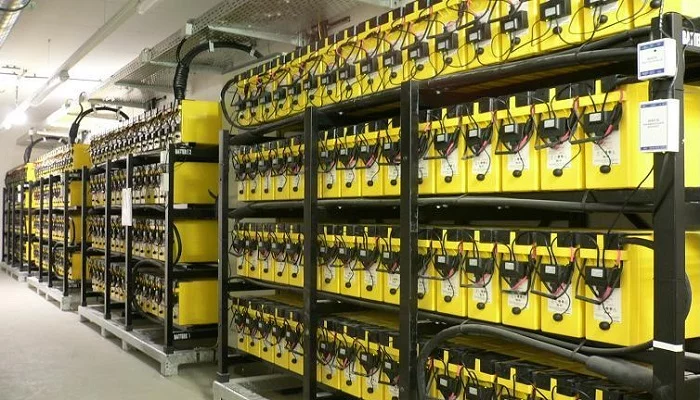
Answer First
The 6-EVF-120 is the 120 Ah, 12 V valve-regulated block that data-centre and telecom buyers usually end up specifying when a string has to sit on a 240 V DC bus. The published figures come from the manufacturer model page and do not change with negotiation: 407×170×240 mm case, 40 ± 0.2 kg, φ20-M8 terminals, 13.5 V float, 14.1 V equalise, 24.0 A maximum charge current, 1.75 V/cell cut-off, ≤3 %/month self-discharge, −15…50 °C working range, and a design life of 2–5 years.
Three calculations settle most projects before a quotation is even requested. First, energy per block is 12 V × 120 Ah = 1,440 Wh, and 1,440 Wh ÷ 40 kg = 36 Wh/kg at the published weight — a useful number for freight costing, floor loading and rack design. Second, a 12 V block holds 12 V ÷ 2 V = 6 cells, so the float bus is 6 × 2.25 V = 13.5 V and the equalise bus is 6 × 2.35 V = 14.1 V, matching the published setpoints exactly. Third, the published C3 rating of 120 Ah is tested at 40 A, so 120 Ah ÷ 40 A = 3 hours of rated discharge — the anchor for every runtime figure in this guide.
What follows is the working method: how to build a string from published numbers, what to check on the pallet at delivery, and which paperwork closes the gap between a factory record and an installed bank. It is written for purchasing engineers who need defensible arithmetic rather than marketing adjectives.
Key Takeaways
- Nominal energy is 1,440 Wh per block — 12 V × 120 Ah, which is 1,440 Wh ÷ 40 kg = 36 Wh/kg at the published 40 ± 0.2 kg weight.
- One block contains six cells — 12 V ÷ 2 V = 6 cells, giving a 13.5 V float bus (6 × 2.25 V) and a 14.1 V equalise bus (6 × 2.35 V).
- The C3 rating is 120 Ah at 40 A — 120 Ah ÷ 40 A = 3 h of rated discharge, and every runtime estimate starts from that figure.
- Maximum charge current is 24.0 A — 24.0 A = 0.2 × 120 Ah, so a charger set at 0.1 C stays inside the published envelope.
- Delivery verification has four numbers — 407×170×240 mm case, 40 ± 0.2 kg weight, φ20-M8 terminal, and a label reading 13.5 V float / 14.1 V equalise.
- Design life is a published range of 2–5 years — with 350–600 cycles at 50–80 % depth of discharge, and storage outside −15…50 °C outside the envelope.
§1 — 6-EVF-120 Quick Specifications
Every figure below is published by the manufacturer for the 6-EVF-120 and is reproduced unchanged. Only the final row is derived, and it is marked so a reviewer can follow the working.
| Parameter | Published value | Source |
|---|---|---|
| Nominal voltage | 12 V | Model page |
| Nominal capacity | 120 Ah | Model page |
| Capacity rate | C3 — 120 Ah at 40 A | Model page |
| Case dimensions (L×W×H) | 407×170×240 mm | Model page |
| Weight | 40 ± 0.2 kg | Model page |
| Terminal | φ20-M8 | Model page |
| Float voltage | 13.5 V (2.25 V/cell) | Model page |
| Equalise voltage | 14.1 V (2.35 V/cell) | Model page |
| Cycle life | 350–600 cycles | Model page |
| Maximum charge current | 24.0 A | Model page |
| Discharge cut-off | 1.75 V/cell | Model page |
| Self-discharge | ≤3 %/month | Model page |
| Working temperature | −15…50 °C | Model page |
| Design life | 2–5 years | Model page |
| Cells per block | 6 cells (12 V ÷ 2 V) | Arithmetic |
One practical consequence follows from the dimensions. The 6-EVF-120 shares the 170 mm case width, the 240 mm height and the φ20-M8 terminal of the 150 Ah block in the same series, so a cabinet designed for one accepts the other on the same shelf geometry, while the intermediate 100 Ah block steps down to 218 mm in height. Confirm the shelf height against the model you actually order rather than assuming a uniform bay.
§2 — The Pain: Why 120 Ah Strings Underperform After Commissioning
The most common failure in a 12 V 120 Ah installation is not a defective block. It is a runtime sheet built on the wrong discharge rate. Nameplate capacity of 120 Ah is measured at the C3 rate, which for the 6-EVF-120 means 120 Ah at 40 A. A runtime sheet that divides 120 Ah by a 20 A load and claims 6 hours is not conservative — it is simply wrong, because 120 Ah ÷ 40 A = 3 hours is the published rated discharge. Every sizing sheet should start from the C3 figure and state its assumptions explicitly.
The second failure is temperature. The published working range is −15…50 °C, and cycle life is published as 350–600 cycles at 50–80 % depth of discharge. A battery room that runs warm at the top of the band will not reach the same cycle count as one held near 25 °C, even though the model number is identical. If a project needs a guaranteed cycle count at a specific ambient temperature, request the temperature-specific curve from the factory rather than extrapolating from the published range. The published data supports the range; it does not support a guarantee at a point on that range.
The third failure is mechanical, and it is often scheduled late. A single 6-EVF-120 block weighs 40 ± 0.2 kg. A 240 V string of 20 blocks therefore weighs 20 × 40 kg = 800 kg of battery before racks, busbars and containment. Handling, access routes and floor loading have to be designed around that number, and the same lifting provision has to exist on the maintenance floor, not only in the delivery bay. Terminal type is published as φ20-M8; the tightening specification and the inter-cell connection hardware should be requested from the factory and written into the installation method statement.
The fourth failure is mixing ages inside one string. Series strings are limited by their weakest block, so replacing a single failed 6-EVF-120 in a bank whose remaining blocks are near the end of their published 2–5 year design life can leave the new block carrying the string and the old blocks setting the end-of-discharge point. Pair replacements by string, and keep the delivered batch records for each string so the history stays traceable.
§3 — The Choice: Sizing a String from Published Numbers
String construction follows directly from the published cell voltage. A 6-EVF-120 block contains 6 cells of 2 V each, so a 240 V DC bus needs 240 V ÷ 2 V = 120 cells, and 120 cells ÷ 6 cells per block = 20 blocks in series.
| DC bus | Cells required | Blocks per string | String energy | String current at C3 |
|---|---|---|---|---|
| 48 V | 24 | 4 | 4 × 1,440 Wh = 5,760 Wh | 40 A |
| 120 V | 60 | 10 | 10 × 1,440 Wh = 14,400 Wh | 40 A |
| 240 V | 120 | 20 | 20 × 1,440 Wh = 28,800 Wh | 40 A |
Two points in that table are worth stating plainly. In series, the string current is the block current, so a string of 6-EVF-120 blocks delivers 40 A at the C3 rate regardless of how many blocks it contains — adding blocks in series adds energy, not current. And because the published charge current ceiling is 24.0 A, the charger for each string must be sized to 24.0 A per parallel string, which is 24.0 A = 0.2 × 120 Ah on the published capacity.
Now work a load example end to end. Take a 12 kW DC load on a 240 V bus: 12,000 W ÷ 240 V = 50 A bus current. One string supports 40 A at the published C3 rate, so one string cannot carry 50 A and two strings in parallel are the minimum. Two strings split the load at 50 A ÷ 2 strings = 25 A per string. Holding end-of-discharge at the published 1.75 V/cell cut-off limits usable capacity to roughly half of nameplate, so 120 Ah × 0.5 = 60 Ah usable per string, and 60 Ah ÷ 25 A = 2.4 hours of runtime. The same two strings on the rated 40 A per string would deliver 120 Ah ÷ 40 A = 3 hours. Both numbers are defensible; the one you quote must state its discharge current and its depth-of-discharge assumption, and that is exactly what a tender committee should ask for.
§4 — The Framework: A Five-Step Verification Method
Most procurement disputes about 12 V VRLA banks are not about chemistry. They come from a project team and a factory working from different documents. The method below removes that gap before the shipment is booked.
Step 1 — Freeze the published baseline. Take the 6-EVF-120 specification row from the manufacturer model page for this model page and store a version-controlled copy inside the tender file. Freeze twelve numbers: 12 V, 120 Ah, C3 rate, 407×170×240 mm, 40 ± 0.2 kg, φ20-M8 terminal, 13.5 V float, 14.1 V equalise, 24.0 A charge current, 1.75 V/cell cut-off, ≤3 %/month self-discharge and −15…50 °C working range. If a supplier quote states something different from these figures, the difference is a question for the factory, not a detail to be negotiated in the margin.
Step 2 — Rebuild the string arithmetic on paper. Six cells per block (12 V ÷ 2 V), a 13.5 V float bus (6 × 2.25 V), a 14.1 V equalise bus (6 × 2.35 V), 1,440 Wh per block, 20 blocks per 240 V string, and a string current of 40 A at the published C3 rate. If the tender document contains a runtime number, the same document should contain the discharge current and depth-of-discharge assumption behind it. A number without its assumption cannot be checked by anyone.
Step 3 — Size the charger and the room. The published maximum charge current of 24.0 A is the ceiling per parallel string, so a charger rated at or below 24.0 A per string keeps the bank inside the published envelope. Float and equalise setpoints come from the label, not from a generic charger menu. The room must sit inside −15…50 °C, with airflow set out around the racked blocks, and it must be instrumented so that temperature history exists for warranty discussion later.
Step 4 — Inspect at the pallet, not in the warehouse. Measure the case at 407×170×240 mm, weigh the block against 40 ± 0.2 kg, confirm the φ20-M8 terminal type, and read the float and equalise values from the label. Record the rest voltage of every block on arrival and compare it against the factory acceptance band, which is to be requested from the factory with the order. Check the self-discharge figure as published, ≤3 %/month, by holding a sample of blocks under the same storage conditions for a defined period. Photograph the pallet label and the terminal area before the shipment leaves the loading bay.
Step 5 — Register the batch and keep it. For every string, file the batch number, production date, delivered quantity, factory test report and warranty terms against the installation location. When a block is later replaced, the new record states which string it entered and what the old batch was. An installed bank with per-string records can be maintained on evidence; a bank without them can only be maintained on assumption.
§5 — Where the 6-EVF-120 Sits in the EVF Series
Selection inside this series is a mechanical and energy decision, not an electrical one. Every block in the EVF line shares the same published float voltage of 13.5 V, the same equalise voltage of 14.1 V, the same 1.75 V/cell discharge cut-off, the same ≤3 %/month self-discharge, the same −15…50 °C working range and the same 350–600 cycle life band. The full EVF line, with all current models and their case drawings, is listed on the full product range page, and the closest neighbour is documented separately on the sibling model page.
| Model | Capacity | Rate | L×W×H mm | Weight | Terminal | Charge current | Wh/kg (Arithmetic) | Design life |
|---|---|---|---|---|---|---|---|---|
| 6-EVF-50 | 50 Ah | C3 | 230×140×180 | 15.25 ± 0.2 kg | φ11.8-M6 | 10.0 A | 600 Wh ÷ 15.25 kg = 39.3 | 2–5 years |
| 6-EVF-60 | 60 Ah | C3 | 258×170×160 | 18.8 ± 0.2 kg | φ14-M6 | 12.0 A | 720 Wh ÷ 18.8 kg = 38.3 | 2–5 years |
| 6-EVF-80 | 80 Ah | C3 | 259×170×218 | 25.7 ± 0.2 kg | φ16-M6 | 16.0 A | 960 Wh ÷ 25.7 kg = 37.4 | 2–5 years |
| 6-EVF-100 | 100 Ah | C3 | 330×170×218 | 31.5 ± 0.2 kg | φ20-M8 | 20.0 A | 1,200 Wh ÷ 31.5 kg = 38.1 | 2–5 years |
| 6-EVF-120 | 120 Ah | C3 | 407×170×240 | 40 ± 0.2 kg | φ20-M8 | 24.0 A | 1,440 Wh ÷ 40 kg = 36.0 | 2–5 years |
| 6-EVF-150 | 150 Ah | C3 | 483×170×240 | 48.5 ± 0.2 kg | φ20-M8 | 30.0 A | 1,800 Wh ÷ 48.5 kg = 37.1 | 2–5 years |
Two readings come out of that table. Energy density on published figures sits in a narrow band of roughly 36–39 Wh/kg, so the 6-EVF-120 gives up only about 3.3 Wh/kg against the 50 Ah block (36.0 vs 39.3 Wh/kg) while carrying 2.4 times the energy per string position, which matters where cabinet depth and floor area are constrained. Second, terminal progression is deliberate: the 6-EVF-120 and the 100 Ah and 150 Ah blocks all use φ20-M8, so one type of inter-cell connection serves three of the largest sizes in the line, while the 50 Ah and 60 Ah blocks move to φ11.8-M6 and φ14-M6.
In service, blocks of this size move in standard pallet quantities through the export chain to importers and system integrators in India, Nigeria, Kenya, Vietnam, the Philippines and Brazil, with the main consignment routes running from Ningbo and Shanghai.
§6 — The Trust: Factory Capacity, Certification and Delivery
CHISEN operates 8 production bases with an annual capacity of 70 million kVAh, and the 12 V VRLA range covering the 6-DZF, 6-DMF and 6-EVF series is produced inside that network, alongside flooded tubular OPzS2 and gel tubular OPzV2 lines. The plant in Hangzhou, China holds CE, ISO 9001, ISO 14001, UL and IEC certification, which is what allows a 6-EVF-120 consignment to clear the import and safety requirements of the destination market.
For a project team, the useful part of that scale is documentation rather than headcount. A batch can be traced to a production line and a production date, factory test data can be requested against the batch number, and warranty terms can be written against the same record that the installation file holds. Items that are not published for the model — the terminal tightening specification, the acceptance band for rest voltage on arrival, and the temperature-specific cycle curve — are handled as a written request to the factory, which returns figures against the order instead of leaving the installer to assume them.
Delivery follows the same discipline. Consignments move from Shanghai and Ningbo to Jebel Ali, Mumbai, Karachi, Colombo, Lagos, Mombasa, Durban, Port Said, Rotterdam, Hamburg and Santos, and every container is accompanied by the batch records described in Step 5 above. The export desk answers technical and commercial questions within 24 hours, and sample blocks can be supplied for approval before a volume order is placed.
§7 — FAQ
Q1: What are the published nominal voltage and capacity of the 6-EVF-120? The manufacturer publishes 12 V nominal and 120 Ah at the C3 rate, which is 120 Ah measured at 40 A discharge down to the 1.75 V/cell cut-off (Model page). Nominal energy per block is therefore 12 V × 120 Ah = 1,440 Wh (Arithmetic).
Q2: What float and equalise setpoints does the manufacturer publish? Float 13.5 V and equalise 14.1 V for the 12 V block, equal to 2.25 V/cell and 2.35 V/cell because a block holds 12 V ÷ 2 V = 6 cells (Model page). On a 240 V string of 20 blocks the bus reads 13.5 V × 20 = 270 V on float and 14.1 V × 20 = 282 V during equalise (Arithmetic).
Q3: What is the maximum charging current for the 6-EVF-120? 24.0 A (Model page). That equals 0.2 × 120 Ah, so a charger set at 0.1 C delivers 12.0 A per string and remains inside the published ceiling. The voltage setpoints stay at the published 13.5 V float and 14.1 V equalise.
Q4: What are the case dimensions and weight of the 6-EVF-120? 407×170×240 mm (L×W×H) and 40 ± 0.2 kg (Model page). The 240 mm height matches the 150 Ah block of the same series, while the 100 Ah block stands 218 mm high, so shelf clearance should be checked against the model actually ordered.
Q5: What terminal type and torque does the 6-EVF-120 use? The published terminal is φ20-M8 (Model page). The tightening torque is not published on the model page and is to be requested from the factory with the order, then written into the installation method statement.
Q6: How many cells does a 12V120Ah string contain and what bus voltage does it give? A 12 V block contains 12 V ÷ 2 V = 6 cells. A 240 V DC bus needs 240 V ÷ 2 V = 120 cells, and 120 cells ÷ 6 cells per block = 20 blocks per string, giving a 13.5 V float bus and a 14.1 V equalise bus per block (Arithmetic from Model page values).
Q7: What is the published design float life of the 6-EVF-120 and at what temperature? Design life is published as 2–5 years, with cycle life of 350–600 cycles at 50–80 % depth of discharge (Model page). The working range is −15…50 °C. A guaranteed cycle count at one ambient temperature is to be requested from the factory rather than read from the range.
Q8: How should an importer verify the 6-EVF-120 on delivery? Check four published numbers at the pallet: case 407×170×240 mm, weight 40 ± 0.2 kg, terminal φ20-M8, and a label reading 13.5 V float / 14.1 V equalise. Record the rest voltage of each block against the factory acceptance band, to be requested with the order, and file batch number, production date and test report against each string.
Q9: Which certifications does the CHISEN factory behind the 6-EVF-120 hold? CE, ISO 9001, ISO 14001, UL and IEC, held by the plant in Hangzhou, China. Production runs across 8 bases with an annual capacity of 70 million kVAh, covering the 12 V VRLA range together with flooded tubular OPzS2 and gel tubular OPzV2 lines.
Q10: How do I request a quotation or samples for the 6-EVF-120? Write to sales@chisen.cn or jack@chisen.cn, or message WhatsApp +86 131 6622 6999; the company details are on www.chisen.cn. State model, quantity, destination port and string configuration, and ask for sample blocks if you want to verify the published label values before a volume order.
Expert Summary
The 6-EVF-120 publishes a narrow, complete set of numbers: 12 V, 120 Ah at C3, 407×170×240 mm, 40 ± 0.2 kg, φ20-M8, 13.5 V float, 14.1 V equalise, 24.0 A charge current, 1.75 V/cell cut-off, ≤3 %/month self-discharge, −15…50 °C working range and a 2–5 year design life. Turned into arithmetic, that gives 1,440 Wh per block, 36.0 Wh/kg, six cells per block, 20 blocks per 240 V string, 40 A string current at the published rate, and about 2.4 hours of runtime for a 12 kW load on two parallel strings at 50 % depth of discharge. Build the string on those figures, verify the case, the weight, the terminal and the label at the pallet, keep per-string batch records, and every later question about the bank can be answered with evidence.
Contact CHISEN — 24-Hour Response
CHISEN Battery, Hangzhou, China — 8 production bases, 70 million kVAh annual capacity.
Sales enquiries: sales@chisen.cn Export desk: jack@chisen.cn WhatsApp: +86 131 6622 6999 Website: www.chisen.cn
Technical questions, sample requests and project quotations are answered within 24 hours by the export desk.
Related CHISEN Buyer Guides
- 12V 100Ah LiFePO4 vs Lead Acid Battery: Cycle Life, Published 6-EVF-100 Specs and Where Ea
- 2V 1000Ah Battery Buyer Guide 2026: Telecom, UPS, and Solar Storage Sourcing
- 6-DMF-52 12V52Ah UPS Battery: Complete Buyer Guide for Data Centres and Telecom
- 6-EVF-150 12V150Ah AGM Battery: Published Specs, Parallel String Sizing and EVF Range Comp
- 6-EVF-50 12V50Ah UPS Battery: Complete Buyer Guide for Data Centres and Telecom
