Answer First
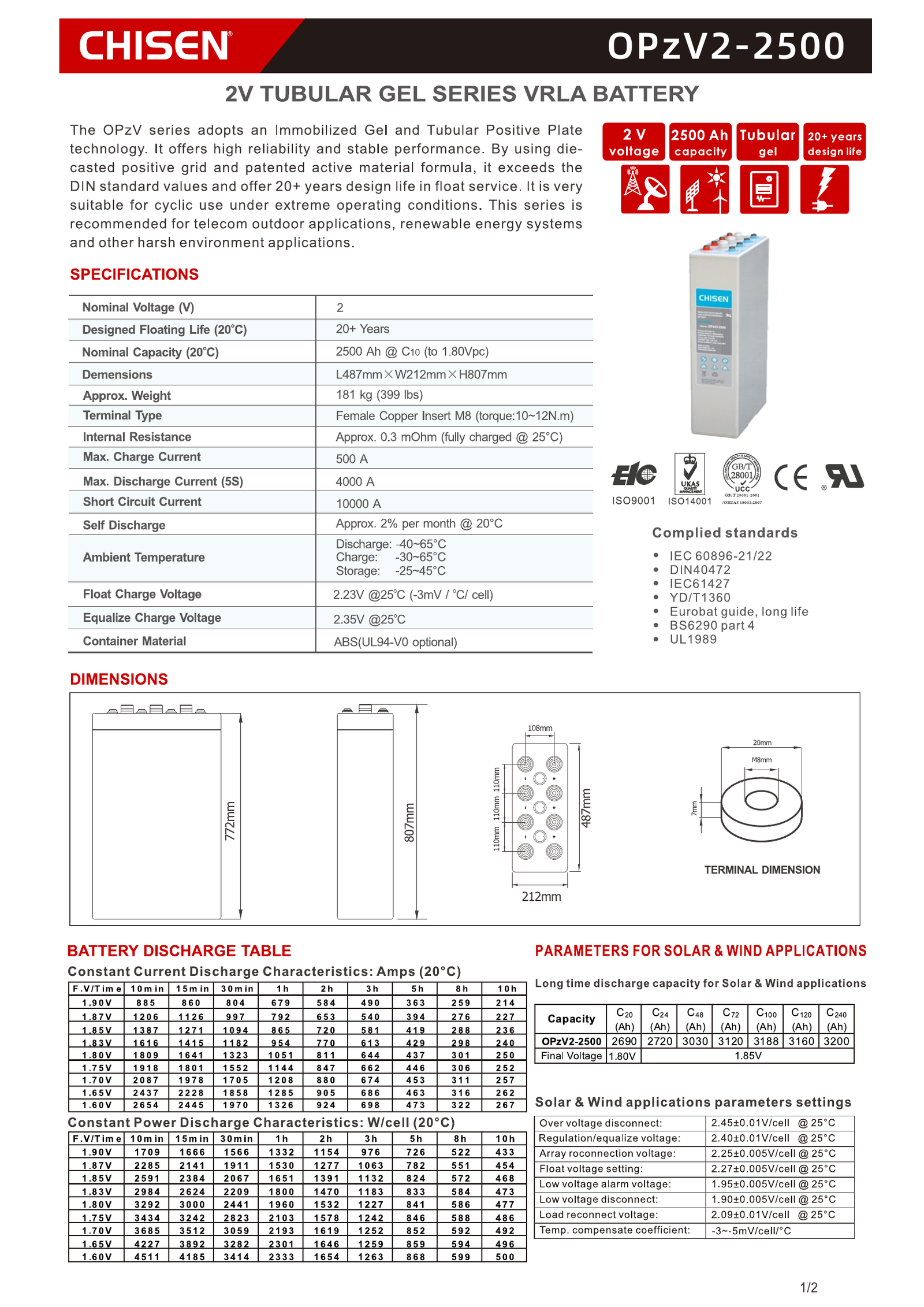
The OPzV2-2500 2V2500Ah is a 2 V, 2,500 amp-hour valve-regulated tubular gel lead-acid cell rated at the ten-hour rate — 250 A for ten hours down to 1.80 V per cell — and it is the largest cell in the CHISEN tubular gel range. On a utility storage duty it is normally paired into a 48 V or 96 V string inside a container, and the published data set is unusually complete for a cell at this capacity: 487 × 212 mm footprint, 772 mm container height, 807 mm over the terminals, approximately 181 kg, about 0.30 mΩ internal resistance, a 10,000 A short-circuit current, a 500 A maximum charging current and a designed floating life of more than twenty years at 20 °C.
The complete published data set sits on the OPzV2-2500 2V2500Ah model page. The immediately smaller cell in the range is listed on the OPzV2-2000 2V2000Ah model page, and the whole gel range is indexed under tubular gel lead-acid batteries.
Two points deserve attention before any quotation is compared. First, this cell has no published solar or wind long-time discharge capacity table and no published solar or wind setpoint table; those rows are marked not published in this guide, because the datasheet does not contain them and a sibling model’s figures must not be carried across. Second, the final-voltage-by-discharge-current table is the only discharge guidance published, and it decides how much of the rated 2,500 Ah a given current can actually draw.
Key Takeaways
- The rating is rate-dependent and the basis belongs in the order. The OPzV2-2500 is 2,500 Ah at C10 to 1.80 V per cell, meaning 250 A for ten hours; the datasheet publishes the final-voltage table alongside it so usable capacity can be matched to the discharge current.
- Charging setpoints are fixed by the datasheet. Float 2.23 V per cell at 25 °C, equalising 2.35 V per cell at 25 °C, temperature compensation −3 mV/°C/cell, and a 500 A maximum charging current (Datasheet).
- Mechanical data decides the container, not the electrical data. Footprint 487 × 212 mm, 772 mm container height, 807 mm over the terminals, approximately 181 kg per cell, ABS container with optional UL94-V0 flame rating (Datasheet).
- Two limits protect the cell. Maximum discharge 4,000 A for five seconds and a 10,000 A short-circuit current, against an internal resistance of approximately 0.30 mΩ fully charged at 25 °C (Datasheet).
- A string is arithmetic, and the arithmetic should be quoted. A 48 V string is 24 cells at 120,000 Wh nominal and approximately 4,344 kg; a 96 V string is 48 cells at 240,000 Wh nominal and approximately 8,688 kg (Arithmetic).
§1 — OPzV2-2500 2V2500Ah Published Specifications
Every figure in the table below is printed in the manufacturer datasheet for this model. Nothing has been extrapolated from a neighbouring cell, and where the datasheet publishes nothing the row says so explicitly.
| Parameter | Published value | Source |
|---|---|---|
| Nominal voltage | 2 V | Datasheet |
| Rated capacity | 2,500 Ah at C10 to 1.80 Vpc | Datasheet |
| Footprint (L × W) | 487 × 212 mm | Datasheet |
| Container height | 772 mm | Datasheet |
| Height over terminals | 807 mm | Datasheet |
| Approximate weight | 181 kg | Datasheet |
| Internal resistance | approx. 0.30 mΩ fully charged at 25 °C | Datasheet |
| Short-circuit current | 10,000 A | Datasheet |
| Maximum discharge current | 4,000 A for 5 s | Datasheet |
| Maximum charging current | 500 A | Datasheet |
| Float voltage | 2.23 V at 25 °C | Datasheet |
| Temperature compensation | −3 mV/°C/cell | Datasheet |
| Equalising voltage | 2.35 V at 25 °C | Datasheet |
| Self-discharge | approx. 2 %/month at 20 °C | Datasheet |
| Operating range, discharge | −40 to 65 °C | Datasheet |
| Operating range, charge | −30 to 65 °C | Datasheet |
| Storage range | −25 to 45 °C | Datasheet |
| Designed floating life | 20+ years at 20 °C | Datasheet |
| Container material | ABS, UL94-V0 optional | Datasheet |
| Terminal | Female copper insert M8, torque 10–12 N·m | Datasheet |
| Solar/wind long-time discharge capacity | Not published | Datasheet |
| Solar/wind setpoint table | Not published | Datasheet |
The standards and certification set is equally specific: IEC 60896-21/22 and DIN 40472 for the valve-regulated cell and its envelope, IEC 61427 for renewable cycling, YD/T 1360 for the Chinese telecoms market, the Eurobat long-life guide, BS 6290 part 4 and UL 1989 for the North American market. The manufacturing management system runs to ISO 9001 and ISO 14001, with GB/T 28001 covering occupational health and safety, and the product is supplied with CE and RU conformity marking.
A useful cross-check on the scale of this cell is the charging ceiling expressed against the rating: 500 A maximum charging current divided by 2,500 Ah C10 equals 0.20 C10, so the charger and the array must both be sized inside that 500 A per cell limit. The same arithmetic applied to the internal resistance gives 0.30 mΩ divided by 2,500 Ah, or 0.12 mΩ per amp-hour, a figure that gets noticeably better as the range moves down toward the smaller gel cells.
§2 — The Pain: Where 2,500 Ah Utility Storage Projects Lose Their Margin
The failure pattern on a container-scale storage job is rarely a single dramatic event. It is a set of small, individually reasonable decisions that accumulate into a specification that cannot meet its own duty cycle.
The first is the capacity basis. A quotation that says “2,500 Ah” without naming the rate is not a quotation at all. The OPzV2-2500 is rated at C10, which means 250 A for ten hours to 1.80 V per cell. On a utility storage duty the discharge profile is rarely a ten-hour plateau; it is a peak-shaving curve with a long tail, and the usable energy at that profile is governed by the final-voltage table, not by the headline capacity. A project team that sizes a string on the 2,500 Ah figure alone and then discovers the average discharge current sits in the 0.08 C to 0.2 C band — where the published final voltage is 1.80 Vpc — has to accept that the number on the datasheet is the optimistic case.
The second is the container geometry. The OPzV2-2500 footprint of 487 × 212 mm with a 772 mm container height and 807 mm over the terminals is not a proportional scale-up of the smaller gel cells. The 2,000 Ah cell measures 399 × 212 mm and the 1,500 Ah cell 275 × 210 mm, so the case length moves by 88 mm between the 1,500 and 2,500 Ah steps while the width barely changes. Container drawings, rack rails and door clearances built on an assumed pitch will not fit the cell that actually arrives.
The third is weight, which is where logistics cost hides. Approximately 181 kg per cell multiplied by 24 cells gives approximately 4,344 kg for a 48 V string, and the same arithmetic on 48 cells gives approximately 8,688 kg for a 96 V string. These are floor loading, gantry lifting and shipping-weight figures before any enclosure is added. A project that discovers the lifting plan was built for 120 kg cells finds out late.
The fourth is the published-setpoint gap. For this model the datasheet prints no solar or wind long-time discharge capacity table and no solar or wind setpoint table. The temptation in a tender response is to quote the 2.27 V float and 2.40 V equalising values that appear in other gel datasheets in the range. That is a fabrication, and it is one that surfaces as premature capacity loss in the second or third year, in a hot container, in a market where a warranty claim is hard to argue.
The fifth is the tolerance for a cell of this mass. The M8 female copper insert with a 10–12 N·m torque figure is not a detail; it is the number that keeps cell-to-cell connections at the published internal resistance of approximately 0.30 mΩ, and a string with undertightened links does not deliver the published short-circuit behaviour of 10,000 A or the 4,000 A for five seconds that the DC protection has to interrupt.
§3 — The Choice: Matching the OPzV2-2500 to the Actual Duty
Choosing between the large tubular gel cells in the range should start with the discharge rate, then the string voltage, then the mechanical envelope.
On discharge rate, the datasheet publishes one guidance table and one only — final voltage by discharge current — and it should be used directly. Below 0.05 C the cell may be taken to 1.90 Vpc or higher; from 0.05 C to 0.08 C the published final voltage is 1.85 Vpc; from 0.08 C to 0.2 C it is 1.80 Vpc; from 0.2 C to 0.6 C it is 1.75 Vpc; from 0.6 C to 1.0 C it is 1.70 Vpc; and from 1 C to 2 C it is 1.60 Vpc. A storage project with a peak-shaving duty in the 0.2 C to 0.6 C band is therefore working to a 1.75 Vpc end point, and every energy calculation should be built from that figure rather than from 1.80 Vpc.
On string voltage, the arithmetic is worth writing into the specification because it is the part that is usually left implicit. A 48 V string is 24 cells at 2 V nominal: 24 × 2 V = 48 V, 24 × 2,500 Ah = 60,000 Ah, 48 V × 2,500 Ah = 120,000 Wh nominal, 24 × 181 kg = 4,344 kg and 24 × 0.30 mΩ = 7.2 mΩ of string resistance. Float at 2.23 V per cell gives 24 × 2.23 V = 53.52 V across the string, and equalising at 2.35 V per cell gives 24 × 2.35 V = 56.40 V. A 96 V string is 48 cells: 48 × 2 V = 96 V, 48 × 2,500 Ah = 120,000 Ah, 96 V × 2,500 Ah = 240,000 Wh nominal, 48 × 181 kg = 8,688 kg, 48 × 0.30 mΩ = 14.4 mΩ, a float of 48 × 2.23 V = 107.04 V and an equalising voltage of 48 × 2.35 V = 112.80 V. The table below sets the two configurations side by side, with a 192 V option included because container inverters commonly run at that class.
| String configuration | Cells | Nominal voltage | Nominal capacity | Nominal energy | Approximate weight | String internal resistance | Float voltage at 2.23 V/cell | Equalising voltage at 2.35 V/cell |
|---|---|---|---|---|---|---|---|---|
| 48 V single | 24 × 2 V = 48 V | 48 V | 24 × 2,500 Ah = 60,000 Ah | 48 V × 2,500 Ah = 120,000 Wh | 24 × 181 kg = 4,344 kg | 24 × 0.30 mΩ = 7.2 mΩ | 24 × 2.23 V = 53.52 V | 24 × 2.35 V = 56.40 V |
| 96 V single | 48 × 2 V = 96 V | 96 V | 48 × 2,500 Ah = 120,000 Ah | 96 V × 2,500 Ah = 240,000 Wh | 48 × 181 kg = 8,688 kg | 48 × 0.30 mΩ = 14.4 mΩ | 48 × 2.23 V = 107.04 V | 48 × 2.35 V = 112.80 V |
| 192 V single | 96 × 2 V = 192 V | 192 V | 96 × 2,500 Ah = 240,000 Ah | 192 V × 2,500 Ah = 480,000 Wh | 96 × 181 kg = 17,376 kg | 96 × 0.30 mΩ = 28.8 mΩ | 96 × 2.23 V = 214.08 V | 96 × 2.35 V = 225.60 V |
The final-voltage table below is the published discharge guidance for the OPzV2-2500 and the only discharge curve in the datasheet. For solar or wind duty the long-time discharge capacity table and the corresponding setpoint table are not published for this model, and both rows are recorded as such rather than filled from a neighbouring cell.
| Discharge current | Published final voltage per cell | Solar/wind long-time discharge capacity | Source |
|---|---|---|---|
| I < 0.05 C | 1.90 Vpc or higher | Not published | Datasheet |
| 0.05 C to 0.08 C | 1.85 Vpc | Not published | Datasheet |
| 0.08 C to 0.2 C | 1.80 Vpc | Not published | Datasheet |
| 0.2 C to 0.6 C | 1.75 Vpc | Not published | Datasheet |
| 0.6 C to 1.0 C | 1.70 Vpc | Not published | Datasheet |
| 1 C to 2 C | 1.60 Vpc | Not published | Datasheet |
§4 — The Framework: A Five-Step Specification That Survives a Tender Review
Step one — write the duty profile before the cell. Record the average daily discharge current, the peak current, the duration of the peak, the end-of-discharge voltage the inverter will accept and the ambient temperature range at the site. Without this, “2,500 Ah” is a number without a duty, and the final-voltage table cannot be applied.
Step two — select the string voltage against the inverter, then count the cells. At 48 V the string floats at 53.52 V and equalises at 56.40 V; at 96 V it floats at 107.04 V and equalises at 112.80 V; at 192 V it floats at 214.08 V and equalises at 225.60 V. Each step doubles the cell count, the mass, the string resistance and the number of inter-cell connections, so the choice should be made on DC distribution economics rather than on cell price.
Step three — size the charger against the published maximum charging current. 500 A per cell is the ceiling, and it equals 0.20 C10. For a 48-cell 96 V string the ceiling is 48 × 500 A = 24,000 A, and for a 24-cell 48 V string it is 24 × 500 A = 12,000 A. A charge controller that exceeds the published limit shortens cell life even when the setpoints are correct.
Step four — confirm the mechanical envelope against the container drawing, not against the model name. 487 mm case length, 212 mm width, 772 mm container height and 807 mm over the terminals, with an approximate cell weight of 181 kg. The container floor loading for a 96 V string is approximately 8,688 kg before the enclosure, and the lifting plan has to be written for that.
Step five — write the setpoints, the compensation and the acceptance test into the contract. Float 2.23 V per cell at 25 °C, equalising 2.35 V per cell at 25 °C, temperature compensation −3 mV/°C/cell, self-discharge approximately 2 % per month at 20 °C, operating range for discharge −40 to 65 °C and for charge −30 to 65 °C, storage range −25 to 45 °C, and designed floating life 20+ years at 20 °C. Acceptance should reference the datasheet float test procedure, so that the cell is judged on capacity retention rather than on an initial reading.
Where a project sits in a hot region, note the reference temperature carefully. The 20+ year designed floating life is quoted at 20 °C, not at 25 °C, and every cell in the range loses achievable life as ambient temperature rises. The float voltage compensation of −3 mV/°C/cell exists to hold float voltage constant as the cell warms; at 35 °C the float setpoint falls by 0.036 V per cell, which is 0.864 V across a 24-cell 48 V string.
The delivery and commissioning side deserves the same precision. Cells in a container at a port such as Hamburg or Rotterdam can arrive having been in transit through an ambient swing, and the self-discharge figure of approximately 2 % per month at 20 °C means the pre-commissioning storage period is not neutral. Ports on the other side of the world — Jebel Ali, Durban, Santos, Chennai, Lagos, Mombasa, Port Said and Valencia — all present the same issue in reverse, because the shipment may have spent its duration at the far end of the temperature range rather than near it. Storage between −25 and 45 °C is the published limit, and a container parked in summer sun outside that band is a warranty question, not a logistics detail.
§5 — The Trust: What to Demand From the Supplier Before the Purchase Order
The most useful question a buyer can ask is “which document is this number from?” A published datasheet answers the questions a quotation never answers. What is the capacity rate and the end voltage? 2,500 Ah at C10 to 1.80 Vpc, with the final-voltage table printed alongside it. What are the case dimensions and the total height over the terminals? 487 × 212 mm and 807 mm — and the 487 mm length is the number that breaks container drawings. What is the weight? Approximately 181 kg, and unlike a flooded cell there is no second figure to add, because the electrolyte is immobilised in the gel. What is the maximum charging current? 500 A. What is the internal resistance? Approximately 0.30 mΩ fully charged at 25 °C. What is the self-discharge rate? Approximately 2 % per month at 20 °C. What defines end of life? The 60 % of nominal capacity criterion in the float test procedure.
Against that standard, reject any quotation that quotes a float voltage above 2.23 V per cell for this model, one that quotes a temperature compensation coefficient other than −3 mV/°C/cell, one that quotes the 20+ year design life against 25 °C rather than 20 °C, or one that offers solar or wind setpoint values for a datasheet that does not publish them. A supplier who quotes different numbers for the same model is either reading a different revision or inventing them.
Two further quality signals are worth checking before the deposit. First, ask for the plant audit trail: paste mixing, grid casting, group assembly, formation and sealing are the process steps that decide whether a 2,500 Ah gel cell still holds 2,500 Ah in year five, and they are the difference between a manufacturer and a packer. Second, ask for the certification package — ISO 9001, ISO 14001, CE, UL and IEC documentation should arrive with the quotation, not three weeks after the deposit. CHISEN operates 8 production bases with an annual capacity of roughly 70 million kVAh, and the company profile is published on the CHISEN company page.
A final point on supply risk. A cell that takes a full day of shipping to reach Durban, Lagos, Mombasa or a Latin American port such as Santos is a cell that will spend time in the container before commissioning, and the self-discharge rate applies to that time. Ask for the manufacturing date and the storage log with the shipment, and ask for the storage conditions to be recorded against the published −25 to 45 °C storage range.
§6 — FAQ
Q1. What is the rated capacity of the OPzV2-2500 2V2500Ah? 2,500 Ah at the ten-hour rate — 250 A for ten hours to 1.80 V per cell. The datasheet publishes the final-voltage table so usable capacity can be matched to the discharge current (Datasheet).
Q2. How many cells does a 48 V string need, and how much energy does it hold? 24 cells. 48 V × 2,500 Ah = 120,000 Wh nominal (Arithmetic). The string weighs approximately 4,344 kg (24 × 181 kg) and presents 7.2 mΩ of internal resistance (24 × 0.30 mΩ).
Q3. What float and equalising voltage should the charger use? Float 2.23 V per cell and equalising 2.35 V per cell, both referenced to 25 °C (Datasheet). The datasheet publishes no solar or wind setpoint table for this model, so those values must be taken from the controller manufacturer rather than borrowed from another cell in the range.
Q4. What temperature compensation does the cell need? −3 mV/°C/cell (Datasheet). At 35 °C the float setpoint falls by 0.036 V per cell, which is 0.864 V across a 24-cell 48 V string (Arithmetic).
Q5. How long is the designed floating life? 20+ years at 20 °C (Datasheet). Higher ambient temperatures reduce achievable service life, so site temperature belongs in the replacement plan rather than in a footnote.
Q6. What is the maximum charging current? 500 A per cell, which is 0.20 × C10 (Datasheet). For a 48-cell 96 V string the ceiling is 24,000 A (48 × 500 A, Arithmetic), and the charger and the array must both fit inside it.
Q7. What are the case dimensions and the weight? Footprint 487 × 212 mm, container height 772 mm, 807 mm over the terminals, approximately 181 kg per cell (Datasheet). The ABS container is available with an optional UL94-V0 flame rating, and the terminal is a female M8 copper insert torqued to 10–12 N·m.
Q8. Can this cell be installed horizontally? Yes. This is a valve-regulated sealed gel cell, so the published range data allows vertical, horizontal or side mounting, but never inverted, because the gel and the safety vent system depend on the electrolyte staying in place.
Q9. What is the internal resistance and short-circuit current? Approximately 0.30 mΩ fully charged at 25 °C, a 10,000 A short-circuit current and a 4,000 A maximum discharge current for five seconds (Datasheet). The string resistance of a 24-cell 48 V arrangement is 7.2 mΩ (24 × 0.30 mΩ, Arithmetic), and the 4,000 A figure is what the DC protection has to interrupt.
Q10. How does the OPzV2-2500 compare with the 2,000 Ah and 1,500 Ah gel cells? The case length is not proportional. The 1,500 Ah cell measures 275 × 210 mm at approximately 102 kg with approximately 0.45 mΩ internal resistance; the 2,000 Ah cell measures 399 × 212 mm at approximately 145 kg with approximately 0.37 mΩ; the OPzV2-2500 measures 487 × 212 mm at approximately 181 kg with approximately 0.30 mΩ. Maximum charging current rises with capacity — 300 A, 400 A and 500 A — while internal resistance falls. The OPzV2-2500 2V2500Ah model page carries the full data set.
Expert Summary
The OPzV2-2500 2V2500Ah is a 2 V valve-regulated tubular gel lead-acid cell with a published 2,500 Ah capacity at the ten-hour rate (250 A to 1.80 Vpc); float 2.23 V per cell and equalising 2.35 V per cell at 25 °C with −3 mV/°C/cell compensation, a 500 A maximum charging current and a 20+ year design floating life referenced to 20 °C; a footprint of 487 × 212 mm with a 772 mm container height, 807 mm over the terminals and approximately 181 kg per cell; an ABS container with optional UL94-V0 flame rating and an M8 female copper insert torqued to 10–12 N·m; approximately 0.30 mΩ internal resistance at 25 °C, a 10,000 A short-circuit current and a 4,000 A maximum discharge for five seconds; discharge operation from −40 to 65 °C, charge operation from −30 to 65 °C and storage from −25 to 45 °C with approximately 2 % per month self-discharge at 20 °C; and IEC 60896-21/22, DIN 40472, IEC 61427, YD/T 1360, BS 6290 part 4 and UL 1989 standards with ISO 9001 and ISO 14001 management systems. A 24-cell 48 V string holds 120,000 Wh nominal, weighs approximately 4,344 kg, presents 7.2 mΩ of internal resistance, floats at 53.52 V and equalises at 56.40 V; a 48-cell 96 V string holds 240,000 Wh nominal, weighs approximately 8,688 kg and floats at 107.04 V. The cell suits utility-scale storage containers, peak-shaving installations and long-duration backup where the maintenance-free sealed construction removes the watering cycle entirely, provided the final-voltage table is used to set the usable capacity, the charger is held inside the 500 A per cell limit and the container drawing is built from the 487 mm case length.
Contact CHISEN — 24-Hour Response
If you are quoting a 2 V 2,500 Ah sealed cell for a utility storage container in Rotterdam, a peak-shaving site in Chennai or a backup installation in Durban, ask for the complete OPzV2-2500 datasheet, the case drawing and the certification package, and ask for them in writing: email sales@chisen.cn, or message the export desk on WhatsApp at +86 131 6622 6999. One line describing your bus voltage, average and peak discharge current, site temperature and container dimensions is enough for us to return the string arithmetic, the charger setpoints, the final-voltage recommendation and the nearest capacity in the gel range.
Related CHISEN Buyer Guides
- Tubular Gel vs Tubular Flooded (OPzV vs OPzS): Which Is Right for Your Stationary Energy S
- OPzV2-1000 2V1000Ah Tubular Gel Battery for Telecom UPS Solar Storage — CHISEN Industrial
- OPzV2-200 2V200Ah Tubular Gel Battery: Industrial Buyer’s Guide for 48V Telecom, Sol
- OPzV2-2000 2V2000Ah Tubular Gel Battery for Utility Storage and DC Backup
- OPzV2-2250 2V2250Ah Tubular Gel Battery: 216V DC Panel and Utility Storage Sizing
