Answer First
The 6-EVF-120 12V120Ah AGM VRLA block is the 120 Ah workhorse of the CHISEN 6-EVF series, and the numbers that decide whether it belongs in your cabinet are already fixed by the manufacturer: 12 V nominal, 120 Ah at the C3 rate, 407 × 170 × 240 mm, 40 ± 2 kg, M6 terminals, a 13.5 V float setpoint, a 14.1 V equalising setpoint, a 24.0 A maximum charge current, a 1.75 V/cell discharge cut-off and a published design life of 2–5 years. The full data sheet is on the 6-EVF-120 model page, and every figure quoted in this article traces back to it or to arithmetic performed on those figures.
Arithmetically, one block delivers 40 A at the three-hour discharge rate (120 Ah ÷ 3 h = 40 A, Arithmetic) and a 48 V string of four blocks stores 5,760 Wh (48 V × 120 Ah, Arithmetic) at a float bus voltage of 54.0 V (4 × 13.5 V, Arithmetic). That string draws 160 kg of mass (4 × 40 kg, Arithmetic) and needs a charger rated for at least 96 A (4 × 24 A, Arithmetic) to bring the bank back to full charge after a deep discharge.
Two figures deserve attention before any purchase order is raised. First, the design life of this VRLA product line is 2–5 years, not the decades associated with CHISEN’s flooded OPzS2 or gel OPzV2 tubular products; a 12 V AGM string on float charge must be planned as a consumable with a scheduled replacement budget. Second, the standby self-discharge of ≤3 %/month at 25 °C still costs a 48 V string 14.4 Ah per month (4 × 3.6 Ah, Arithmetic), so the float current setpoint and the room temperature envelope are not optional details — they decide how much of the 5,760 Wh is still available when the grid fails.
Key Takeaways
- Published specification, not a guess. The 6-EVF-120 12V120Ah is a 12 V, 120 Ah, C3-rate AGM VRLA block measuring 407 × 170 × 240 mm and weighing 40 ± 2 kg with M6 terminals (Model page).
- Float charging at 13.5 V per block. That is 2.25 V per cell (Arithmetic), the standard VRLA float target that keeps the cell on the absorption plateau without boiling the electrolyte away (Model page).
- Equalising at 14.1 V per block, or 2.35 V per cell. Equalising is a controlled weekly procedure, not a permanent setpoint, and it must be applied block by block rather than across a partially wired bank (Model page).
- A 48 V string is four blocks, not three. Four 12 V blocks give 48 V nominal, 5,760 Wh, 160 kg and a 54.0 V float bus (Arithmetic).
- Size the charger from the published 24.0 A maximum charge current. Four blocks in series require a charger of at least 96 A, and a 72 V string needs 144 A (Arithmetic).
- Design life is 2–5 years for this VRLA product line. Long-life tubular OPzS2 and OPzV2 products are a different range with different physics; budget the 12 V AGM string as a five-year replacement item (Model page).
§1 — 6-EVF-120 12V120Ah Published Specifications
The table below reproduces the specification block exactly as published for the 6-EVF-120 12V120Ah on the CHISEN model page. No value has been rounded, converted or derived.
| Parameter | Value | Source |
|---|---|---|
| Nominal voltage | 12 V | Model page |
| Capacity | 120 Ah | Model page |
| Rate | C3 | Model page |
| Dimensions | 407 × 170 × 240 mm | Model page |
| Weight | 40 ± 2 kg | Model page |
| Terminal | M6 | Model page |
| Float voltage | 13.5 V | Model page |
| Equalize voltage | 14.1 V | Model page |
| Cycle life | 350–600 cycles (DoD 50–80 %) | Model page |
| Charge current | 24.0 A | Model page |
| Cut-off | 1.75 V/cell | Model page |
| Self-discharge | ≤3 %/month @25 °C | Model page |
| Working temperature | −15…50 °C | Model page |
| Design life | 2–5 years | Model page |
Four observations from the published data drive the rest of this article.
First, the capacity rating is quoted at C3, meaning the 120 Ah figure is the three-hour rate discharge. The corresponding discharge current is 120 Ah ÷ 3 h = 40 A (Arithmetic). A UPS that draws 40 A continuously from one block would flatten it in three hours; a shorter high-current event must be checked against the manufacturer’s discharge curves rather than against the headline 120 Ah number.
Second, the working temperature window of −15…50 °C (Model page) is wide, but the self-discharge figure of ≤3 %/month is quoted specifically at 25 °C (Model page). Outside 25 °C, expect both a higher standby draw and a shorter life; the data centre specification should therefore hold the battery room closer to 20–25 °C than to the edges of the envelope.
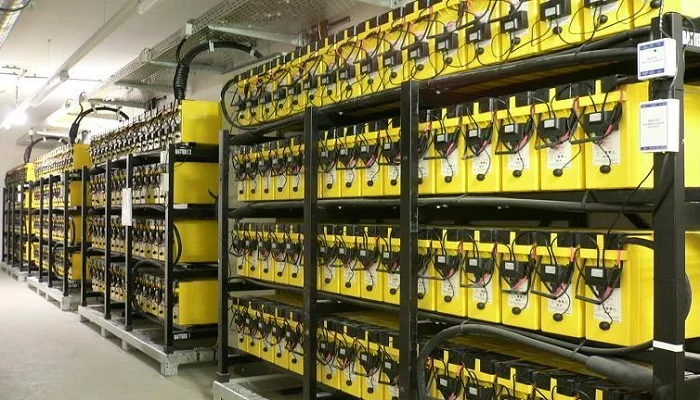
Third, the M6 terminal and 40 ± 2 kg mass matter mechanically: a 48 V string of four blocks places 160 kg (Arithmetic) across the shelf, and the terminal design dictates the cable lug and the torque specification used during installation.
Fourth, the cut-off of 1.75 V/cell applies to the six internal cells of the block, so the block-level discharge floor is 6 × 1.75 V = 10.5 V per block (Arithmetic). On a 48 V string of four blocks the bus floor is 4 × 10.5 V = 42.0 V (Arithmetic).
§2 — Float and Equalising Setpoints for a UPS String
The published setpoints are 13.5 V float and 14.1 V equalise per 12 V block (Model page). Converted to cell level, 13.5 V ÷ 6 cells = 2.25 V per cell for float, and 14.1 V ÷ 6 cells = 2.35 V per cell for equalising (Arithmetic). Those two figures are the entire charging strategy for a VRLA string, and they are deliberately narrow.
Float is the permanent state. A UPS battery sits on float charge for 99 % of its life, and at 2.25 V per cell the cell is held just past the point where the charge current falls into the self-discharge plus parasitic-load band. Set it higher and you accelerate the water loss that shortens VRLA life; set it lower and the string sags, the inverter sees a lower DC bus and the cells stratify. The charger output must therefore be programmed to 13.5 V per block, and for the 48 V string that means a 54.0 V float bus (4 × 13.5 V, Arithmetic).
Equalising is the corrective tool. At 2.35 V per cell the charger drives current through the block long enough to redistribute charge between cells that have drifted apart, which happens naturally after months of unequal temperature and discharge history. For the 48 V string the equalise bus is 56.4 V (4 × 14.1 V, Arithmetic). Equalising should be scheduled periodically, not left permanently enabled, because the higher voltage accelerates positive-grid corrosion and water loss; the trigger is a measurable spread in individual cell or block voltages under float, not a calendar date alone.
Temperature compensation closes the loop. The 13.5 V float figure is a 25 °C reference point; in a warm data centre the charger should reduce the float voltage per degree above that reference to avoid chronic overcharge, and in a cold room it should raise it to keep the string fully charged. The −15…50 °C working range (Model page) tells you how much the chemistry tolerates, but only the charger’s compensation curve moves the setpoint.
Finally, respect the published 24.0 A maximum charge current (Model page). For the 48 V string that is 4 × 24 A = 96 A (Arithmetic); for the 72 V string, 144 A; for the 144 V string, 288 A (Arithmetic). A charger that is smaller simply takes longer to recover; a charger that exceeds the limit forces the block into a forced overcharge, which drives electrolyte loss in a sealed AGM cell where the loss cannot be topped up with water.
§3 — String Sizing: 48 V, 72 V and 144 V DC Buses
A 12 V block is only useful in series strings whose count matches the DC bus of the UPS. The three configurations below are built entirely from 6-EVF-120 12V120Ah blocks, with all figures shown as formulas.
| String | Blocks | Nominal | Energy | Weight | Max charge current | Float bus | Equalise bus |
|---|---|---|---|---|---|---|---|
| 48 V bus | 4 × 12 V | 48 V | 48 V × 120 Ah = 5,760 Wh | 4 × 40 kg = 160 kg | 4 × 24 A = 96 A | 4 × 13.5 V = 54.0 V | 4 × 14.1 V = 56.4 V |
| 72 V bus | 6 × 12 V | 72 V | 72 V × 120 Ah = 8,640 Wh | 6 × 40 kg = 240 kg | 6 × 24 A = 144 A | 6 × 13.5 V = 81.0 V | 6 × 14.1 V = 84.6 V |
| 144 V bus | 12 × 12 V | 144 V | 144 V × 120 Ah = 17,280 Wh | 12 × 40 kg = 480 kg | 12 × 24 A = 288 A | 12 × 13.5 V = 162.0 V | 12 × 14.1 V = 169.2 V |
The 48 V configuration is by far the most common in small-to-medium data centres and server rooms, because it matches the classic 220 V single-phase UPS rectifier output of 54.0 V float and 56.4 V equalise (Arithmetic). The 72 V string serves three-phase systems and, in Europe, the 216 V class of bus. The 144 V string is the large single-phase configuration used in bigger installations and in DC bus distribution for telecommunications-grade plants.
Two practical constraints follow directly from the arithmetic. The first is string-to-string balance: with four blocks in series, the weakest block defines the usable capacity of the entire string, so blocks should be drawn from the same production batch, given identical rest time before installation, and wired with matched cable lengths. The second is mass and floor load: 480 kg on a single 144 V rack of twelve blocks requires a rated plinth, and the 40 ± 2 kg per block (Model page) has to be planned into the handling logistics, not discovered on delivery day.
A note on runtime. The 5,760 Wh of a 48 V string is the nameplate energy, not the deliverable energy. After derating for temperature, ageing, converter losses and the fact that a UPS rarely runs its battery below the 10.5 V per block cut-off (6 × 1.75 V, Arithmetic), the usable fraction is meaningfully smaller, and it shrinks further as the product line advances through its 2–5 year design life (Model page).
§4 — Standby Losses, Float Life and the Acceptance Test
Standby float charge is not a free state. The published self-discharge is ≤3 %/month at 25 °C (Model page), which converts to 3 % × 120 Ah = 3.6 Ah per month per block (Arithmetic). A 48 V string of four blocks therefore loses 4 × 3.6 Ah = 14.4 Ah per month (Arithmetic) to self-discharge alone, before the UPS converter’s own quiescent draw on the DC bus. That figure is the physical reason the float setpoint is 13.5 V and not something lower: the charger must continuously replace 14.4 Ah per month of string loss, and it does so at a voltage that holds the cells just above the point of imbalance.
Float life follows from the same chemistry. VRLA cells have no way to replace lost water, so every cycle of overcharge and every month of high-temperature float erodes the positive grid. The published design life of 2–5 years for this product line (Model page) is the number to put into the replacement schedule, and the published cycle life of 350–600 cycles at 50–80 % depth of discharge (Model page) is the number to put into the application margin, not the standby case. Where an installation genuinely needs multi-decade float life, the correct answer is a different CHISEN product line — the flooded tubular OPzS2 or the gel tubular OPzV2 series, covered in the CHISEN VRLA and GFM overview — not a larger block from the same VRLA range.
The acceptance test is where the real capacity is proved. Measure the actual capacity of each block or string at the published C3 rate, that is at 40 A for three hours (120 Ah ÷ 3 h = 40 A, Arithmetic), and record the voltage at the end of discharge. A block that delivers 120 Ah at C3 while ending at or above the 1.75 V/cell cut-off (Model page) has passed. Accept on a measured figure, not on the label, and keep the discharge log: the first three capacity tests after commissioning establish the baseline against which the annual acceptance test is judged.
§5 — Where the 6-EVF-120 Sits in the 12 V AGM Range
The 6-EVF-120 12V120Ah belongs to a wide 12 V portfolio that also includes smaller 6-DZF and 6-DMF blocks and the larger 6-EVF-150. The mechanical table below shows where the 120 Ah block sits in that range, and the electrical table that follows shows that the charging regime, cut-off, self-discharge and design life are identical across the whole 12 V line — which means one charger profile and one acceptance procedure can cover an entire mixed fleet.
| Model | V | Capacity | Rate | L×W×H mm | Weight | Terminal |
|---|---|---|---|---|---|---|
| 6-DZF-12 | 12 | 12 Ah | C2 | 151×99×99 | 3.6 ± 0.2 kg | φ8.0-M5 |
| 6-DZF-20 | 12 | 20 Ah | C2 | 180×76×170 | 6.1 ± 0.2 kg | φ8.8-M5 |
| 6-DMF-38 | 12 | 38 Ah | C3 | 224×106×175 | 10.45 ± 0.2 kg | φ9.8-M5 |
| 6-DMF-45 | 12 | 45 Ah | C3 | 224×121×175 | 12.3 ± 0.2 kg | φ11.8-M5 |
| 6-DMF-52 | 12 | 52 Ah | C3 | 224×135×175 | 13.7 ± 0.2 kg | φ11.8-M6 |
| 6-EVF-50 | 12 | 50 Ah | C3 | 230×140×180 | 15.25 ± 0.2 kg | φ11.8-M6 |
| 6-EVF-60 | 12 | 60 Ah | C3 | 258×170×160 | 18.8 ± 0.2 kg | φ14-M6 |
| 6-EVF-80 | 12 | 80 Ah | C3 | 259×170×218 | 25.7 ± 0.2 kg | φ16-M6 |
| 6-EVF-100 | 12 | 100 Ah | C3 | 330×170×218 | 31.5 ± 0.2 kg | φ20-M8 |
| 6-EVF-120 | 12 | 120 Ah | C3 | 407×170×240 | 40 ± 2 kg | φ20-M8 |
| 6-EVF-150 | 12 | 150 Ah | C3 | 483×170×240 | 48.5 ± 0.2 kg | φ20-M8 |
| Model | Float | Equalize | Cycle life | Charge current | Cut-off | Self-discharge |
| — | — | — | — | — | — | — |
| 6-DZF-12 | 13.5 V | 14.1 V | 350–600 (DoD 50–80 %) | 2.4 A | 1.75 V/cell | ≤3 %/month @25 °C |
| 6-DZF-20 | 13.5 V | 14.1 V | 350–600 | 4.0 A | 1.75 V/cell | ≤3 %/month @25 °C |
| 6-DMF-38 | 13.5 V | 14.1 V | 350–600 | 7.6 A | 1.75 V/cell | ≤3 %/month @25 °C |
| 6-DMF-45 | 13.5 V | 14.1 V | 350–600 | 9.0 A | 1.75 V/cell | ≤3 %/month @25 °C |
| 6-DMF-52 | 13.5 V | 14.1 V | 350–600 | 10.4 A | 1.75 V/cell | ≤3 %/month @25 °C |
| 6-EVF-50 | 13.5 V | 14.1 V | 350–600 | 10.0 A | 1.75 V/cell | ≤3 %/month @25 °C |
| 6-EVF-60 | 13.5 V | 14.1 V | 350–600 | 12.0 A | 1.75 V/cell | ≤3 %/month @25 °C |
| 6-EVF-80 | 13.5 V | 14.1 V | 350–600 | 16.0 A | 1.75 V/cell | ≤3 %/month @25 °C |
| 6-EVF-100 | 13.5 V | 14.1 V | 350–600 | 20.0 A | 1.75 V/cell | ≤3 %/month @25 °C |
| 6-EVF-120 | 13.5 V | 14.1 V | 350–600 | 24.0 A | 1.75 V/cell | ≤3 %/month @25 °C |
| 6-EVF-150 | 13.5 V | 14.1 V | 350–600 | 30.0 A | 1.75 V/cell | ≤3 %/month @25 °C |
Two comparisons frame the selection decision. Against the 6-EVF-100 (see the 6-EVF-100 12V100Ah model page), the 6-EVF-120 12V120Ah gains 20 % capacity — 120 Ah ÷ 100 Ah = 1.2 (Arithmetic) — while its mass rises by a factor of about 1.27, that is 40 kg ÷ 31.5 kg ≈ 1.27 (Arithmetic). So the 120 Ah block is better per amp-hour and per kilogram; the 100 Ah block is better per footprint, at 330 × 170 × 218 mm against 407 × 170 × 240 mm. Against the 6-EVF-150 12V150Ah, the 120 Ah step is usually the sweet spot for a single rack of a 48 V string, while the 150 Ah block at 48.5 ± 0.2 kg is worth it when the runtime requirement pushes the string to more energy than four 120 Ah blocks can give.
For small footprints, the 6-EVF-60 (see the 6-EVF-60 12V60Ah model page) at 258 × 170 × 160 mm and 18.8 ± 0.2 kg covers cabinet and telecom applications, and the 6-DMF-52 at 224 × 135 × 175 mm and 13.7 ± 0.2 kg (see the 6-DMF-52 12V52Ah model page) is the compact mid-range option, with the 6-DZF and 6-DMF range overview covering the smaller blocks.
§6 — The Trust: What to Ask the Supplier Before the Purchase Order
CHISEN Battery is based in Hangzhou, China, operates 8 production bases with an annual capacity of 70 million kVAh, and holds CE, ISO 9001, ISO 14001, UL and IEC certifications. The product portfolio spans flooded tubular OPzS2, gel tubular OPzV2, the 12 V VRLA blocks in the 6-DZF, 6-DMF and 6-EVF series, 6 V and 8 V EVF blocks, solar storage systems and lithium storage systems. The company profile page and the EVF series overview describe the capability in more detail.
Before signing for a 6-EVF-120 12V120Ah shipment, put these questions in writing on the purchase order.
- Which certificate accompanies this exact block, and can the test report be provided before shipment? Ask for the IEC 60896-3 or UL V94 test reference tied to the 6-EVF-120 12V120Ah rather than a generic product line certificate.
- What is the factory batch and date code on the delivered blocks, and can blocks from one batch be supplied for one string? This protects the balance of the 48 V string.
- What is the factory float voltage programme, and is it temperature compensated? The published 13.5 V (Model page) must be the value programmed at 25 °C.
- What capacity test data is supplied, at what rate, and with what end-of-discharge voltage? The reference acceptance test is 120 Ah at C3, that is 40 A for three hours (Arithmetic), ending above 1.75 V/cell (Model page).
- What is the warranty structure, and does it start from the manufacturing date or from the delivery date? For a product line with a 2–5 year design life (Model page), the start point changes the economics of the replacement schedule.
- What is the packaging standard — pallet quantity, carton count and gross weight per pallet — and what are the HS code and shipping documentation for customs clearance?
- Which accessories are available from the same factory: inter-block cables with M6 lugs, terminal torque values, busbars, and matching enclosures.
FAQ
Q1: What are the nominal voltage and capacity of the 6-EVF-120 12V120Ah? 12 V nominal and 120 Ah at the C3 rate (Model page).
Q2: What float and equalising voltages should the charger be set to? 13.5 V float and 14.1 V equalise per block, which is 2.25 V and 2.35 V per cell (Model page).
Q3: How many blocks make a 48 V UPS string, and what does it hold? Four 12 V blocks in series, storing 48 V × 120 Ah = 5,760 Wh nominal (Arithmetic).
Q4: What is the float and equalise voltage of a 48 V string built from these blocks? 54.0 V float (4 × 13.5 V) and 56.4 V equalise (4 × 14.1 V) (Arithmetic).
Q5: How much does a 48 V string of four 6-EVF-120 12V120Ah blocks weigh? 160 kg, that is 4 × 40 kg (Arithmetic).
Q6: What charger current is needed to recharge a 48 V string? At least 96 A, because 4 × 24 A = 96 A, matching the published 24.0 A maximum charge current per block (Model page).
Q7: What is the discharge current at the published C3 rate? 40 A, since 120 Ah ÷ 3 h = 40 A (Model page).
Q8: At what voltage should the discharge be stopped? At 1.75 V per cell, which is 10.5 V per block (6 × 1.75 V) and 42.0 V across a 48 V string (Model page).
Q9: How much standby charge does a 48 V string lose per month? 14.4 Ah per month, from 3 % × 120 Ah = 3.6 Ah per block and 4 × 3.6 Ah for the string (Arithmetic).
Q10: How long is the design life of this battery? 2–5 years for the 12 V VRLA product line, with a published cycle life of 350–600 cycles at 50–80 % depth of discharge (Model page).
Expert Summary
The 6-EVF-120 12V120Ah is a 12 V, 120 Ah C3 AGM VRLA block, 407 × 170 × 240 mm, 40 ± 2 kg, M6 terminal, floating at 13.5 V and equalising at 14.1 V, rated 24.0 A charge current, cut-off 1.75 V/cell, self-discharge ≤3 %/month at 25 °C, working range −15…50 °C, cycle life 350–600 cycles at 50–80 % DoD and a 2–5 year design life (Model page). In service that means a 40 A C3 discharge current (120 Ah ÷ 3 h, Arithmetic), a 10.5 V block floor (6 × 1.75 V, Arithmetic), a 54.0 V float and 56.4 V equalise bus on 48 V (4 × 13.5 V and 4 × 14.1 V, Arithmetic), a 56.4 V to 42.0 V working window on discharge, 5,760 Wh and 160 kg for a four-block 48 V string, 8,640 Wh and 240 kg for six blocks at 72 V, 17,280 Wh and 480 kg for twelve blocks at 144 V, charger requirements of 96 A, 144 A and 288 A respectively (Arithmetic), a 48 V standby loss of 14.4 Ah per month (4 × 3.6 Ah, Arithmetic), and versus the 6-EVF-100 a 1.2 gain in capacity (120 Ah ÷ 100 Ah) against a 1.27 rise in mass (40 kg ÷ 31.5 kg) (Arithmetic). The float setpoint is 2.25 V per cell and equalising 2.35 V per cell (Arithmetic); the whole 12 V range shares one charging profile, one cut-off, one self-discharge figure and one 2–5 year design life, while multi-decade float life belongs to the separate OPzS2 and OPzV2 tubular product lines rather than to this VRLA block.
Contact CHISEN — 24-Hour Response
CHISEN Battery replies to technical and commercial enquiries within 24 hours, every day of the week. Send specification requests, project drawings, UPS bus voltages and delivery schedules to sales@chisen.cn; export desk correspondence also goes to jack@chisen.cn. For immediate discussion, the WhatsApp line is +86 131 6622 6999. The full company profile, product documentation and factory capability statements are published at www.chisen.cn, and the 6-EVF-120 12V120Ah model page with its complete specification block sits at https://www.chisen.cn/en/6-EVF-120/12V120Ah.html.
Related CHISEN Buyer Guides
- Data Center UPS Battery Selection: VRLA AGM vs LFP in 2026
- 6-EVF-150 12V150Ah AGM Battery: Published Specs, Parallel String Sizing and EVF Range Comp
- OPzV2-100 2V100Ah Tubular GEL VRLA Battery for Telecom Access, Small UPS and Off-Grid Sola
- 12V 100Ah LiFePO4 vs Lead Acid Battery: Cycle Life, Published 6-EVF-100 Specs and Where Ea
- 3-EVF-200 6V200Ah AGM Battery: 48V Pack Sizing for Golf Carts, Sightseeing Vehicles and AG
