Answer First
If your procurement file needs a 12V 50Ah battery with published numbers rather than a catalogue guess, the 6-EVF-50 is the unit to specify. CHISEN publishes it as a 12 V, 50 Ah valve-regulated AGM battery rated at C3, in a 230 × 140 × 180 mm case weighing 15.25 ± 0.2 kg. The published charge control is 13.5 V float and 14.1 V equalise, maximum charge current 10.0 A, a 1.75 V per cell cut-off, self-discharge of no more than 3 % per month at 25 °C, an operating window of −15 to 50 °C, 350–600 cycles at 50–80 % depth of discharge, and a design life of 2–5 years. All of it comes from the factory model page, and the published figures are set out on this model page.
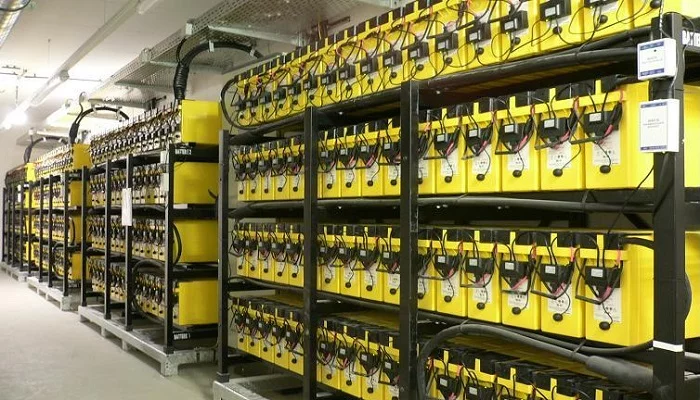
The arithmetic is simple enough to audit on a loading dock. A 12 V battery is six 2 V cells in series: 6 × 2 V = 12 V. Stored energy at the C3 rate is 12 V × 50 Ah = 600 Wh, and specific energy is 600 Wh ÷ 15.25 kg = 39.3 Wh/kg. Where it fits is the practical half of the answer: one 6-EVF-50 gives a single 12 V string, two strings give 24 V, four give 48 V (4 × 12 V = 48 V) — the bus voltage most single-phase UPS units and telecom rectifier cabinets expect. In parallel, 2 × 50 Ah = 100 Ah and 4 × 50 Ah = 200 Ah, so a 48 V / 100 Ah bank is four strings of two units, eight batteries weighing 8 × 15.25 kg = 122 kg before racks and cables. That makes the 6-EVF-50 a cabinet-scale battery for small server rooms, edge sites, base stations and 3 kW-class UPS installations.
Key Takeaways
- Published setpoints: float 13.5 V and equalise 14.1 V for a six-cell string, which is 2.25 V and 2.35 V per cell (13.5 ÷ 6 and 14.1 ÷ 6).
- C3 rating, 50 Ah nominal: capacity is measured at the 3-hour rate, so a 3 kW load on a 48 V bank is the design point.
- Maximum charge current 10.0 A, which is 10.0 A ÷ 50 Ah = 0.2 of rated capacity per hour; size the charger to match.
- 600 Wh per unit at 39.3 Wh/kg (12 V × 50 Ah = 600 Wh; 600 Wh ÷ 15.25 kg = 39.3 Wh/kg), useful where weight or shelf space is limited.
- Cut-off at 1.75 V per cell, so a string should be withdrawn at 1.75 V × 6 cells = 10.5 V.
- 350–600 cycles at 50–80 % depth of discharge and a 2–5 year design life — the honest planning window for a cabinet on mains most of the day.
§1 — 6-EVF-50 Quick Specifications
Every row below comes from the CHISEN model page for the 6-EVF-50, except where the source column reads Arithmetic. If you are writing a tender for a 12V 50Ah battery, these are the lines that belong in it.
| Parameter | Value | Source |
|---|---|---|
| Nominal voltage | 12 V | Model page |
| Nominal capacity | 50 Ah | Model page |
| Capacity rate | C3 | Model page |
| Dimensions L×W×H | 230 × 140 × 180 mm | Model page |
| Weight | 15.25 ± 0.2 kg | Model page |
| Terminal | φ11.8-M6 | Model page |
| Float voltage | 13.5 V | Model page |
| Equalise voltage | 14.1 V | Model page |
| Cycle life | 350–600 cycles (DoD 50–80 %) | Model page |
| Maximum charge current | 10.0 A | Model page |
| Discharge cut-off | 1.75 V per cell | Model page |
| Self-discharge | ≤ 3 %/month at 25 °C | Model page |
| Working temperature | −15 to 50 °C | Model page |
| Design life | 2–5 years | Model page |
| Cell configuration | 6 × 2 V cells in series (6 × 2 V = 12 V) | Arithmetic |
| Energy per unit | 12 V × 50 Ah = 600 Wh | Arithmetic |
| Specific energy | 600 Wh ÷ 15.25 kg = 39.3 Wh/kg | Arithmetic |
| String cut-off | 1.75 V × 6 cells = 10.5 V | Arithmetic |
| Float per cell | 13.5 V ÷ 6 cells = 2.25 V | Arithmetic |
| Equalise per cell | 14.1 V ÷ 6 cells = 2.35 V | Arithmetic |
Internal resistance, self-discharge at temperatures other than 25 °C, and the cycle curve at each depth of discharge are not published for this model — treat them as “not published”, or request them from the factory before freezing the design.
§2 — The Pain: Why 12V 50Ah Procurement Goes Wrong
Most disputes over a 12V 50Ah battery are not technical. They come from documents that contradict each other, or from numbers copied between models that differ in more than their label. Three patterns dominate.
Rating-rate confusion. A 50 Ah figure printed without a rate means little, because lead-acid capacity falls as the discharge rate lengthens. The 6-EVF-50 is published at C3, so 50 Ah is the three-hour rate capacity. A rival datasheet showing 50 Ah at the 10-hour rate describes a different discharge profile, and a rack designed against the softer number will not deliver the expected autonomy. Write “50 Ah at C3” into the specification and let a supplier who publishes at another rate disqualify itself.
Setpoint drift. Float voltage is the most consequential line in a UPS battery file, because 0.05 V of error per cell across six cells is 0.3 V on the string, and 0.1 V per cell is 0.6 V. On long float this shows up directly as lost capacity or over-charge. The published values here are 13.5 V float and 14.1 V equalise; a cabinet shipping with a default of 13.6 V or 13.8 V is not a documentation error, it is a shortened service life.
Mechanical assumptions carried over. The 230 × 140 × 180 mm case and 15.25 ± 0.2 kg weight set shelf loading, tray spacing and lifting method, and the φ11.8-M6 terminal sets the cable lug size. A purchase order specifying only “50 Ah 12 V” leaves all three open, and those three are what cause returns.
§3 — The Choice: Narrowing the Field Before You Specify
The 12 V VRLA shelf contains four mechanical footprints, and choosing between them is an exercise in removing options with published numbers rather than adjectives.
The 6-DZF series covers the small end. The 6-DZF-12 is 151 × 99 × 99 mm and 3.6 ± 0.2 kg for 12 Ah at C2; the 6-DZF-20 is 180 × 76 × 170 mm and 6.1 ± 0.2 kg for 20 Ah at C2. Both are lighter than a 12V 50Ah battery and both are correct for a small cabinet that genuinely needs 12 or 20 Ah. They are the wrong choice where a 3 kW UPS load has to ride through a generator start.
The 6-DMF series is the step up, with 38 Ah, 45 Ah and 52 Ah options in a 224 mm-long, 175 mm-tall case. The 6-DMF-45 publishes 12.3 ± 0.2 kg and the 6-DMF-52 publishes 13.7 ± 0.2 kg, both at C3, both at 13.5 V float and 14.1 V equalise with a 1.75 V per cell cut-off. Their gravimetric performance is strong: 12 V × 45 Ah = 540 Wh, and 540 Wh ÷ 12.3 kg = 43.9 Wh/kg for the 6-DMF-45; 12 V × 52 Ah = 624 Wh, and 624 Wh ÷ 13.7 kg = 45.5 Wh/kg for the 6-DMF-52.
The 6-EVF series is the heavy-duty line, and the choice is genuinely open here. The 6-EVF-50 at 50 Ah sits at 39.3 Wh/kg; the 6-EVF-60 at 60 Ah and 18.8 ± 0.2 kg works out to 12 V × 60 Ah = 720 Wh, and 720 Wh ÷ 18.8 kg = 38.3 Wh/kg; the 6-EVF-80 at 80 Ah and 25.7 ± 0.2 kg works out to 12 V × 80 Ah = 960 Wh, and 960 Wh ÷ 25.7 kg = 37.4 Wh/kg. Specific energy falls as the case grows because the plates scale sub-linearly against case mass, so the larger units buy runtime per string rather than runtime per kilogram.
Two questions settle it. Is the load runtime-driven or space-driven? If floor area is the constraint, the 6-EVF-50 delivers 600 Wh in a 230 × 140 × 180 mm footprint. If runtime is the constraint and floor space is free, a larger unit wins, and the sibling model page for the 6-EVF-60 documents the 258 × 170 × 160 mm case and 60 Ah rating that a 48 V string needs on wider shelves. What does the charger allow? Maximum charge current scales with the model — 4.0 A on the 6-DZF-20, 9.0 A on the 6-DMF-45, 10.0 A on the 6-EVF-50, 12.0 A on the 6-EVF-60 — and a rectifier sized for the smaller model will under-charge the larger one indefinitely.
For the balance of the 12 V VRLA options, the full product range for the 6-EVF series lists every model in that line with its published dimensions, so a tender for a 12V 50Ah battery can be written against the whole list rather than a shortlist.
§4 — The Framework: A Five-Step Specification Method
Step 1 — Fix the bus voltage and string count. A 48 V UPS needs four 12 V strings: 48 V ÷ 12 V = 4 strings, and 4 × 12 V = 48 V. A 24 V system needs two. Record the count in the tender so every quotation answers on the same basis.
Step 2 — Fix the required Ah at the design rate. Take the load in watts, divide by bus voltage to get amperes, multiply by required autonomy hours, then read the result against the C3 discharge curve. Convert to parallel strings: required Ah ÷ 50 Ah = parallel strings per series group. A 48 V / 100 Ah bank is 100 Ah ÷ 50 Ah = 2 parallel strings, so 4 × 2 = 8 batteries in total.
Step 3 — Check the energy budget end to end. Eight 6-EVF-50 units hold 8 × 600 Wh = 4,800 Wh. At a 50 % depth-of-discharge planning limit that is 4,800 Wh ÷ 2 = 2,400 Wh usable, which against a 3 kW load gives 2,400 Wh ÷ 3,000 W = 0.8 hours of runtime.
Step 4 — Size the charger from the published maximum. The 6-EVF-50 accepts 10.0 A. In a four-string parallel bank, a rectifier charging each string at the model maximum must deliver 4 strings × 10.0 A = 40.0 A. Set float at 13.5 V and equalise at 14.1 V, and confirm the cabinet controller holds both.
Step 5 — Fix the mechanical and acceptance items. Record 230 × 140 × 180 mm, 15.25 ± 0.2 kg, φ11.8-M6 terminals, the −15 to 50 °C operating window and the 1.75 V per cell cut-off, then require the supplier to confirm every line in the delivery dossier.
§5 — Published Comparison: 6-EVF-50 Against Its Closest Siblings
The table below uses only values published on the CHISEN model pages. The 6-EVF-50 row is the unit this guide is about; the surrounding rows are the options a tender committee will normally place beside it.
| Model | Capacity | Rate | L×W×H mm | Weight | Terminal | Float / Equalise | Max charge current | Cycle life |
|---|---|---|---|---|---|---|---|---|
| 6-DMF-38 | 38 Ah | C3 | 224 × 106 × 175 | 10.45 ± 0.2 kg | φ9.8-M5 | 13.5 V / 14.1 V | 7.6 A | 350–600 |
| 6-DMF-45 | 45 Ah | C3 | 224 × 121 × 175 | 12.3 ± 0.2 kg | φ11.8-M5 | 13.5 V / 14.1 V | 9.0 A | 350–600 |
| 6-DMF-52 | 52 Ah | C3 | 224 × 135 × 175 | 13.7 ± 0.2 kg | φ11.8-M6 | 13.5 V / 14.1 V | 10.4 A | 350–600 |
| 6-EVF-50 (this model) | 50 Ah | C3 | 230 × 140 × 180 | 15.25 ± 0.2 kg | φ11.8-M6 | 13.5 V / 14.1 V | 10.0 A | 350–600 |
| 6-EVF-60 | 60 Ah | C3 | 258 × 170 × 160 | 18.8 ± 0.2 kg | φ14-M6 | 13.5 V / 14.1 V | 12.0 A | 350–600 |
| 6-EVF-80 | 80 Ah | C3 | 259 × 170 × 218 | 25.7 ± 0.2 kg | φ16-M6 | 13.5 V / 14.1 V | 16.0 A | 350–600 |
| 6-EVF-120 | 120 Ah | C3 | 407 × 170 × 240 | 40 ± 0.2 kg | φ20-M8 | 13.5 V / 14.1 V | 24.0 A | 350–600 |
All rows share the same published float and equalise setpoints, the same 1.75 V per cell discharge cut-off, self-discharge of no more than 3 % per month at 25 °C, and a −15 to 50 °C operating window.
| Model | Energy per unit | Specific energy |
|---|---|---|
| 6-DMF-45 | 12 V × 45 Ah = 540 Wh | 540 Wh ÷ 12.3 kg = 43.9 Wh/kg |
| 6-DMF-52 | 12 V × 52 Ah = 624 Wh | 624 Wh ÷ 13.7 kg = 45.5 Wh/kg |
| 6-EVF-50 | 12 V × 50 Ah = 600 Wh | 600 Wh ÷ 15.25 kg = 39.3 Wh/kg |
| 6-EVF-60 | 12 V × 60 Ah = 720 Wh | 720 Wh ÷ 18.8 kg = 38.3 Wh/kg |
| 6-EVF-120 | 12 V × 120 Ah = 1,440 Wh | 1,440 Wh ÷ 40 kg = 36.0 Wh/kg |
Two practical notes follow. A 6-EVF-50 is heavier than a 6-DMF-52 by 15.25 kg − 13.7 kg = 1.55 kg per unit while giving 600 Wh instead of 624 Wh, so the 6-DMF-52 is the value choice only where the footprint allows it. And the 6-EVF-60 needs a 258 × 170 mm shelf against the 6-EVF-50’s 230 × 140 mm, so a cabinet built for one will not physically accept the other without a new tray.
§6 — The Trust: Factory Evidence, Delivery and After-Sales
Behind every figure in this guide is a manufacturer with published production scale. CHISEN operates eight production bases with an annual capacity of 70 million kVAh and holds CE, ISO 9001, ISO 14001, UL and IEC certifications. Its lines span flooded tubular OPzS2, gel tubular OPzV2 and the 12 V VRLA 6-DZF, 6-DMF and 6-EVF series. That breadth matters for a buyer, because one supplier can cover the small cabinet battery, the mid-size string and the large tubular bank without re-qualifying a second vendor.
For delivery, ask for four documents and check four numbers. The documents: model datasheet, shipment batch test report, certificate of conformity covering CE and the applicable UL or IEC mark, and a packing list showing batch and date codes. The numbers: nameplate 12 V, terminal type φ11.8-M6, mass against 15.25 ± 0.2 kg per unit, and open-circuit voltage on arrival. For a 12V 50Ah AGM battery resting after shipment, an open-circuit reading of 12.4 to 12.8 V per string is normal; below roughly 12.0 V, or a spread of more than about 0.15 V between units in the same batch, should trigger a hold rather than an installation.
CHISEN ships 12 V VRLA units through the export desks in Hangzhou, with container loading from Shanghai and Ningbo and onward routing to distributor and installer accounts. Regular markets for this class of battery include India, Nigeria, Kenya, Vietnam, the Philippines, Brazil, Egypt, Mexico, Indonesia and Pakistan, with volumes moving through Karachi, Mumbai, Lagos, Mombasa, Colombo, Dubai and Jebel Ali for African and Middle East destinations, and through Hamburg and Santos for European and South American programmes. Documented batches and a written warranty matter more on those routes than on a domestic one, because the after-sales path is longer and the importer carries the risk.
§7 — FAQ
Q1: What are the published nominal voltage and capacity of the 6-EVF-50? 12 V and 50 Ah at the C3 rate (Model page). Six 2 V cells in series give 6 × 2 V = 12 V, and stored energy is 12 V × 50 Ah = 600 Wh per unit.
Q2: What float and equalise setpoints does the manufacturer publish for the 6-EVF-50? Float 13.5 V and equalise 14.1 V across the six-cell string (Model page), which is 13.5 V ÷ 6 = 2.25 V and 14.1 V ÷ 6 = 2.35 V per cell.
Q3: What is the maximum charging current for the 6-EVF-50? 10.0 A (Model page), or 10.0 A ÷ 50 Ah = 0.2 of rated capacity per hour. A four-string bank at the model maximum needs 4 strings × 10.0 A = 40.0 A from the rectifier.
Q4: What are the case dimensions and weight of the 6-EVF-50? 230 × 140 × 180 mm and 15.25 ± 0.2 kg (Model page), giving 12 V × 50 Ah = 600 Wh and 600 Wh ÷ 15.25 kg = 39.3 Wh/kg.
Q5: What terminal type and torque does the 6-EVF-50 use? The published terminal is φ11.8-M6 (Model page). Tightening torque is not published and should be requested from the factory with the recommended cable lug size for your busbar.
Q6: How many cells does a 12V50Ah string contain and what bus voltage does it give? Six 2 V cells in series, so 6 × 2 V = 12 V. Two strings in series give 24 V and four give 48 V: 4 × 12 V = 48 V, the common single-phase UPS and telecom rectifier bus voltage.
Q7: What is the published design float life of the 6-EVF-50 and at what temperature? Design life 2–5 years with 350–600 cycles at 50–80 % depth of discharge (Model page). Self-discharge of no more than 3 % per month is stated at 25 °C, and the operating window is −15 to 50 °C (Model page).
Q8: How should an importer verify the 6-EVF-50 on delivery? Check nameplate 12 V, terminal φ11.8-M6, unit mass against 15.25 ± 0.2 kg, and open-circuit voltage per string, normally 12.4 to 12.8 V after shipment. Keep the batch test report, certificate of conformity and packing list with the batch codes for warranty claims.
Q9: Which certifications does the CHISEN factory behind the 6-EVF-50 hold? CE, ISO 9001, ISO 14001, UL and IEC, across eight production bases with 70 million kVAh of annual capacity. The marks are stated at company level; ask for the certificate covering your specific shipment.
Q10: How do I request a quotation or samples for the 6-EVF-50? Send the model, bus voltage, string count, load, autonomy and destination port to the export desk. Samples can be arranged with the dossier for the 12V 50Ah battery, and the response is normally given within 24 hours.
Expert Summary
The 6-EVF-50 is a 12 V, 50 Ah C3 valve-regulated AGM battery suited to cabinet and small-room work: 230 × 140 × 180 mm, 15.25 ± 0.2 kg, 600 Wh per unit at 39.3 Wh/kg, 13.5 V float, 14.1 V equalise, 10.0 A maximum charge current, a 1.75 V per cell cut-off that becomes 10.5 V across six cells, 350–600 cycles at 50–80 % depth of discharge, 2–5 years of design life, self-discharge of no more than 3 % per month at 25 °C, and an operating window of −15 to 50 °C. A 48 V bank is four strings; a 48 V / 100 Ah bank is four strings of two units; eight units hold 4,800 Wh gross and about 2,400 Wh at a 50 % planning limit, covering a 3 kW load for 0.8 hours. Buy it when floor area is the constraint; choose the 6-DMF-52 or 6-EVF-60 when runtime per kilogram or per string matters more than footprint. Specify rating rate, setpoints, cut-off, dimensions, terminal type and maximum charge current in the tender, and require answers against those figures rather than a watt-hour headline.
Contact CHISEN — 24-Hour Response
CHISEN Battery, Hangzhou, China. Export desk: sales@chisen.cn and jack@chisen.cn. WhatsApp: +86 131 6622 6999. Technical details: www.chisen.cn. Send the bus voltage, string count, load and destination port and you receive the 6-EVF-50 dossier, the published specification table and a quotation within 24 hours.
Related CHISEN Buyer Guides
- 12V 100Ah LiFePO4 vs Lead Acid Battery: Cycle Life, Published 6-EVF-100 Specs and Where Ea
- 2V 1000Ah Battery Buyer Guide 2026: Telecom, UPS, and Solar Storage Sourcing
- 6-EVF-150 12V150Ah AGM Battery: Published Specs, Parallel String Sizing and EVF Range Comp
- OPzS2-100 2V100Ah Flooded Tubular Battery: Published Specs, 48 V String Sizing and Sibling
- OPzS2-150 2V150Ah Flooded Tubular Cell: Published Specs and Sizing
