Answer First
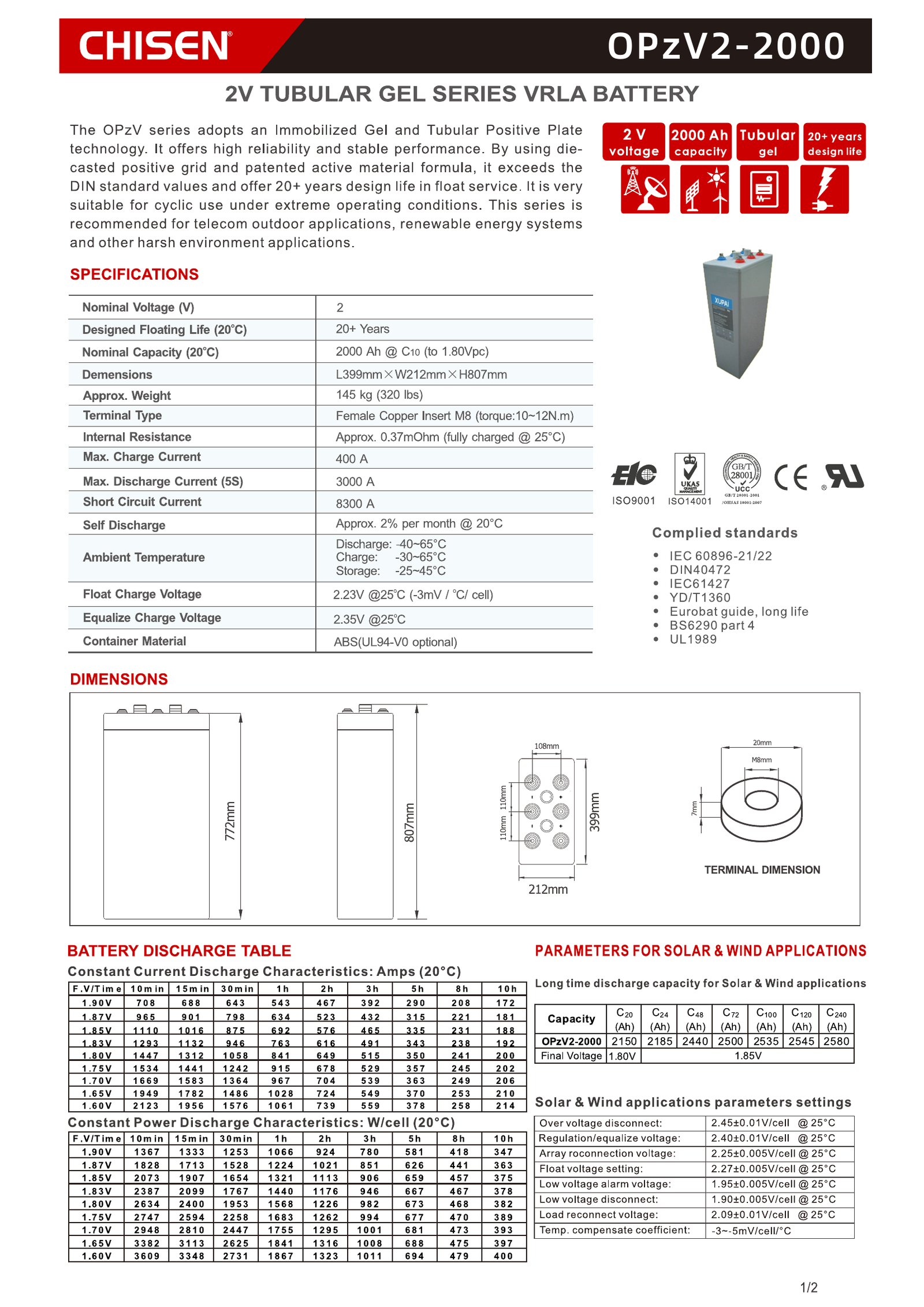
The OPzV2-2000 2V2000Ah is a single 2 V tubular gel cell rated at 2000 Ah at the C10 rate to 1.80 Vpc. Published case dimensions are 399 × 212 × 807 mm, published weight is 145 kg, published maximum charge current is 400 A, published float is 2.23 V at 25 °C and published equalise is 2.35 V at 25 °C, and published design float life is 20+ years @20 °C. Every number in this guide is taken from the datasheet published for this model; where the datasheet is silent, the guide says so rather than estimating.
For a UPS or telecom purchasing team, three facts drive the whole decision. First, this is a cell, not a finished battery: nominal stored energy per cell is 2 V × 2000 Ah = 4,000 Wh, so a 24-cell string on a 48 V bus holds 24 × 2 V × 2000 Ah = 96,000 Wh = 96 kWh nominal. Second, the maximum charge current of 400 A is 0.2 × C10 (400 A ÷ 2000 Ah), which is a normal acceptance limit for a 10-hour-rated tubular cell and constrains the recharge window after a deep discharge. Third, the 20+ year float life applies at 20 °C ambient, not at 25 °C and not at the higher temperatures found inside uncooled cabinets.
Key Takeaways
- The OPzV2-2000 2V2000Ah is a 2 V cell — 2000 Ah at the C10 rate to 1.80 Vpc, 399 × 212 × 807 mm, 145 kg. Procurement documents should specify strings, not “batteries”.
- Nominal energy per cell is 4,000 Wh (2 V × 2000 Ah); a 24-cell 48 V string is 96 kWh nominal before any usable-capacity derating.
- Setpoints are published: float 2.23 V, equalise 2.35 V, both at 25 °C, with temperature compensation of −3 mV/°C/cell.
- Maximum charge current is 400 A, equal to 0.2 C10 — check the UPS charger curve against it before sign-off.
- Design float life is 20+ years @20 °C; the same figure must not be read across to 12 V VRLA products, whose published design life is 2–5 years.
§1 — OPzV2-2000 Quick Specifications
| Parameter | Value | Source |
|---|---|---|
| Nominal voltage | 2 V | Datasheet |
| Capacity at C10 to 1.80 Vpc | 2000 Ah | Datasheet |
| Case dimensions (L × W × H) | 399 × 212 × 807 mm | Datasheet |
| Weight | 145 kg | Datasheet |
| Maximum charge current | 400 A | Datasheet |
| Float voltage | 2.23 V at 25 °C | Datasheet |
| Equalise voltage | 2.35 V at 25 °C | Datasheet |
| Temperature compensation | −3 mV/°C/cell | Datasheet |
| Internal resistance | ~0.37 mΩ @25 °C | Datasheet |
| Design float life | 20+ years @20 °C | Datasheet |
| Terminal | Female Copper Insert M8 | Datasheet |
| Terminal tightening torque | 10–12 N·m | Datasheet |
§2 — The Pain: What Goes Wrong When Tubular Gel Cells Are Bought by Brochure
Trap 1 — treating a cell as a battery. The OPzV2-2000 2V2000Ah is a 2 V monobloc. A 48 V UPS string is 24 of these cells in series; a 24 V system is 12. Ordering “24 OPzV2-2000 2V2000Ah batteries” without stating the string architecture produces a rack that cannot be installed. Write the string count into the order line, and state whether the string is supplied pre-welded or as loose cells.
Trap 2 — no acceptance test. Without a written acceptance procedure, a shipment can arrive with correct paperwork and unusable cells. The delivery check must state the method, the endpoints and the values from this model page.
§3 — The Choice: Selecting the Right Capacity in the OPzV2 Tubular Gel Range
The published tubular gel range runs from 200 Ah to 2500 Ah in single-cell format, and the choice is driven by three variables: the bus voltage, the runtime the site must hold, and the cabinet geometry.
Bus voltage first. Every cell in the range is 2 V. A 48 V bus is 24 cells; a 24 V bus is 12 cells; a 240 V DC bus is 120 cells. The string count is fixed by the site and cannot be adjusted to suit the cell. Published capacities in the current build list are listed on the full product range page.
Runtime second. For a target runtime, the arithmetic is: usable energy = string voltage × string Ah × depth of discharge × inverter efficiency. At 48 V with 24 cells of 2000 Ah, nominal energy is 24 × 2 V × 2000 Ah = 96,000 Wh = 96 kWh. At 50% depth of discharge and 88% inverter efficiency, usable energy is 96 kWh × 0.5 × 0.88 = 42.2 kWh. A 30 kW load then runs 42.2 kWh ÷ 30 kW = 1.41 hours. The same calculation on a 12-cell 24 V string of 2000 Ah gives 48 kWh nominal and 21.1 kWh usable, which is why telecom cabinets usually pair smaller capacities or longer strings instead.
§4 — The Framework: A Three-Step Qualification Method for Tubular Gel Strings
Before a single cell is quoted, run the same three steps. They take an afternoon on paper and remove most of the avoidable cost later in the project.
Step 1 — Fix the electrical frame. Write down the bus voltage, the string count, the discharge rate that defines the runtime requirement, and the target end voltage. The published 1.80 Vpc endpoint for the C10 rating of the OPzV2-2000 2V2000Ah is the natural starting point, because it is the endpoint the manufacturer publishes for the capacity figure.
Step 2 — Compute, then compare. Nominal energy per cell = 2 V × Ah. For this model: 2 V × 2000 Ah = 4,000 Wh per cell; a 24-cell string gives 96 kWh nominal. Only after that calculation do you pick the cell size, and only from capacities where the published numbers exist.
Step 3 — Check the mechanical and thermal envelope. Published dimensions of 399 × 212 × 807 mm and 145 kg per cell determine rack depth, floor loading and handling method. Published float life of 20+ years at 20 °C determines the room design target: every degree above 20 °C shortens it, and the published temperature compensation of −3 mV/°C/cell is what keeps the charging voltage correct as the cabinet warms.
§5 — Sibling Models: Published Data Side by Side
The OPzV2 series shares one electrical design — float 2.23 V, equalise 2.35 V, both at 25 °C, temperature compensation of −3 mV/°C/cell, and design float life of 20+ years at 20 °C — so the real decision is capacity, mass and footprint. The table lists only published values; the two right-hand columns are arithmetic on those values.
| Model | Ah @ C10 to 1.80 Vpc | L × W × H mm | Weight | Max charge current | Nominal energy (Arithmetic) | Specific energy (Arithmetic) |
|---|---|---|---|---|---|---|
| OPzV2-200 | 200 | 103 × 206 × 390 | 17.0 kg | 40 A | 400 Wh (2 V × 200 Ah) | 23.5 Wh/kg (400 ÷ 17.0) |
| OPzV2-500 | 500 | 166 × 206 × 506 | 36.3 kg | 100 A | 1,000 Wh (2 V × 500 Ah) | 27.5 Wh/kg (1,000 ÷ 36.3) |
| OPzV2-2000 | 2000 | 399 × 212 × 807 | 145 kg | 400 A | 4,000 Wh (2 V × 2,000 Ah) | 27.6 Wh/kg (4,000 ÷ 145) |
§6 — The Trust: Factory Facts, Certifications and Delivery
The OPzV2-2000 2V2000Ah is produced by CHISEN Battery in Hangzhou, China, on a manufacturing base of eight plants with an annual capacity of 70 million kVAh. The company runs flooded tubular OPzS2, gel tubular OPzV2 and 12 V VRLA lines covering the 6-DZF, 6-DMF and 6-EVF families, so a buyer running a mixed fleet can consolidate on one manufacturer without changing the spare-parts policy. Certifications held by the factory are CE, ISO 9001, ISO 14001, UL and IEC, and the current certificates and their scope should be requested with the quotation rather than assumed from a website page.
Delivery and export markets. Production is in Hangzhou, and export shipments move through the main Chinese container ports — Shanghai, Ningbo, Shenzhen and Xiamen — to distributor and integrator customers in India, Nigeria, Kenya, Vietnam, the Philippines, Brazil, Egypt and Mexico, with cargo also consigned through Jebel Ali and Dubai in the Gulf, through Karachi and Mumbai for South Asia, and through Lagos, Mombasa and Durban for East and Southern Africa. Incoterm, packing method and the number of cells per carton should all be fixed in the order, because a 145 kg cell sets the limits of both container loading and handling equipment at the site.
§7 — FAQ
Q1: What are the published nominal voltage and capacity of the OPzV2-2000? For the OPzV2-2000 2V2000Ah, the published nominal voltage is 2 V and the published capacity is 2000 Ah at the C10 rate to 1.80 Vpc (Datasheet). Nominal energy per cell is therefore 2 V × 2000 Ah = 4,000 Wh (Arithmetic).
Q2: What float and equalise setpoints does the manufacturer publish for the OPzV2-2000? Published float is 2.23 V at 25 °C and published equalise is 2.35 V at 25 °C, with temperature compensation of −3 mV/°C/cell (Datasheet). For solar and wind applications the series values are 2.27 ± 0.005 V/cell float and 2.40 ± 0.01 V/cell equalise at 25 °C.
Q3: What is the maximum charging current for the OPzV2-2000? For the OPzV2-2000 2V2000Ah, the published maximum charge current is 400 A (Datasheet), which equals 400 A ÷ 2000 Ah = 0.2 C10 (Arithmetic). The UPS charger curve should be checked against this limit for the post-discharge recharge window.
Q4: What are the case dimensions and weight of the OPzV2-2000? For the OPzV2-2000 2V2000Ah, published case dimensions are 399 × 212 × 807 mm and published weight is 145 kg (Datasheet). Both figures should be used for rack geometry, floor loading and handling planning.
Q5: What terminal type and torque does the OPzV2-2000 use? The published terminal is a female copper insert M8 with a tightening torque of 10–12 N·m (Datasheet). Torque tools should be calibrated, since loose inter-cell connections raise string resistance.
Q6: How many cells does a 2V2000Ah string contain and what bus voltage does it give? A 48 V bus uses 24 cells (24 × 2 V = 48 V) and a 24 V bus uses 12 cells (Arithmetic). A 24-cell string of the OPzV2-2000 2V2000Ah holds 24 × 2 V × 2000 Ah = 96,000 Wh = 96 kWh nominal.
Q7: What is the published design float life of the OPzV2-2000 and at what temperature? The published design float life is 20+ years at 20 °C (Datasheet). It is a 20 °C figure and must not be read across to 12 V VRLA products, whose design life is 2–5 years.
Q8: How should an importer verify the OPzV2-2000 on delivery? Check open-circuit voltage per cell, then run a capacity discharge to 1.80 Vpc at the agreed discharge rate, and compare the delivered Ah with the published 2000 Ah at C10. Confirm internal resistance against the published reference of about 0.37 mΩ at 25 °C, check case dimensions and weight, and record the terminal torque applied. The published data set for the model is listed on this model page.
Expert Summary
The OPzV2-2000 2V2000Ah is a 2 V, 2000 Ah tubular gel cell built for long-life standby duty: published dimensions 399 × 212 × 807 mm, published weight 145 kg, published maximum charge current 400 A (0.2 C10), published float 2.23 V and equalise 2.35 V at 25 °C with −3 mV/°C/cell compensation, published internal resistance about 0.37 mΩ at 25 °C, and published design float life of 20+ years @20 °C. Each cell carries 2 V × 2000 Ah = 4,000 Wh, so a 24-cell 48 V string holds 96 kWh nominal and about 42.2 kWh usable at 50% depth of discharge and 88% inverter efficiency, which is roughly 1.41 hours for a 30 kW load. The series shares these electrical settings across published capacities from 200 Ah to 2500 Ah, with specific energy rising from 23.5 Wh/kg at 200 Ah to 27.6 Wh/kg at 2000 Ah and internal resistance falling from about 1.0 mΩ to about 0.37 mΩ over the same range, so the choice is driven by runtime, rack depth and cell count rather than by chemistry. CHISEN operates eight production bases with an annual capacity of 70 million kVAh and holds CE, ISO 9001, ISO 14001, UL and IEC, exporting from Hangzhou through Shanghai, Ningbo and Shenzhen to distributors in India, Nigeria, Kenya, Vietnam, the Philippines, Brazil, Egypt and Mexico. ## Contact CHISEN — 24-Hour Response
- Email: sales@chisen.cn
- Export desk: jack@chisen.cn
- WhatsApp: +86 131 6622 6999
- Website: www.chisen.cn
Related CHISEN Buyer Guides
- 12V 100Ah LiFePO4 vs Lead Acid Battery: Cycle Life, Published 6-EVF-100 Specs and Where Ea
- 2V 1000Ah Battery Buyer Guide 2026: Telecom, UPS, and Solar Storage Sourcing
- 6-DMF-52 12V52Ah UPS Battery: Complete Buyer Guide for Data Centres and Telecom
- 6-EVF-120 12V120Ah UPS Battery: Complete Buyer Guide for Data Centres and Telecom
- 6-EVF-150 12V150Ah AGM Battery: Published Specs, Parallel String Sizing and EVF Range Comp
