Answer First
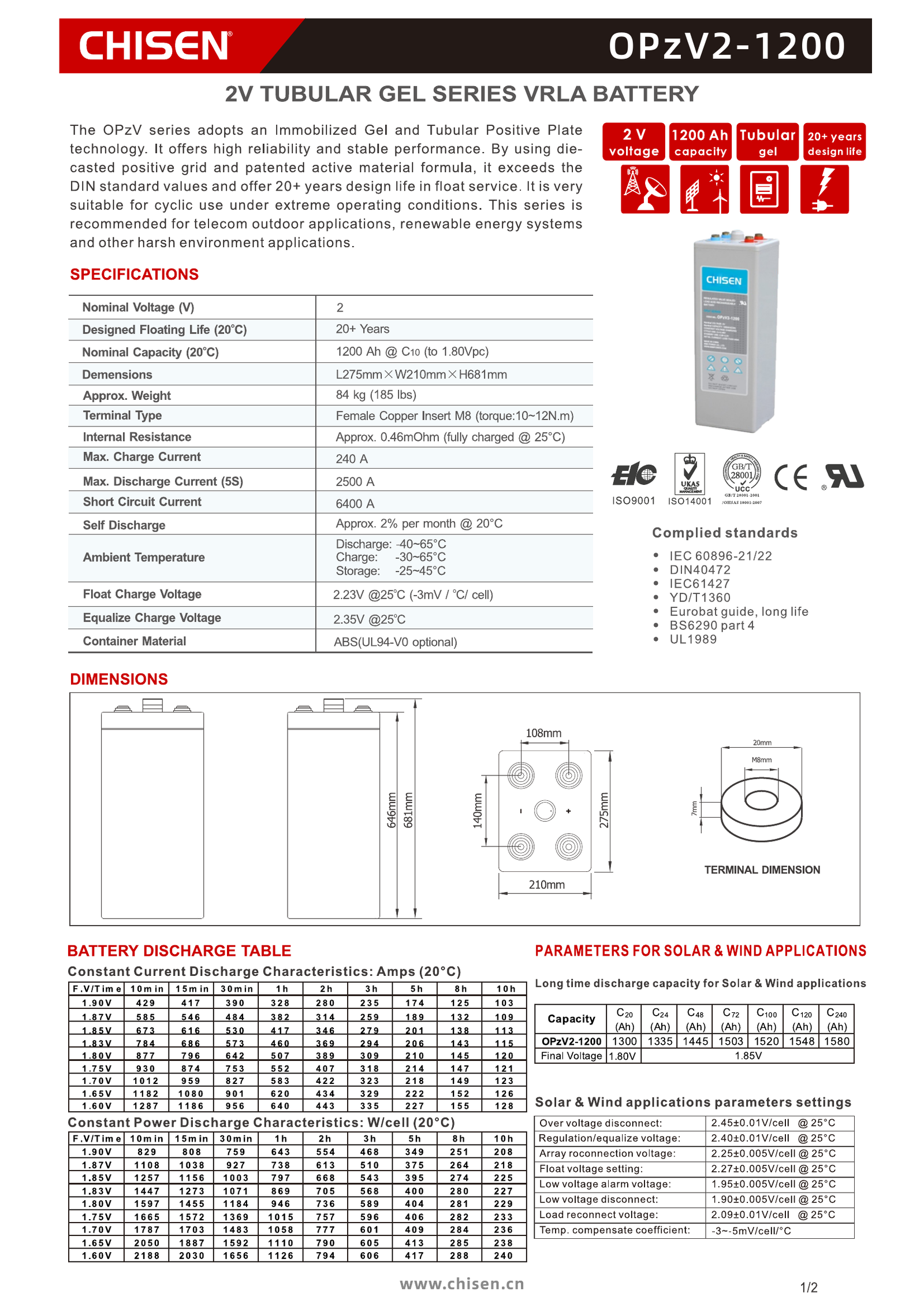
Short answer for a purchasing team: the OPzV2-1200 2V1200Ah is a 2 V, 1200 Ah tubular gel cell sized for cabinet and rack power systems in data centres, telecom power rooms and small industrial UPS plants. Published values on this model page are 1200 Ah at the C10 rate to 1.80 V per cell, 275 × 210 × 681 mm, 84 kg, 2.23 V float and 2.35 V equalise at 25 °C, −3 mV/°C/cell temperature compensation, 240 A maximum charge current, approximately 0.46 mΩ internal resistance at 25 °C and a design float life of 20+ years at 20 °C.
The arithmetic behind those numbers matters more than the headline capacity. One cell stores 2 V × 1200 Ah = 2,400 Wh and weighs 84 kg, so specific energy is 2,400 Wh ÷ 84 kg = 28.6 Wh/kg. A 24-cell string gives 24 × 2 V = 48 V bus, floats at 24 × 2.23 V = 53.52 V and equalises at 24 × 2.35 V = 56.4 V — the set of voltages your rectifier and UPS must accept.
Key Takeaways
- The OPzV2-1200 2V1200Ah is a 2 V cell rated 1200 Ah at C10 (1.80 Vpc); 2 V × 1200 Ah = 2,400 Wh per cell.
- Float 2.23 V @25 °C, equalise 2.35 V @25 °C, compensation −3 mV/°C/cell — every value is per cell (Datasheet).
- Design float life is 20+ years at 20 °C for tubular gel; that figure does not transfer to 12 V VRLA cells.
§1 — OPzV2-1200 Quick Specifications
| Parameter | Value | Source |
|---|---|---|
| Nominal voltage | 2 V | Datasheet |
| Capacity at C10 (1.80 Vpc) | 1200 Ah | Datasheet |
| Dimensions (L × W × H) | 275 × 210 × 681 mm | Datasheet |
| Weight | 84 kg | Datasheet |
| Maximum charge current | 240 A | Datasheet |
| Float setpoint | 2.23 V @ 25 °C | Datasheet |
| Equalise setpoint | 2.35 V @ 25 °C | Datasheet |
| Temperature compensation | −3 mV/°C/cell | Datasheet |
| Internal resistance | ~0.46 mΩ @ 25 °C | Datasheet |
| Design float life | 20+ years @20 °C | Datasheet |
| Terminal | Female Copper Insert M8, torque 10–12 N·m | Datasheet |
| Specific energy (derived) | 2 V × 1200 Ah ÷ 84 kg = 28.6 Wh/kg | Arithmetic |
§2 — The Pain: Two Numbers That Decide Most 2V1200Ah Purchases
The first pain is that “1200 Ah” describes a laboratory rate, not your power room. The published 1200 Ah for the OPzV2-1200 2V1200Ah is measured at the C10 rate to 1.80 V per cell, so the test current is 1200 Ah ÷ 10 h = 120 A. A rectifier that pulls 240 A — the published maximum charge current — runs the cell at 240 ÷ 1200 = 0.2 C10. Real discharge curves at higher current deliver less usable Ah, so a tender that compares nameplate Ah across 2 V, 6 V and 12 V blocks is comparing different things.
The second pain is the float-life claim. “20+ years” is published at 20 °C. A battery room that runs at 28 °C loses roughly 0.3 % of design life per °C above 20 °C, so eight degrees of ambient difference erodes a meaningful share of the quoted life. That is a temperature effect, not a defect, and it is why the cell carries a published compensation of −3 mV/°C/cell.
§3 — The Choice: String Architecture, Setpoints and Cell Count
Start from the bus voltage, not the cell. A 2 V cell supports the standard telecom and UPS strings: 12 cells × 2 V = 24 V, 24 cells × 2 V = 48 V, 48 cells × 2 V = 96 V. For a 48 V cabinet the OPzV2-1200 2V1200Ah typically appears in 24-cell strings, so the string floats at 24 × 2.23 V = 53.52 V and equalises at 24 × 2.35 V = 56.4 V. Size the rectifier to hold the string within its own float window and to absorb the equalise current.
Next, parallel strings. Because every cell in a series string carries the same current, the string charge limit stays 240 A regardless of how many cells are in series: 24 cells × 240 A does not give 5,760 A, because the same 240 A passes through each cell in turn. Two parallel 24-cell strings raise site output to 2 × 240 A = 480 A while each string still respects its 240 A cell limit. That is the correct way to grow a power room.
Finally, confirm the physical envelope: 275 × 210 × 681 mm and 84 kg per cell means 24 cells weigh 24 × 84 kg = 2,016 kg of cells alone, before racks, busbars and clearance. If the cabinet height or floor loading does not suit, compare the other sizes in the full product range before the cabinet is fabricated rather than after.
§4 — The Framework: A Five-Step Acceptance Sequence for Incoming Cells
Step 1 — Mechanical. Inspect every case for cracks, bulges, seal leakage and terminal damage. Confirm the M8 insert turns to 10–12 N·m without thread galling, and that the cell seats flat on its support.
Step 2 — Open-circuit voltage. Measure each cell at rest before energising the bus. At float the expected value is 2.23 V per cell, so a 24-cell string should read 24 × 2.23 V = 53.52 V. A spread beyond roughly ±2 % across a string points to a weak cell or a poor contact; the acceptance limit itself is to be requested from the factory.
Step 3 — Capacity. Run a constant-current discharge at the C10 rate: 1200 Ah ÷ 10 h = 120 A, holding cell voltage above 1.80 Vpc, and read back the delivered Ah against the published 1200 Ah.
Step 4 — Charge acceptance. Configure the charger to the published float 2.23 V and equalise 2.35 V at 25 °C with −3 mV/°C/cell compensation, then confirm the current drawn never exceeds the published 240 A per cell.
Step 5 — Resistance and records. Check internal resistance per cell against ~0.46 mΩ at 25 °C, which gives 24 × 0.46 mΩ = 11.04 mΩ across a 24-cell string, and file the measured values with the serial numbers and cell position map.
Two acceptance disputes recur with 2 V cells of this size. The first is measured Ah against the published 1200 Ah at the C10 rate to 1.80 Vpc: if the discharge is stopped earlier than the reference end voltage, the shortfall is a test-method difference, not a capacity defect. The second is float voltage spread across a string, where one weak OPzV2-1200 cell pulls the whole string down even when its neighbours read normal. Record per-cell open-circuit voltage before and after the discharge test, so cell ageing and connection faults can be told apart on site instead of in a claim against the factory. For every OPzV2-1200 in the consignment, keep the serial number, the cabinet position and the measured value on the same sheet. An OPzV2-1200 flagged by that sheet, and only that OPzV2-1200, can then be quarantined and replaced without disturbing the rest of the string.
§5 — Sizing Against the Sibling Cells: Published Values Side by Side
The comparison below uses published datasheet values for each cell. The final column is derived as 2 V × Ah ÷ weight, and the arithmetic is written out inside each cell.
| Model | V | Ah @ C10 | Dimensions (mm) | Weight | Max charge current | Internal resistance | Float / Equalise | Design float life | Wh/kg (derived) | Source |
|---|---|---|---|---|---|---|---|---|---|---|
| OPzV2-200 | 2 | 200 | 103×206×390 | 17.0 kg | 40 A | ~1.0 mΩ | 2.23 / 2.35 V @ 25 °C | 20+ years @20 °C | 2 V × 200 Ah = 400 Wh ÷ 17.0 kg = 23.5 | Datasheet |
| OPzV2-1200 | 2 | 1200 | 275×210×681 | 84 kg | 240 A | ~0.46 mΩ | 2.23 / 2.35 V @ 25 °C | 20+ years @20 °C | 2 V × 1,200 Ah = 2,400 Wh ÷ 84 kg = 28.6 | Datasheet |
| OPzV2-2000 | 2 | 2000 | 399×212×807 | 145 kg | 400 A | ~0.37 mΩ | 2.23 / 2.35 V @ 25 °C | 20+ years @20 °C | 2 V × 2,000 Ah = 4,000 Wh ÷ 145 kg = 27.6 | Datasheet |
§6 — The Trust: Factory Evidence, Certifications and Export Logistics
The OPzV2-1200 2V1200Ah is produced by CHISEN Battery in Hangzhou, China, which operates 8 production bases with an annual capacity of 70 million kVAh. The company holds CE, ISO 9001, ISO 14001, UL and IEC certifications, and builds three lead-acid lines in parallel: flooded tubular OPzS2, gel tubular OPzV2 and 12 V VRLA in the 6-DZF, 6-DMF and 6-EVF series. That matters for a UPS buyer because a single vendor can cover standby, telecom and motive blocks with the same gel chemistry and the same float protocol.
On the logistics side, gel tubular OPzV2 ships as palletised cells from the Chinese ports of Ningbo and Shanghai. Typical consignees are distributors and installers in India, Nigeria, Kenya, Vietnam, the Philippines, Brazil and Egypt, arriving through Mumbai and Chennai, Lagos, Mombasa, Ho Chi Minh City, Manila, Santos and Port Said, with Gulf traffic moving through Jebel Ali and Dubai. Container loading, cell count per pallet and gross weight should be confirmed on the order acknowledgement, because 84 kg per cell makes the packing plan a real constraint on a 20-foot container rather than a formality.
§7 — FAQ
Q1: What are the published nominal voltage and capacity of the OPzV2-1200? The datasheet lists 2 V nominal and 1200 Ah at the C10 rate, measured to 1.80 V per cell (Datasheet). Stored energy per cell is 2 V × 1200 Ah = 2,400 Wh, which at the published 84 kg gives 28.6 Wh/kg.
Q2: What float and equalise setpoints does the manufacturer publish for the OPzV2-1200? Float is 2.23 V per cell at 25 °C and equalise is 2.35 V per cell at 25 °C, with temperature compensation of −3 mV/°C/cell (Datasheet). For solar and wind duty the series reference values are float 2.27 ± 0.005 V/cell and equalise 2.40 ± 0.01 V/cell at 25 °C; confirm which setpoint applies to your shipment in writing.
Q3: What is the maximum charging current for the OPzV2-1200? 240 A, which is 0.2 × the 1,200 Ah C10 rating (Datasheet). Because the same current flows through every cell of a series string, a 24-cell string is still limited to 240 A; parallel strings multiply site output without exceeding the cell limit.
Q4: What are the case dimensions and weight of the OPzV2-1200? 275 × 210 × 681 mm and 84 kg per cell (Datasheet). A 24-cell string therefore weighs 24 × 84 kg = 2,016 kg of cells before racks and busbars, which drives both floor loading and cabinet height.
Q5: What terminal type and torque does the OPzV2-1200 use? Female copper insert M8 terminals tightened to 10–12 N·m (Datasheet). Under-torqued inserts raise contact resistance and heat at the joint, so include torque verification in the acceptance checklist.
Q6: How many cells does a 2V1200Ah string contain and what bus voltage does it give? The cell count is fixed by the bus voltage you need: 12 cells × 2 V = 24 V, 24 cells × 2 V = 48 V, or 48 cells × 2 V = 96 V. A 48 V string floats at 24 × 2.23 V = 53.52 V and equalises at 24 × 2.35 V = 56.4 V, and at 35 °C ambient the compensated float becomes 24 × (2.23 V − 10 × 0.003 V) = 52.8 V.
Q7: What is the published design float life of the OPzV2-1200 and at what temperature? 20+ years at 20 °C (Datasheet), for the tubular gel OPzV2 construction. Higher ambient shortens the achieved life, and the figure applies to float service; deep-cycle life at a defined depth of discharge is not published and should be requested from the factory.
Q8: Which certifications does the CHISEN factory behind the OPzV2-1200 hold? CE, ISO 9001, ISO 14001, UL and IEC. The plant group runs 8 production bases with 70 million kVAh of annual capacity across flooded tubular OPzS2, gel tubular OPzV2 and 12 V VRLA lines (6-DZF, 6-DMF, 6-EVF).
Q9: How do I request a quotation or samples for the OPzV2-1200? Send the destination port, required quantity, target bus voltage and the acceptance standard you intend to apply to the export desk. Samples and batch test reports are available on request, and the desk replies with a full specification sheet before any commercial step is taken.
Expert Summary
The OPzV2-1200 2V1200Ah is a 2 V, 1200 Ah C10 tubular gel cell whose published envelope — 275 × 210 × 681 mm, 84 kg, 240 A maximum charge current, ~0.46 mΩ internal resistance at 25 °C, float 2.23 V and equalise 2.35 V at 25 °C, −3 mV/°C/cell compensation and 20+ years design float life at 20 °C — maps cleanly onto 24-cell 48 V cabinets for data centres and telecom power rooms. Capacity in Wh is 2 V × 1200 Ah = 2,400 Wh per cell, specific energy is 28.6 Wh/kg, a 24-cell string floats at 53.52 V and equalises at 56.4 V, and string resistance is 11.04 mΩ. Because a series string shares one current path, each cell caps at 240 A regardless of string length, so growth comes from parallel strings. Procurement should fix the C10 test current of 120 A, the 1.80 Vpc end voltage, the 2.23 V / 2.35 V setpoints and the 10–12 N·m terminal torque in the purchase order, then run the five-step acceptance sequence on arrival.
Contact CHISEN — 24-Hour Response
- Email: sales@chisen.cn
- Email: jack@chisen.cn
- WhatsApp: +86 131 6622 6999
- Website: www.chisen.cn
Send the destination port, required quantity, bus voltage and your acceptance standard, and the export desk replies with the current datasheet, batch test report availability and lead time.
Related CHISEN Buyer Guides
- 12V 100Ah LiFePO4 vs Lead Acid Battery: Cycle Life, Published 6-EVF-100 Specs and Where Ea
- 2V 1000Ah Battery Buyer Guide 2026: Telecom, UPS, and Solar Storage Sourcing
- 6-DMF-52 12V52Ah UPS Battery: Complete Buyer Guide for Data Centres and Telecom
- 6-EVF-120 12V120Ah UPS Battery: Complete Buyer Guide for Data Centres and Telecom
- 6-EVF-150 12V150Ah AGM Battery: Published Specs, Parallel String Sizing and EVF Range Comp
