Answer First
The CHISEN 6-EVF-50 is a 12 V, 50 Ah VRLA AGM battery rated at the C3 discharge rate, and its sizing arithmetic fits on one sheet of paper. One 12V50Ah string delivers 12 V × 50 Ah = 600 Wh nominal at a published 15.25 ± 0.2 kg, so a 12V 50Ah battery carries 600 Wh ÷ 15.25 kg = 39.3 Wh/kg. Four strings in series give a 48 V bus of 2,400 Wh.
Runtime decides the design, and it is set by load and depth of discharge, not by the label. Usable energy per string at the published 1.75 V/cell cutoff and 50 % DoD is 600 Wh × 0.50 = 300 Wh, so runtime (h) = (strings × 300 Wh) ÷ (bus voltage × load current) — 16 strings on a 48 V, 20 A load give 4,800 Wh ÷ 960 W = 5.0 hours.
The second constraint is recharge: the published 10.0 A charge current means 50 Ah ÷ 10.0 A = 5.0 hours minimum to restore one string, which often dictates the generator window. Every figure below comes from the published CHISEN model page, and every derived number shows its arithmetic. Current datasheet values are on the 6-EVF-50 12V50Ah product page.
Key Takeaways
- One 12V 50Ah battery is 600 Wh nominal (12 V × 50 Ah) at 15.25 ± 0.2 kg, or 39.3 Wh/kg.
- Runtime = (strings × 300 Wh) ÷ (bus voltage × load current) at 50 % DoD; the label alone does not set autonomy.
- Recharge governs the site: 50 Ah ÷ 10.0 A = 5.0 hours minimum per string at the published maximum charge current.
- Series sets voltage, parallel sets amp-hours: 4 strings = 48 V / 50 Ah; 16 strings = 48 V / 400 Ah and four times the runtime.
- Setpoints are fixed and published: 13.5 V float (2.25 V/cell), 14.1 V equalise (2.35 V/cell), 1.75 V/cell cutoff.
§1 — 6-EVF-50 Quick Specifications
Values come verbatim from the published CHISEN model page; derived rows show the calculation. The full 12 V VRLA range is on the EVF series overview.
| Parameter | Published value | Source |
|---|---|---|
| Nominal voltage | 12 V | Model page |
| Nominal capacity | 50 Ah | Model page |
| Capacity rate | C3 | Model page |
| Dimensions (L×W×H) | 230 × 140 × 180 mm | Model page |
| Weight | 15.25 ± 0.2 kg | Model page |
| Terminal | φ11.8-M6 | Model page |
| Float voltage | 13.5 V | Model page |
| Equalise voltage | 14.1 V | Model page |
| Cycle life | 350–600 | Model page |
| Maximum charge current | 10.0 A | Model page |
| Discharge cutoff | 1.75 V/cell | Model page |
| Self-discharge | ≤3 %/month @25 °C | Model page |
| Working temperature | −15…50 °C | Model page |
| Design life | 2–5 years | Model page |
| Nominal energy | 600 Wh | Arithmetic |
| Specific energy | 39.3 Wh/kg | Arithmetic |
Terminal torque and per-cell internal resistance are not published and are to be requested from the factory. The 6-EVF-60 12V60Ah adds 20 % capacity on the same 170 mm depth.
§2 — The Pain: Why Nameplate Amp-Hours Fail in the Field
The most expensive failure in a UPS battery project is not a bad cell — it is numbers that were right on a spreadsheet and wrong on site. The 6-EVF-50 is published at 50 Ah C3, meaning 50 Ah over a three-hour discharge, and that qualifier belongs in every runtime calculation you sign off.
Pain one: C3 is not C10. A bank of 6-EVF-50 strings that looks oversized on paper delivers less than the arithmetic suggests when the real discharge runs eight or ten hours, the normal case for a telecom cabinet or a solar-backed site. That is a specification error, not a manufacturing defect.
Pain two: usable energy is 50 % DoD, not 100 %. The published 350–600 cycle life applies at 50–80 % depth of discharge, so designing on 600 Wh per string leaves no margin for the 1.75 V/cell cutoff, for ageing, or for cold-temperature capacity loss.
Pain three: the recharge window is the hidden constraint. The published maximum charge current for the 12V 50Ah battery is 10.0 A, so a 50 Ah string needs 50 Ah ÷ 10.0 A = 5.0 hours of continuous charging to restore full capacity. If the site’s generator or rectifier window is two hours, the bank never reaches 100 % and every later outage starts partly discharged.
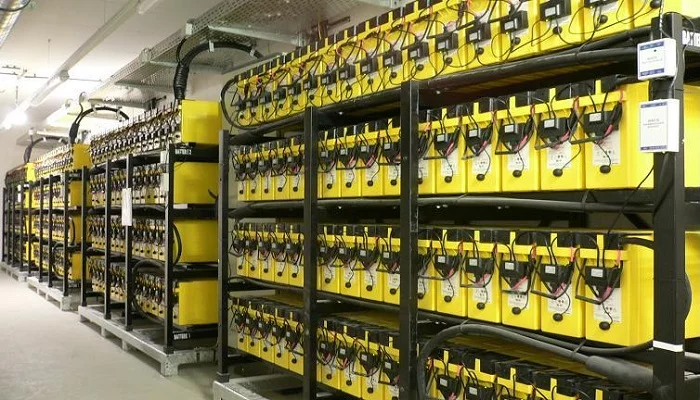
Pain four: cabinet geometry sets the layout. At 230 × 140 × 180 mm and 15.25 ± 0.2 kg per unit, a 48 V / 400 Ah bank of 16 strings weighs 16 × 15.25 = 244 kg — often the constraint that changes the design.
§3 — The Choice: Where a 12V 50Ah Battery Fits — and Where It Does Not
CHISEN builds four relevant lines: flooded tubular OPzS2, gel tubular OPzV2, 12 V VRLA AGM (6-DZF / 6-DMF / 6-EVF), and lithium storage systems. The 6-EVF-50 sits in the third group, and it fits when four conditions hold.
- Short-to-medium runtime in a small footprint. AGM needs no watering, no gas venting and no special room; the 180 mm case height fits a standard 200 mm shelf.
- A maintenance-free installation. Sealed construction means no topping-up on site and predictable logistics for distributors.
- A load profile that matches a C3 rating. Motor starting, DC bus ride-through, inverter peak support and moderate telecom loads are what this block is designed for.
- A controlled environment and a budget that makes lithium unjustifiable. The published range is −15…50 °C, but capacity still falls in cold conditions, so unsheltered sites need controlled enclosures; for one cabinet, a lithium system with BMS and enclosure does not pay back against VRLA.
Where it does not fit: sub-hour bridge requirements suit a different chemistry; autonomy above ten hours needs a tubular product or a larger VRLA block; and high daily cycling falls outside the 350–600 cycle envelope.
§4 — The Framework: A Five-Step DC Bus String Sizing Method
Step 1 — inventory the load in watts. Sum the continuous load and, separately, the peak the inverter must carry. Do it per rack or cabinet, not per building.
Step 2 — fix the DC bus voltage. 12 V for a single telecom cabinet, 24 V for a small site, 48 V for a room or larger. Bus voltage is set by the rectifier and inverter, not by the battery.
Step 3 — choose strings in series, then in parallel. For a 48 V bus: 4 strings in series = 4 × 12 V = 48 V with amp-hour output unchanged at 50 Ah. Then add parallel strings: 8 strings = 48 V / 200 Ah; 16 strings = 48 V / 400 Ah. Parallel strings must match in type, age and length, and each parallel group needs its own fuse and cable.
Step 4 — compute runtime at 50 % DoD. Usable energy per string = 600 Wh × 0.50 = 300 Wh. Runtime (h) = (strings × 300 Wh) ÷ (bus voltage × load current). Worked example: 48 V bus, 20 A load, 16 strings → (16 × 300 Wh) ÷ (48 V × 20 A) = 4,800 Wh ÷ 960 W = 5.0 hours. The same 16 strings on a 25 A load give 4,800 Wh ÷ 1,200 W = 4.0 hours, so a 25 % load increase costs 20 % of the autonomy. Re-run at the highest load the inverter allows.
Step 5 — validate charging, temperature and margin. Charge current = parallel strings × 10.0 A maximum, and the rectifier must deliver it for at least 5.0 hours. Apply a temperature derate for cold sites and confirm the enclosure can carry the 244 kg that 16 strings represent.
§5 — Sibling Models in the 12 V VRLA Range
Float 13.5 V, equalise 14.1 V, cutoff 1.75 V/cell, self-discharge ≤ 3 %/month at 25 °C and −15…50 °C working temperature are common to every model below, so the table carries only the values that differ. All cells are published model-page data.
| Model | Capacity | Rate | L×W×H (mm) | Weight | Terminal | Charge current | Source |
|---|---|---|---|---|---|---|---|
| 6-DZF-20 | 20 Ah | C2 | 180×76×170 | 6.1 ± 0.2 kg | φ8.8-M5 | 4.0 A | Model page |
| 6-DMF-45 | 45 Ah | C3 | 224×121×175 | 12.3 ± 0.2 kg | φ11.8-M5 | 9.0 A | Model page |
| 6-DMF-52 | 52 Ah | C3 | 224×135×175 | 13.7 ± 0.2 kg | φ11.8-M6 | 10.4 A | Model page |
| 6-EVF-50 | 50 Ah | C3 | 230×140×180 | 15.25 ± 0.2 kg | φ11.8-M6 | 10.0 A | Model page |
| 6-EVF-60 | 60 Ah | C3 | 258×170×160 | 18.8 ± 0.2 kg | φ14-M6 | 12.0 A | Model page |
Every model reaches a 48 V bus with four strings in series and carries the same 350–600 cycle life at 50–80 % DoD. Energy density is nominal Wh ÷ published weight: 540 Wh ÷ 12.3 kg = 43.9 Wh/kg for the 6-DMF-45, 624 Wh ÷ 13.7 kg = 45.5 Wh/kg for the 6-DMF-52 and 600 Wh ÷ 15.25 kg = 39.3 Wh/kg for the 6-EVF-50.
Two observations matter for an importer. The 6-DMF-45 and 6-DMF-52 blocks carry the best weight-to-energy ratio in the range because they use the same 175 mm case height at a narrower width — against the 12V 50Ah battery the trade is 600 Wh in a wider case versus 624 Wh in a narrower one. The EVF cases are also wider, so moving from 6-EVF-50 to 6-EVF-60 changes the row width, not only the capacity.
§6 — The Trust: Who Manufactures the 6-EVF-50
CHISEN operates 8 production bases with an annual capacity of 70 million kVAh, and the 6-EVF-50 comes out of that VRLA line alongside the 6-DZF and 6-DMF series, the flooded tubular OPzS2 range and the gel tubular OPzV2 range. Factory certifications are CE, ISO 9001, ISO 14001, UL and IEC — the set an importer’s broker and quality auditor will request on a repeat order.
For procurement teams, three trust signals matter more than the certificate list. The published specification set is complete and internally consistent: float, equalise, cutoff, charge current and cycle life all come from one model page, so no figure has to be reconstructed from a datasheet cover sheet. The weight tolerance is stated as ± 0.2 kg rather than rounded, which is the level of control that makes incoming goods inspection meaningful. And design life is published as a 2–5 year range alongside the cycle figure, so a replacement window can be planned.
On delivery, verify the model designation, the case dimensions against 230 × 140 × 180 mm, the weight against 15.25 ± 0.2 kg and the terminal marking, then log the open-circuit voltage of each string before installation so any cell stored too long is identified before it joins the bank. CHISEN is based in Hangzhou, China, and the export desk handles specification confirmation, samples and production slot allocation.
§7 — FAQ
Q1: What are the published nominal voltage and capacity of the 6-EVF-50? 12 V and 50 Ah at the C3 discharge rate (Model page). The 12V 50Ah battery holds six series cells, since 13.5 V float ÷ 2.25 V/cell = 6 (Arithmetic).
Q2: What float and equalise setpoints does the manufacturer publish? Float 13.5 V and equalise 14.1 V, which is 2.25 V/cell and 2.35 V/cell across the six cells of the string (Model page).
Q3: What is the maximum charging current for the 6-EVF-50? 10.0 A per string (Model page), so a 50 Ah string needs 50 Ah ÷ 10.0 A = 5.0 hours of charge to return to full capacity (Arithmetic).
Q4: What are the case dimensions and weight of the 6-EVF-50? 230 × 140 × 180 mm and 15.25 ± 0.2 kg (Model page); a 48 V bank of 16 strings weighs 16 × 15.25 = 244 kg (Arithmetic).
Q5: What terminal type and torque does the 6-EVF-50 use? φ11.8-M6 terminals (Model page); the tightening torque is not published and is to be requested from the factory.
Q6: How many cells does a 12V50Ah string contain and what bus voltage does it give? Six cells per 12 V string (13.5 V ÷ 2.25 V/cell = 6, Arithmetic). One string gives 12 V, two give 24 V, four in series give a 48 V bus.
Q7: What is the published design float life and the temperature range? Design life 2–5 years, cycle life 350–600 at 50–80 % DoD, working temperature −15…50 °C, self-discharge ≤ 3 %/month at 25 °C (Model page).
Q8: How should an importer verify the 6-EVF-50 on delivery? Check the model designation and label voltage, measure 230 × 140 × 180 mm and 15.25 ± 0.2 kg, confirm the φ11.8-M6 marking, and log each string’s open-circuit voltage (Model page).
Q9: Which certifications does the CHISEN factory hold? CE, ISO 9001, ISO 14001, UL and IEC, produced across 8 bases with 70 million kVAh annual capacity (Company facts).
Q10: How do I request a quotation or samples for the 6-EVF-50? Contact the export desk at sales@chisen.cn or jack@chisen.cn, or on WhatsApp +86 131 6622 6999, stating the bus voltage, load in watts and required autonomy.
Expert Summary
The CHISEN 12V 50Ah battery, model 6-EVF-50, is a 12 V, 50 Ah C3 VRLA AGM block published at 230 × 140 × 180 mm, 15.25 ± 0.2 kg, φ11.8-M6 terminals, 13.5 V float, 14.1 V equalise, 1.75 V/cell cutoff, 10.0 A maximum charge current, 350–600 cycles at 50–80 % DoD, ≤ 3 %/month self-discharge at 25 °C, −15…50 °C working range and 2–5 years design life (Model page). One string is 600 Wh and 39.3 Wh/kg; four strings in series make a 48 V bus and parallel strings scale runtime linearly. Runtime is decided by load and depth of discharge, not by the amp-hour label: usable energy is 300 Wh per string at 50 % DoD, so runtime (h) = (strings × 300 Wh) ÷ (bus voltage × load current). The model suits short-to-medium autonomy in a controlled, maintenance-free installation with a C3-matched load; long autonomy or deep daily cycling belongs to the OPzS2 and OPzV2 tubular lines or to lithium. CHISEN runs 8 production bases, 70 million kVAh annual capacity and CE, ISO 9001, ISO 14001, UL and IEC certification.
Contact CHISEN — 24-Hour Response
CHISEN Battery, Hangzhou, China — 8 production bases, 70 million kVAh annual capacity, certified to CE, ISO 9001, ISO 14001, UL and IEC. The export desk confirms specifications, supplies samples and allocates production slots, with a 24-hour response commitment on every enquiry.
- Sales enquiries: sales@chisen.cn
- Export desk: jack@chisen.cn
- WhatsApp: +86 131 6622 6999
- Website: www.chisen.cn
Send the model designation (6-EVF-50), the DC bus voltage, the load in watts, the required autonomy and the destination port, and you will receive a confirmed string configuration with the runtime arithmetic shown.
Related CHISEN Buyer Guides
- 12V 100Ah LiFePO4 vs Lead Acid Battery: Cycle Life, Published 6-EVF-100 Specs and Where Ea
- 2V 1000Ah Battery Buyer Guide 2026: Telecom, UPS, and Solar Storage Sourcing
- 6-EVF-120 12V120Ah AGM VRLA Battery for UPS: Specs, Float Charging
- 6-EVF-150 12V150Ah AGM Battery: Published Specs, Parallel String Sizing and EVF Range Comp
- 6-EVF-60 12V60Ah UPS Battery: DC Bus String Sizing and Runtime Engineering
