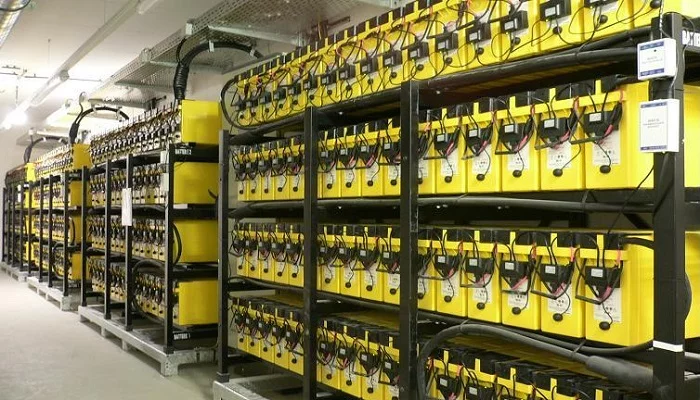
Answer First
A 12 V UPS bank is sized by two numbers: how many parallel strings you install, and how many Ah each string delivers at end of discharge. The 6-EVF-60 12V60Ah answers both with published figures: a 6-cell 12 V block rated 60 Ah at C3, 258×170×160 mm, 18.8 ± 0.2 kg, float at 13.5 V and equalise at 14.1 V per unit.
The number that governs runtime is the cutoff: the published 1.75 V per cell means a six-cell string ends at 1.75 × 6 = 10.5 V. Quoting runtime against a generic 13.6 V floor overstates usable energy by roughly 23 %, the most common cause of a UPS that trips its load earlier than promised. For a 6 kVA unit at 4.5 kW bus load, two 6-EVF-60 12V60Ah strings give 120 Ah nominal, 96 Ah usable at 80 % DoD, and 96 × 10.5 = 1,008 Wh per pair — about 12 minutes at that load. If the specification calls for 30 minutes, the bank must grow and the arithmetic redone.
Key Takeaways
- 6-EVF-60 12V60Ah is a 6-cell 12 V block rated 60 Ah at C3, published at 258×170×160 mm, 18.8 ± 0.2 kg.
- Float 13.5 V and equalise 14.1 V are the published setpoints — 2.25 V/cell and 2.35 V/cell across six cells.
- The published cutoff is 1.75 V/cell = 10.5 V per string. Runtime quoted at 13.6 V overstates usable energy by about 23 %.
- Two parallel strings yield 120 Ah nominal, 96 Ah usable at 80 % DoD = 1,008 Wh — the starting point for 6 kVA installations.
- Maximum charge current is 12.0 A per block, so a 48 A charger suits four parallel strings.
- Cycle life is 350–600 at 50–80 % DoD and design life 2–5 years; a bank at 25 °C outlives the same part at 35 °C.
§1 — 6-EVF-60 Quick Specifications
All values below are published by CHISEN for the 6-EVF-60 12V60Ah; nothing is estimated or carried over.
| Parameter | Value | Source |
|---|---|---|
| Nominal voltage / capacity | 12 V / 60 Ah | Model page |
| Capacity test rate | C3 | Model page |
| Dimensions (L×W×H) | 258×170×160 mm | Model page |
| Weight | 18.8 ± 0.2 kg | Model page |
| Terminal | φ14-M6 | Model page |
| Float / equalise voltage | 13.5 V / 14.1 V | Model page |
| Cycle life | 350–600 cycles | Model page |
| Maximum charge current | 12.0 A | Model page |
| End-of-discharge cutoff | 1.75 V/cell | Model page |
| Self-discharge / working temp | ≤3 %/month @25 °C / −15…50 °C | Model page |
| Design life | 2–5 years | Model page |
| Cutoff per string | 10.5 V | Arithmetic (1.75 V × 6 cells) |
A 12 V VRLA block is six 2 V cells in series with an internal balancing network. A charger set to the published 13.5 V float keeps all six cells balanced; a charger set to 13.8 V pushes the block to 2.30 V/cell and raises float current without adding usable capacity. See also the CHISEN EVF index and 6-EVF-50 12V50Ah.
§2 — The Pain: Runtime Numbers That Do Not Survive Commissioning
Most UPS battery disputes are arithmetic disputes, beginning in the tender document, where runtime is quoted at a nominal end voltage no commissioning engineer would accept. Take the shortcut: 60 Ah at 13.6 V gives 816 Wh per string, so two strings read as 1,632 Wh. Apply the published cutoff for the 6-EVF-60 12V60Ah instead: 1.75 V/cell × 6 cells = 10.5 V at the string terminal, so two strings deliver 2 × 60 Ah × 10.5 V = 1,260 Wh — 372 Wh less, a 23 % overstatement before any rate, temperature or age correction.
Three further errors stack on top. The C3 rate is quoted as the deliverable: published capacity is 60 Ah at C3, a three-hour discharge, so a UPS that empties the bank in ten minutes gets less than the rated Ah. End voltage is confused with trigger voltage: the inverter trips at its own transfer point, commonly below 1.75 V/cell, so setting the threshold at the published cutoff discharges the battery past its rating limit. Temperature is ignored: a room at 35 °C sits above the 25 °C self-discharge reference, and below 10 °C equalisation must be extended to reach the 14.1 V setpoint. For an importer the damage is direct: a bank specified for 30 minutes that delivers 17 causes a return shipment and a dispute.
§3 — The Choice: String Configuration and the Number That Governs
Once the errors are removed, the decision is not “which battery” but how many strings, at what DoD, with what charger.
String count and bus voltage. A 12 V block cannot be placed in series to build a 24 V bus; the series unit is a 2 V cell. Every additional block must therefore go in parallel, and parallel strings need matched cell counts, matched ages and equal state of charge — if one string has three blocks and another four, the shorter governs.
The arithmetic: two strings give 120 Ah nominal; at 80 % DoD that is 120 × 0.80 = 96 Ah usable. At the published cutoff of 1.75 V × 6 = 10.5 V, usable energy is 96 Ah × 10.5 V = 1,008 Wh; the same bank quoted at 13.6 V reads 1,306 Wh, the overstatement shown. At a 4.5 kW load and 0.9 inverter efficiency the bus carries 5,000 W, so 1,008 Wh ÷ 5,000 W = 0.202 h ≈ 12.1 minutes of runtime. String count alone buys no runtime: three strings at 50 % DoD deliver 90 Ah, fewer than two strings at 80 %.
Choosing the 6-EVF-60 12V60Ah over another capacity in the same range is a decision about rack geometry and load profile, not chemistry: float, equalise, cutoff, self-discharge and working temperature are identical throughout. The block is documented on the 6-EVF-60 12V60Ah page.
§4 — The Framework: A Five-Step Sizing Method That Survives Audit
This is the sequence CHISEN applies to incoming sizing requests, so an installer or OEM engineer can reproduce the answer and hand it to an auditor.
Step 1 — Establish the DC bus load, not the UPS rating. Nameplate kVA is AC output; the battery carries DC. Start from inverter input power at full rated load and divide by inverter efficiency, typically 0.90–0.95: a 6 kVA unit at 0.8 power factor carries 6 ÷ 0.8 = 7.5 kVA real load, roughly 6.9 kW at the bus — where factor-of-1.2 errors enter tenders.
Step 2 — Fix the usable end voltage and declare the DoD. Use the published cutoff of 1.75 V/cell, giving 10.5 V per string, then apply the inverter’s transfer threshold if higher; never use the float voltage as the discharge floor. Published cycle life applies at 50–80 % DoD, so state the design point: 50 % with a generator starting within 30 seconds, 80 % where a long start delay pushes expected life toward 350 cycles.
Step 4 — Compute the bank, then check geometry. Required Ah at the bus = (bus W × runtime h) ÷ (usable V × DoD). For 5,000 W, 0.5 h, 10.5 V and 0.5 DoD: 2,500 Wh ÷ (10.5 × 0.5) = 476 Ah; 476 ÷ 60 Ah per 6-EVF-60 12V60Ah = 7.94 blocks, so 8 blocks — typically 2 strings of 4 or 4 strings of 2. Check the shelf: four blocks occupy 1,032 mm and put 75.2 kg on it, so below a 76 kg shelf rating the string must be split, each shelf able to carry the fault current of one short-circuited cell.
Step 5 — Validate charger and thermal envelope. Charge current should sit between 10 % and 12 % of bank Ah, so a 480 Ah bank wants 48–57.6 A; at the published 12.0 A per-block maximum, four parallel strings is the ceiling for a 48 A charger. Below 10 °C, extend equalisation to reach 14.1 V; above 30 °C, check float life against the 25 °C reference. Where a value is not published — internal resistance, equalise duration, life curve — request it from the factory.
§5 — 6-EVF-60 Against Its Siblings in the 6-EVF / 6-DMF Range
The table below lists published values for the 6-EVF-60 12V60Ah and neighbouring models.
| Model | Capacity | L×W×H mm | Weight | Terminal | Charge current |
|---|---|---|---|---|---|
| 6-EVF-60 | 60 Ah (C3) | 258×170×160 | 18.8 ± 0.2 kg | φ14-M6 | 12.0 A |
| 6-EVF-80 | 80 Ah (C3) | 259×170×218 | 25.7 ± 0.2 kg | φ16-M6 | 16.0 A |
Source: CHISEN Model page for each model. All models here are 12 V with 13.5 V float, 14.1 V equalise, 1.75 V/cell cutoff, ≤3 %/month self-discharge at 25 °C, a −15…50 °C working range, 350–600 cycle life and 2–5 years of design life (not published for 6-DMF-52).
Three practical differences decide which model goes into which rack.
§6 — The Trust: How CHISEN Supports the 6-EVF-60 12V60Ah in the Field
A battery that arrives with published numbers still needs a reachable supplier. CHISEN backs the 6-EVF-60 12V60Ah with 8 production bases, 70 million kVAh annual capacity and certifications covering CE, ISO 9001, ISO 14001, UL and IEC. The range behind the 6-EVF number includes flooded tubular OPzS2, gel tubular OPzV2 and the 12 V VRLA lines (6-DZF, 6-DMF, 6-EVF), produced in Hangzhou, China and shipped to importers, distributors and OEM builders across Europe, North America, the Middle East, Africa and Asia-Pacific.
Incoming inspection and commissioning. Check case dimensions against 258×170×160 mm and weight against 18.8 ± 0.2 kg on a calibrated scale; a block outside that band is a transit-damage question, not a sizing question. Confirm the φ14-M6 marking and record the manufacturing date, since the published self-discharge of ≤3 %/month @25 °C and the 2–5 year design life both run from it. Measure open-circuit voltage for every block before and after first charge: a charged 6-EVF-60 12V60Ah block at rest should read roughly 12.6–12.8 V (2.10–2.13 V/cell), and a lower reading points to a damaged unit. After the first equalise at the published 14.1 V, block-to-block spread should narrow — if not, re-match the string rather than ship it.
String matching. Parallel strings must be of equal age and state of charge. Mixing a fresh 6-EVF-60 12V60Ah block with one in service for a year causes current to redistribute toward the weaker unit, which then runs at the edge of its cutoff on every discharge. Replacing blocks singly inside a string is the most common cause of early bank failure, and is avoidable at installation.
§7 — FAQ
Q1: What are the published nominal voltage and capacity of the 6-EVF-60? 12 V and 60 Ah at the C3 rate, per the CHISEN Model page; six 2 V cells in series.
Q2: What float and equalise setpoints does the manufacturer publish for the 6-EVF-60? Float 13.5 V and equalise 14.1 V per block — 2.25 V/cell and 2.35 V/cell.
Q3: What are the case dimensions and weight of the 6-EVF-60? 258×170×160 mm and 18.8 ± 0.2 kg; four blocks occupy 1,032 mm of shelf and 75.2 kg of load.
Q4: What terminal type and torque does the 6-EVF-60 use? φ14-M6 terminals. The busbar torque figure is not published and should be requested.
Q5: How many cells does a 12V60Ah string contain and what bus voltage does it give? Six cells in series. The published 1.75 V/cell cutoff corresponds to 10.5 V at the string terminal.
Q6: What is the published design float life of the 6-EVF-60 and at what temperature? Design life 2–5 years, working range −15…50 °C. Self-discharge is quoted at ≤3 %/month @25 °C, so 25 °C is the reference; the temperature-corrected life curve is not published.
Q7: How should an importer verify the 6-EVF-60 on delivery? Check dimensions against 258×170×160 mm, weigh against 18.8 ± 0.2 kg, confirm the φ14-M6 marking, record the manufacturing date, and measure open-circuit voltage of each block before first charge (12.6–12.8 V).
Q8: Which certifications does the CHISEN factory behind the 6-EVF-60 hold? CE, ISO 9001, ISO 14001, UL and IEC, with 8 production bases and 70 million kVAh annual capacity across flooded tubular OPzS2, gel tubular OPzV2 and 12 V VRLA.
Q9: How do I request a quotation or samples for the 6-EVF-60? Contact the CHISEN export desk at sales@chisen.cn or jack@chisen.cn, or WhatsApp +86 131 6622 6999; the model page carries the full published data.
Expert Summary
The 6-EVF-60 12V60Ah is a 6-cell 12 V VRLA block rated 60 Ah at C3, published at 258×170×160 mm, 18.8 ± 0.2 kg, φ14-M6 terminals, 13.5 V float, 14.1 V equalise, 12.0 A maximum charge current, 1.75 V/cell cutoff, ≤3 %/month self-discharge at 25 °C, −15…50 °C working range, 350–600 cycles at 50–80 % DoD and 2–5 years of design life. Its published 10.5 V string cutoff, not a nominal 13.6 V, governs runtime: a two-string bank at 80 % DoD delivers 96 Ah and 1,008 Wh, a 23 % honest reduction against the common shortcut, and string count buys cycle life before it buys minutes. Five steps — bus load from kVA and efficiency, the published end voltage, the declared DoD, Ah calculation validated against shelf length and load, then charger sizing within the 12.0 A per-block ceiling — produce a bank an auditor can reproduce. Behind the specification sit 8 production bases, 70 million kVAh of annual capacity and CE, ISO 9001, ISO 14001, UL and IEC certification. Values that remain unpublished — internal resistance, equalise duration, life curve, terminal torque — should be requested from the factory, and every string matched for age and charge before service.
Contact CHISEN — 24-Hour Response
- Sales enquiries: sales@chisen.cn
- Export desk: jack@chisen.cn
- WhatsApp: +86 131 6622 6999
- Website: www.chisen.cn
- Model page: https://www.chisen.cn/en/6-EVF-60/12V60Ah.html
Related CHISEN Buyer Guides
- 12V 100Ah LiFePO4 vs Lead Acid Battery: Cycle Life, Published 6-EVF-100 Specs and Where Ea
- 2V 1000Ah Battery Buyer Guide 2026: Telecom, UPS, and Solar Storage Sourcing
- 6-EVF-120 12V120Ah AGM VRLA Battery for UPS: Specs, Float Charging
- 6-EVF-150 12V150Ah AGM Battery: Published Specs, Parallel String Sizing and EVF Range Comp
- OPzS2-100 2V100Ah Flooded Tubular Battery: Published Specs, 48 V String Sizing and Sibling
