Answer First
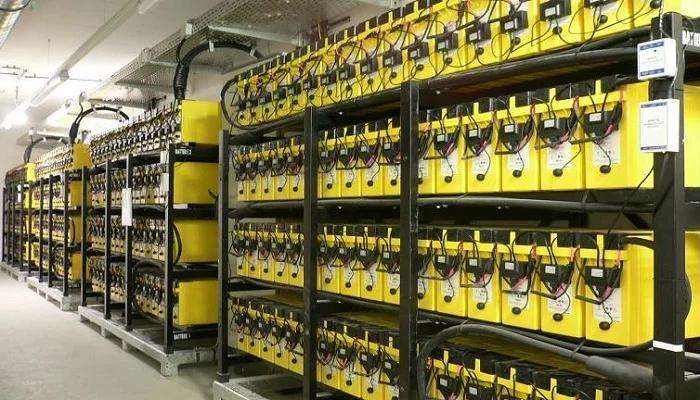
The 6-EVF-50 is a 12 V 50Ah battery built for standby duty in data centres: 12 V nominal, 50 Ah at the C3 rate, 230×140×180 mm case, 15.25 ± 0.2 kg, φ11.8-M6 terminals, float 13.5 V and equalise 14.1 V. A single 12V 50Ah battery carries 600 Wh of nominal energy (50 Ah × 12 V = 600 Wh) and weighs 15.25 kg, so it delivers about 39.3 Wh/kg of nameplate energy (600 Wh ÷ 15.25 kg = 39.3 Wh/kg). Four blocks in series give the 48 V bus most mid-size UPS cabinets are built around, with a float voltage of 54.0 V (4 × 13.5 V = 54.0 V) and an equalise voltage of 56.4 V (4 × 14.1 V = 56.4 V).
For an importer or OEM buyer, the decision is arithmetic before it is chemistry: how many strings, how many blocks per string, how much runtime at the real load, and how much float headroom the charger leaves. This article works through those numbers using only the values published for the 6-EVF-50 on this model page, and it states plainly where a figure is derived rather than published.
Key Takeaways
- Published rating: 12 V nominal, 50 Ah at C3, 230×140×180 mm, 15.25 ± 0.2 kg, φ11.8-M6 terminal, charge current 10.0 A.
- Charge discipline: float 13.5 V, equalise 14.1 V, discharge cutoff 1.75 V/cell, self-discharge ≤3 %/month at 25 °C.
- String arithmetic: 6 cells × 2 V = 12 V nominal; a 48 V bus needs 4 blocks in series, 54.0 V float and 56.4 V equalise.
- Energy check: 50 Ah × 12 V = 600 Wh per block; 39.3 Wh/kg nameplate; 4 blocks × 600 Wh = 2,400 Wh per string at 48 V.
- Parallel capacity: N strings in parallel give N × 50 Ah — two strings give 100 Ah at 48 V, 4,800 Wh total.
- Service envelope: working temperature −15…50 °C, design life 2–5 years under float service, cycle life 350–600 at 50–80 % depth of discharge.
§1 — 6-EVF-50 Quick Specifications
Every figure below is taken from the published 6-EVF-50 model page for the 12 V VRLA AGM type. Where the factory has not published a value, the row says so rather than estimating.
| Parameter | Value | Source |
|---|---|---|
| Nominal voltage | 12 V | Model page |
| Capacity | 50 Ah | Model page |
| Capacity rate | C3 | Model page |
| Dimensions L×W×H | 230×140×180 mm | Model page |
| Weight | 15.25 ± 0.2 kg | Model page |
| Terminal | φ11.8-M6 | Model page |
| Float voltage | 13.5 V (2.25 V/cell) | Model page |
| Equalise voltage | 14.1 V (2.35 V/cell) | Model page |
| Cycle life | 350–600 cycles | Model page |
| Maximum charge current | 10.0 A | Model page |
| Discharge cutoff | 1.75 V/cell | Model page |
| Self-discharge | ≤3 %/month at 25 °C | Model page |
| Working temperature | −15…50 °C | Model page |
| Design life | 2–5 years | Model page |
| Cell count per block | 6 cells | Arithmetic (12 V ÷ 2 V per cell) |
| Nominal energy | 600 Wh | Arithmetic (50 Ah × 12 V) |
| Energy density | 39.3 Wh/kg | Arithmetic (600 Wh ÷ 15.25 kg) |
| Charge current in C-rate | 0.2 C10 | Arithmetic (10.0 A ÷ 50 Ah) |
| Bus string configuration | 4 blocks = 48 V | Arithmetic (48 V ÷ 12 V per block) |
| Float/equalise at 48 V | 54.0 V / 56.4 V | Arithmetic (4 × 13.5 V; 4 × 14.1 V) |
| Case colour, vent, torque | Not published | To be requested from the factory |
The remaining 12 V VRLA values the factory publishes for this block are the series defaults: float 13.5 V, equalise 14.1 V, cutoff 1.75 V/cell, self-discharge ≤3 %/month at 25 °C, working temperature −15…50 °C and cycle life 350–600 at 50–80 % depth of discharge. The wider AGM programme is listed on the full product range if you need the neighbouring sizes for string design.
§2 — The Pain: Why Data Centre Standby Specs Fail on Paper
The failure mode in data centre standby power is rarely the battery chemistry. It is the gap between the number written on the quotation and the behaviour of the block in the cabinet. Most datasheet-driven purchasing decisions reduce a 12V 50Ah battery to two numbers — 12 V and 50 Ah — and stop there. Four things get lost at that point.
First, the capacity rate is not the same number for every block. The 6-EVF-50 is published at C3: 50 Ah delivered over a three-hour discharge. A data centre UPS rarely draws its full load for three hours; the characteristic event is a generator start that ramps the load hard for ten to twenty minutes and then settles. Energy delivered over that short, high-rate window is not the C3 figure, and no short-rate curve is published for this model. The published cutoff of 1.75 V/cell gives the boundary — 6 cells × 1.75 V = 10.5 V at the end of discharge for one block — but the shortfall between nameplate 600 Wh and delivered energy at a high rate is exactly the number a buyer cannot get from a published table. Ask the factory for the short-rate curve, or specify a larger string so the margin covers it.
Second, the usable voltage window in a 48 V bus is narrow. Four blocks in series float at 54.0 V and equalise at 56.4 V, and the string hits its 42.0 V cutoff (4 × 10.5 V) at the end of discharge. Charger tolerance, cable drop and cell imbalance all consume part of that window. A string assembled from mixed production lots with different capacities splits the current unequally during discharge, and the weakest cells reach 1.75 V/cell while the rest of the string still shows voltage on the meter. That is why a 12V 50Ah battery bought as a single lot matters more here than in almost any other application.
Third, nameplate energy is not cabinet energy. 600 Wh per block (50 Ah × 12 V) is arithmetic on the nameplate. Real delivered energy is lower because of inverter conversion loss, the depth of discharge you allow in service, cell temperature and ageing. Every bank sizing model published for data centres applies a derating factor for exactly these reasons. If the quotation you are comparing shows 600 Wh and no derating, the comparison is not yet a comparison.
Fourth, the documentation gap. Torque figures, case colour, vent type, cabinet clearance and the short-rate curve are simply not published for this model. They have to be requested from the factory before the order is placed, not after the container arrives.
§3 — The Choice: Sizing a 48 V String from a 12V 50Ah Battery
Once the pain is named, the choice becomes a short list of decisions. Each one can be made with published numbers.
Bus voltage and blocks per string. A 48 V bus is 4 blocks in series: 48 V ÷ 12 V = 4. Each block floats at 13.5 V, so the string floats at 54.0 V and equalises at 56.4 V. A 24 V bus uses two blocks (24 V ÷ 12 V = 2), floating at 27.0 V and equalising at 28.2 V. Choose the string that matches the UPS input window published by your UPS supplier; do not mix.
Strings and capacity. Each string carries 50 Ah at 48 V. Two strings in parallel give 100 Ah and 4,800 Wh of nameplate energy (2 × 50 Ah = 100 Ah; 2 × 2,400 Wh = 4,800 Wh); four strings give 200 Ah and 9,600 Wh. Parallel strings are the standard way to add runtime without changing the UPS.
Runtime. Work from energy, not from Ah. One string of four blocks holds 4 × 600 Wh = 2,400 Wh. Against a 3 kVA UPS at full load (3,000 W), nameplate runtime is 2,400 Wh ÷ 3,000 W = 0.8 h = 48 minutes. A single block is 600 Wh ÷ 3,000 W = 0.2 h = 12 minutes. Both figures are nameplate-only; apply your own derating factor for inverter efficiency and allowable depth of discharge before you commit to a string count.
Charger. The published maximum charge current for the 6-EVF-50 is 10.0 A, so a four-block string draws up to 4 × 10.0 A = 40 A from the charger. Size the charger on that number, and keep the float/equalise setpoints at 13.5 V and 14.1 V per block as published — a charger set to a generic 13.8 V will sit the string at 55.2 V float (4 × 13.8 V) and quietly push the cells past their published equalise point.
Which block size. If the cabinet footprint does not allow a second string, the neighbouring sizes change the answer rather than the arithmetic: the 6-EVF-60 publishes 60 Ah at 18.8 ± 0.2 kg and the 6-DMF-45 publishes 45 Ah at 12.3 ± 0.2 kg. Specifications for the neighbouring 60 Ah block are on the sibling model page.
§4 — The Framework: A Five-Step Acceptance Test for Any Data Centre Quotation
Use this sequence before you sign. Each step uses only published numbers, so any answer that requires a guess is a gap you close with the factory before the order ships.
Step 1 — Confirm the published row set. For the 6-EVF-50 the model page publishes voltage, Ah at C3, dimensions, weight with tolerance, terminal, float and equalise setpoints, cycle life, maximum charge current, cutoff, self-discharge, working temperature and design life. If a quotation sheet omits the rate (C3 here), the terminal (φ11.8-M6), or the cutoff (1.75 V/cell), you cannot verify it against anything. Ask for the missing rows in writing.
Step 2 — Run the string arithmetic against the UPS input window. Bus voltage ÷ 12 V = blocks per string. For a 48 V bus: 48 ÷ 12 = 4 blocks, floating at 4 × 13.5 V = 54.0 V, equalising at 4 × 14.1 V = 56.4 V, and stopping at 4 × 6 × 1.75 V = 42.0 V. Compare those three numbers with the input window your UPS supplier publishes. If the equalise point sits above the UPS maximum, the charger setpoint must be changed or the string reconfigured — this is a design decision, not a rounding question.
Step 3 — Compute runtime from energy, then derate. Energy per block = Ah × 12 V. A 12V 50Ah battery gives 50 Ah × 12 V = 600 Wh; a four-block 48 V string gives 2,400 Wh. Runtime = string energy ÷ real UPS load. At a 1.5 kW load: 2,400 Wh ÷ 1,500 W = 1.6 h nameplate. Then apply your derating factor for inverter efficiency, temperature and ageing, and state the factor in the quotation so the comparison is like-for-like.
Step 4 — Size the charger and the temperature compensation. Charge current ceiling per block is 10.0 A; a four-block string therefore draws up to 40 A. Set float to 13.5 V and equalise to 14.1 V, and confirm the charger offers temperature compensation across the −15…50 °C working range the model page publishes, because the float setting that is right at 25 °C is wrong at either end of that range.
Step 5 — Close the documentation and lot questions. Certificate set, terminal torque, case colour and vent type are not published and must be requested from the factory. Request one production lot for a string, and check the delivered set against the nameplate before it enters the cabinet. A string assembled across lots is where imbalance starts.
Step 6 — Confirm the ship path and the spares policy. Container loading, export packing and the recommended spare ratio are commercial decisions; ask for them in the same quotation so the landed cost of the 12V 50Ah battery is comparable across suppliers.
§5 — 6-EVF-50 Against the Neighbouring 12 V VRLA Sizes
The table below uses published values only, with the energy column calculated from published Ah and published weight.
| Model | Capacity | Rate | L×W×H mm | Weight | Terminal | Float | Equalise | Charge current | Cutoff | Design life | Wh per block (Arithmetic) | Wh/kg (Arithmetic) |
|---|---|---|---|---|---|---|---|---|---|---|---|---|
| 6-DMF-38 | 38 Ah | C3 | 224×106×175 | 10.45 ± 0.2 kg | φ9.8-M5 | 13.5 V | 14.1 V | 7.6 A | 1.75 V/cell | not published | 456 Wh | 43.6 |
| 6-DMF-45 | 45 Ah | C3 | 224×121×175 | 12.3 ± 0.2 kg | φ11.8-M5 | 13.5 V | 14.1 V | 9.0 A | 1.75 V/cell | 2–5 years | 540 Wh | 43.9 |
| 6-DMF-52 | 52 Ah | C3 | 224×135×175 | 13.7 ± 0.2 kg | φ11.8-M6 | 13.5 V | 14.1 V | 10.4 A | 1.75 V/cell | not published | 624 Wh | 45.5 |
| 6-EVF-50 | 50 Ah | C3 | 230×140×180 | 15.25 ± 0.2 kg | φ11.8-M6 | 13.5 V | 14.1 V | 10.0 A | 1.75 V/cell | 2–5 years | 600 Wh | 39.3 |
| 6-EVF-60 | 60 Ah | C3 | 258×170×160 | 18.8 ± 0.2 kg | φ14-M6 | 13.5 V | 14.1 V | 12.0 A | 1.75 V/cell | 2–5 years | 720 Wh | 38.3 |
| 6-EVF-80 | 80 Ah | C3 | 259×170×218 | 25.7 ± 0.2 kg | φ16-M6 | 13.5 V | 14.1 V | 16.0 A | 1.75 V/cell | 2–5 years | 960 Wh | 37.4 |
Three conclusions follow directly from those rows. The charge setpoints, cutoff and self-discharge are identical across the range, so a mixed-size string built on this platform does not create a voltage or cutoff mismatch — only a capacity and current mismatch. The published charge current tracks capacity almost linearly: 10.0 A for the 6-EVF-50 against 12.0 A for the 6-EVF-60 and 16.0 A for the 6-EVF-80, so charger sizing carries over between sizes without re-deriving it. And the energy density falls as the case grows: 45.5 Wh/kg for the 6-DMF-52 down to 37.4 Wh/kg for the 6-EVF-80, because the larger EVF cases add height and walls rather than proportionally more active material.
For a specific cabinet decision, compare the string totals rather than the block totals. A four-block 48 V string built on the 6-EVF-50 gives 4 × 600 Wh = 2,400 Wh; the same string built on the 6-DMF-45 gives 4 × 540 Wh = 2,160 Wh; on the 6-DMF-52 it gives 4 × 624 Wh = 2,496 Wh. The 6-DMF-52 delivers 24 Wh more per string and sits in a case 1.55 kg lighter, and it uses the same φ11.8-M6 terminal as the 6-EVF-50 — but its design life is not published, while the 6-EVF-50 carries a published 2–5 years. That single missing row is often what decides the specification.
§6 — The Trust: Factory Capacity, Certification and Delivery
The 6-EVF-50 comes from a manufacturer operating 8 production bases with an annual capacity of 70 million kVAh, certified to CE, ISO 9001, ISO 14001, UL and IEC. The programme behind this block covers flooded tubular OPzS2, gel tubular OPzV2 and the 12 V VRLA series in 6-DZF, 6-DMF and 6-EVF sizes — which is why published setpoints, cutoff and self-discharge values stay consistent across the sizes in the comparison table above.
For data centre buyers the useful part of that is scale plus traceability: capacity of this order is what makes single-lot string supply and a documented spare-parts policy realistic rather than aspirational. The published 15.25 ± 0.2 kg tolerance on the 6-EVF-50 is a concrete example of the kind of tolerance a buyer can hold the factory to at goods-in.
Delivery runs through the Chinese export ports of Shanghai, Ningbo and Shenzhen, and the factory’s export desk serves distributors and installers in India, Nigeria, Kenya, Vietnam, the Philippines, Brazil, Egypt, Mexico and Pakistan, with container shipments moving on to Lagos, Mombasa, Karachi, Jebel Ali and Rotterdam. Products are loaded as a labelled production lot with the model number, voltage, Ah rate and date of manufacture visible on each block, so a receiving team can record what actually arrived rather than what the packing list claims.
Verifying a delivery. Check the label against the published row set for the 6-EVF-50: 12 V, 50 Ah at C3, 230×140×180 mm, 15.25 ± 0.2 kg, φ11.8-M6 terminal. Weigh a sample of blocks; measure a sample of cases; compare terminal type against the specification. Confirm that the lot numbers on all blocks in a string match, and that the shipment carries the certificate documents for the certification set above. If anything in the shipment disagrees with the published specification, photograph it before the containers are unloaded and raise it with the export desk the same day — that is the only window in which a mixed lot or a wrong version can be corrected without a shipment re-routing.
§7 — FAQ
Q1: What are the published nominal voltage and capacity of the 6-EVF-50? 12 V nominal and 50 Ah at the C3 rate, from the Model page. That is 600 Wh of nameplate energy per block (50 Ah × 12 V = 600 Wh, Arithmetic) and about 39.3 Wh/kg (600 Wh ÷ 15.25 kg = 39.3 Wh/kg, Arithmetic).
Q2: What float and equalise setpoints does the manufacturer publish for the 6-EVF-50? Float 13.5 V and equalise 14.1 V per block, which is 2.25 V/cell and 2.35 V/cell across the six cells of the block (Model page). In a four-block 48 V string that is 54.0 V float and 56.4 V equalise (4 × 13.5 V and 4 × 14.1 V, Arithmetic).
Q3: What is the maximum charging current for the 6-EVF-50? 10.0 A per block (Model page), which is 0.2 C10 (10.0 A ÷ 50 Ah = 0.2 C10, Arithmetic). A four-block 48 V string therefore draws up to 40 A from the charger (4 × 10.0 A).
Q4: What are the case dimensions and weight of the 6-EVF-50? 230×140×180 mm and 15.25 ± 0.2 kg (Model page). Rack clearance and shipping weight per pallet should be calculated on those figures before the cabinet layout is signed off.
Q5: What terminal type and torque does the 6-EVF-50 use? Terminal type is published as φ11.8-M6 (Model page). Torque is not published and should be requested from the factory; it is also worth confirming against the 6-DMF-52, which uses the same φ11.8-M6 terminal (Model page).
Q6: How many cells does a 12V 50Ah string contain and what bus voltage does it give? Six 2 V cells per block (12 V ÷ 2 V per cell = 6, Arithmetic), so a single block is a 12 V unit. A 48 V bus takes four blocks in series (48 V ÷ 12 V = 4, Arithmetic), giving 4 × 50 Ah = 200 Ah per string and 4 × 600 Wh = 2,400 Wh of nameplate energy.
Q7: What is the published design float life of the 6-EVF-50 and at what temperature? Design life is published as 2–5 years under float service (Model page), with cycle life of 350–600 cycles at 50–80 % depth of discharge. The 25 °C reference temperature is the published basis for the ≤3 %/month self-discharge figure (Model page); the model page does not publish a separate float-life curve versus temperature, so ask the factory for that curve if your cabinet runs hot.
Q8: How should an importer verify the 6-EVF-50 on delivery? Check label, dimensions, weight and terminal against the published values, weigh and measure a sample of blocks, confirm one production lot across a string, and verify the certificate documents before unloading. Photograph any discrepancy before the containers are opened and raise it with the export desk the same day.
Q9: Which certifications does the CHISEN factory behind the 6-EVF-50 hold? CE, ISO 9001, ISO 14001, UL and IEC (factory certificate set), produced across 8 production bases with an annual capacity of 70 million kVAh.
Q10: How do I request a quotation or samples for the 6-EVF-50? Send the model, the bus voltage, the string and parallel-string configuration, the load in watts and the required runtime to the export desk, and ask at the same time for the short-rate discharge curve, the terminal torque figure, the float-life-versus-temperature curve and the recommended spare ratio. Samples can be arranged with the same request.
Expert Summary
The 6-EVF-50 is a 12 V 50Ah battery with a published 50 Ah at C3, a 230×140×180 mm case at 15.25 ± 0.2 kg, φ11.8-M6 terminals, float 13.5 V, equalise 14.1 V, a 10.0 A maximum charge current, a 1.75 V/cell cutoff, ≤3 %/month self-discharge at 25 °C, a −15…50 °C working range and a published 2–5 year design life. On those figures one block carries 600 Wh (50 Ah × 12 V) at 39.3 Wh/kg (600 Wh ÷ 15.25 kg), a four-block 48 V string floats at 54.0 V and equalises at 56.4 V while holding 2,400 Wh, and two strings in parallel double the capacity to 100 Ah and 4,800 Wh. Against a 3 kVA UPS at full load the nameplate runtime of one string is 48 minutes (2,400 Wh ÷ 3,000 W = 0.8 h) and a single block is 12 minutes (600 Wh ÷ 3,000 W = 0.2 h), before any derating for inverter efficiency, temperature and ageing. The decisive gaps for a data centre buyer are the short-rate discharge curve, the terminal torque and the float-life-versus-temperature curve, none of which are published for this model; request them with the quotation. Within the 12 V VRLA programme the 6-DMF-52 publishes slightly more energy per string (624 Wh per block) at 1.55 kg less weight on the same terminal, while the 6-EVF-60 and 6-EVF-80 carry published design lives and scale to 720 Wh and 960 Wh per block at 38.3 Wh/kg and 37.4 Wh/kg. Behind all of it sits a manufacturer with 8 production bases, 70 million kVAh of annual capacity and CE, ISO 9001, ISO 14001, UL and IEC certification, shipping from Shanghai, Ningbo and Shenzhen to distributors and installers across India, Nigeria, Kenya, Vietnam, the Philippines, Brazil, Egypt, Mexico and Pakistan.
Contact CHISEN — 24-Hour Response
CHISEN Battery, Hangzhou, China. Export desk replies within 24 hours on every enquiry.
- Email: sales@chisen.cn
- Email: jack@chisen.cn
- WhatsApp: +86 131 6622 6999
- Website: www.chisen.cn
- Model page: https://www.chisen.cn/en/6-EVF-50/12V50Ah.html
- Series page: https://www.chisen.cn/en/LeadacidBattery/EVF.html
Related CHISEN Buyer Guides
- 2V 500Ah Battery: Industrial Buyer’s Guide for Telecom, UPS, and Solar Backup System
- 6-EVF-120 12V120Ah AGM VRLA Battery for UPS: Specs, Float Charging
- OPzV2-1200 2V1200Ah Tubular Gel Battery for Data Center and UPS Backup
- OPzV2-150 2V150Ah Tubular Gel Battery — Telecom / UPS / Solar Backup Buyer’s Guide 2
- OPzV2-200 2V200Ah Tubular Gel Battery: Industrial Buyer’s Guide for 48V Telecom, Sol
