Answer First
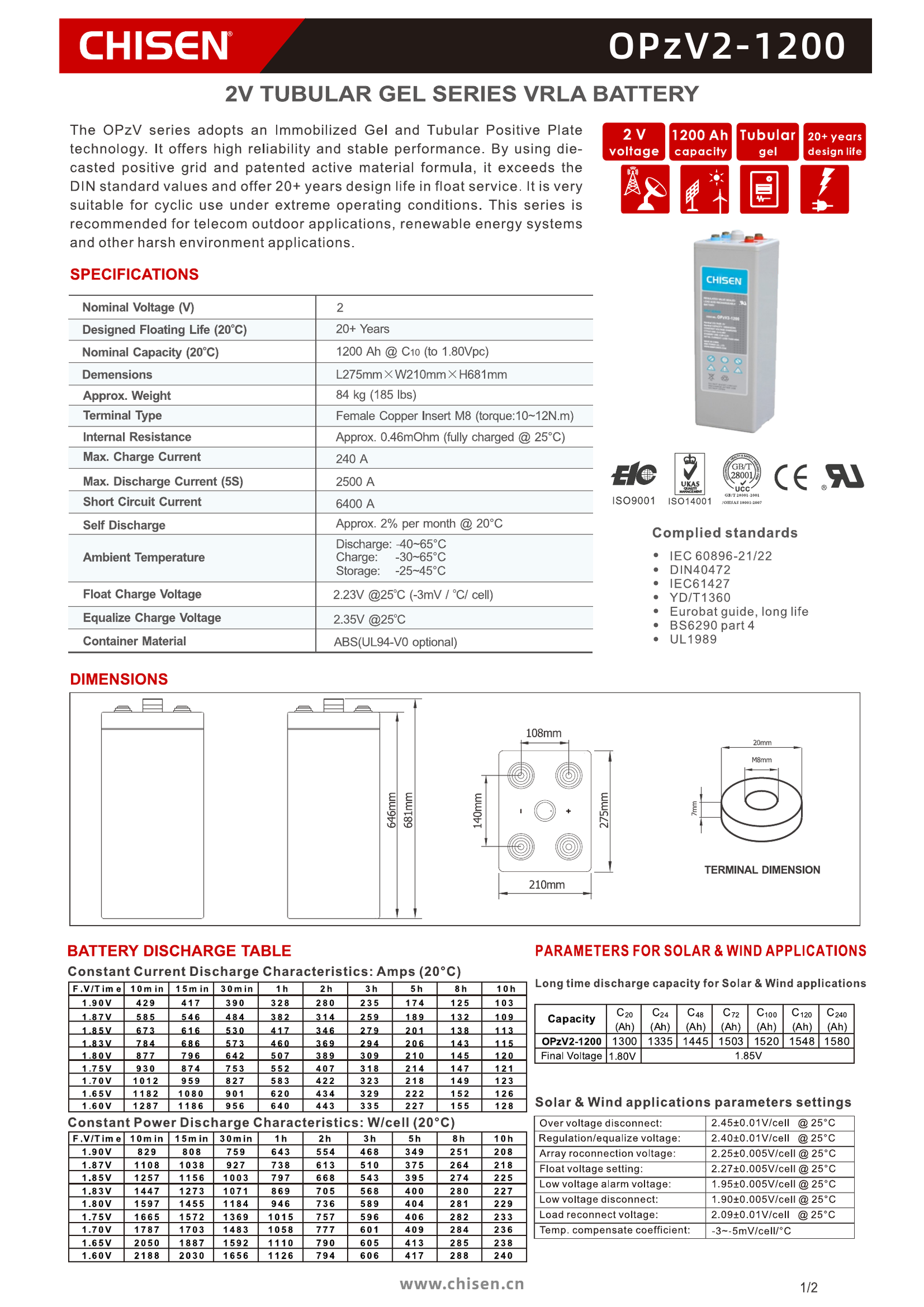
The OPzV2-1200 2V1200Ah is a 2 V, 1200 Ah gel tubular cell built for solar and off-grid energy storage systems. Published figures from the factory datasheet give a nominal capacity of 1200 Ah at the C10 rate to an end-point voltage of 1.80 Vpc, a case size of 275×210×681 mm, a weight of 84 kg, a maximum charging current of 240 A, a float setpoint of 2.23 V at 25 °C and an equalise setpoint of 2.35 V at 25 °C. The design float life is 20+ years at 20 °C, and the internal resistance reference is approximately 0.46 mΩ at 25 °C. All of these numbers come from the datasheet and are repeated in full on this model page.
For solar and off-grid duty the two setpoints that matter most are the solar-adjusted ones, which the factory documents as 2.27 ± 0.005 V per cell at 25 °C for float and 2.40 ± 0.01 V per cell at 25 °C for equalise, with temperature compensation of −3 mV/°C/cell applied on top of the standard curve.
In a bank, one 2 V cell gives a 48 V bus when 24 cells are wired in series. Six OPzV2-1200 units in series therefore deliver a 48 V, 1200 Ah string, and the same six-cell series string repeated in parallel scales the capacity linearly without changing the bus voltage. Every calculated figure in this article is shown as a full equation rather than as a headline number.
Key Takeaways
- Published, not estimated: the OPzV2-1200 2V1200Ah is specified at 2 V nominal and 1200 Ah at C10 to 1.80 Vpc, with a 275×210×681 mm case and 84 kg mass (Source: Datasheet).
- Charging window: maximum charge current 240 A, float 2.23 V and equalise 2.35 V at 25 °C, with solar/wind adjusted setpoints of 2.27 ± 0.005 V and 2.40 ± 0.01 V per cell (Source: Datasheet).
- Temperature compensation: −3 mV/°C/cell, so a cell at 35 °C is set 30 mV lower than the 25 °C reference (Arithmetic).
- Long design horizon: 20+ years of float life at 20 °C for tubular gel construction — this figure belongs to tubular OPzV2/OPzS2 cells, not to 12 V VRLA batteries (Source: Datasheet).
- Low internal resistance: approximately 0.46 mΩ per cell at 25 °C, which keeps voltage drop across a long parallel string small (Source: Datasheet).
- Terminal detail: female copper insert M8 with a 10–12 N·m tightening torque (Source: Datasheet).
§1 — OPzV2-1200 Quick Specifications
The table below lists every figure used in this article exactly as it appears in the factory datasheet. Nothing here is inferred; derived values are marked separately in the sections that follow.
| Parameter | Value | Source |
|---|---|---|
| Nominal voltage | 2 V | Datasheet |
| Capacity at C10, end-point 1.80 Vpc | 1200 Ah | Datasheet |
| Dimensions L×W×H | 275×210×681 mm | Datasheet |
| Weight | 84 kg | Datasheet |
| Maximum charge current | 240 A | Datasheet |
| Float voltage | 2.23 V @25 °C | Datasheet |
| Equalise voltage | 2.35 V @25 °C | Datasheet |
| Solar/wind float setpoint | 2.27 ± 0.005 V/cell @25 °C | Datasheet |
| Solar/wind equalise setpoint | 2.40 ± 0.01 V/cell @25 °C | Datasheet |
| Temperature compensation | −3 mV/°C/cell | Datasheet |
| Internal resistance | ~0.46 mΩ @25 °C | Datasheet |
| Design float life | 20+ years @20 °C | Datasheet |
| Terminal | Female copper insert M8, 10–12 N·m | Datasheet |
The full catalogue of tubular gel models, from 200 Ah to 2500 Ah, is listed on the full product range page. Buyers who need the electrical footprint of a smaller frame for a constrained cabinet can compare it with the sibling model page, which carries the same published setpoint and terminal data at 200 Ah.
§2 — The Pain: Why Solar and Off-Grid Buyers Keep Re-Speccing the Same Cell
Off-grid and solar storage projects fail in the specification stage far more often than in the cabinet. The recurring causes are consistent, and each of them is a documentation gap rather than a chemistry problem.
The datasheet is treated as a marketing page. Sellers quote a single headline capacity, often the 20-hour rate, and stop. A buyer who designs around a 20-hour figure and then runs a genuinely cyclical solar duty cycle — long days of charge, short bursts of evening discharge, then a long tail of float — discovers the shortfall during the second year of operation. The factory publishes the C10 rate at an end-point voltage of 1.80 Vpc for the OPzV2-1200 2V1200Ah, which is the honest number to design against, and it publishes nothing else. Anything else in a supplier quote should be treated as unverified.
Float and equalise are quoted as one “charging voltage.” For solar and off-grid duty this is the most expensive ambiguity in the whole purchase. The datasheet separates the two clearly: 2.23 V per cell for float and 2.35 V per cell for equalise at 25 °C, and it adds the solar/wind adjusted figures of 2.27 ± 0.005 V and 2.40 ± 0.01 V per cell at 25 °C. A charge controller configured with a single compromise value will either never reach equalise — leaving the string chronically under-equalised — or will sit at equalise voltage through the day and drive electrolyte temperature up on every sunny cycle.
Temperature compensation is treated as an optional extra. The published compensation slope is −3 mV/°C/cell. Arithmetic on the OPzV2-1200 2V1200Ah: 10 °C above the 25 °C reference × 3 mV = 30 mV reduction per cell. In a 24-cell, 48 V string that is 30 mV × 24 = 720 mV, which is 30 mV × 24 ÷ 2 V = 0.36 V off the string float voltage. In a rack of 600 strings across a site, that difference compounds into a measurable difference in delivered energy and in battery life.
Internal resistance is assumed to be zero. The published value is approximately 0.46 mΩ per cell at 25 °C. Arithmetic for a six-cell series string at 240 A: 6 × 0.46 mΩ = 2.76 mΩ total; voltage drop = 240 A × 2.76 mΩ = 0.662 V across the string. On a 48 V bus that is 0.662 ÷ 48 = 1.38% of the bus, and it is the drop that the charge controller sees in addition to the cell stack voltage.
Lifetime figures are quoted without the reference temperature. The design float life for the OPzV2-1200 2V1200Ah is 20+ years at 20 °C. That number belongs to tubular gel and tubular flooded construction only. A 12 V VRLA battery of comparable size has a design life of 2–5 years, and any quotation that mixes the two categories is wrong in a way that cannot be corrected later.
Delivery verification is skipped. Cell voltage spread, electrolyte density, terminal torque and date codes are all checkable on arrival, and all of them are cheaper to check at the dock than to correct in the field.
§3 — The Choice: What Actually Drives the Selection of a 2V1200Ah Gel Tubular Cell
Four decisions fix the configuration of an OPzV2-1200 2V1200Ah bank, and each of them can be resolved from published data alone.
Bus voltage. The cell is a 2 V unit, so bus voltage is set by the number of cells in series. Arithmetic: 24 cells × 2 V = 48 V; 48 cells × 2 V = 96 V. Every configuration on the same 48 V bus shares one charger and one setpoint table, which simplifies both spares and field service.
Series-parallel count. The published capacity of 1200 Ah at C10 is the capacity of one cell. Arithmetic: 6 cells in series give 48 V at 1200 Ah; 12 cells in series give 48 V at 2400 Ah (2 × 1200 Ah); 6 cells in series × 2 strings in parallel give 48 V at 2400 Ah. Parallel strings keep the string voltage identical, so the charge current per string must be reviewed against the 240 A maximum charging current — 2 parallel strings at 240 A per string would demand 480 A from the charger, and the charger must be rated for the total.
Depth-of-discharge strategy. The published capacity is quoted to a 1.80 Vpc end-point at the 10-hour rate, so the usable figure depends on the discharge profile. Arithmetic on a daily solar cycle: a 1200 Ah cell delivering 600 Ah per day spends 600 ÷ 1200 = 50% of nominal capacity per cycle, which is the working point most off-grid designers settle on for long service life.
Charge-acceptance headroom. The maximum charging current of 240 A equals 240 A ÷ 1200 Ah = C/5 for the OPzV2-1200 2V1200Ah. This is the published ceiling for the cell itself, and a solar array sized to push more than 240 A into one cell forces a second parallel string.
Selecting on those four axes, with published numbers rather than distributor adjectives, is what turns the OPzV2-1200 2V1200Ah from a catalogue line into a bank that a commissioning engineer can sign off.
§4 — The Framework: A Five-Step Commissioning Method for Solar and Off-Grid Strings
A repeatable method removes the guesswork from installing an OPzV2-1200 2V1200Ah bank. Five steps, each anchored to a published number.
Step 1 — Fix the bus voltage and write down the cell count. The OPzV2-1200 2V1200Ah is a 2 V cell, so 24 cells make a 48 V bus: 24 × 2 V = 48 V nominal, which is the standard configuration for off-grid inverters and charge controllers in that class. Record the cell count on the cabinet drawing, because every setpoint later in the method is a per-cell value multiplied by it.
Step 2 — Set the charge controller from the per-cell table. Use the solar/wind float value of 2.27 ± 0.005 V per cell at 25 °C and the solar/wind equalise value of 2.40 ± 0.01 V per cell at 25 °C. Arithmetic for the 48 V string: 24 cells × 2.27 V = 54.48 V string float; 24 cells × 2.40 V = 57.60 V string equalise. If the controller is programmed in string volts, these two figures are the only numbers needed. The standard non-solar defaults of 2.23 V and 2.35 V apply to float and equalise when the array is not PV-driven.
Step 3 — Apply the temperature compensation and write the compensated value into the manual. Slope: −3 mV/°C/cell. Arithmetic at a cell temperature of 35 °C: 3 mV/°C × (35 °C − 25 °C) = 30 mV reduction per cell, so 2.27 V − 0.030 V = 2.240 V per cell; across 24 cells, 24 × 2.240 V = 53.76 V. At a cell temperature of 15 °C: 3 mV/°C × (25 °C − 15 °C) = 30 mV increase per cell, so 2.27 V + 0.030 V = 2.300 V per cell; across 24 cells, 24 × 2.300 V = 55.20 V. The sensor belongs on the battery, not in the ambient air.
Step 4 — Check the charge current against the published ceiling. The maximum charging current for the OPzV2-1200 2V1200Ah is 240 A per cell. Arithmetic: a 48 V string of 24 cells in series still charges at one string’s current, because series connection does not multiply current — so 240 A is the ceiling for the whole string. With two parallel strings of 24 cells each, the array may deliver 2 × 240 A = 480 A, and the charger and the cable sizing must both be rated for 480 A.
Step 5 — Size the array against the daily cycle and record the depth of discharge. Arithmetic for a 1200 Ah cell on a 600 Ah daily load: 600 Ah ÷ 1200 Ah = 50% nominal depth of discharge per day. For a 900 Ah daily load: 900 ÷ 1200 = 75% per day. Write the percentage into the commissioning sheet, because it is the number that determines replacement intervals on a site with a fixed array size.
Two further checks close the method. First, verify the DC bus and cable voltage drop against the published internal resistance of approximately 0.46 mΩ per cell at 25 °C: a six-cell series string at 240 A gives 6 × 0.46 mΩ = 2.76 mΩ, so the drop is 240 A × 2.76 mΩ = 0.662 V. Second, verify the enclosure: the published case is 275×210×681 mm and 84 kg, so the cabinet must be rated for the mass of the full string plus the lifting clearance needed to seat a cell at that height.
§5 — OPzV2-1200 Against the Other Published Tubular Gel Frames
The tubular gel series covers 200 Ah to 2500 Ah with an identical electrical philosophy: 2 V nominal, float 2.23 V, equalise 2.35 V, −3 mV/°C/cell compensation, 20+ years of design float life at 20 °C. What changes between the frames is capacity, geometry, mass, charge ceiling and internal resistance. The table below reproduces the published datasheet values for the neighbouring models so that an engineer can size against the right frame without opening five separate documents.
| Model | V | Ah @ C10 (1.80 Vpc) | L×W×H mm | Weight | Max charge current | Float | Equalise | Temp. comp. | Internal resistance | Design float life | Source |
|---|---|---|---|---|---|---|---|---|---|---|---|
| OPzV2-200 | 2 | 200 | 103×206×390 | 17.0 kg | 40 A | 2.23 V @25 °C | 2.35 V @25 °C | −3 mV/°C/cell | ~1.0 mΩ @25 °C | 20+ years @20 °C | Datasheet |
| OPzV2-500 | 2 | 500 | 166×206×506 | 36.3 kg | 100 A | 2.23 V @25 °C | 2.35 V @25 °C | −3 mV/°C/cell | ~0.56 mΩ @25 °C | 20+ years @20 °C | Datasheet |
| OPzV2-1200 | 2 | 1200 | 275×210×681 | 84 kg | 240 A | 2.23 V @25 °C | 2.35 V @25 °C | −3 mV/°C/cell | ~0.46 mΩ @25 °C | 20+ years @20 °C | Datasheet |
| OPzV2-2000 | 2 | 2000 | 399×212×807 | 145 kg | 400 A | 2.23 V @25 °C | 2.35 V @25 °C | −3 mV/°C/cell | ~0.37 mΩ @25 °C | 20+ years @20 °C | Datasheet |
| OPzV2-2500 | 2 | 2500 | 487×212×807 | 181 kg | 500 A | 2.23 V @25 °C | 2.35 V @25 °C | −3 mV/°C/cell | ~0.30 mΩ @25 °C | 20+ years @20 °C | Datasheet |
Three ratios are worth computing from these published figures rather than assuming them.
Charge current against capacity. The published maximum charge current equals one fifth of capacity in every frame listed: 40 A ÷ 200 Ah = C/5; 100 A ÷ 500 Ah = C/5; 240 A ÷ 1200 Ah = C/5; 400 A ÷ 2000 Ah = C/5; 500 A ÷ 2500 Ah = C/5. For the OPzV2-1200 2V1200Ah this means 240 A ÷ 1200 Ah = 0.2 C, so a charger sized above 240 A per parallel string needs a second string rather than a larger single string.
Internal resistance against the frame. The published internal resistance falls as capacity rises, and the OPzV2-1200 2V1200Ah sits between the 1000 Ah and 2000 Ah frames. At 240 A on a six-cell series string: 6 × 0.46 mΩ = 2.76 mΩ, and 240 A × 2.76 mΩ = 0.662 V drop. The same calculation on the 2000 Ah frame gives 6 × 0.37 mΩ = 2.22 mΩ, so 240 A × 2.22 mΩ = 0.533 V. On a 48 V bus, 0.662 ÷ 48 = 1.38% for the 1200 Ah frame against 0.533 ÷ 48 = 1.11% for the 2000 Ah frame — a real difference in a long parallel string, and a reason to parallel strings rather than keep adding cells in series.
Mass against capacity. The published masses give 84 kg ÷ 1200 Ah = 0.070 kg/Ah for the OPzV2-1200 2V1200Ah, against 17.0 kg ÷ 200 Ah = 0.085 kg/Ah for the 200 Ah frame, 36.3 kg ÷ 500 Ah = 0.0726 kg/Ah, 145 kg ÷ 2000 Ah = 0.0725 kg/Ah, and 181 kg ÷ 2500 Ah = 0.0724 kg/Ah. The large frame carries the lowest specific mass in the series, which matters directly for cabinet design, floor loading and shipping weight.
Because every frame shares the same float, equalise, compensation and lifetime figures, a mixed-frame site can run on one setpoint table — while the current ceiling and internal resistance still have to be checked frame by frame.
§6 — The Trust: Who Manufactures the Cells and How to Verify a Delivery
The OPzV2-1200 2V1200Ah is produced by CHISEN Battery, a Hangzhou-based manufacturer operating 8 production bases with an annual capacity of 70 million kVAh across flooded tubular OPzS2, gel tubular OPzV2 and 12 V VRLA ranges (6-DZF, 6-DMF, 6-EVF). Factory certifications are CE, ISO 9001, ISO 14001, UL and IEC. The published electrical figures quoted throughout this article come from the factory datasheet for this model, and the mechanical and terminal details are repeated on this model page.
Delivery verification is the step that protects the 20+ year design float life at 20 °C. On arrival, check the cell voltage spread within the delivered string, the terminal torque against the published 10–12 N·m for the female copper insert M8 terminal, the date codes, and the case condition — 275×210×681 mm and 84 kg per cell makes handling damage visible in transit. Record the measured values next to the datasheet setpoints of 2.23 V float and 2.35 V equalise at 25 °C before the bank is commissioned.
CHISEN ships containerised battery consignments to importers and distributors in India, Nigeria, Kenya, Vietnam, the Philippines, Brazil, Egypt, Mexico and Indonesia, with the main loading ports at Ningbo and Shanghai and consolidated freight moving on through Singapore, Rotterdam and Jebel Ali. Buyers sourcing for their own market — a distributor in Chennai or Karachi, a project integrator in Lagos, a workshop in Mombasa, an installer in Durban or Port Said — can request the current datasheet, the certification files and a shipment-specific quotation directly from the export desk, and sample cells can be supplied for independent bench verification before a container order is placed.
§7 — FAQ
Q1: What are the published nominal voltage and capacity of the OPzV2-1200? The factory datasheet publishes a nominal voltage of 2 V and a capacity of 1200 Ah at the C10 rate to an end-point voltage of 1.80 Vpc (Source: Datasheet). The cell is a 2 V unit, so string bus voltage is set by the number of cells in series: 24 cells give a 48 V bus (24 × 2 V = 48 V).
Q2: What float and equalise setpoints does the manufacturer publish for the OPzV2-1200? Standard values are float 2.23 V @25 °C and equalise 2.35 V @25 °C. For solar and wind applications the datasheet additionally specifies 2.27 ± 0.005 V/cell @25 °C for float and 2.40 ± 0.01 V/cell @25 °C for equalise (Source: Datasheet). For a 24-cell, 48 V string, 24 × 2.27 V = 54.48 V string float and 24 × 2.40 V = 57.60 V string equalise (Arithmetic).
Q3: What is the maximum charging current for the OPzV2-1200? The published maximum charging current is 240 A per cell (Source: Datasheet). In arithmetic terms 240 A ÷ 1200 Ah = 0.2 C, so the array and charger must be limited to 240 A per parallel string; two parallel strings allow 480 A in total.
Q4: What are the case dimensions and weight of the OPzV2-1200? The published case dimensions are 275×210×681 mm and the published weight is 84 kg (Source: Datasheet). At 84 kg per cell, a 24-cell, 48 V string weighs 24 × 84 kg = 2016 kg, which sets the floor loading and handling requirement for the cabinet.
Q5: What terminal type and torque does the OPzV2-1200 use? The cell uses a female copper insert M8 terminal, tightened to 10–12 N·m (Source: Datasheet). Torque should be verified again at installation and after any cable re-termination.
Q6: How many cells does a 2V1200Ah string contain and what bus voltage does it give? It depends on the target bus: 24 cells × 2 V = 48 V, 48 cells × 2 V = 96 V, and 12 cells × 2 V = 24 V (Arithmetic). In a 48 V configuration a string of 24 OPzV2-1200 units delivers 48 V at 1200 Ah; adding a second identical string in parallel gives 48 V at 2400 Ah (2 × 1200 Ah).
Q7: What is the published design float life of the OPzV2-1200 and at what temperature? The published design float life is 20+ years at 20 °C (Source: Datasheet). This figure applies to the tubular gel construction of the OPzV2 series; 12 V VRLA batteries are designed for a 2–5 year life, so the two figures must not be mixed in one quotation.
Q8: How should an importer verify the OPzV2-1200 on delivery? Check the measured voltage spread across the delivered string, the terminal torque against the published 10–12 N·m, the case condition for transit damage on the 275×210×681 mm, 84 kg cell, and the date codes. Record the readings next to the datasheet setpoints of 2.23 V float and 2.35 V equalise at 25 °C, and confirm the cell count and the string configuration match the cabinet drawing before energising the bank.
Q9: Which certifications does the CHISEN factory behind the OPzV2-1200 hold? CHISEN Battery holds CE, ISO 9001, ISO 14001, UL and IEC, and operates 8 production bases with an annual capacity of 70 million kVAh (Source: factory facts). The current certification files and the model datasheet are issued on request by the export desk.
Q10: How do I request a quotation or samples for the OPzV2-1200? Send the required quantity, the target bus voltage, the number of parallel strings, the delivery port and the destination country to the export desk. Sample cells can be supplied for independent bench verification, and the current datasheet and certification documents are issued with the quotation.
Expert Summary
The OPzV2-1200 2V1200Ah is a 2 V, 1200 Ah gel tubular cell for solar and off-grid storage, specified at 1200 Ah at C10 to 1.80 Vpc, 275×210×681 mm, 84 kg, 240 A maximum charge current, float 2.23 V and equalise 2.35 V at 25 °C, solar/wind setpoints of 2.27 ± 0.005 V and 2.40 ± 0.01 V per cell at 25 °C, −3 mV/°C/cell compensation, approximately 0.46 mΩ internal resistance at 25 °C, a female copper insert M8 terminal at 10–12 N·m, and a 20+ year design float life at 20 °C. A 24-cell series string gives a 48 V bus at 54.48 V float and 57.60 V equalise, and 30 mV of compensation per cell translates to 720 mV across 24 cells. The charge ceiling of 240 A per string equals C/5 and defines the parallel string count. Sizing decisions, comparisons against the 200 Ah, 500 Ah, 1000 Ah, 2000 Ah and 2500 Ah frames, delivery verification and export logistics are covered above, and the factory behind the cell is CHISEN Battery in Hangzhou with 8 production bases, 70 million kVAh annual capacity and CE, ISO 9001, ISO 14001, UL and IEC certification.
Contact CHISEN — 24-Hour Response
- Sales: sales@chisen.cn
- Export desk: jack@chisen.cn
- WhatsApp: +86 131 6622 6999
- Website: www.chisen.cn
Send the cell count, bus voltage, parallel string layout, delivery port and destination country for a project-specific quotation, and the current datasheet, certification files and sample cells will follow within one working day.
Related CHISEN Buyer Guides
- 6-DMF-52 12V52Ah Solar and Off-Grid Energy Storage Battery
- 6-EVF-120 12V120Ah Solar and Off-Grid Energy Storage Battery
- 6-EVF-50 12V50Ah Solar and Off-Grid Energy Storage Battery
- 6-EVF-60 12V60Ah Solar and Off-Grid Energy Storage Battery
- Battery Storage for Solar: Grid-Tied, Off-Grid, and Hybrid Systems Explained
