Answer First
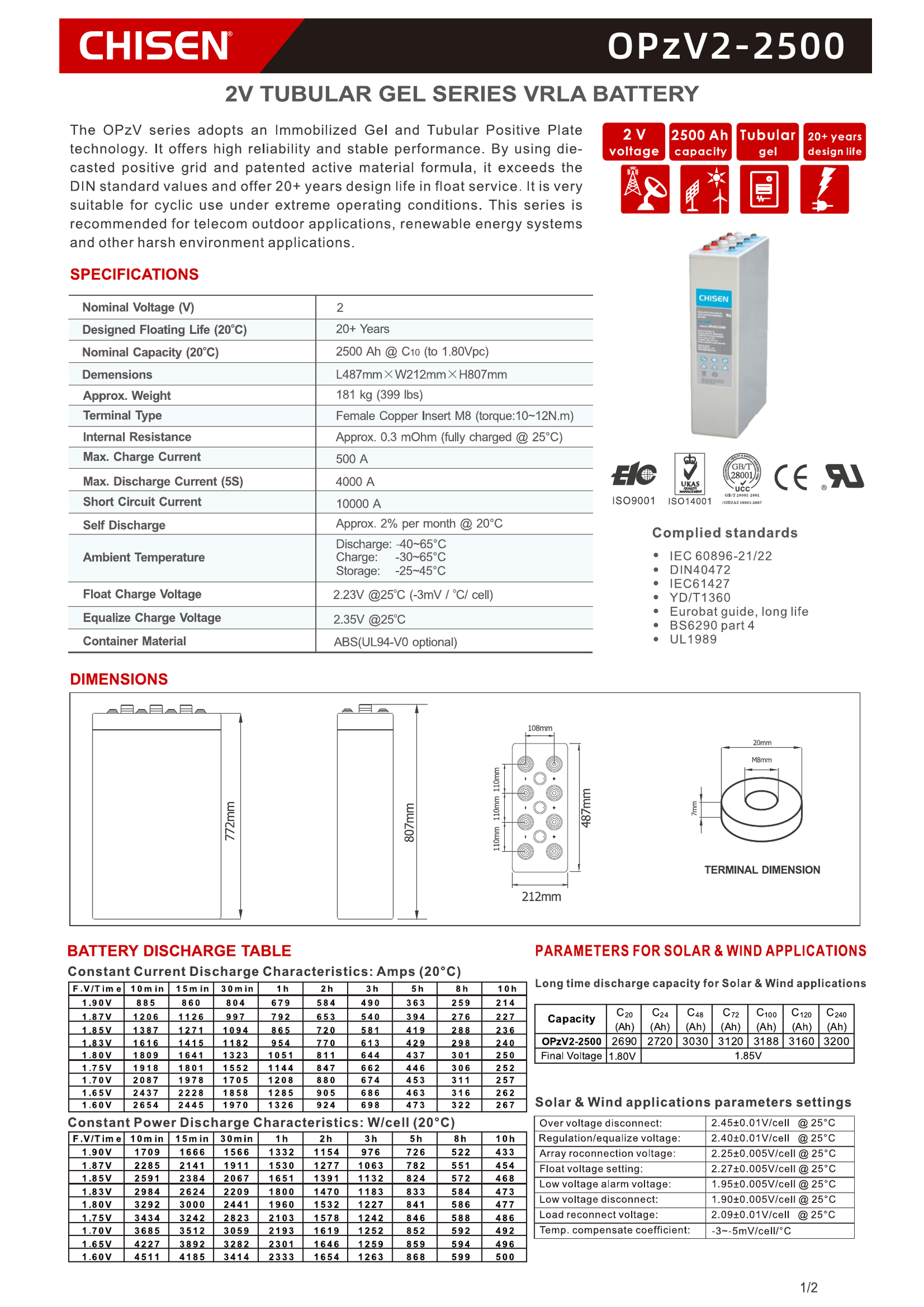
The OPzV2-2500 is a 2 V gel tubular (OPzV2) cell rated 2500 Ah at the C10 rate to 1.80 Vpc, with a published case size of 487×212×807 mm and a published weight of 181 kg per cell. Factory-published electrical data for this model: float 2.23 V/cell at 25 °C, equalise 2.35 V/cell at 25 °C, temperature compensation −3 mV/°C/cell, maximum charge current 500 A, internal resistance approximately 0.30 mΩ at 25 °C, and a design float life of 20+ years at 20 °C. Full published values are listed on this model page.
One cell stores 2 V × 2500 Ah = 5,000 Wh = 5.0 kWh of nominal energy. A 24 V solar bus therefore needs 12 cells in series (12 × 5.0 kWh = 60 kWh nominal), and a 48 V bus needs 24 cells (24 × 5.0 kWh = 120 kWh nominal). At the published float setpoint, that 24 V string sits at 12 × 2.23 V = 26.76 V, and rises to 12 × 2.35 V = 28.20 V during equalise. Weight follows the same arithmetic: 12 × 181 kg = 2,172 kg of cells for a 24 V string, plus enclosure, busbar and balance-of-system hardware.
For solar and off-grid projects the OPzV2 series matters because tubular gel construction separates plate growth from electrolyte movement. Published figures also put energy density at 5,000 Wh ÷ 181 kg = 27.6 Wh/kg per cell, and the 500 A maximum charge current equals 2 × C10 (500 A ÷ 250 A, where C10 = 2500 Ah ÷ 10 h). That headroom matters when an array recharges a bank faster than the load is drawn.
Key Takeaways
- Published, not estimated: the OPzV2-2500 datasheet states 2 V, 2500 Ah at C10 (1.80 Vpc), 487×212×807 mm, 181 kg, 500 A maximum charge current, 2.23 V float, 2.35 V equalise, −3 mV/°C/cell, ~0.30 mΩ internal resistance, and 20+ years design float life at 20 °C.
- String maths you can check: 12 cells give a 24 V bus at 26.76 V float and 28.20 V equalise; 24 cells give 48 V. Nominal energy is 5.0 kWh per cell.
- Solar and wind setpoints differ from the general setpoints: 2.27 ± 0.005 V/cell float and 2.40 ± 0.01 V/cell equalise at 25 °C are the published values for renewable-energy charging.
- Temperature compensation is not optional at site level: at 35 °C, 10 °C above the 25 °C reference, the −3 mV/°C/cell coefficient gives 10 × 3 mV = 30 mV, so 2.23 V − 0.030 V = 2.20 V/cell, or 12 × 2.20 V = 26.40 V across a 24 V string.
- The 20+ year design float life belongs to tubular OPzV2 and OPzS2 construction at 20 °C, not to 12 V VRLA families, whose design life is typically 2–5 years.
- Procurement reality: every number above comes from the manufacturer datasheet; balance-of-system data, warranty schedules and test certificates for a specific shipment are issued on request from the factory.
§1 — OPzV2-2500 Quick Specifications
The table below reproduces the published datasheet values for the OPzV2-2500. Derived rows are labelled as arithmetic so an importer can separate factory data from calculation.
| Parameter | Value | Source |
|---|---|---|
| Nominal voltage | 2 V | Datasheet |
| Capacity at C10 (1.80 Vpc) | 2500 Ah | Datasheet |
| Case dimensions L×W×H | 487×212×807 mm | Datasheet |
| Weight per cell | 181 kg | Datasheet |
| Maximum charge current | 500 A | Datasheet |
| Float voltage | 2.23 V @25 °C | Datasheet |
| Equalise voltage | 2.35 V @25 °C | Datasheet |
| Float, solar/wind charging | 2.27 ± 0.005 V/cell @25 °C | Datasheet |
| Equalise, solar/wind charging | 2.40 ± 0.01 V/cell @25 °C | Datasheet |
| Temperature compensation | −3 mV/°C/cell | Datasheet |
| Internal resistance | ~0.30 mΩ @25 °C | Datasheet |
| Design float life | 20+ years @20 °C | Datasheet |
| Terminal | Female copper insert M8, torque 10–12 N·m | Datasheet |
| Nominal energy per cell | 5.0 kWh (2 V × 2500 Ah) | Arithmetic |
| Energy density per cell | 27.6 Wh/kg (5,000 Wh ÷ 181 kg) | Arithmetic |
| Cell volume | ~83.3 L (0.487 × 0.212 × 0.807 m) | Arithmetic |
| 24 V string float voltage | 26.76 V (12 × 2.23 V) | Arithmetic |
| 24 V string equalise voltage | 28.20 V (12 × 2.35 V) | Arithmetic |
| 24 V string weight, cells only | 2,172 kg (12 × 181 kg) | Arithmetic |
§2 — The Pain: Off-Grid String Design, Documentation and Logistics
Most solar and off-grid projects fail on paperwork and logistics long before they fail on chemistry. Four recurring problems shape the specification of any 2 V tubular cell such as the OPzV2-2500.
Published data is often incomplete. Catalogue listings frequently state a nominal amp-hour figure without naming the discharge rate or the end-point voltage. That makes cross-brand comparison meaningless. The OPzV2-2500 datasheet removes the ambiguity by publishing capacity at C10 to 1.80 Vpc, and by publishing the charge window (2.23 V float, 2.35 V equalise at 25 °C) alongside a temperature coefficient of −3 mV/°C/cell. When a distributor quotes only “2,500 Ah”, the engineer still has to ask which rate, which temperature and which compensation curve apply.
Temperature is the silent variable in most sites. A containerised off-grid system in a hot climate can sit 15–20 °C above the 25 °C reference used for the published setpoints. Applying the published coefficient: at 40 °C, ΔT = 40 − 25 = 15 °C, so 15 × 3 mV = 45 mV per cell of reduction, giving 2.23 V − 0.045 V = 2.185 V/cell, and 12 × 2.185 V = 26.22 V across a 24 V string. If the controller does not implement that correction, the bank sits permanently undercharged, or the site overshoots into gas and loses water.
Handling and floor loading are real constraints. At 181 kg per cell, one 24 V string is 12 × 181 kg = 2,172 kg of cells before enclosure and cabling. Container planning, access routes, lifting gear and the floor design of the power room all have to be sized around a number that is published, not guessed. A 12 V block battery of equivalent total capacity is roughly three times the cell count for the same bus, and each replacement becomes a separate, individually specified item.
Charge acceptance limits the array design. The published maximum charge current for this model is 500 A, which is 2 × C10 because C10 = 2500 Ah ÷ 10 h = 250 A. A controller that cannot deliver the current the array can generate leaves usable capacity stranded, and an array sized beyond the acceptance limit adds cost without adding stored energy.
§3 — The Choice: Matching the OPzV2-2500 to the Application
The first choice is bus voltage, and it follows from the load rather than from the cell. A 2 V cell scales cleanly: 12 cells give a 24 V bus, 24 cells give 48 V, 60 cells give 120 V for three-phase industrial sites. Since each cell holds 2 V × 2500 Ah = 5,000 Wh = 5.0 kWh, the same 60 kWh of storage is 12 cells at 24 V or 24 cells at 48 V — identical energy, different current per cable, different controller voltage and different enclosure geometry.
The second choice is series and parallel layout. A 48 V installation needing 240 kWh uses 4 × 24-cell strings in parallel (4 × 120 kWh = 480 kWh nominal) with each string limited to the published 500 A maximum charge current; the charge controller bank must therefore be rated 4 × 500 A = 2,000 A across the parallel group. Parallel strings should be of equal length and age so that current divides evenly.
The third choice is chemistry against duty cycle. For applications with frequent deep discharge and daily cycling, tubular gel construction is the relevant construction because plate growth does not consume electrolyte in the way a conventional 12 V VRLA does. The published design float life of 20+ years at 20 °C applies to the tubular OPzV2 and OPzS2 families; 12 V VRLA designs are typically specified at 2–5 years, and mixing the two claims on one datasheet is a procurement error.
The fourth choice is whether the OPzV2-2500 is the right capacity step. At 2,500 Ah per cell it belongs in mid-to-large off-grid installations: village microgrids, telecom and data back-up in remote sites, industrial peak-shaving blocks and utility-scale solar storage. The full published set of sizes is listed on the full product range, and a directly comparable smaller cell is documented on the sibling model page.
§4 — The Framework: A Six-Step Specification Method
A workable specification for a solar or off-grid installation using the OPzV2-2500 follows six steps, in this order.
Step 1 — Fix the usable energy, not the cell count. Start from the measured daily load. If a site draws 50 kWh per day and the design assumes two days of autonomy before the array recharges, the target is 100 kWh of nominal storage. Divide by 5.0 kWh per cell (2 V × 2500 Ah) to get 20 cells, then group them to the bus voltage: 20 cells at 48 V (480 V nominal) gives 20 × 5.0 kWh = 100 kWh. Round the string count so that it divides evenly into parallel groups.
Step 2 — Choose the bus voltage. 24 V suits smaller installations with long cable runs; 48 V is the usual compromise for off-grid commercial sites; 120 V suits three-phase industrial and utility-scale storage. Higher bus voltage means lower current for the same power, so thinner cables, smaller busbars and lower I²R loss, at the cost of more cells and more interconnects.
Step 3 — Derive the string architecture. For a 48 V bank, every string has 24 cells (24 × 2 V = 48 V nominal). Three parallel strings give 3 × 24 = 72 cells and 3 × 120 kWh = 360 kWh nominal. Keep all strings the same length, the same age and the same charge programme, because imbalance shows up first as unequal current sharing and, over time, as premature capacity loss in the older string.
Step 4 — Set the charge programme. For renewable charging, the published setpoints are 2.27 ± 0.005 V/cell float and 2.40 ± 0.01 V/cell equalise at 25 °C. On a 48 V string of 24 cells, that is 24 × 2.27 V = 54.48 V float and 24 × 2.40 V = 57.60 V equalise. Configure the controller to the solar/wind profile rather than the general 2.23 V / 2.35 V values when the array is the only charging source.
Step 5 — Enable temperature compensation. With −3 mV/°C/cell, each degree above 25 °C removes 3 mV per cell and each degree below adds 3 mV. On the 24-cell string above, the full correction at 25 °C is 24 × 0.003 V = 72 mV across the string, so a 10 °C shift moves the string by 0.240 V. Use a sensor located in the cell compartment rather than in the control cabinet, and confirm the compensation slope in the controller settings.
Step 6 — Verify against published data before shipment. Confirm the datasheet identity (2 V, 2500 Ah at C10 to 1.80 Vpc, 487×212×807 mm, 181 kg), confirm the terminal type (female copper insert M8, 10–12 N·m torque), and request the production test report for the actual lot. Any value not published in the datasheet should be recorded as not published, or requested from the factory in writing.
§5 — Where the OPzV2-2500 Sits Inside the OPzV2 Series
The table below reproduces published datasheet values across the OPzV2 sizes. All charge setpoints in this series are identical — 2.23 V float and 2.35 V equalise at 25 °C, with −3 mV/°C/cell compensation and a 20+ years design float life at 20 °C — so selection is driven by capacity, footprint, weight, charge acceptance and internal resistance.
| Model | V | Ah @ C10 (1.80 Vpc) | L×W×H mm | Weight | Max charge current | Float | Equalise | Internal resistance | Design float life |
|---|---|---|---|---|---|---|---|---|---|
| OPzV2-200 | 2 | 200 | 103×206×390 | 17.0 kg | 40 A | 2.23 V @25 °C | 2.35 V @25 °C | ~1.0 mΩ @25 °C | 20+ years @20 °C |
| OPzV2-500 | 2 | 500 | 166×206×506 | 36.3 kg | 100 A | 2.23 V @25 °C | 2.35 V @25 °C | ~0.56 mΩ @25 °C | 20+ years @20 °C |
| OPzV2-1000 | 2 | 1000 | 233×210×681 | 73.2 kg | 200 A | 2.23 V @25 °C | 2.35 V @25 °C | ~0.50 mΩ @25 °C | 20+ years @20 °C |
| OPzV2-1200 | 2 | 1200 | 275×210×681 | 84 kg | 240 A | 2.23 V @25 °C | 2.35 V @25 °C | ~0.46 mΩ @25 °C | 20+ years @20 °C |
| OPzV2-2000 | 2 | 2000 | 399×212×807 | 145 kg | 400 A | 2.23 V @25 °C | 2.35 V @25 °C | ~0.37 mΩ @25 °C | 20+ years @20 °C |
| OPzV2-2500 | 2 | 2500 | 487×212×807 | 181 kg | 500 A | 2.23 V @25 °C | 2.35 V @25 °C | ~0.30 mΩ @25 °C | 20+ years @20 °C |
The second table converts those published figures into 24 V string blocks, so that cabinet and handling planning can be done on one page.
| Model | 24 V string: cells | Nominal energy per string | Cell weight per string | Max charge current per string |
|---|---|---|---|---|
| OPzV2-200 | 12 | 48 kWh (12 × 200 Ah × 2 V) | 204 kg (12 × 17.0 kg) | 40 A |
| OPzV2-500 | 12 | 120 kWh (12 × 500 Ah × 2 V) | 435.6 kg (12 × 36.3 kg) | 100 A |
| OPzV2-1000 | 12 | 240 kWh (12 × 1000 Ah × 2 V) | 878.4 kg (12 × 73.2 kg) | 200 A |
| OPzV2-1200 | 12 | 288 kWh (12 × 1200 Ah × 2 V) | 1,008 kg (12 × 84 kg) | 240 A |
| OPzV2-2000 | 12 | 480 kWh (12 × 2000 Ah × 2 V) | 1,740 kg (12 × 145 kg) | 400 A |
| OPzV2-2500 | 12 | 600 kWh (12 × 2500 Ah × 2 V) | 2,172 kg (12 × 181 kg) | 500 A |
§6 — The Trust: Factory Capacity, Certification and Delivery
The OPzV2-2500 is produced by CHISEN Battery, Hangzhou, China. The factory operates 8 production bases with an annual capacity of 70 million kVAh, and holds CE, ISO 9001, ISO 14001, UL and IEC certifications. The product portfolio covers flooded tubular OPzS2, gel tubular OPzV2 and 12 V VRLA series (6-DZF, 6-DMF and 6-EVF), which means a distributor can fill an entire cabinet, hybrid and motive portfolio from one manufacturer instead of managing several supplier interfaces.
For solar and off-grid buyers the practical trust markers are documentation, not adjectives. Each shipment can be supported with the production test report for the actual lot, the applicable certificates listed above, and the published datasheet figures reproduced in this article. Values that are not on the datasheet are recorded as not published, or requested from the factory in writing before an order is placed — a rule that protects both the importer and the supplier.
Delivery reach is broad for this product line, with export shipments moving to distributor partners in India, Nigeria, Kenya, Vietnam, the Philippines, Brazil, Mexico, Egypt, Turkey and South Africa, mainly from Ningbo, Shanghai and Shenzhen on the Chinese side. For African and South American projects the freight path runs through Lagos and Durban for the west and south-east coasts, and through Santos on the Brazilian east coast; for Middle East and South Asian volumes the usual entry points are Jebel Ali, Karachi, Mumbai and Chennai. European orders are typically consolidated through Hamburg or Rotterdam, and Mexican projects are served through Pacific and Gulf ports. Container planning should follow the published weight: 181 kg per cell, 2,172 kg for a full 12-cell 24 V string, with cell handling gear and floor loading checked against the published figures rather than against an estimate.
The same discipline applies to the 20+ years design float life at 20 °C: it is a published design figure under stated conditions, tied to gel tubular construction and to correct temperature-compensated charging, not a guarantee for every installation. The written warranty terms for a given shipment are issued by the factory on request.
§7 — FAQ
Q1: What are the published nominal voltage and capacity of the OPzV2-2500? 2 V nominal and 2500 Ah at the C10 rate to 1.80 Vpc, as stated in the manufacturer datasheet. At 2 V × 2500 Ah that is 5,000 Wh, or 5.0 kWh of nominal energy per cell.
Q2: What float and equalise setpoints does the manufacturer publish for the OPzV2-2500? Float 2.23 V/cell and equalise 2.35 V/cell at 25 °C, with temperature compensation of −3 mV/°C/cell (Datasheet). For solar and wind charging the published values are 2.27 ± 0.005 V/cell float and 2.40 ± 0.01 V/cell equalise at 25 °C.
Q3: What is the maximum charging current for the OPzV2-2500? 500 A per cell (Datasheet). Because C10 = 2500 Ah ÷ 10 h = 250 A, that published limit equals 2 × C10, which sets the ceiling for array sizing on each string.
Q4: What are the case dimensions and weight of the OPzV2-2500? 487×212×807 mm and 181 kg per cell (Datasheet). That is approximately 83.3 L per cell (0.487 × 0.212 × 0.807 m) and 2,172 kg for a 12-cell 24 V string, before enclosure and cabling.
Q5: What terminal type and torque does the OPzV2-2500 use? Female copper insert M8 terminals, torqued to 10–12 N·m (Datasheet). The same terminal arrangement is used across the OPzV2 series, so tooling and busbar design can be standardised within a site.
Q6: How many cells does a 2V2500Ah string contain and what bus voltage does it give? It depends on the bus voltage: 12 cells give 24 V, 24 cells give 48 V, 60 cells give 120 V. A 12-cell 24 V string stores 12 × 5.0 kWh = 60 kWh nominal and floats at 12 × 2.23 V = 26.76 V.
Q7: What is the published design float life of the OPzV2-2500 and at what temperature? 20+ years at 20 °C (Datasheet). This figure applies to the tubular OPzV2 and OPzS2 families; 12 V VRLA designs are typically specified at 2–5 years, so the two figures should not be quoted interchangeably.
Q8: How should an importer verify the OPzV2-2500 on delivery? Check the identity markings against the published datasheet — 2 V, 2500 Ah at C10 to 1.80 Vpc, 487×212×807 mm, 181 kg — confirm the female M8 copper insert terminals and the 10–12 N·m torque specification, and request the production test report for the delivered lot. Any figure that is not published in the datasheet should be recorded as not published, or requested from the factory.
Q9: Which certifications does the CHISEN factory behind the OPzV2-2500 hold? CE, ISO 9001, ISO 14001, UL and IEC, across 8 production bases with an annual capacity of 70 million kVAh (factory certification records). Certificate copies for a specific shipment are issued on request.
Q10: How do I request a quotation or samples for the OPzV2-2500? Contact the export desk at sales@chisen.cn or jack@chisen.cn, or by WhatsApp on +86 131 6622 6999. Ask for the datasheet, the certificate set, the published test report for the production lot, and the delivery terms for the destination port. Samples and staged shipments can be arranged against the same published specification.
Expert Summary
The OPzV2-2500 is a 2 V gel tubular cell with published values throughout: 2500 Ah at C10 to 1.80 Vpc, 487×212×807 mm, 181 kg, 500 A maximum charge current, float 2.23 V and equalise 2.35 V at 25 °C, solar and wind setpoints of 2.27 V and 2.40 V, −3 mV/°C/cell compensation, ~0.30 mΩ internal resistance and a 20+ years design float life at 20 °C. Each cell carries 5.0 kWh, so 12 cells give a 24 V bus at 26.76 V float, 28.20 V equalise and 2,172 kg of cell weight, while a 48 V bank needs 24 cells and 120 kWh per string. Specify it through six steps — usable energy, bus voltage, string architecture, charge programme, temperature compensation, delivery verification — and keep every number traceable to the datasheet or to arithmetic on it, which is what makes an imported installation bankable for a distributor in India, Nigeria, Kenya, Vietnam, the Philippines, Brazil, Mexico, Egypt, Turkey or South Africa.
Contact CHISEN — 24-Hour Response
CHISEN Battery, Hangzhou, China — 8 production bases, annual capacity 70 million kVAh, certified to CE, ISO 9001, ISO 14001, UL and IEC.
- Email: sales@chisen.cn
- Export desk: jack@chisen.cn
- WhatsApp: +86 131 6622 6999
- Website: www.chisen.cn
Related CHISEN Buyer Guides
- 6-EVF-50 12V50Ah Solar and Off-Grid Energy Storage Battery
- Battery Storage for Solar: Grid-Tied, Off-Grid, and Hybrid Systems Explained
- OPzS2-1500 2V1500Ah Flooded Tubular Battery: Utility-Scale Solar and Wind Storage
- OPzV2-100 2V100Ah Tubular GEL VRLA Battery for Telecom Access, Small UPS and Off-Grid Sola
- OPzV2-1000 2V1000Ah Tubular Gel Battery for Telecom UPS Solar Storage — CHISEN Industrial
