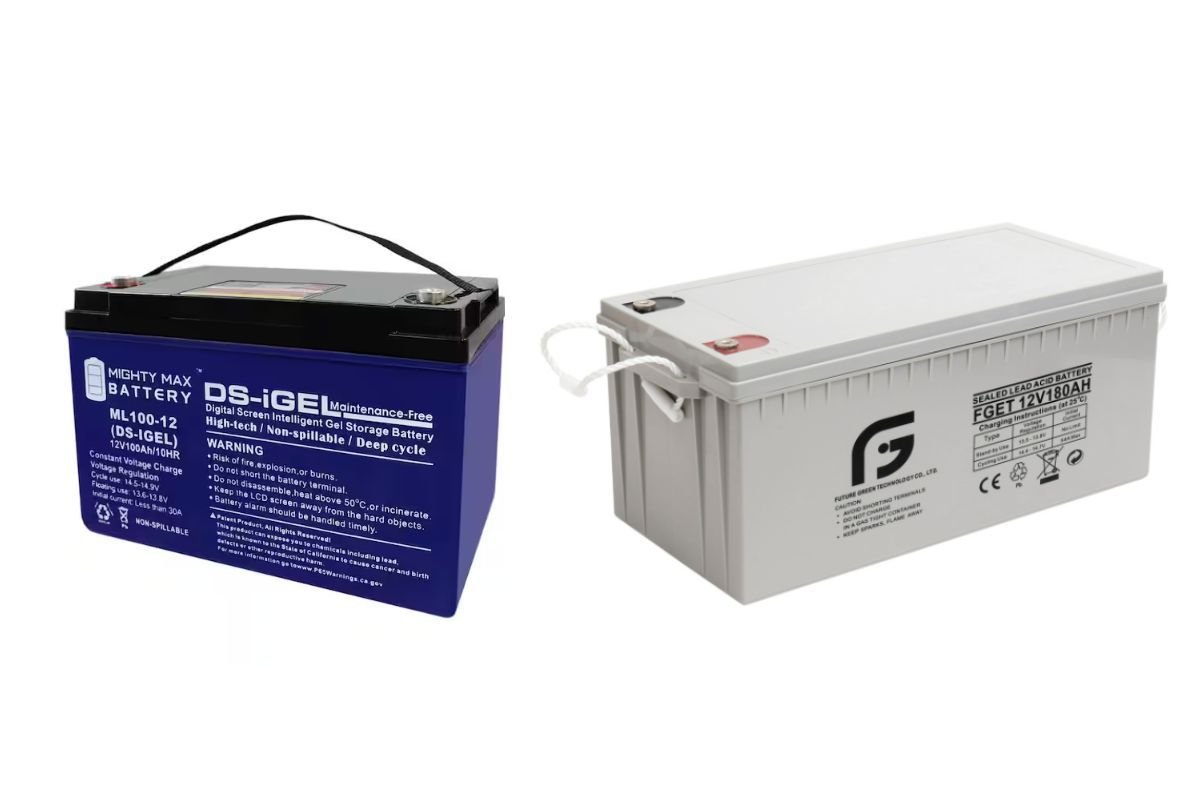
A deep cycle battery is designed to be regularly discharged to 50–80% of its capacity and then recharged — unlike a car starting battery, which delivers brief high-current bursts and stays near full charge. This fundamental difference in design determines which applications each battery type suits.
Standard starting batteries use thin positive plates with a large surface area — ideal for delivering 300–600A for engine cranking. Deep cycle batteries use thick solid plates with denser active material — designed to withstand repeated deep discharge without degrading rapidly.
Using a starting battery for deep cycle applications — or vice versa — causes premature failure and is a common and costly mistake.
Types of Deep Cycle Lead-Acid Batteries
Flooded Lead-Acid Deep Cycle
The original deep cycle technology. Requires periodic watering maintenance but offers the lowest cost per cycle when properly maintained.
Specification
FOB Price (CNY)
Best Application
6V 200Ah deep cycle
¥320–480
Golf carts, marine
6V 225Ah deep cycle
¥380–560
Golf carts, solar
12V 100Ah deep cycle
¥280–420
Small solar, buffer storage
12V 200Ah deep cycle
¥480–720
Solar storage, industrial
48V 200Ah (4×12V)
¥1,200–1,800
Forklifts, EVs
AGM Deep Cycle (VRLA)
Absorbed Glass Mat batteries are sealed, maintenance-free, and offer better vibration resistance than flooded units. More expensive upfront, but no maintenance cost over life.
Specification
FOB Price (CNY)
Best Application
12V 65Ah AGM deep cycle
¥180–280
UPS backup, solar buffer
12V 100Ah AGM deep cycle
¥280–420
UPS, solar, telecom
12V 150Ah AGM deep cycle
¥380–580
Commercial solar, marine
12V 200Ah AGM deep cycle
¥520–780
Large UPS, industrial solar
Tubular Gel OPzV Deep Cycle
The premium deep cycle option. Gel electrolyte provides the best PSOC performance and highest cycle life of any lead-acid technology.
Specification
FOB Price (CNY)
Best Application
2V 200Ah OPzV
¥600–900
Commercial/industrial solar
2V 500Ah OPzV
¥1,200–1,800
Utility-scale solar storage
2V 1000Ah OPzV
¥2,200–3,200
Telecom, grid storage
How to Choose: A Practical Decision Framework
Choose flooded deep cycle when:
Budget is the primary constraint
A maintenance team is available for quarterly watering
Battery will be discharged to 50–80% DoD daily
Application is off-grid solar with long design life
Choose AGM deep cycle when:
Zero maintenance is required
Installation is indoors or in a confined space
Battery needs to be installed in any orientation
Application involves frequent partial discharges with occasional deep cycles
Choose OPzV tubular gel when:
Batteries will be subjected to partial state of charge (PSOC) operation
Ambient temperatures regularly exceed 30°C
System design life exceeds 10 years
Total cost of ownership is the key metric — not upfront cost
Understanding Cycle Life: What the Numbers Really Mean
Battery manufacturers state cycle life at specific test conditions. Real-world performance depends on how your actual use matches those conditions.
Battery Type
Rated Cycles (50% DoD)
Realistic Cycles (80% DoD, PSOC)
Flooded deep cycle
600–800
300–450
AGM deep cycle
700–900
350–500
OPzV tubular gel
1,200–1,500
800–1,000
A battery rated at 1,000 cycles at 50% DoD tested under ideal lab conditions will deliver fewer cycles in a real-world solar installation where PSOC operation is the norm.
Common Mistakes When Buying Deep Cycle Batteries
Mistake 1: Buying a car starting battery instead of a deep cycle battery Starting batteries cannot handle deep cycling — they will fail within months in solar or traction applications.
Mistake 2: Comparing prices without comparing cycle life A ¥400 battery that lasts 400 cycles costs ¥1.00 per cycle. A ¥700 battery that lasts 1,200 cycles costs ¥0.58 per cycle.
Mistake 3: Ignoring the battery’s C20 vs C5 capacity rating Battery capacity is stated at a specific discharge rate. A 200Ah battery rated at C5 may show 180Ah at C20. Always compare batteries at the same discharge rate.
Mistake 4: Not verifying PSOC performance for solar applications Standard cycle test data (IEC 60896-21) does not reflect real-world solar operation. Ask for PSOC cycle test data.
CHISEN Battery Deep Cycle Range
CHISEN Battery manufactures the complete range of deep cycle lead-acid batteries:
Flooded EVF deep cycle series: 6V, 12V, 48V configurations, 150–400Ah
AGM VRLA deep cycle series: 12V, 24V, 48V configurations, 40–250Ah
OPzV tubular gel series: 2V single cells, 100–3000Ah
Custom voltage configurations: 24V, 36V, 48V, 60V, 72V, 80V systems built to specification
Certifications: CE, ISO9001, UKAS, TUV Rheinland
MOQ: 20 units for standard specs; custom configurations from 50 units
Request specifications and FOB pricing for your application: 📧 jack@chisen.cn | WhatsApp: +86 131 6622 6999 | www.chisen.cn
The 48V battery platform is the most versatile voltage in electric mobility and energy storage. From 48V ebike batteries to solar storage banks to telecom backup power, this single voltage covers an enormous range of applications. This guide explains everything you need to know about sourcing 48V batteries in 2026.
Why 48V Is the Dominant System Voltage
48V represents an optimal balance between power delivery and safety:
Higher than 24V: Can deliver more power through the same gauge wire
Lower than 60V/72V: Does not require the same safety certifications as systems above 60V in most markets
Standard rack format: Fits standard 19-inch server/telecom rack mounting
Wide availability: More manufacturers make 48V products, driving competition and availability
From 2V cells (most common for large systems): 48V = 24 cells × 2V in series
For a 48V 500Ah solar storage bank: → 24 × 2V 500Ah cells in series → Total capacity: 24kWh (at C10 rate) → Can deliver 24kWh × 0.80 (80% DoD) = 19.2kWh usable
From 12V blocs (alternative): 48V = 4 × 12V blocs in series
For a 48V 200Ah golf cart bank: → 4 × 12V 200Ah blocs in series → Same 48V system but easier to replace individual units
Note: Always use identical batteries in a series string. Mixing different ages, capacities, or manufacturers reduces overall bank life.
Key 48V Battery Specifications to Verify
BMS (Battery Management System) for lithium: Over-current, over/under-voltage, over-temperature protection
Cell balancing: Passive or active balancing for lithium packs
Charge voltage accuracy: 48V LiFePO4 requires 54.4–58.4V bulk charge (varies by cell, check exact spec from manufacturer)
IP rating: For outdoor or dusty environments, IP65 or higher recommended
Operating temperature range: -20°C to 60°C for LiFePO4; -10°C to 45°C for lead-acid
Communication protocol: RS485, CAN bus, or Bluetooth for monitoring (optional)
CHISEN Battery 48V Product Range
CHISEN Battery offers the most comprehensive 48V battery range in China:
A UPS battery pack is sized by three numbers — string voltage, load current and required runtime — and every procurement error in this category traces back to one of them being treated as an estimate rather than a calculation. This guide sets out how to size a UPS battery 2026 requirement from first principles, how to read a published datasheet without inheriting the supplier’s assumptions, and how to build an acceptance test that any supplier can pass.
Answer First
Size a UPS battery 2026 requirement by dividing the load in watts by the DC bus voltage to obtain battery current, multiplying that current by the required runtime in hours, and then dividing by the permitted depth of discharge — normally 50 % — to get the amp-hour requirement per string; count the units per string from the bus voltage before anything else, because a 192 V bus is sixteen 12 V units and the string count determines every figure that follows. Compare candidates on the discharge rate basis rather than on the headline amp-hour rating, since a capacity quoted at C20 and one quoted at C3 are not interchangeable for the short runtimes that UPS duty actually imposes, and apply a temperature derating for the real battery room rather than the 25 °C rating condition.
Key Takeaways
Size the string voltage first: a 192 V bus needs sixteen 12 V units, and the string count is what makes or breaks the arithmetic.
Convert load to battery current with load watts divided by bus voltage, then apply the depth-of-discharge limit before any capacity figure is quoted.
Compare datasheets on discharge rate basis, not on amp-hour alone — a 60 Ah rating at C3 is not the same 60 Ah as a C20 rating.
Temperature is the most expensive invisible variable: every 10 °C above 25 °C cuts usable capacity, so a controlled battery room is cheaper than oversized strings.
Acceptance testing on the same cut-off voltage, the same rate and the same temperature converts a quotation into a comparable result.
§1 — Quick Specifications
The figures below are the published envelope for the models most often specified into UPS and standby-power strings. They are the reference set every later calculation in this article works from.
Sightseeing vehicles, golf carts, forklifts, floor scrubbers, AGVs, electric boats
Electric bicycles, e-bikes, electric wheelchairs
Electric tricycles, motorcycles, mopeds, freight e-tricycles, sanitation trucks
Model page
Energy per unit
12 V × 60 Ah = 720 Wh
12 V × 100 Ah = 1,200 Wh
12 V × 20 Ah = 240 Wh
12 V × 32 Ah = 384 Wh
Arithmetic
Specific energy
720 Wh ÷ 18.8 kg = 38.3 Wh/kg
1,200 Wh ÷ 31.5 kg = 38.1 Wh/kg
240 Wh ÷ 6.1 kg = 39.3 Wh/kg
384 Wh ÷ 9.1 kg = 42.2 Wh/kg
Arithmetic
Footprint area L × W
258 × 170 = 43,860 mm²
330 × 170 = 56,100 mm²
180 × 76 = 13,680 mm²
267 × 78 = 20,826 mm²
Arithmetic
Recharge time at published charge current
60 Ah ÷ 12.0 A = 5.0 h
100 Ah ÷ 20.0 A = 5.0 h
20 Ah ÷ 4.0 A = 5.0 h
32 Ah ÷ 6.4 A = 5.0 h
Arithmetic
ups data center battery room lead acid banks
Every unit in this table publishes the same float voltage of 13.5 V and the same equalisation voltage of 14.1 V. That shared setpoint is the single most useful fact in the table, because it means one charger configuration covers the whole range and a mixed fleet does not need model-specific charge profiles.
The cut-off voltage of 1.75 V per cell is equally important, and it is frequently misread. A 12 V unit contains six cells, so the end-of-discharge point is 6 × 1.75 V = 10.5 V for the block, and a 192 V string of sixteen such blocks reaches its end point at 16 × 10.5 V = 168 V. Any acceptance test that uses a different cut-off produces a different capacity figure from the same battery, which is why the cut-off belongs in the purchase specification rather than in the supplier’s test certificate.
Self-discharge of no more than 3 % per month at 25 °C sets the storage rule for a spare string sitting in a rack during commissioning, and the −15 °C to 50 °C working range sets the deployment envelope for a containerised unit bound for a cold northern port or an equatorial distribution centre. Design life of 2–5 years is the basis for a replacement programme rather than a warranty conversation.
§2 — The Pain
Most UPS battery 2026 procurement failures are arithmetic failures, and they cluster into four recurring patterns.
The first is the rate-basis substitution. A datasheet states “60 Ah”, and the quotation compares that number directly against a competitor’s “60 Ah”. But the 6-EVF-60 rating is published on the three-hour rate, while many other manufacturers quote the same nominal capacity on the ten-hour or twenty-hour rate. The higher the rate basis, the higher the figure that looks best on paper, and the discrepancy at short discharge is substantial — a capacity quoted at C20 can fall to roughly half the C3 figure when the string is actually carrying a load for thirty minutes. This is the single most common way a nominally comparable quotation turns out not to be comparable.
The second is the depth-of-discharge miscalculation. A planner sizes a string for the full nameplate capacity and then discovers the UPS manufacturer only permits 50 % depth of discharge for battery life reasons. A 120 Ah string sized at 100 % DoD delivers 60 Ah in practice, and the runtime falls out by exactly the same ratio.
The third is thermal. Capacity is rated at 25 °C, and a battery room that sits at 32 °C delivers materially less. The published working range of −15 °C to 50 °C describes where the cell may be operated, not where it delivers its rated capacity, and a room that averages above 25 °C shortens replacement intervals across the whole installation simultaneously.
The fourth failure sits on the purchasing desk rather than the engineering desk. Importers serving Hamburg, Rotterdam, Jebel Ali, Lagos, Chennai, Santos, Port Said, Mombasa, Valencia or Durban regularly receive a quotation reading “UPS battery 2026, premium quality, lowest cost” with no model code, no rate basis, no dimensions, no charge current and no terminal type. Nothing in that line can be compared, tested or defended at the dock, and the pack that eventually arrives may not fit the cabinet that was designed around a different footprint.
§3 — The Choice
Once the load is fixed, the choice narrows quickly. The table below sets out three configurations against a 2,000 W load on a 192 V bus, which is the common three-phase arrangement.
Configuration
Units per string
Strings
Total Ah
Runtime at 50 % DoD
Weight per string
Source
12 V 9 Ah AGM block
16
3
27 Ah
27 Ah ÷ 10.4 A = 2.6 h
16 × 7.8 kg = 124.8 kg
Arithmetic
12 V 20 Ah block
16
3
60 Ah
60 Ah ÷ 10.4 A = 5.8 h
16 × 6.1 kg = 97.6 kg
Arithmetic
12 V 60 Ah block
16
2
120 Ah
120 Ah ÷ 10.4 A = 11.5 h
16 × 18.8 kg = 300.8 kg
Arithmetic
12 V 100 Ah block
16
1
100 Ah
100 Ah ÷ 10.4 A = 9.6 h
16 × 31.5 kg = 504.0 kg
Arithmetic
Two patterns in that table deserve emphasis. The 12 V 60 Ah block reaches longer runtime on two strings than the 12 V 100 Ah reaches on one, because the 100 Ah configuration carries 16 × 31.5 kg = 504.0 kg per string against 16 × 18.8 kg = 300.8 kg — a difference of 203.2 kg per string that a floor slab, a rack frame and an installation crew all have to absorb. Conversely, the small-block configuration reaches its runtime with three strings of light units, which is easier to handle but occupies three cabinets rather than two.
The second pattern concerns the recharge rate. A published charging current of 12.0 A for the 6-EVF-60 against a 60 Ah rating gives 60 Ah ÷ 12.0 A = 5.0 h to full charge from empty, and the 6-EVF-100 gives 100 Ah ÷ 20.0 A = 5.0 h on the same basis. If the UPS charger is set to a lower current, the recharge time stretches in direct proportion, and a string that is not fully recovered after a discharge event starts the next event already degraded.
There is one further selection point that is not a capacity question at all: chemistry. VRLA AGM and VRLA gel share the same 13.5 V float and 14.1 V equalisation setpoints, so both fit the same charger, but gel tolerates a hotter room better and AGM compacts better in a given footprint. Both remain within the published envelope of this table, which is why the EVF range is specified for the mid-to-large applications listed above. For further model detail, the 6-EVF-60 specification page carries the full published dataset.
§4 — The Framework
Seven checks decide whether a quoted UPS battery string will actually deliver the runtime being paid for. Run them in order, because each one eliminates a class of error before the next one is even considered.
Confirm the string configuration. Count the units per string and confirm the bus voltage against the count: 16 × 12 V = 192 V. A string built with the wrong count is either over- or under-volted for the charger, and no capacity figure survives that error.
Read the rate basis, not the headline number. Confirm whether the amp-hour rating is quoted at C2, C3, C10 or C20, and compare like with like across suppliers.
Apply the permitted depth of discharge. If the UPS allows 50 % DoD, halve the nameplate capacity before converting to runtime.
Convert load to battery current. Divide load watts by bus voltage: 2,000 W ÷ 192 V = 10.4 A.
Derive runtime from the derated capacity. Required Ah = current × runtime hours ÷ permitted DoD. For 2,000 W, a 30-minute runtime and 50 % DoD: 10.4 A × 0.5 h ÷ 0.5 = 10.4 Ah minimum per string.
Apply the temperature derating. Step the calculated capacity down for the actual room temperature, not the rated one, and factor in the acceleration in ageing at sustained high temperature.
Set the acceptance test. Fix the cut-off voltage, the discharge rate, the ambient temperature and the measurement method in the purchase document, so every supplier’s result is produced on identical conditions.
The fifth check is worth expanding, because the arithmetic in step five is where most published runtime claims are quietly inflated. The formula contains a division by the permitted depth of discharge, and that division is frequently omitted. A string rated at 120 Ah delivering 60 Ah of usable capacity at 10.4 A provides 60 Ah ÷ 10.4 A = 5.8 h, not the 11.5 h that the nameplate suggests. The seven checks are a sequence, not a checklist: a string that fails check one makes checks four through seven meaningless, because the current in the denominator has not been established.
§5 — The Trust
What makes a battery programme auditable is a published envelope that a third party can reproduce, and the figures in §1 are that envelope for this range. The 6-EVF-60 publishes a 12 V nominal voltage, a 60 Ah rating on the three-hour rate, dimensions of 258 × 170 × 160 mm, a weight of 18.8 ± 0.2 kg, a φ14-M6 terminal, a charging current of 12.0 A, a float voltage of 13.5 V, an equalisation voltage of 14.1 V, a cycle life of 350–600 cycles at 50–80 % depth of discharge, a cut-off of 1.75 V per cell, self-discharge of no more than 3 % per month at 25 °C, a working range of −15 °C to 50 °C and a design life of 2–5 years.
The manufacturing scale behind that data matters for a different reason. CHISEN operates eight production bases with an annual capacity of 70 million kVAh, and holds ISO 9001 and ISO 14001 certification alongside CE, UL and IEC conformity for the markets each cell ships into. For a buyer replacing strings across a European data hall, a container bound for Jebel Ali and a plant floor in Chennai, that is the difference between a supplier who can commit to a delivery slot and one who cannot.
The standards position is specific rather than general. VRLA units are built to GB/T 32620.1-2016 and GB/T 32620.2-2016 and to IEC 60896-21 and IEC 60896-22; tubular gel units are built to IEC 60896-11. When a project specification names one of these, it is naming a test regime, and the certificate that matters is the one covering the standard actually written into the purchase order.
A second trust marker is physical rather than documentary. The tolerance on weight is ±0.2 kg and the dimensions are published to the millimetre, and those two figures together are what let a cabinet be designed before the battery arrives. A supplier that publishes a footprint within a millimetre and a weight tolerance within a fraction of a kilogram is describing a product that has been through tooling and measurement, and a supplier that does not is describing a range.
Finally, trust in a standby programme is built on the maintenance plan, not the datasheet. Measure and record the float charge voltage of each block, check internal resistance against a baseline captured at installation, inspect terminals and connectors for corrosion, confirm the ambient temperature is below 25 °C, and watch for the replacement indicators on the monitoring system. Replace on any of four triggers: a block reaching 80 % of rated design life, an internal resistance rise of more than 25 % from baseline, float voltage drifting outside the specified band, or an average ambient temperature above 30 °C.
§6 — FAQ
Q1. How many UPS batteries do I need for my load? Convert load watts to battery current by dividing by the bus voltage, then work back from required runtime and permitted depth of discharge. For a 2,000 W load on a 192 V bus the current is 2,000 W ÷ 192 V = 10.4 A; with 50 % DoD and a 30-minute runtime the requirement is 10.4 A × 0.5 h ÷ 0.5 = 10.4 Ah per string.
Q2. What is the difference between C3 and C10 capacity ratings? They are the same nominal capacity measured at different discharge rates. The three-hour rate pushes a short, high-current discharge and yields a lower usable figure than the ten-hour rate for the same cell, so a datasheet quoted at C10 will look more generous than one quoted at C3 for a runtime of a few minutes. Always compare at the same rate.
Q3. Why does my UPS string deliver less runtime than the catalogue figure? Three causes account for most of the shortfall: the permitted depth of discharge is usually 50 %, not 100 %; the capacity is rated at 25 °C and the room is warmer; and the datasheet rate basis does not match the actual discharge duration. Apply the depth-of-discharge divisor first, then the temperature derating, then compare at a matched rate.
Q4. Can I use gel instead of AGM in the same UPS? Both are VRLA and share the 13.5 V float and 14.1 V equalisation setpoints, so the same charger serves both. Gel performs better in a warm environment; AGM compacts into a smaller footprint. Choose on room temperature and cabinet space rather than on the charger.
Q5. What float voltage should I set? 13.5 V per 12 V block, which is 2.25 V per cell. The equalisation point for these models is 14.1 V per block, which is 2.35 V per cell. Because the published range shares one float setpoint across every capacity, a mixed fleet can run on a single charge profile.
Q6. How often should UPS batteries be inspected? A scheduled annual inspection covering float voltage per block, internal resistance against the installation baseline, terminal and connector condition, and ambient temperature. Continuous monitoring shortens this to trend-based review, but the baseline measurement at commissioning must be recorded, because internal resistance is only meaningful relative to it.
Q7. When should a UPS battery be replaced? On any of four triggers: a block reaching 80 % of rated design life, an internal resistance increase of more than 25 % from the installation baseline, float voltage drifting outside the specified band, or an ambient temperature averaging above 30 °C. In practice a string should be replaced as a set rather than cell by cell, since cells in one string age under the same conditions.
Q8. Does battery temperature affect service life? Yes, and more strongly than most buyers expect. Sustained operation above 25 °C accelerates ageing across every block in the installation at once. The published working range of −15 °C to 50 °C defines where a cell may operate, not where it delivers rated capacity, so a controlled battery room is usually cheaper than oversizing the string to compensate.
Q9. What data do I need to request a quotation? The UPS model and its DC bus voltage, the load in watts, the required runtime in minutes, the number of strings and the units per string, the permitted depth of discharge, the ambient temperature range and the terminal type. With those seven inputs the configuration can be calculated directly, and two suppliers can be compared on identical basis.
Q10. What certifications should UPS batteries carry? For VRLA units, GB/T 32620.1-2016 and GB/T 32620.2-2016 for the domestic regime and IEC 60896-21 and IEC 60896-22 internationally; IEC 60896-11 covers tubular gel. CE, UL and IEC conformity apply to the markets each cell ships into. Request certificates covering the standards named in the purchase order rather than a general conformity statement.
Expert Summary
Sizing a UPS battery 2026 requirement comes down to three published numbers and the discipline of using them in order. Establish the string voltage and the units per string first, because the bus voltage sets the current that appears in every subsequent formula. Convert load watts to battery current by dividing by that bus voltage, then work backwards from required runtime and the UPS manufacturer’s permitted depth of discharge to obtain the amp-hour requirement per string. Compare suppliers on the discharge rate basis rather than on the headline capacity, since a rating quoted at C20 and one quoted at C3 are not interchangeable for a short runtime. Apply temperature derating for the actual battery room rather than the 25 °C rating condition, and treat the ambient temperature as a design variable, since a controlled room is cheaper across a fleet than oversized strings. Fix the cut-off voltage, discharge rate and ambient temperature in the purchase document so that every supplier’s capacity result is produced under identical conditions. On the supply side, a range that publishes nominal voltage, rate basis, dimensions to the millimetre, weight to ±0.2 kg, charge current, float and equalisation setpoints, cut-off voltage, self-discharge, working range and design life gives the buyer an envelope that can be verified independently. The shared 13.5 V float and 14.1 V equalisation across the capacity range means one charger profile serves a mixed fleet, and eight production bases with 70 million kVAh annual capacity under ISO 9001, ISO 14001, CE, UL and IEC conformity give a buyer a supplier that can commit to a delivery schedule across markets such as Europe, the Gulf, West Africa, South Asia and South America.
Contact CHISEN
Tell us the UPS model and DC bus voltage, the load in watts, the required runtime, the ambient temperature and the terminal type, and we will return a sized string configuration with the arithmetic shown.
CHISEN Battery — eight production bases, 70 million kVAh annual capacity, ISO 9001 and ISO 14001 certified, with CE, UL and IEC conformity for the markets each cell ships into.
The 12V battery is the world’s most versatile battery format — powering everything from motorcycles and scooters to UPS systems, solar installations, and recreational vehicles. This guide covers every 12V battery type available in 2026 and how to select the right one for your application.
Prices FOB China. For DDP/CIF pricing, contact our export team.
How to Choose the Right 12V Battery
Application-based selection
Motorcycle / ATV / Snowmobile: → 12V starting battery (YT / YTX series) → Prioritize CCA rating, not Ah capacity → AGM preferred for modern vehicles with electronic fuel injection
Solar energy storage (small off-grid): → 12V 40–100Ah AGM or Gel deep cycle → Match to PWM or MPPT charge controller settings → Size for 50% DoD maximum for long life
UPS / backup power: → 12V 65–100Ah AGM VRLA → Prioritize float life and recharge acceptance → Look for “UPS grade” batteries rated for frequent discharges
Electric vehicle / golf cart (48V bank): → 12V 150–200Ah EVF deep cycle (assembled into 4S or 8S banks) → Budget option: 6V 200Ah × 8 for 48V system → Better option: 2V cells × 24 for maximum service life
Marine / RV / recreational: → 12V 100–200Ah dual-purpose (starting + light cycling) or LiFePO4 → LiFePO4 for RV solar systems (weight saving is significant) → AGM or Gel for traditional marine house banks
Common Mistakes When Buying 12V Batteries
Mistake 1: Buying a starting battery for a deep cycle application. Starting batteries have thin plates designed for brief high-current discharge — they fail rapidly under deep discharge cycling.
Mistake 2: Using Ah capacity alone to compare batteries. A 100Ah battery discharged at 5A for 20 hours (C20 rate) delivers 100Ah. The same battery discharged at 50A for 1 hour may deliver only 60Ah. Always compare at the same discharge rate.
Mistake 3: Ignoring the Battery Council International (BCI) group size. Batteries must physically fit the application space. Always verify dimensions before ordering.
CHISEN Battery 12V Range
CHISEN Battery manufactures a complete range of 12V batteries:
Size a forklift battery 2026 requirement on the truck’s energy consumption per shift rather than on the battery compartment’s nominal volume: divide the average power draw in kilowatts by the drive efficiency to get the energy the traction pack must deliver, then apply the shift hours and the depth-of-discharge limit to obtain the required kilowatt-hours. A 5 kW average draw over an 8-hour shift at 80 % drive efficiency needs 5 kW × 8 h ÷ 0.8 = 50 kWh of usable energy, and at a 50 % depth-of-discharge limit for lead-acid that becomes 100 kWh of installed capacity. Match that capacity to the cell voltage the forklift’s traction controller accepts, because the controller, the charger and the cell format have to agree before anything else can be specified.
Key Takeaways
Size on energy per shift, not on compartment volume — the compartment is a consequence of the calculation, not an input to it.
Lead-acid and lithium differ on recharge strategy as much as on chemistry: opportunity charging suits lithium, scheduled charging suits lead-acid.
The charger, the traction controller and the cell voltage are one decision, not three separate ones.
Cell matching within a pack determines service life: mixing capacities and ages in one series string shortens the string.
Depth of discharge is the planning constraint — 50 % for lead-acid, and the published cycle life is measured against it.
§1 — Quick Specifications
The quick specifications below are the published reference set for the models used in electric forklift, stacker and materials-handling duties, together with the published operating envelope for the automotive start-stop series used in auxiliary and low-voltage vehicle applications.
Specification
6-EVF-80
6-EVF-60
6-QTF-80 (AGM start-stop)
Source
Nominal voltage
12 V
12 V
12 V
Model page
Rated capacity
80 Ah
60 Ah
80 Ah at 20 h
Model page
Discharge rate basis
C3 (3 h)
C3 (3 h)
20 h
Model page
Dimensions L × W × H
259 × 170 × 218 mm
258 × 170 × 160 mm
314 × 174 × 190 mm
Model page
Weight
25.7 ± 0.2 kg
18.8 ± 0.2 kg
22.5 kg
Model page
Terminal
φ16-M6
φ14-M6
Tapered terminal, +φ19.5±0.3 / −φ17.9±0.3
Model page
Charging current
16.0 A
12.0 A
0–160 A acceptable
Model page
Float charge voltage
13.5 V
13.5 V
13.5–14.8 V at 25 °C
Model page
Equalisation voltage
14.1 V
14.1 V
14.8 V upper limit
Model page
Cycle life
350–600 cycles (DoD 50–80 %)
350–600 cycles (DoD 50–80 %)
Not published as a cycle count
Model page
Cold cranking amps
Not published
Not published
800 A at −18 °C
Model page
Reserve capacity
Not published
Not published
150 min
Model page
Self-discharge
≤ 3 % per month at 25 °C
≤ 3 % per month at 25 °C
< 8 % over 90 days
Model page
Working temperature
−15 °C to 50 °C
−15 °C to 50 °C
−30 °C to 70 °C
Model page
Design life
2–5 years
2–5 years
Not published
Model page
Shell material
ABS engineering plastic, V0 flame retardant
ABS engineering plastic, V0 flame retardant
High-temperature polypropylene
Model page
Published applications
Electric forklifts, stackers, tractors, floor scrubbers, sweepers, AGVs, electric boats
Electric forklifts, stackers, floor scrubbers, AGVs, golf carts, sightseeing vehicles
Start-stop vehicles, low-voltage auxiliary systems in electric and hybrid vehicles, emergency service vehicles, industrial and smart-city equipment including forklifts
Model page
Energy per unit
12 V × 80 Ah = 960 Wh
12 V × 60 Ah = 720 Wh
12 V × 80 Ah = 960 Wh
Arithmetic
Specific energy
960 Wh ÷ 25.7 kg = 37.4 Wh/kg
720 Wh ÷ 18.8 kg = 38.3 Wh/kg
960 Wh ÷ 22.5 kg = 42.7 Wh/kg
Arithmetic
Footprint area L × W
259 × 170 = 44,030 mm²
258 × 170 = 43,860 mm²
314 × 174 = 54,636 mm²
Arithmetic
Recharge time at published charge current
80 Ah ÷ 16.0 A = 5.0 h
60 Ah ÷ 12.0 A = 5.0 h
Not applicable to traction duty
Arithmetic
electric forklift warehouse logistics operation
Two rows in that table carry most of the decision weight. The charge current row shows that the 6-EVF-80 accepts 16.0 A and the 6-EVF-60 accepts 12.0 A, and both recharge from empty in 5.0 hours at those currents — 80 Ah ÷ 16.0 A and 60 Ah ÷ 12.0 A resolve identically. A charger sized below the published current extends recharge time in direct proportion, which on a single-shift operation means the truck finishes the next shift short of full charge and the deficit compounds.
The working temperature row is the reason the start-stop series is published alongside the traction series. The 6-EVF-80 publishes −15 °C to 50 °C while the 6-QTF-80 publishes −30 °C to 70 °C, and the cold cranking figure of 800 A at −18 °C with a 150-minute reserve capacity belongs to a different duty entirely. Reading across the two product lines as though they were interchangeable is a category error, and they sit on different catalogue pages for that reason.
The energy row gives the arithmetic the rest of this article builds on: 12 V × 80 Ah = 960 Wh per unit, and at 960 Wh ÷ 25.7 kg = 37.4 Wh/kg the 6-EVF-80 carries roughly the same specific energy as the smaller 6-EVF-60 at 38.3 Wh/kg — so the cell count, not the cell mass, is what the layout decision turns on.
§2 — The Pain
The reason a forklift battery 2026 specification goes wrong is rarely the cell. It is that three quantities — energy per shift, depth of discharge and recharge window — are treated as independent when they are not.
The first failure is sizing on shift hours alone. A forklift’s energy consumption is dominated by the load it carries, the distance it travels, the gradient and the number of lifts, not by the clock. A truck on 8 hours of light duty and a truck on 8 hours of full-pallet racking work consume very different energy, and a specification that lists only the shift length produces a pack that is oversized in one case and inadequate in the other.
The second failure is the depth-of-discharge assumption. Lead-acid planned at 100 % usable capacity will not meet its published cycle life, because a cell taken to full depletion and left there recovers incompletely and ages faster than one cycled in the middle of its range. At 50 % depth of discharge the requirement doubles.
The third failure is the recharge window mismatch. A lead-acid pack needing a 5.0 hour recharge at its published charge current cannot be recharged between two shifts without shortening the recharge or accepting an incomplete charge, and the deficit carries into the next shift. This is why opportunity charging became the norm for lithium and stayed difficult for lead-acid.
The fourth failure is cell matching. A series string in which the cells differ in capacity or in age runs on the weakest cell, because the string’s available capacity is set by its lowest member. Mixing units from different production batches inside one pack is a common shortcut in the field and a common cause of premature pack replacement.
Under all four sits the sourcing failure. Fleet buyers and distributors serving Hamburg, Rotterdam, Jebel Ali, Lagos, Chennai, Santos, Port Said, Mombasa, Valencia or Durban regularly receive a response reading “forklift battery 2026, industrial grade, good price” with no cell voltage, no capacity basis, no charge current, no cycle life condition and no case dimensions. Nothing in that line can be matched against a truck’s traction controller or a charger, and nothing in it can be tested on arrival.
§3 — The Choice
The choice is between chemistry classes and between cell formats within a class. The table below sets out three configurations against the same 19.2 kWh of installed energy, which is the working point for a mid-size electric counterbalance truck.
Configuration
Cells in series
Parallel strings
Installed energy
String weight
Footprint per string
Source
6-EVF-80 (80 Ah)
4
5
5 × 4 × 960 Wh = 19,200 Wh
4 × 25.7 kg = 102.8 kg
4 × 44,030 mm² = 176,120 mm²
Arithmetic
6-EVF-60 (60 Ah)
4
8
8 × 4 × 720 Wh = 23,040 Wh
4 × 18.8 kg = 75.2 kg
4 × 43,860 mm² = 175,440 mm²
Arithmetic
6-EVF-100 (100 Ah)
4
5
5 × 4 × 1,200 Wh = 24,000 Wh
4 × 31.5 kg = 126.0 kg
4 × 56,100 mm² = 224,400 mm²
Arithmetic
6-EVF-80 at 12 V in a 4-cell series pack
4
1
1 × 4 × 960 Wh = 3,840 Wh
4 × 25.7 kg = 102.8 kg
4 × 44,030 mm² = 176,120 mm²
Arithmetic
The dominant pattern is that the number of parallel strings, not the cell capacity, sets the installed energy. Five strings of four 6-EVF-80 units and five strings of four 6-EVF-100 units differ by 4,800 Wh, while eight strings of 6-EVF-60 reach 23,040 Wh with the same footprint per string as the 80 Ah arrangement — 175,440 mm² against 176,120 mm², a difference of 680 mm² — and with a lighter string at 75.2 kg against 102.8 kg. The 100 Ah option carries the heaviest string at 126.0 kg, a difference of 4 × (31.5 kg − 18.8 kg) = 50.8 kg per string, which is the figure that decides it once a forklift bay and a maintenance aisle have to be designed around it.
The chemistry decision sits above this table and changes the arithmetic entirely. Opportunity charging — returning the truck to a charger for 15 to 30 minutes during a break — is the operating pattern that makes lithium work in a warehouse, because partial charges are harmless to a lithium pack while they are not to a lead-acid pack. Lead-acid fleets therefore run on scheduled charging with a dedicated bay, an off-board charger or an on-board charger, and a shift pattern that leaves the pack enough hours to complete a 5.0 hour recharge.
Seven checks decide whether a quoted forklift battery 2026 pack will actually work in a warehouse. Run them in order.
Measure the energy per shift. Log the average power draw in kilowatts and the shift hours, then apply the drive efficiency: 5 kW × 8 h ÷ 0.8 = 50 kWh of usable energy per shift.
Apply the depth-of-discharge limit. 50 % for lead-acid, which doubles the installed capacity: 50 kWh ÷ 0.5 = 100 kWh installed.
Confirm the cell voltage against the traction controller. The controller, the charger and the cell format are one decision; a pack voltage the controller does not support will not run regardless of its capacity.
Match the charger to the published charge current. The 6-EVF-80 accepts 16.0 A and the 6-EVF-60 accepts 12.0 A, and both recharge in 5.0 hours at those currents. A charger below the published current extends the recharge proportionally.
Confirm the recharge window fits the operating pattern. A single-shift operation needs the full recharge to fit the gap between shifts, or an opportunity-charging pattern if the chemistry supports it.
Plan cell matching. Every cell in a series string should be the same model, the same capacity and from the same production batch, because the weakest cell sets the string’s capacity.
Write the acceptance test into the purchase order. Fix the discharge rate, the cut-off voltage at 1.75 V per cell, the ambient temperature and the measurement method, so every bid is a result produced under identical conditions.
The first and second checks together set the money, and they are the two most often skipped. A pack specified on shift hours and a 100 % depth of discharge will be roughly half the size of the pack the duty actually requires, which shows up as a truck that finishes its shift unable to complete the last scheduled lift. The seventh check is what makes the bids comparable: capacity measured to a different cut-off voltage, at a different rate or at a different temperature is not a different result but a different question, and the difference between suppliers is frequently a difference in test condition rather than in product.
§5 — The Trust
What makes a battery programme auditable is a published envelope a third party can reproduce. For the traction range it is consistent and complete: 12 V nominal voltage, rated capacity with its rate basis stated, dimensions to the millimetre, weight to ±0.2 kg, published charging current, float voltage of 13.5 V, equalisation voltage of 14.1 V, cycle life with its depth of discharge attached, a cut-off of 1.75 V per cell, self-discharge of no more than 3 % per month at 25 °C, a working range of −15 °C to 50 °C, a design life of 2–5 years and an ABS engineering plastic case at V0 flame retardant grade. The shell material matters in a warehouse specifically, because a battery bay is an enclosed space in which a flame-retardant grade is a compliance item rather than a preference.
The manufacturing scale behind that data is the second trust marker. CHISEN operates eight production bases with an annual capacity of 70 million kVAh and holds ISO 9001 and ISO 14001 certification, with CE, UL and IEC conformity for the markets each cell ships into. For a fleet order delivering containers to Rotterdam, Jebel Ali, Lagos, Chennai or Mombasa, that is the difference between a supplier who can commit to a delivery slot and one who quotes a window.
The standards position is specific. VRLA units are built to GB/T 32620.2-2016 and to IEC 60896-21 and IEC 60896-22, with tubular gel units to IEC 60896-11. A specification naming one of these is naming a test regime, and the certificate that matters is the one covering the standard written into the purchase order.
A third trust marker is the breadth of the range. The 6-EVF range publishes capacities from 24 Ah through 135 Ah with a model page for each, and the adjacent start-stop series publishes 50 Ah to 105 Ah with cold cranking amps, reserve capacity, acceptable charging current and shell material — all in one catalogue group with one charge discipline. A fleet operator can serve a mixed fleet from one supplier rather than assembling a pack from four.
Finally, the operating discipline protects the investment. Measure and record the float charge voltage of each block, check internal resistance against the baseline captured at commissioning, inspect terminals and connectors for corrosion, and confirm the ambient temperature is near 25 °C. Replace on any of four triggers: a unit reaching 80 % of rated design life, an internal resistance rise of more than 25 % from baseline, float voltage drifting outside the specified band, or an average ambient temperature above 30 °C — and for a traction fleet, replace as a matched set rather than cell by cell, because a mixed-age string loses the capacity of its newest cells along with its oldest.
§6 — FAQ
Q1. How do I size a forklift battery? Start from the truck’s energy consumption per shift: average power draw in kilowatts multiplied by shift hours, divided by drive efficiency, gives usable energy. Apply the depth-of-discharge limit of 50 % for lead-acid to obtain installed capacity, then divide by the unit’s watt-hour figure and confirm the resulting voltage against the traction controller.
Q2. How long does it take to charge a forklift battery? At the published charge current, five hours from empty: the 6-EVF-80 recharges in 80 Ah ÷ 16.0 A = 5.0 h and the 6-EVF-60 in 60 Ah ÷ 12.0 A = 5.0 h. A charger set below the published current extends the recharge in direct proportion, so a charger specified on the truck’s power draw rather than on the battery’s charge current will over-lengthen every recharge.
Q3. Can I opportunity-charge a lead-acid forklift battery? Partially, but with care. Frequent partial charges shorten lead-acid service life because the pack does not reach full recovery between cycles. Opportunity charging suits lithium, and lead-acid fleets are usually run on scheduled charging with enough hours between shifts for a complete 5.0 hour recharge.
Q4. Is lithium worth the cost for a forklift fleet? It depends on the operating pattern rather than the chemistry alone. Lithium earns its premium where opportunity charging is possible and where the battery bay can be removed from the duty, because a partial charge costs lithium almost nothing. In a single-shift operation with a fixed bay and no opportunity window, the lead-acid pack with its lower capital cost and 5.0 hour recharge may still be the better answer.
Q5. What cell voltage does my forklift need? Confirm it against the traction controller and the existing charger, because those two define the format. The 6-EVF range publishes at 12 V nominal per unit, and a 48 V pack is four units in series. A pack voltage the controller does not support will not run, whatever its capacity.
Q6. Why does my forklift battery pack fail early? Three causes account for most cases. A pack specified on shift hours rather than on measured energy consumption is undersized and works harder than designed. Cells of mixed capacity or age in one series string reduce the pack to its weakest member. And a pack repeatedly taken to full depth of discharge ages faster than the published cycle life assumes.
Q7. Can I mix cells from different batches in one pack? No. Every cell in a series string should be the same model, the same capacity and from the same production batch. A mixed string charges to the state of its weakest cell and delivers the capacity of that cell, so the newest units in the pack are never fully used.
Q8. What temperature should a forklift battery room be kept at? Around 25 °C, which is the condition the rated capacity figure assumes. A battery bay in a hot warehouse, or outdoors in a tropical port, will deliver less than the nameplate and age faster, and the published working range of −15 °C to 50 °C is the operating envelope rather than the rated condition.
Q9. How long should a forklift battery last? The published design life is 2–5 years, and real service life in a traction duty depends on the recharge discipline, the depth of discharge and the ambient temperature far more than on the calendar. A fleet that returns every pack to a full charge on a fixed cycle and keeps the bay at 25 °C reaches the upper end of that range.
Q10. What do you need to quote a forklift battery pack? The truck make and model, the traction controller voltage, the measured energy consumption per shift or the average power draw and shift hours, the depth of discharge you intend to design to, the charger type and its maximum output current, the cell format and case dimensions available in the bay, the number of packs required and the destination market for certification purposes.
Expert Summary
Sizing a forklift battery 2026 pack follows a fixed sequence that determines the capital cost, and the sequence begins with measured data rather than with the battery catalogue: log the truck’s average power draw in kilowatts and its shift hours, divide by the drive efficiency to obtain usable energy per shift, then apply the depth-of-discharge limit. For a 5 kW draw across an 8-hour shift at 80 % efficiency, that is 5 kW × 8 h ÷ 0.8 = 50 kWh of usable energy, and at a 50 % lead-acid limit the installed requirement becomes 100 kWh rather than the 50 kWh the load implies. Cell voltage is fixed by the traction controller and the charger, which together with the cell format make one decision rather than three, and the unit count then follows from the required watt-hours divided by the published figure of 960 Wh for the 6-EVF-80 and 720 Wh for the 6-EVF-60. The charger must be matched to the published charge current of 16.0 A and 12.0 A respectively, each of which yields a 5.0 hour recharge from empty, and the recharge window has to fit the operating pattern — opportunity charging suits lithium and partial charges cost lead-acid life, so a single-shift lead-acid operation depends on a scheduled bay with enough hours between shifts. Cell matching inside a series string is not a refinement but a requirement, since the weakest cell sets the string’s capacity and a mixed-age pack wastes the newest cells in it. The acceptance test must fix the discharge rate, the 1.75 V per cell cut-off, the ambient temperature and the measurement method so that every bid is a result produced under identical conditions. On the supply side, the published envelope — nominal voltage, rate basis, dimensions to the millimetre, weight to ±0.2 kg, charge current, float and equalisation setpoints, cycle life with its depth of discharge attached, cut-off voltage, self-discharge, working range, design life and an ABS engineering plastic case at V0 flame retardant grade — gives the buyer something independently verifiable, and eight production bases with 70 million kVAh annual capacity under ISO 9001, ISO 14001, CE, UL and IEC conformity give a supplier able to serve a mixed fleet from one catalogue group and to commit to delivery across Europe, the Gulf, West Africa, South Asia and South America.
Contact CHISEN
Send the truck make and model, the traction controller voltage, the average power draw and shift hours, the charger output current, the cell format available in the bay and the destination market, and we will return a sized pack with the arithmetic shown.
CHISEN Battery — eight production bases, 70 million kVAh annual capacity, ISO 9001 and ISO 14001 certified, with CE, UL and IEC conformity for the markets each cell ships into.
Choose between gel, AGM and flooded lead-acid on two axes rather than on the chemistry label: the float charge setpoint and the depth of discharge your cycle life can tolerate. All three accept the same float voltage — 2.27–2.30 V per cell for the CNF series at 25 °C — so the charger is rarely the deciding factor; what decides it is the published cycle life and the depth of discharge it is measured at. A gel or AGM bank planned at 50 % depth of discharge will outlast a flooded bank on the same duty by a wide margin, because flooded chemistry loses water through gassing and needs periodic topping-up that AGM and gel do not.
Key Takeaways
Float voltage is not the discriminator — all three chemistry types charge at roughly the same per-cell setpoints, so the charger usually fits any of them.
Depth of discharge is the discriminator: 50 % for lead-acid, and every cycle taken below it shortens service life.
Cycle life figures are only comparable when the depth of discharge and the discharge rate are attached to them.
Temperature is where gel and AGM diverge most — gel tolerates heat better, AGM compacts better.
Flooded chemistry needs water, ventilation and a service regime; the two VRLA types need none of the three.
§1 — Quick Specifications
The quick specifications below cover the two VRLA product lines that dominate solar and industrial standby work today, together with the published operating envelope for the flooded reference case.
Specification
6-EVF-100 (AGM VRLA)
6-CNF-100 (CNF AGM)
CNF-500 (CNF)
Source
Nominal voltage
12 V
12 V
2 V cell
Model page
Rated capacity
100 Ah
100 Ah (C10)
500 Ah (C10)
Model page
Discharge rate basis
C3 (3 h)
C10 (10 h)
C10 (10 h)
Model page
Dimensions L × W × H
330 × 170 × 218 mm
Published on model page
Published on model page
Model page
Weight
31.5 ± 0.2 kg
Published on model page
Published on model page
Model page
Terminal
φ20-M8
Published on model page
Published on model page
Model page
Charging current
20.0 A
0.25 C10 = 25.0 A
0.25 C10 = 125.0 A
Model page
Float charge voltage
13.5 V
2.27–2.30 V/cell = 13.62–13.80 V for 6 cells
2.27–2.30 V/cell
Model page
Cyclic charge voltage
14.1 V equalisation
2.40–2.45 V/cell = 14.40–14.70 V for 6 cells
2.40–2.45 V/cell
Model page
Cycle life
350–600 cycles (DoD 50–80 %)
“Excellent cycle life”, count not published
“Excellent cycle life”, count not published
Model page
Float design life
2–5 years
12 years at 20 °C
12 years at 20 °C
Model page
Self-discharge
≤ 3 % per month at 25 °C
Sealing reaction rate ≥ 99 %
Sealing reaction rate ≥ 99 %
Model page
Working temperature
−15 °C to 50 °C
−40 °C to 50 °C
−40 °C to 50 °C
Model page
Altitude rating
Not published
Up to 4,500 m
Up to 4,500 m
Model page
Published applications
Sightseeing vehicles, golf carts, forklifts, floor scrubbers, AGVs, electric boats
Solar and wind renewable systems, backup power, PV water pumps, PV stations 10 kW–50 MW, telecom and signal lighting
Solar and wind renewable systems, backup power, PV stations, marine and cathodic protection
Model page
Energy per unit
12 V × 100 Ah = 1,200 Wh
12 V × 100 Ah = 1,200 Wh
2 V × 500 Ah = 1,000 Wh
Arithmetic
Recharge time at published charge current
100 Ah ÷ 20.0 A = 5.0 h
100 Ah ÷ 25.0 A = 4.0 h
500 Ah ÷ 125.0 A = 4.0 h
Arithmetic
agm gel lead acid battery comparison
The float setpoint row is the most instructive line in the table. The 6-EVF-100 publishes a float voltage of 13.5 V, which is 2.25 V per cell, while the CNF series publishes 2.27–2.30 V per cell — a difference of 0.02 to 0.05 V per cell, or 13.62 to 13.80 V across six cells. That is a fraction of a volt across a whole 12 V block, and it is the reason a single charger configuration usually serves a mixed VRLA installation. The cyclic charge voltage tells the same story: 2.40–2.45 V per cell for the CNF series against a 14.1 V equalisation point on the 6-EVF-100, which is 2.35 V per cell. Both are ordinary lead-acid setpoints.
The working temperature row is where the chemistry types genuinely separate. The CNF series publishes −40 °C to 60 °C against −15 °C to 50 °C for the 6-EVF-100, and the CNF pages add an altitude rating of up to 4,500 m — a figure that matters for high-altitude photovoltaic sites and containerised installations where air-cooled battery rooms lose their thermal margin. The CNF design life of 12 years at 20 °C float is a standby figure and should not be read against a cycling duty.
§2 — The Pain
The reason a gel battery 2026 specification goes wrong is rarely the chemistry. It is that three quantities are quoted without their conditions, and the conditions change the answer more than the chemistry does.
The first failure is the bare cycle-life number. A figure of “500 cycles” means nothing on its own: measured at 50 % depth of discharge it describes a life of 500 cycles, measured at 80 % it describes fewer, and measured at a shallower depth it describes more. The 6-EVF-100 publishes 350–600 cycles at 50–80 % depth of discharge, which is a range precisely because the outcome depends on the condition. A tender that writes “500 cycles” without the depth of discharge has not specified the requirement at all.
The second failure is the rate-basis substitution. The 6-EVF-100 publishes its 100 Ah on a three-hour basis while the CNF series publishes capacity on a ten-hour basis. Those are different quantities measured under different conditions, and a comparison between them is a comparison of two test regimes rather than of two products. The gap is real and it is not small: capacity falls as the discharge rate rises, so a C10 figure flatters the same cell against a C3 figure for any short-duration duty.
The third failure is treating the depth-of-discharge limit as a design choice rather than a constraint. Lead-acid chemistry is not damaged by depth of discharge in a single event; it is damaged by the number of times it is taken to that depth and left there, because the recharge is then a long, partly absorbed reaction and the cell does not fully recover. Planning at 80 % rather than 50 % buys more usable energy per unit and takes service life with it.
Under all three sits the sourcing failure. Importers serving Hamburg, Rotterdam, Jebel Ali, Lagos, Chennai, Santos, Port Said, Mombasa, Valencia or Durban regularly receive a response reading “gel battery 2026, deep cycle, best quality” with no capacity basis, no depth of discharge, no cycle life at a stated condition, no charge setpoints and no enclosure dimensions. That line cannot be compared between suppliers and cannot be turned into an acceptance test.
§3 — The Choice
The comparison table below sets out the three chemistry types against the four attributes that actually drive an industrial purchase decision.
Attribute
Gel (VRLA)
AGM (VRLA)
Flooded lead-acid
Source
Electrolyte form
Thixotropic silica gel, immobilized
Absorbed glass mat, immobilized
Liquid sulphuric acid, free
Datasheet
Water maintenance
None
None
Periodic topping-up required
Datasheet
Gas venting
Minimal, recombining
Minimal, recombining
Requires ventilation
Datasheet
Float setpoint
2.27–2.30 V/cell
2.25–2.30 V/cell
2.23–2.27 V/cell
Datasheet
Cyclic charge setpoint
2.40–2.45 V/cell
2.35–2.45 V/cell
2.35–2.45 V/cell
Datasheet
Deep-cycle tolerance
High
High
Moderate
Datasheet
High-temperature tolerance
Best of the three
Moderate
Poor without controlled rooms
Datasheet
Footprint for a given energy
Compact
Most compact
Least compact
Arithmetic
Service regime
Inspection only
Inspection only
Inspection plus electrolyte service
Arithmetic
Relative installed weight
High
High
Highest for the same energy
Arithmetic
The table shows that the charge setpoints cluster into one band for all three chemistry types, which is the single fact that removes the charger from most of these decisions. What separates them is the service regime and the thermal envelope. Flooded chemistry carries a permanent operational cost — water, ventilation and a technician — that VRLA eliminates entirely, and that cost does not appear in any quotation because it sits in the operating cost instead.
The capacity side of the decision follows from the CNF range, which publishes capacities from 38 Ah at C10 through to 3,000 Ah per cell, spanning the whole 6-cell and single-cell formats. The 6-CNF-100 provides 12 V × 100 Ah = 1,200 Wh per unit, while a CNF-500 cell provides 2 V × 500 Ah = 1,000 Wh per cell — so 600 cells would be needed for the same 600 kWh, and the 12 V format reaches 1,200 Wh per unit with far fewer interconnects. That is the argument for the 12 V format on installation labour and connection count, and against the 2 V cell format on cell count and maintenance access.
Seven checks turn a gel battery 2026 specification into a bank that performs. Run them in order.
Fix the duty first. Standby or cycling. A standby bank is specified on float life and self-discharge; a cycling bank is specified on cycle life at a stated depth of discharge. Mixing the two produces a bank that is either oversized or short-lived.
Write the cycle life with its condition. Every cycle figure must carry its depth of discharge and its discharge rate — 350–600 cycles at 50–80 % depth of discharge, or the equivalent for the CNF series.
Align the rate basis before comparing. C10 and C3 capacities are different quantities; convert or compare at a single rate.
Choose the depth of discharge and price it in. 50 % is the planning figure for lead-acid, and it doubles the installed capacity relative to the 80 % figure.
Confirm the charge setpoints against the charger. Float 2.27–2.30 V per cell and cyclic 2.40–2.45 V per cell for the CNF series; verify the charger can hold the cyclic setpoint without overcharging.
Check the environmental envelope. The CNF series publishes −40 °C to 60 °C and an altitude rating to 4,500 m, both of which decide whether a site is inside the envelope at all.
Write the acceptance test into the tender. Fix the cut-off voltage at 1.75 V per cell, the discharge rate, the ambient temperature and the method, so that every bid is a result produced under identical conditions.
The second and seventh checks are what separate a real specification from a brand preference, and they are also where the most money is saved or lost. A tender that omits the depth of discharge accepts bids that are not comparable, and the resulting difference shows up as a capacity shortfall in service rather than at delivery. The fifth check deserves a specific warning: a charger set for float only will not deliver the 2.40–2.45 V cyclic setpoint, so a bank cycled daily on a float-only charger works and then charges incompletely on every cycle, which is precisely the condition that shortens cycle life.
§5 — The Trust
What makes a battery programme auditable is a published envelope that a third party can reproduce. The figures in §1 are that envelope, and they carry the credibility that comes from being specific. A published float voltage of 2.27–2.30 V per cell, a cyclic charge voltage of 2.40–2.45 V per cell, a maximum charging current of 0.25 C10, an operating range of −40 °C to 60 °C, an altitude rating to 4,500 m, a sealing reaction rate of at least 99 % and a 12-year float design life at 20 °C are all testable statements rather than marketing language.
The manufacturing scale behind them is the second trust marker. CHISEN operates eight production bases with an annual capacity of 70 million kVAh and holds ISO 9001 and ISO 14001 certification, with CE, UL and IEC conformity for the markets each cell ships into. For a project container moving through Hamburg, Rotterdam, Jebel Ali, Lagos, Chennai or Mombasa, that is the difference between a supplier who can commit to a delivery slot and one who quotes a delivery window.
The standards position is specific rather than general. VRLA units are built to GB/T 32620.2-2016 and to IEC 60896-21 and IEC 60896-22, and tubular gel units to IEC 60896-11. A specification naming one of these is naming a test regime, and the certificate that matters is the one covering the standard written into the purchase order.
A third trust marker is the published range itself. A catalogue that publishes capacities from 38 Ah through 3,000 Ah per cell, in both 6-cell and single-cell formats, with matching model pages for each, is a supplier who can serve a project from one voltage series and one charge profile rather than from a patchwork of sources. That matters for the buyer who will need a 12 V unit for a small installation and a 2 V cell for a utility site.
Finally, the operating discipline protects the investment, and it is the same discipline the acceptance test demands. Measure and record the float charge voltage of each block, check internal resistance against the baseline captured at commissioning, inspect terminals and connectors for corrosion, and confirm the ambient temperature stays near 25 °C for a float installation or near 20 °C for a 12-year design-life claim. Replace on any of four triggers: a unit reaching 80 % of rated design life, an internal resistance rise of more than 25 % from baseline, float voltage drifting outside the specified band, or an average ambient temperature above 30 °C.
§6 — FAQ
Q1. What is the difference between gel and AGM batteries? Both are VRLA with the same charge setpoints; the difference is the electrolyte. Gel uses a thixotropic silica gel that is immobilised in the case, and it tolerates high temperature better. AGM uses an absorbed glass mat holding the electrolyte in contact with the plates, and it compacts into a smaller footprint for the same energy.
Q2. Are gel and AGM batteries interchangeable? For charging, yes — the float setpoints overlap closely at 2.27–2.30 V per cell and the cyclic setpoints at 2.40–2.45 V per cell. For the application they are not interchangeable in every respect, because thermal behaviour and footprint differ. Always confirm the charge profile against the specific model’s published setpoints.
Q3. Is flooded lead-acid still worth considering? For a large, stationary, attended site with a technician on hand it retains an economic argument, because the capital cost per kilowatt-hour is lower and the electrolyte can be serviced. It requires ventilation, periodic topping-up and a controlled environment, and that operating cost is what usually decides it against VRLA.
Q4. Which chemistry lasts longest in solar storage? The published data points to VRLA for solar duty, with the CNF series publishing a 12-year float design life at 20 °C, an operating range of −40 °C to 60 °C and a sealing reaction rate of at least 99 %. For a cycling installation the cycle life figure at a stated depth of discharge is the deciding number, and it should be compared across suppliers at the same condition.
Q5. What depth of discharge should I design to? Fifty per cent for lead-acid of any kind. Designing to 80 % gives more usable energy per unit but takes service life with it, because every cycle taken to that depth leaves the cell incompletely recovered. The published cycle ranges are quoted at 50–80 % precisely because the two ends of that range produce very different service lives.
Q6. How do I compare cycle life figures from different suppliers? Only at the same depth of discharge and the same discharge rate. A figure of 500 cycles at 50 % depth of discharge is not comparable with 500 cycles at 80 %, and a C10 capacity is not comparable with a C3 capacity. Require the three conditions in the specification and compare like with like.
Q7. What temperature should the battery room be kept at? Around 25 °C, and around 20 °C if a 12-year float design life is being claimed, because that figure is stated at 20 °C. Sustained operation above 30 °C accelerates ageing across the whole bank simultaneously, so temperature control is usually cheaper than oversizing.
Q8. Can gel or AGM batteries be installed in series? Yes, and to a published string voltage the charger supports. All cells in a series string must be the same model and the same age, because the weakest cell sets the string’s available capacity and the string cannot be recovered if one unit reaches end of life.
Q9. What is the difference between standby and cycling batteries? A standby battery is optimised for float operation and judged on float life, self-discharge and how little it deteriorates while idle. A cycling or deep-cycle battery is judged on cycle life at a stated depth of discharge and rate. Substituting one for the other is the classic specification error in solar and industrial work.
Q10. What data do I need for a quotation? The daily load in kilowatt-hours, the autonomy in days, the duty type — standby or cycling — the preferred chemistry, the DC bus voltage, the ambient temperature range, the altitude of the site, the enclosure footprint available and the required service life. With those inputs the capacity, the unit count and the charge setpoints all follow directly.
Expert Summary
Choosing between gel, AGM and flooded lead-acid for an energy storage battery 2026 duty comes down to the service regime and the thermal envelope, not to the charge setpoints, because all three chemistry types cluster around 2.27–2.30 V per cell for float and 2.40–2.45 V per cell for cycling, which is why one charger usually serves any of them. What separates them is that flooded chemistry carries a permanent operating cost in water, ventilation and technician time that appears nowhere in a quotation, while gel and AGM eliminate it entirely. Cycle life must be read with its conditions attached: the published 350–600 cycles at 50–80 % depth of discharge on the 6-EVF-100 spans a wide range precisely because the outcome depends on the depth and the rate, and a tender that writes “500 cycles” without the condition has not specified anything. The CNF series extends the envelope with a −40 °C to 60 °C operating range, an altitude rating to 4,500 m, a maximum charge current of 0.25 C10, a sealing reaction rate of at least 99 % and a 12-year float design life at 20 °C, with capacities published from 38 Ah to 3,000 Ah per cell across both 6-cell and single-cell formats. Capacity planning must start from the duty: a standby bank is judged on float life and self-discharge, a cycling bank on cycle life at a stated depth of discharge, and a 50 % depth-of-discharge limit for lead-acid doubles the installed capacity relative to an 80 % assumption. Write the acceptance test into the tender with a 1.75 V per cell cut-off, a fixed discharge rate and a fixed ambient temperature, so that every bid is a result produced under identical conditions. On the supply side, eight production bases with 70 million kVAh annual capacity under ISO 9001, ISO 14001, CE, UL and IEC conformity give a buyer a supplier able to serve a project from a single voltage series and a single charge profile, and to commit to delivery across Europe, the Gulf, West Africa, South Asia and South America.
Contact CHISEN
Send the duty type, the daily load in kilowatt-hours, the autonomy in days, the DC bus voltage, the ambient temperature range, the site altitude and the available footprint, and we will return a sized bank with the arithmetic shown.
CHISEN Battery — eight production bases, 70 million kVAh annual capacity, ISO 9001 and ISO 14001 certified, with CE, UL and IEC conformity for the markets each cell ships into.
Size an energy storage battery 2026 installation by calculating the daily load in kilowatt-hours, multiplying it by the autonomy in days, and then dividing by the permitted depth of discharge for the chosen chemistry — a 50 kWh daily load needing two days of autonomy on a lead-acid bank with a 50 % depth-of-discharge limit requires 50 kWh × 2 ÷ 0.5 = 200 kWh of installed capacity, not the 100 kWh the load alone implies. Choose the chemistry from the required cycle count and the installation environment rather than from energy density alone, because the depth-of-discharge limit, the temperature range and the published cycle life decide the real economics of the bank long before the cell chemistry does.
Key Takeaways
Convert the daily load to kilowatt-hours first, then apply autonomy and depth of discharge — the load alone is never the bank size.
Depth of discharge is the single largest multiplier: 50 % for lead-acid, typically 80 % for lithium, and it moves the installed capacity by a factor of two.
Published cycle life is only meaningful with its depth of discharge and test rate attached, and against a fixed cut-off voltage.
Standby energy needs float charge on a temperature-controlled basis; cycle energy needs fast recharge and a repeatable acceptance test.
Compare capacities in kilowatt-hours, not amp-hours: 12 V × 100 Ah = 1,200 Wh per unit, and the arithmetic must be shown.
§1 — Quick Specifications
The quick specifications below are the published reference set for the models used in stationary energy storage banks. Every later calculation in this article works from these figures.
Specification
6-DZF-20
6-DMF-32
6-EVF-60
6-EVF-100
Source
Nominal voltage
12 V
12 V
12 V
12 V
Model page
Rated capacity
20 Ah
32 Ah
60 Ah
100 Ah
Model page
Discharge rate basis
C2 (2 h)
C3 (3 h)
C3 (3 h)
C3 (3 h)
Model page
Dimensions L × W × H
180 × 76 × 170 mm
267 × 78 × 170 mm
258 × 170 × 160 mm
330 × 170 × 218 mm
Model page
Weight
6.1 ± 0.2 kg
9.1 ± 0.2 kg
18.8 ± 0.2 kg
31.5 ± 0.2 kg
Model page
Terminal
φ8.8-M5
φ8.8-M5
φ14-M6
φ20-M8
Model page
Charging current
4.0 A
6.4 A
12.0 A
20.0 A
Model page
Float charge voltage
13.5 V
13.5 V
13.5 V
13.5 V
Model page
Equalisation voltage
14.1 V
14.1 V
14.1 V
14.1 V
Model page
Cycle life
350–600 cycles (DoD 50–80 %)
350–600 cycles (DoD 50–80 %)
350–600 cycles (DoD 50–80 %)
350–600 cycles (DoD 50–80 %)
Model page
Cut-off voltage
1.75 V/cell
1.75 V/cell
1.75 V/cell
1.75 V/cell
Model page
Self-discharge
≤ 3 % per month at 25 °C
≤ 3 % per month at 25 °C
≤ 3 % per month at 25 °C
≤ 3 % per month at 25 °C
Model page
Working temperature
−15 °C to 50 °C
−15 °C to 50 °C
−15 °C to 50 °C
−15 °C to 50 °C
Model page
Design life
2–5 years
2–5 years
2–5 years
2–5 years
Model page
Published applications
Electric bicycles, e-bikes, electric wheelchairs
Electric tricycles, motorcycles, mopeds, freight e-tricycles, sanitation trucks
Sightseeing vehicles, golf carts, forklifts, floor scrubbers, AGVs, electric boats
Sightseeing vehicles, golf carts, forklifts, floor scrubbers, AGVs, electric boats
Model page
Energy per unit
12 V × 20 Ah = 240 Wh
12 V × 32 Ah = 384 Wh
12 V × 60 Ah = 720 Wh
12 V × 100 Ah = 1,200 Wh
Arithmetic
Specific energy
240 Wh ÷ 6.1 kg = 39.3 Wh/kg
384 Wh ÷ 9.1 kg = 42.2 Wh/kg
720 Wh ÷ 18.8 kg = 38.3 Wh/kg
1,200 Wh ÷ 31.5 kg = 38.1 Wh/kg
Arithmetic
Footprint area L × W
180 × 76 = 13,680 mm²
267 × 78 = 20,826 mm²
258 × 170 = 43,860 mm²
330 × 170 = 56,100 mm²
Arithmetic
Recharge time at published charge current
20 Ah ÷ 4.0 A = 5.0 h
32 Ah ÷ 6.4 A = 5.0 h
60 Ah ÷ 12.0 A = 5.0 h
100 Ah ÷ 20.0 A = 5.0 h
Arithmetic
industrial solar energy storage system farm
The four units publish one float voltage of 13.5 V and one equalisation voltage of 14.1 V, and every recharge from empty at the published charge current takes 5.0 hours — 20 Ah ÷ 4.0 A, 32 Ah ÷ 6.4 A, 60 Ah ÷ 12.0 A and 100 Ah ÷ 20.0 A all resolve to the same figure. For a bank assembled from mixed capacities, that single charge profile is what keeps the string balanced, and it is the reason a 48 V bank of four 6-DZF-20 units can be charged by the same charger as a bank of four 6-EVF-100 units.
The cut-off voltage of 1.75 V per cell fixes the end of the discharge window: a 12 V unit reaches 6 × 1.75 V = 10.5 V, and a 48 V bank of four units reaches 4 × 10.5 V = 42 V. Self-discharge of no more than 3 % per month at 25 °C sets the storage rule for a bank that sits idle through a low-solar season. The working range of −15 °C to 50 °C defines where a cell may be operated, and the design life of 2–5 years is the basis on which a replacement programme should be scheduled.
§2 — The Pain
The reason an energy storage battery 2026 project goes wrong on site is rarely the cell itself. It is that three published quantities point in different directions, and the tender document usually collapses them into one number.
The first failure is the depth-of-discharge substitution. A bank sized at 100 kWh for a 50 kWh load with two days of autonomy assumes the bank can be emptied, but a lead-acid bank that is regularly fully discharged will not meet its published cycle life. With a 50 % limit the requirement is 50 kWh × 2 ÷ 0.5 = 200 kWh, so the installed capacity doubles. Lithium, typically permitted at 80 %, gives 50 kWh × 2 ÷ 0.8 = 125 kWh — the same load, the same autonomy and three different bank sizes depending on which limit is applied.
The second failure is the rate basis. A capacity quoted at C20 and the same nominal capacity quoted at C2 are different quantities measured under different conditions, and a specification that writes “100 Ah” without the rate lets the comparison drift. The published bases here are C2 for the 6-DZF-20 and C3 for the rest, which means a bank sized from a C20 figure will underperform the design assumption at the discharge rates a solar-storage duty actually imposes.
The third failure is thermal. Capacity is rated at 25 °C, and a container in a hot equatorial climate or an unventilated plant room in a temperate one will deliver materially less than the nameplate. In a project bound for Jebel Ali, Lagos, Chennai, Santos or Mombasa, ambient temperature is not an academic variable — it is the difference between a bank that meets its warranty and one that does not.
Under all three sits a sourcing failure. Importers and EPC contractors serving Hamburg, Rotterdam, Port Said, Valencia, Durban or Jebel Ali regularly receive a tender response reading “energy storage battery 2026, industrial quality, competitive cost” with no model code, no rate basis, no cut-off voltage, no charge current and no dimensions. A line like that cannot be compared between suppliers, cannot be checked at the dock, and cannot be turned into an acceptance test.
§3 — The Choice
Two decisions separate the viable designs from the unviable ones: how much energy is installed, and how the bank is arranged. The table below sets out three 48 V arrangements for the same 7.2 kWh of installed energy.
Arrangement
Units per string
Parallel strings
Installed energy
Usable at 50 % DoD
Footprint L × W per string
Source
6-DZF-20 (20 Ah)
4
30
30 × 4 × 240 Wh = 28,800 Wh
30 × 4 × 120 Wh = 14,400 Wh
4 × 13,680 mm² = 54,720 mm²
Arithmetic
6-DMF-32 (32 Ah)
4
19
19 × 4 × 384 Wh = 29,184 Wh
19 × 4 × 192 Wh = 14,592 Wh
4 × 20,826 mm² = 83,304 mm²
Arithmetic
6-EVF-60 (60 Ah)
4
10
10 × 4 × 720 Wh = 28,800 Wh
10 × 4 × 360 Wh = 14,400 Wh
4 × 43,860 mm² = 175,440 mm²
Arithmetic
6-EVF-100 (100 Ah)
4
6
6 × 4 × 1,200 Wh = 28,800 Wh
6 × 4 × 600 Wh = 14,400 Wh
4 × 56,100 mm² = 224,400 mm²
Arithmetic
All four arrangements deliver the same 28,800 Wh installed and the same 14,400 Wh usable at a 50 % depth of discharge, which is the point of the table: the energy requirement sets the answer, and the model choice is free. What differs is physical. The 6-DZF-20 arrangement needs 30 strings where the 6-EVF-100 needs six, so the small-cell design carries far more interconnects, more tray area per unit of energy and more connection points to inspect — while the 100 Ah arrangement needs 4 × 56,100 mm² = 224,400 mm² of footprint per string against 4 × 13,680 mm² = 54,720 mm² for the small cells, so it occupies 169,680 mm² more floor per string.
The second decision is chemistry class. The published cycle life across this range is 350–600 cycles at 50–80 % depth of discharge for AGM VRLA and tubular gel, against 800–1,500 cycles at 80 % for OPzV tubular gel, and lithium-iron-phosphate figures run higher still at 2,000–6,000 cycles. Where the duty is a few cycles per week the lead-acid bank is usually the economical answer; where the duty is a daily cycle, the cycle count gap decides the comparison.
Round-trip efficiency follows the same ordering — published at 78–85 % for OPzV tubular gel against 88–95 % for LiFePO4 — so a bank cycled daily loses 10–20 % of its energy in the round trip against 5–12 % for lithium. Further model detail is published on the 6-EVF-100 specification page, and the CNF series range for larger renewable-energy installations is published on the CNF series page.
§4 — The Framework
Seven checks turn an energy storage battery 2026 tender into a bank that performs. Run them in order.
Establish the daily load in kilowatt-hours. Multiply each load in watts by its daily hours and sum the result. This is the only number that comes from the site rather than the supplier.
Fix the autonomy in days. One day for daily solar shifting, two to three days for off-grid primary power, and the full outage period for backup duty.
Apply the chemistry’s depth-of-discharge limit. 50 % for lead-acid, typically 80 % for lithium. Required bank energy = daily kWh × autonomy days ÷ depth of discharge.
Convert the bank energy into units. For a 48 V bank, divide by 4 × the unit’s watt-hour figure: 28,800 Wh ÷ 4 = 7,200 Wh per string, and 7,200 Wh ÷ 240 Wh = 30 strings of 6-DZF-20.
Check the discharge rate against the duty. The published bases here are C2 and C3, and a daily solar duty sits closer to the C3 basis than to the C20 basis a competitor may quote.
Apply the temperature derating and confirm the enclosure. The published working range of −15 °C to 50 °C is the operating envelope; the rated capacity figure assumes 25 °C.
Write the acceptance test into the tender. Fix cut-off voltage, discharge rate, ambient temperature and measurement method, so that every bid is a result produced on identical conditions.
The third check is where most of the commercial risk sits, because the depth-of-discharge limit is frequently left out of the tender entirely. A 50 kWh daily load with two days of autonomy produces 100 kWh before the limit and 200 kWh after it — a factor of two on the capital cost of the bank, decided by a single line that is often missing. The seventh check is what separates a comparable bid from an incomparable one: capacity measured to a different cut-off voltage, a different rate or a different temperature is not a different result, it is a different question.
§5 — The Trust
What makes an energy storage programme auditable is a published envelope that a third party can reproduce. For the models in this range the envelope is consistent and complete: 12 V nominal voltage, rated capacity with its rate basis stated, dimensions to the millimetre, weight to ±0.2 kg, published charging current, float voltage of 13.5 V, equalisation voltage of 14.1 V, cycle life with its depth of discharge attached, a cut-off of 1.75 V per cell, self-discharge of no more than 3 % per month at 25 °C, a working range of −15 °C to 50 °C and a design life of 2–5 years.
The manufacturing scale behind that data is a second trust marker. CHISEN operates eight production bases with an annual capacity of 70 million kVAh and holds ISO 9001 and ISO 14001 certification, with CE, UL and IEC conformity for the markets each cell ships into. For a project container moving through Hamburg, Rotterdam, Jebel Ali, Lagos, Chennai or Santos, that is the difference between a supplier that can commit to a slot and one that quotes a delivery window.
The standards position is specific. VRLA units are built to GB/T 32620.2-2016 and to IEC 60896-21 and IEC 60896-22; tubular gel units are built to IEC 60896-11. A tender that names one of these is naming a test regime, and the certificate that matters is the one covering the standard written into the purchase order.
A third trust marker is physical rather than documentary: a tolerance on weight of ±0.2 kg and a footprint published to the millimetre let the enclosure be designed before the battery arrives, and they are evidence of tooling and measurement rather than of a catalogue estimate.
Finally, the operating discipline is what protects the investment, and it is the same discipline the acceptance test demands. Measure and record the float charge voltage of each block, check internal resistance against the baseline captured at commissioning, inspect terminals and connectors for corrosion, and confirm the ambient temperature stays near 25 °C. Replace on any of four triggers: a block reaching 80 % of rated design life, an internal resistance rise of more than 25 % from baseline, float voltage drifting outside the specified band, or an average ambient temperature above 30 °C.
§6 — FAQ
Q1. How many batteries do I need for a home energy storage system? Work from the daily load in kilowatt-hours, multiply by the autonomy in days and divide by the permitted depth of discharge, then divide by the watt-hour figure of each unit. For 12 kWh daily, one day of autonomy and a 50 % lead-acid limit, the requirement is 12 kWh × 1 ÷ 0.5 = 24 kWh installed, which a 48 V bank fills with 24 strings of four 6-DZF-20 units at 240 Wh each.
Q2. What depth of discharge should I design to for lead-acid? Fifty per cent is the standard planning figure for VRLA and tubular gel, and it is what the published cycle life of 350–600 cycles assumes at 50–80 % depth of discharge. Designing to 100 % doubles the required installed capacity and shortens service life; designing to 80 % for lead-acid buys more capacity than the chemistry will reliably deliver over time.
Q3. How do I calculate the kWh of a battery bank? Multiply nominal voltage by rated amp-hours for each unit, then add across the string and multiply by the number of parallel strings. For a 48 V bank of four 6-EVF-60 units across two strings: 4 × 720 Wh = 2,880 Wh per string, and 2 × 2,880 Wh = 5,760 Wh installed.
Q4. Should I choose AGM, gel or OPzV for solar storage? AGM suits a smaller bank with limited space and infrequent cycling, gel improves high-temperature performance in the same footprint, and OPzV tubular gel serves larger stationary installations where the published cycle life of 800–1,500 cycles at 80 % depth of discharge justifies the larger footprint. The float and equalisation voltages are the same across the range, so the charger is not the deciding factor.
Q5. How many cycles will the battery last? The published range for this product line is 350–600 cycles at 50–80 % depth of discharge, and OPzV tubular gel reaches 800–1,500 cycles at 80 %. The figure only holds with its depth of discharge and test rate attached, and it shortens when the bank is operated warm, so a real service life below the published cycle count is normal rather than a defect.
Q6. What temperature should the battery room be kept at? Around 25 °C, which is the condition the rated capacity figure assumes. Sustained operation above 30 °C accelerates ageing across the whole bank at once, so cooling or ventilation is usually cheaper than oversizing the bank to compensate for a hot enclosure.
Q7. What is the maximum charge current for these batteries? The published charging currents are 4.0 A for the 6-DZF-20, 6.4 A for the 6-DMF-32, 12.0 A for the 6-EVF-60 and 20.0 A for the 6-EVF-100. Each is 0.25 C10 of the unit’s rated capacity, and each gives a 5.0 hour recharge from empty, so a charger set below the published figure extends recharge time in direct proportion.
Q8. Can I mix different models in one bank? The float voltage of 13.5 V and equalisation voltage of 14.1 V are common across the range, so the charger works for any mix. What does not mix is the state of charge, so keep like capacities on the same string and avoid paralleling units with a large capacity difference, because the weaker units limit the string.
Q9. How long can the battery be stored without charging? At 25 °C the published self-discharge is no more than 3 % per month, so a bank can sit through a low-solar season and still be brought back with a normal recharge. Storage above 25 °C accelerates the loss, and a bank stored for many months should be put on float charge and re-capacity-tested before it is put back into service.
Q10. What data do you need to size and quote a bank? The daily load in kilowatt-hours, the autonomy in days, the preferred chemistry and its depth-of-discharge limit, the DC bus voltage, the ambient temperature range, the enclosure footprint available and the required cycle frequency. With those inputs the unit count, the string arrangement and the charger current all follow directly and two suppliers can be compared on the same basis.
Expert Summary
Sizing an energy storage battery 2026 installation reduces to four published numbers applied in a fixed order: the daily load in kilowatt-hours from the site, the autonomy in days from the duty, the chemistry’s permitted depth of discharge, and the watt-hour figure of the unit from the datasheet. Required bank energy is daily kilowatt-hours multiplied by autonomy and divided by depth of discharge, which for 50 kWh over two days at a 50 % limit gives 200 kWh installed rather than the 100 kWh the load alone suggests. Convert that energy into units with the string configuration fixed by the DC bus — four 12 V units for a 48 V bank — and the unit count follows: 28,800 Wh ÷ 4 = 7,200 Wh per string, and 7,200 Wh ÷ 240 Wh = 30 strings of 6-DZF-20. Compare candidates on the discharge rate basis, on the published cycle life with its depth of discharge attached, and on round-trip efficiency rather than on nominal amp-hours, since a capacity quoted at C20 and one quoted at C3 are different quantities. Apply the temperature derating for the real installation rather than the 25 °C rating condition, and treat the enclosure temperature as a design variable, because a controlled battery room is cheaper across a bank than oversizing that bank. Fix cut-off voltage, discharge rate and ambient temperature in the tender so every bid is a capacity result produced on identical conditions. On the supply side, a range that publishes nominal voltage, rate basis, dimensions to the millimetre, weight to ±0.2 kg, charge current, float and equalisation setpoints, cut-off voltage, self-discharge, working range and design life gives the buyer an envelope that can be verified independently, and eight production bases with 70 million kVAh annual capacity under ISO 9001, ISO 14001, CE, UL and IEC conformity give a supplier that can commit to delivery across markets such as Europe, the Gulf, West Africa, South Asia and South America.
Contact CHISEN
Send the daily load in kilowatt-hours, the autonomy in days, the DC bus voltage, the ambient temperature and the cycle frequency, and we will return a sized bank with the arithmetic shown.
CHISEN Battery — eight production bases, 70 million kVAh annual capacity, ISO 9001 and ISO 14001 certified, with CE, UL and IEC conformity for the markets each cell ships into.
professional lead acid battery bank solar installation
Whether you’re powering a fleet of golf carts at a resort, a utility vehicle fleet at an airport, or a solar-powered tricycle in rural Southeast Asia, choosing the right battery determines your total operating cost for years. This guide covers golf cart battery types, sizing, pricing, and maintenance best practices for 2026.
Most golf carts run on 36V or 48V systems. Here’s how to configure:
48V system (most common for 8-passenger / performance carts):
8 × 6V batteries in series (recommended)
4 × 12V batteries in series (alternative)
1 × 48V LiFePO4 pack (modern upgrade)
36V system (older / standard carts):
6 × 6V batteries in series
Voltage upgrade tip: Replacing a 36V lead-acid pack with a 48V pack (requires controller upgrade) increases efficiency by approximately 15% — same battery capacity, longer run time.
2026 Golf Cart Battery Price Reference
Specification
Type
FOB Price (CNY)
FOB Price (USD est.)
6V 180Ah Golf Cart
Flooded lead-acid
¥280–420
$40–60
6V 200Ah Golf Cart
Flooded lead-acid
¥320–480
$46–69
6V 225Ah Golf Cart
Flooded lead-acid
¥380–560
$54–80
8V 170Ah Golf Cart
Flooded lead-acid
¥300–440
$43–63
8V 200Ah Golf Cart
Flooded lead-acid
¥360–530
$51–76
12V 75Ah Golf Cart
AGM
¥220–340
$31–49
12V 100Ah Golf Cart
AGM
¥280–420
$40–60
48V 40Ah Golf Cart
LiFePO4
¥1,350–1,950
$193–279
48V 60Ah Golf Cart
LiFePO4
¥1,900–2,750
$271–393
48V 100Ah Golf Cart
LiFePO4
¥2,800–4,000
$400–571
Complete 48V golf cart set = 8 batteries for 6V config or 4 batteries for 12V config. Prices are per battery unit.
How to Size Golf Cart Batteries
Step 1: Know your cart’s voltage system (36V or 48V) This is non-negotiable — never mix voltages.
Step 2: Calculate daily amp-hour usage Daily Ah used = (motor watts × hours/day) ÷ system voltage ÷ 0.85 (efficiency)
Step 3: Size for 50% depth of discharge Battery bank capacity = Daily Ah usage × 2
High-voltage ebike systems — 48V, 52V, 60V, and 72V — are the fastest-growing segment of the electric mobility market. This guide explains the tradeoffs between voltage options and how to select the right battery for your ebike, e-motorcycle, or electric vehicle project.
Why Voltage Matters in Ebike Systems
Higher voltage systems offer three key advantages over lower voltage:
Lower current for same power output — thinner, lighter wiring
Reduced resistive losses — more efficient at high power
Higher top speed potential — controllers can handle more watts
The tradeoff: higher voltage batteries cost more per watt-hour and require compatible controllers and motors.
72V 30Ah = 2,160Wh → suitable for 1000W, 120km/day
BMS Requirements for High-Voltage Ebike Batteries
A quality Battery Management System (BMS) is non-negotiable for 60V and 72V lithium batteries:
Cell balancing: Prevents individual cells from becoming over/under-charged
Over-current protection: Cuts power if current exceeds BMS rating
Temperature monitoring: Reduces charging rate or cuts off if too hot
Short circuit protection: Essential safety feature for high-capacity packs
For lead-acid ebike batteries, a BMS is not required — but a properly sized controller with low-voltage disconnect is essential to prevent battery damage.
Lead-Acid vs Lithium for Ebike: 48V / 60V / 72V Systems
Factor
Lead-Acid (EVF)
Lithium (LiFePO4)
Upfront cost
3–5× cheaper
Higher initial investment
Weight (48V 20Ah)
14–18 kg
3–5 kg
Lifespan
1–2 years (daily use)
5–8 years
Charge time
6–10 hours
2–4 hours
Partial charge OK?
Yes (no memory effect)
Yes
Fire risk
Very low
Low (LiFePO4 is stable)
Recyclability
98% recyclable
70% recyclable
For delivery fleets and daily-use ebikes: invest in LiFePO4. For occasional individual use: lead-acid is still practical.
CHISEN Battery Ebike Battery Range
CHISEN Battery offers the full voltage range for electric bikes and light electric vehicles:
A motorcycle battery 2026 procurement decision turns on three published numbers — cold cranking amps, amp-hour capacity and the terminal and case dimensions — and on the chemistry the vehicle’s charging system supports. A lead-acid replacement must stay within the vehicle’s specified CCA rating and match the case footprint exactly, because a battery that fits the physical space but delivers less than the published CCA of the original unit will fail to start under load; an aftermarket lithium pack delivers far more energy per kilogram but requires a charge controller with a lithium profile and will damage the electronics of a motorcycle built for lead-acid charging. Send the vehicle model, the original battery code, the required CCA and the terminal polarity, and a supplier can quote an equivalent directly.
Key Takeaways
Match three numbers before anything else: CCA, Ah at the stated rate, and the case footprint including terminal position.
Lead-acid and lithium are not interchangeable in a motorcycle — the charging profile differs, and a lithium pack on a lead-acid charger is a failure, not a upgrade.
Compare CCA at the same test temperature, because a rating quoted at −18 °C and one quoted at 0 °C are not comparable figures.
The published cycle life of 350–600 cycles at 50–80 % depth of discharge describes deep-cycle duty, which a starter battery never sees.
OEM programmes need a documented equivalence test — dimensions, CCA, terminal type and the vehicle’s own charging voltage — not a catalogue claim.
§1 — Quick Specifications
The quick specifications below are the published reference set for the models used across motorcycle, electric two-wheeler and light industrial applications. Every later calculation works from these figures. The 12 V, 52 Ah unit that anchors this guide is the 6-DMF-52 in the DZF/DMF series, and the tabled models are the capacity steps around it.
Specification
6-DZF-20
6-DMF-32
6-EVF-60
6-EVF-80
Source
Nominal voltage
12 V
12 V
12 V
12 V
Model page
Rated capacity
20 Ah
32 Ah
60 Ah
80 Ah
Model page
Discharge rate basis
C2 (2 h)
C3 (3 h)
C3 (3 h)
C3 (3 h)
Model page
Dimensions L × W × H
180 × 76 × 170 mm
267 × 78 × 170 mm
258 × 170 × 160 mm
259 × 170 × 218 mm
Model page
Weight
6.1 ± 0.2 kg
9.1 ± 0.2 kg
18.8 ± 0.2 kg
25.7 ± 0.2 kg
Model page
Terminal
φ8.8-M5
φ8.8-M5
φ14-M6
φ16-M6
Model page
Charging current
4.0 A
6.4 A
12.0 A
16.0 A
Model page
Float charge voltage
13.5 V
13.5 V
13.5 V
13.5 V
Model page
Equalisation voltage
14.1 V
14.1 V
14.1 V
14.1 V
Model page
Cycle life
350–600 cycles (DoD 50–80 %)
350–600 cycles (DoD 50–80 %)
350–600 cycles (DoD 50–80 %)
350–600 cycles (DoD 50–80 %)
Model page
Cut-off voltage
1.75 V/cell
1.75 V/cell
1.75 V/cell
1.75 V/cell
Model page
Self-discharge
≤ 3 % per month at 25 °C
≤ 3 % per month at 25 °C
≤ 3 % per month at 25 °C
≤ 3 % per month at 25 °C
Model page
Working temperature
−15 °C to 50 °C
−15 °C to 50 °C
−15 °C to 50 °C
−15 °C to 50 °C
Model page
Design life
2–5 years
2–5 years
2–5 years
2–5 years
Model page
Published applications
Electric bicycles, e-bikes, electric wheelchairs
Electric tricycles, motorcycles, mopeds, freight e-tricycles, sanitation trucks
Sightseeing vehicles, golf carts, forklifts, floor scrubbers, AGVs, electric boats
Sightseeing vehicles, golf carts, electric forklifts, floor scrubbers, electric boats, AGVs
Model page
Energy per unit
12 V × 20 Ah = 240 Wh
12 V × 32 Ah = 384 Wh
12 V × 60 Ah = 720 Wh
12 V × 80 Ah = 960 Wh
Arithmetic
Specific energy
240 Wh ÷ 6.1 kg = 39.3 Wh/kg
384 Wh ÷ 9.1 kg = 42.2 Wh/kg
720 Wh ÷ 18.8 kg = 38.3 Wh/kg
960 Wh ÷ 25.7 kg = 37.4 Wh/kg
Arithmetic
Footprint area L × W
180 × 76 = 13,680 mm²
267 × 78 = 20,826 mm²
258 × 170 = 43,860 mm²
259 × 170 = 44,030 mm²
Arithmetic
Recharge time at published charge current
20 Ah ÷ 4.0 A = 5.0 h
32 Ah ÷ 6.4 A = 5.0 h
60 Ah ÷ 12.0 A = 5.0 h
80 Ah ÷ 16.0 A = 5.0 h
Arithmetic
battery warehouse export shipping pallets
The shared float voltage of 13.5 V and equalisation voltage of 14.1 V across the range means one charger configuration covers every model in the line, which matters for a dealer or distributor carrying several SKUs from one warehouse. Each unit also recharges from empty in 5.0 hours at its published charge current — 20 Ah ÷ 4.0 A, 32 Ah ÷ 6.4 A, 60 Ah ÷ 12.0 A and 80 Ah ÷ 16.0 A all resolve to the same figure — so a common recharge window works across the range.
The cut-off voltage of 1.75 V per cell is the number that fixes the discharge window for a warranty test: a 12 V unit reaches 6 × 1.75 V = 10.5 V at end of discharge. Self-discharge of no more than 3 % per month at 25 °C matters for a motorcycle parked for weeks at a dealer or in a customer’s garage, and the working range of −15 °C to 50 °C defines the deployment envelope for a unit shipped through a northern European winter or an equatorial distribution centre.
§2 — The Pain
The reason a motorcycle battery 2026 sourcing decision goes wrong is rarely the battery itself. It is that four published quantities are quoted loosely and then compared against each other.
The first failure is the CCA mismatch. Cold cranking amps are quoted at a test temperature, and a rating at −18 °C is not the same number as one at 0 °C. Comparing a supplier’s 200 A against a competitor’s 180 A tells the buyer nothing if the second figure was measured at a different temperature, and the comparison runs in the wrong direction more often than buyers expect, because a warmer test temperature flatters a weak cell.
The second failure is the rate-basis substitution on capacity. A battery quoted at C10 and one quoted at C3 are different quantities measured under different conditions. A motorcycle that starts an engine draws a very high current for a very short time, so a deep-cycle capacity figure quoted at C10 tells the buyer almost nothing about starting performance, and a supplier who quotes only amp-hours without a CCA number is describing a different product from the one the vehicle needs.
The third failure is physical. A replacement that does not occupy the original footprint, or whose terminals sit in the wrong positions, will not fit the battery tray or the wiring clearance. The published dimensions here differ materially between models — 180 × 76 = 13,680 mm² for the 6-DZF-20 against 259 × 170 = 44,030 mm² for the 6-EVF-80, a difference of 30,350 mm² of tray area — so a case that looks interchangeable by capacity is not interchangeable by fit.
The fourth failure is the chemistry substitution. A lithium replacement in a motorcycle built for lead-acid charging will overcharge the pack, and the damage is to the vehicle’s electronics rather than to the battery. The reverse is also true: a lead-acid replacement in a lithium-equipped vehicle under-delivers the cranking current the vehicle expects. Neither substitution is a valid way to reduce cost.
Under all four sits the sourcing failure. Importers and OEM programme managers serving Hamburg, Rotterdam, Jebel Ali, Lagos, Chennai, Santos, Port Said, Mombasa, Valencia or Durban regularly receive a quotation reading “motorcycle battery 2026, high quality” with no model code, no CCA at a stated temperature, no case dimensions, no terminal type and no polarity. Nothing in that line can be validated against the vehicle, and nothing in it can be defended at the dock.
§3 — The Choice
Two decisions separate the workable answers from the unworkable ones: the chemistry, and the fit. The table below sets out three pack arrangements against the same 2,400 Wh energy target, which is the working point for a two-wheeler fitted with a lighting, instrumentation and auxiliary load beyond the starter motor.
Configuration
Units per pack
Parallel packs
Delivered energy
Pack weight
Footprint per pack
Source
6-DZF-20 (20 Ah)
1
10
10 × 240 Wh = 2,400 Wh
10 × 6.1 kg = 61.0 kg
10 × 13,680 mm² = 136,800 mm²
Arithmetic
6-DMF-32 (32 Ah)
1
6
6 × 384 Wh = 2,304 Wh
6 × 9.1 kg = 54.6 kg
6 × 20,826 mm² = 124,956 mm²
Arithmetic
6-EVF-60 (60 Ah)
1
3
3 × 720 Wh = 2,160 Wh
3 × 18.8 kg = 56.4 kg
3 × 43,860 mm² = 131,580 mm²
Arithmetic
6-EVF-80 (80 Ah)
1
2
2 × 960 Wh = 1,920 Wh
2 × 25.7 kg = 51.4 kg
2 × 44,030 mm² = 88,060 mm²
Arithmetic
The pattern worth noticing is that the weight is roughly flat while the unit count falls sharply. Ten 6-DZF-20 units weigh 61.0 kg against two 6-EVF-80 units at 51.4 kg, a difference of 9.6 kg, but the footprint per pack moves in the opposite direction: 136,800 mm² for the small-cell arrangement against 88,060 mm² for the large-cell one, saving 48,740 mm² per pack while raising the number of interconnects that each pack has to carry.
That is the whole trade-off. Fewer, larger units mean fewer connections, fewer failure points and lower installation labour per unit of energy, at the cost of a heavier single component that has to be handled individually. For a fleet assembled on a line, that labour difference is usually the deciding factor; for a dealer stocking shelf space, the reverse can be true.
The chemistry choice is made separately and is not negotiable by cost. Where the vehicle’s charging system is a lead-acid alternator with a float voltage of 13.5–14.4 V, a VRLA unit from the range above is the correct answer, and the AGM, gel and flooded variants differ in gas recombination behaviour and in high-temperature tolerance rather than in compatibility. Where the vehicle is designed for lithium from the factory, the charge profile, the BMS and the terminal arrangement all come as a system and must be quoted as one. The published data sheet for the 12 V, 52 Ah reference unit of this guide, the 6-DMF-52, is on the 6-DMF-52 specification page, and the surrounding type codes are reviewed on the DZF-DMF series page.
§4 — The Framework
Seven checks decide whether a quoted motorcycle battery 2026 unit will actually fit and perform. Run them in order.
Record the original battery code. The code on the existing battery carries the case size, the polarity and the technology, and it is the reference against which every candidate is judged.
Confirm the case dimensions. Compare length, width and height in millimetres, and confirm the terminal position and type — a φ8.8-M5 post and a φ16-M6 post are not interchangeable in a tray.
Check CCA at the same test temperature. Compare the candidate’s cold cranking rating against the original at the identical temperature, not against a figure measured under a different condition.
Confirm capacity and its rate basis. The published 20 Ah, 32 Ah, 60 Ah and 80 Ah figures sit on C2 and C3 bases, so a comparison against a C10 quotation needs the rates aligned first.
Confirm the charging system. Verify the vehicle’s charging voltage and whether a lithium profile or BMS is present, before any chemistry change is considered.
Check the environmental envelope. The published working range of −15 °C to 50 °C is the operating limit, and the −30 °C to 70 °C range published for the automotive start-stop series covers a wider cold-climate duty.
Write the acceptance test into the purchase order. Fix the test temperature, the load, the duration and the pass criterion — for a starter battery the pass criterion is usually minutes of cranking at a stated current before the voltage falls below the cut-off.
The third check is the one most often skipped and the one that decides field failure rates. A battery that meets every other specification and delivers 15 % less CCA than the original will pass a bench check in a warm workshop and fail on a cold morning in a European city or during a start at Jebel Ali or Chennai in the hot season. The seventh check is what makes the difference measurable rather than arguable: a cranking test performed at a stated temperature, load and duration produces a comparable result between suppliers, whereas “starts the bike” does not.
§5 — The Trust
What makes a battery programme auditable is a published envelope that a third party can reproduce. For this range the envelope is consistent: 12 V nominal voltage, rated capacity with its rate basis stated, dimensions to the millimetre, weight to ±0.2 kg, published charging current, float voltage of 13.5 V, equalisation voltage of 14.1 V, cycle life with its depth of discharge attached, a cut-off of 1.75 V per cell, self-discharge of no more than 3 % per month at 25 °C, a working range of −15 °C to 50 °C and a design life of 2–5 years.
The manufacturing scale behind that data is the second trust marker. CHISEN operates eight production bases with an annual capacity of 70 million kVAh, holds ISO 9001 and ISO 14001 certification, and provides CE, UL and IEC conformity for the markets each cell ships into. For a distributor ordering a container bound for Rotterdam, Jebel Ali, Lagos, Chennai or Santos, that is the difference between a supplier who can commit to a delivery slot and one who quotes a window.
The standards position is specific. VRLA units are built to GB/T 32620.2-2016 and to IEC 60896-21 and IEC 60896-22, and tubular gel units to IEC 60896-11. A specification naming one of these is naming a test regime, and the certificate that matters is the one covering the standard written into the purchase order.
A third trust marker is physical. A weight tolerance of ±0.2 kg and a footprint published to the millimetre allow the tray, the clamp and the wiring clearance to be designed before the battery arrives, and they are the practical evidence of tooling and measurement rather than a catalogue estimate.
Finally, the discipline that protects the programme is the same discipline the acceptance test demands: record the float charge voltage of each block, check internal resistance against the baseline captured at commissioning, inspect terminals and connectors for corrosion, and confirm the ambient temperature is near 25 °C. Replace on any of four triggers — a unit reaching 80 % of rated design life, an internal resistance rise above 25 % from baseline, float voltage drifting outside the specified band, or an average ambient temperature above 30 °C.
§6 — FAQ
Q1. What size motorcycle battery do I need? Match the original battery code first, then confirm three published numbers against it: the case dimensions including terminal position, the cold cranking amp rating at a stated temperature, and the amp-hour capacity at its rate basis. Anything that matches all three is a direct replacement; anything that matches only two needs a written engineering justification.
Q2. Can I fit a lithium battery in my motorcycle? Only if the vehicle’s charging system has a lithium charge profile and a battery management system. A lithium pack on a lead-acid alternator will be overcharged and will damage the vehicle electronics. Weight reduction is the usual motive, but the charging compatibility is the condition, and it cannot be waived.
Q3. What does CCA mean and how much do I need? Cold cranking amps is the current a battery can deliver for a defined period at a low temperature. The requirement is the CCA of the original battery, matched at the same test temperature — a figure quoted at −18 °C and one quoted at 0 °C are not comparable, so specify the test temperature in the enquiry.
Q4. Is AGM better than flooded for a motorcycle? AGM is sealed and maintenance-free, which suits most two-wheeler and dealer programmes. Flooded lead-acid needs electrolyte servicing and ventilation and is generally not appropriate for a road motorcycle. Gel improves high-temperature behaviour in the same sealed format. All three are VRLA variants sharing the 13.5 V float and 14.1 V equalisation setpoints.
Q5. How long should a motorcycle battery last? The published design life for this range is 2–5 years, and real service life depends heavily on how the battery is treated. A unit that spends its life on a charger at 13.5 V in a 25 °C environment will reach the top of that range; a unit exposed to summer heat, short trips and vibration will not.
Q6. What charging voltage should I use? 13.5 V for float and 14.1 V for equalisation across this range, which is 2.25 V and 2.35 V per cell respectively. Check the vehicle’s own charging voltage before assuming it matches, and confirm the maximum charge current against the published figures of 4.0 A, 6.4 A, 12.0 A and 16.0 A.
Q7. Can I store the battery over winter? Yes, at no more than 3 % self-discharge per month at 25 °C, so a unit stored for three months retains the large majority of its capacity. Store it above freezing and on a maintenance charger, and give it a capacity check before returning it to service.
Q8. What is the difference between the 6-DZF-20 and 6-DMF-32? Both are 12 V VRLA units with the same float and equalisation setpoints, but they serve different duties. The 6-DZF-20 is published for electric bicycles, e-bikes and wheelchairs with a 20 Ah capacity on a C2 basis, while the 6-DMF-32 is published for electric tricycles, motorcycles, mopeds, freight e-tricycles and sanitation trucks at 32 Ah on a C3 basis.
Q9. How do I check a new battery before accepting a shipment? Test on arrival: measure the open-circuit voltage of each unit against the published 13.5 V float setpoint, check the terminal type against the specification, confirm the case dimensions against the drawing, and run the agreed cranking or capacity test at the specified temperature with the specified load and cut-off.
Q10. What data do you need for a quotation and an OEM programme? The vehicle or machine model, the original battery code, the required CCA at a stated test temperature, the capacity requirement and its rate basis, the case dimensions and terminal type, the charging voltage and whether a lithium profile applies, and the destination market for certification purposes.
Expert Summary
A motorcycle battery 2026 sourcing decision is made on four published numbers rather than on a catalogue claim: cold cranking amps at a stated test temperature, amp-hour capacity at a stated rate basis, case dimensions with terminal position, and the charging voltage the vehicle actually delivers. The original battery code is the reference document for all four. A direct replacement matches the case footprint and terminal exactly, delivers at least the published CCA of the original at the identical test temperature, and carries a capacity that is comparable only after the rate bases are aligned, because a C10 rating and a C3 rating are different quantities. Chemistry is not substitutable by cost: a lithium pack on a lead-acid charging system is a failure, because the overcharge damages the vehicle electronics rather than the battery, and a lead-acid pack in a lithium-equipped vehicle under-delivers the cranking current the vehicle expects. Where multiple capacities satisfy the requirement, the deciding variable is usually installation labour and interconnect count rather than mass, since the weight difference across the range is smaller than the footprint and connection-count difference. The reference unit for a 12 V, 52 Ah programme is the 6-DMF-52, published in the DZF/DMF series alongside the other models quoted above. The acceptance test must specify the test temperature, the load, the duration and the pass criterion, because a cranking test performed under those conditions produces a comparable result between suppliers while a bench check in a warm workshop does not. On the supply side, a range publishing nominal voltage, rate basis, dimensions to the millimetre, weight to ±0.2 kg, charging current, float and equalisation setpoints, cut-off voltage, self-discharge, working range and design life gives the buyer an independently verifiable envelope, and eight production bases with 70 million kVAh annual capacity under ISO 9001, ISO 14001, CE, UL and IEC conformity give a supplier that can commit to delivery schedules across Europe, the Gulf, West Africa, South Asia and South America.
Contact CHISEN
Send the vehicle or machine model, the original battery code, the required CCA and its test temperature, the case dimensions and terminal type, and the destination market, and we will return a quoted equivalent with the equivalence shown.
CHISEN Battery — eight production bases, 70 million kVAh annual capacity, ISO 9001 and ISO 14001 certified, with CE, UL and IEC conformity for the markets each cell ships into.