Answer First
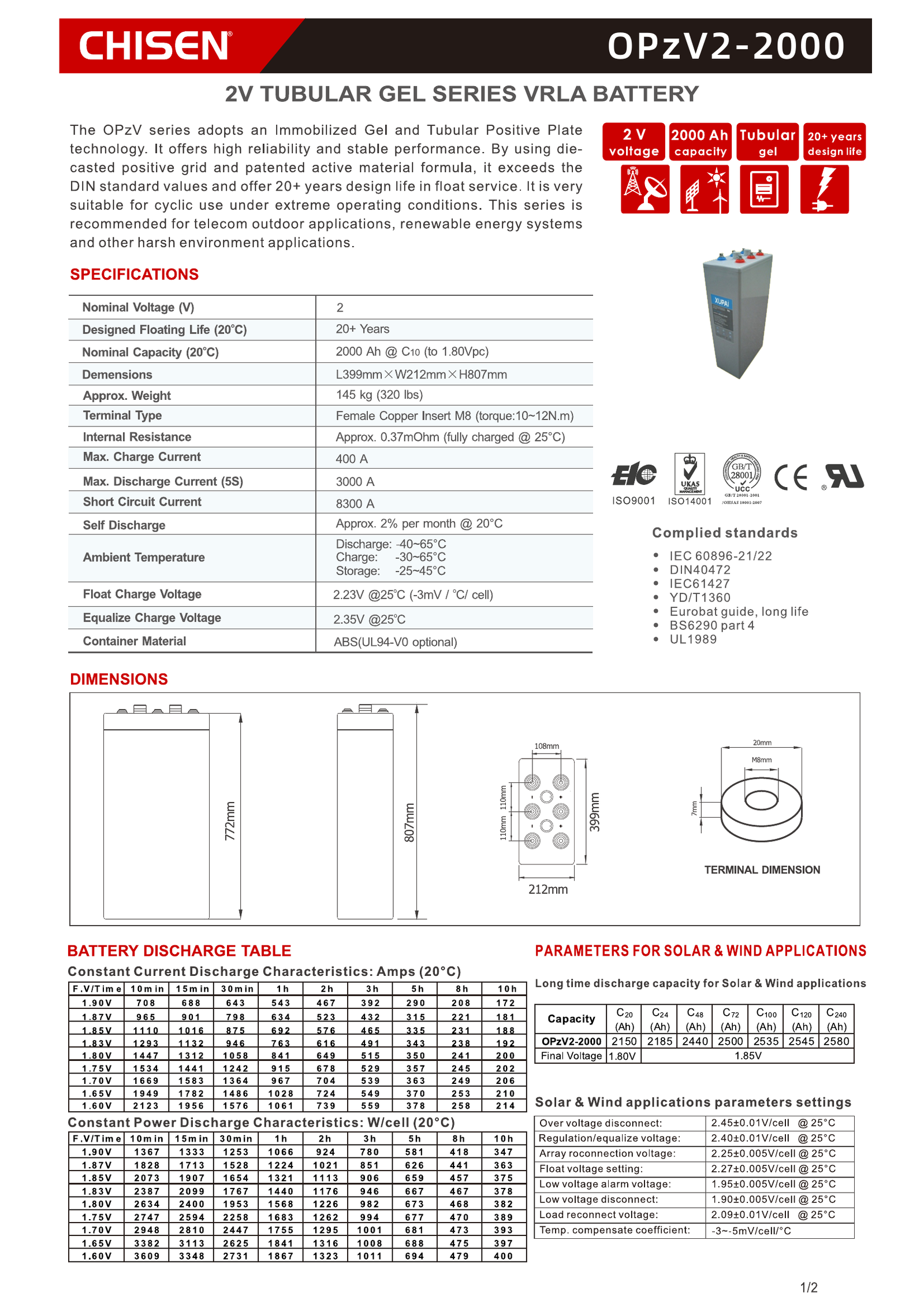
The OPzV2-2000 2V2000Ah is a 2 V tubular gel cell built for solar and off-grid storage: 2000 Ah at C10 (1.80 Vpc), a 399 × 212 × 807 mm case, 145 kg, 400 A maximum charge current, float 2.23 V at 25 °C, equalise 2.35 V at 25 °C, −3 mV/°C/cell compensation, about 0.37 mΩ internal resistance at 25 °C, and a design float life of 20+ years @20 °C. Every figure here comes from the published datasheet row for this model, and the cell-level data is repeated on this model page.
In solar service the setpoints shape the system more than the headline Ah rating does. The published series defaults shift to 2.27 ± 0.005 V per cell for float and 2.40 ± 0.01 V per cell for equalise at 25 °C, because an off-grid string is driven back toward the top of the charge curve each time the array recovers after a cloudy spell. The same strings also run hotter than a grid-tied standby cabinet, which is why the −3 mV/°C/cell compensation term should stay enabled on any site with a wide diurnal temperature swing.
The sizing arithmetic is short and fully checkable. One cell stores 2 V × 2000 Ah = 4,000 Wh = 4 kWh. A 24-cell string gives 24 × 2 V = 48 V, stores 24 × 4 kWh = 96 kWh and weighs 24 × 145 kg = 3,480 kg, so specific energy is 96,000 Wh ÷ 3,480 kg = 27.6 Wh/kg. A 240-cell string gives 480 V, 960 kWh and 34,800 kg, and the same 27.6 Wh/kg, which is the expected result when every cell in the string is identical. Runtime follows from the same figures: 96 kWh at 50% depth of discharge leaves 48,000 Wh, so a 960 W continuous load (20 A at 48 V) runs 48,000 ÷ 960 = 50 hours, and a 1,920 W load (40 A at 48 V) runs 25 hours.
Key Takeaways
- Published cell data: 2 V nominal, 2000 Ah at C10 (1.80 Vpc), 399 × 212 × 807 mm, 145 kg — datasheet values.
- Solar setpoints: float 2.27 ± 0.005 V per cell, equalise 2.40 ± 0.01 V per cell at 25 °C, with −3 mV/°C/cell compensation.
- Charge headroom: 400 A maximum charge current, equal to 20% of the 2000 Ah C10 rating an array designer sizes against.
- String arithmetic: 4 kWh per cell; a 24-cell string is 48 V, 96 kWh, 3,480 kg and 27.6 Wh/kg.
- String resistance: about 0.37 mΩ per cell, so 240 cells in series give 88.8 mΩ end to end.
- Longevity: 20+ years of design float life at 20 °C — a tubular gel figure that must not be read across to 12 V VRLA.
§1 — OPzV2-2000 Quick Specifications
The table below lists published data first and derived values second. Anything marked Arithmetic is calculated here from a datasheet row, and the calculation is shown in the value column.
| Parameter | Value | Source |
|---|---|---|
| Nominal voltage | 2 V | Datasheet |
| Capacity at C10 (1.80 Vpc) | 2000 Ah | Datasheet |
| Dimensions L×W×H | 399 × 212 × 807 mm | Datasheet |
| Weight | 145 kg | Datasheet |
| Maximum charge current | 400 A (400 A ÷ 2000 Ah = 20% of C10) | Datasheet / Arithmetic |
| Float setpoint | 2.23 V at 25 °C | Datasheet |
| Float setpoint, solar and wind service | 2.27 ± 0.005 V per cell at 25 °C | Datasheet |
| Equalise setpoint | 2.35 V at 25 °C | Datasheet |
| Equalise setpoint, solar and wind service | 2.40 ± 0.01 V per cell at 25 °C | Datasheet |
| Temperature compensation | −3 mV/°C/cell | Datasheet |
| Internal resistance | about 0.37 mΩ at 25 °C | Datasheet |
| Design float life | 20+ years @20 °C | Datasheet |
| Terminal | Female copper insert M8, tightening torque 10–12 N·m | Datasheet |
| Energy per cell | 2 V × 2000 Ah = 4,000 Wh | Arithmetic |
| Specific energy | 4,000 Wh ÷ 145 kg = 27.6 Wh/kg | Arithmetic |
| 24-cell string (48 V) | 24 × 4 kWh = 96 kWh; 24 × 145 kg = 3,480 kg; 24 × 0.37 mΩ = 8.9 mΩ | Arithmetic |
| 240-cell string (480 V) | 240 × 4 kWh = 960 kWh; 240 × 145 kg = 34,800 kg; 240 × 0.37 mΩ = 88.8 mΩ | Arithmetic |
§2 — The Pain: Off-Grid Sites Are Sized by Guesswork
Most off-grid storage problems are not chemistry problems. They are arithmetic problems that were never written down, and they surface in three places: a string that reaches the customer with less charge than the label promises, a charge controller configured with standby setpoints on a site that never stops cycling, and a battery room in Lagos, Mombasa or Mumbai that sits 10 °C above the reference temperature all year.
The first is a shipping and storage problem. A 2 V cell is far too heavy to treat as a consumable: 145 kg per OPzV2-2000 means a 24-cell string is 3,480 kg of freight, and a 240-cell string is 34,800 kg. Storage in a partial state of charge, a long lay-over in a container, and a hot yard in Karachi or Jebel Ali all consume capacity before the string is ever energised. A delivery inspection that only reads the terminals will miss this entirely.
The second is the setpoint mismatch. The published float of 2.23 V and equalise of 2.35 V are standby values for a string that sits on float and is rarely cycled. A solar string spends its life being charged and discharged, which is why the published solar and wind figures are higher: 2.27 ± 0.005 V per cell at float and 2.40 ± 0.01 V per cell at equalise, both at 25 °C. A controller left on the standby values under-charges the string on every cycle, the cells drift into a partially charged state, and usable energy per cycle falls well below the 4 kWh that the nameplate implies.
The third is thermal. The 20+ year design float life is specified at 20 °C, not at 25 °C and certainly not at the 35 °C that a sealed battery room in Dubai or Chennai can reach in the dry season. Temperature compensation of −3 mV/°C/cell exists precisely to move the setpoint down as the cell warms, and on a 48 V string that is 24 cells × 3 mV per °C = 72 mV per °C of string adjustment. Disable compensation and the string is overcharged on hot days; enable it and the correction is applied automatically. Long strings also accumulate resistance: 240 cells at about 0.37 mΩ each give 88.8 mΩ end to end, which is a meaningful voltage drop when a 400 A maximum charge current is flowing.
§3 — The Choice: Where the OPzV2-2000 Fits and Where It Does Not
The OPzV2-2000 sits in the tubular gel technology line, and the choice is usually made against three alternatives: flooded tubular cells, 12 V VRLA blocks, and lithium systems. The full product range lists the tubular gel options from 200 Ah to 2500 Ah, and the correct cell within that line is a function of string voltage and required energy, not of a single headline number.
Against flooded tubular cells, the gel construction removes watering, spill containment and mandatory ventilation, and it removes the electrolyte-level inspection that a remote site with no trained technician cannot perform reliably. Against 12 V VRLA blocks, the published design float life differs by an order of magnitude: 20+ years @20 °C for tubular OPzV2 cells, against 2–5 years for a 12 V VRLA design. Against lithium, the case for the OPzV2-2000 is not energy density but serviceability, tolerance of deep discharge and long standby periods, and the fact that a failed cell can be diagnosed and replaced with standard tooling in a string of 24 or 240 identical cells.
The OPzV2-2000 is the right choice when the bus voltage is 48 V DC or 240 V DC, when the site cycles the bank daily for more than a decade, when ambient temperature regularly exceeds 30 °C, and when maintenance is limited to voltage and density checks. It is the wrong choice when the project needs a small, lightweight package for frequent transport, or when the bank must be reconfigured repeatedly within a single season.
Selection within the line is arithmetic. For a 48 V string with 96 kWh of nominal storage, 24 cells in series hold 2,000 Ah at 48 V, and 48 V × 2,000 Ah = 96,000 Wh. For a 240 V string of the same cells, 120 cells in series hold 2,000 Ah at 240 V, and 240 V × 2,000 Ah = 480,000 Wh. Cells in series raise the bus voltage and leave the Ah rating unchanged, so the parallel count is what sets the total energy of a bank, not the cell capacity.
§4 — The Framework: A Four-Step Sizing Method for Off-Grid Strings
Step 1 — fix the bus voltage. Cells in series raise voltage and leave amp-hour capacity unchanged, so the series count is simply bus volts ÷ 2. A 48 V system uses 24 cells (24 × 2 V = 48 V), a 120 V system uses 60 cells, and a 240 V system uses 120 cells. For a 48 V string of OPzV2-2000 cells, energy is 48 V × 2,000 Ah = 96,000 Wh.
Step 2 — fix the usable energy and add the parallel count. Take the load profile, apply the depth of discharge you are willing to design around (50% is a common planning figure for long-life off-grid work), and double it to reach nominal energy. Nominal kWh ÷ 4 kWh per cell gives the parallel count: a 192 kWh nominal bank at 48 V needs 192,000 Wh ÷ 4,000 Wh = 48 cells, that is 24 in series by 2 in parallel, and it delivers 48 V × 4,000 Ah = 192,000 Wh. Each parallel group adds another 4,000 Wh to the same bus.
Step 3 — check the charge path. The published maximum charge current for the OPzV2-2000 is 400 A per cell, which is 400 A ÷ 2,000 Ah = 20% of the C10 rating. Series strings share one current, so the array current must stay within that 400 A ceiling for every cell in the string, and the controller rating should be matched to it. Series resistance then has to be carried on the cable plan: 24 cells at about 0.37 mΩ each give 8.9 mΩ for the string, so at an assumed 100 A charge current the internal drop is 100 A × 0.0089 Ω = 0.89 V on a 48 V string. A 240-cell string gives 88.8 mΩ, and the same 100 A produces 100 A × 0.0888 Ω = 8.88 V on a 480 V bus.
Step 4 — write the controller settings into the tender. Use the solar and wind service values, not the standby values: float 2.27 ± 0.005 V per cell and equalise 2.40 ± 0.01 V per cell at 25 °C. Enable the −3 mV/°C/cell compensation, and confirm that the controller applies it across a 24-cell string as 24 × 3 mV = 72 mV per °C. Record the voltage window, the equalise interval and the temperature sensor location in the delivery documentation, because a controller left at default values is the most common cause of an undercharged off-grid bank.
§5 — The Sibling Cells in the Same Tubular Gel Line
The OPzV2-2000 is the largest capacity in a series that shares one set of published setpoints, terminal design and case format across the whole line, so a project can move up or down in capacity without changing the installation method. For the smallest size in the line, see the sibling model page. The published electrical data for the range is:
| Model | V | Ah at C10 (1.80 Vpc) | Max charge current | Float | Equalise | Temp. comp. | Internal resistance | Design float life |
|---|---|---|---|---|---|---|---|---|
| OPzV2-200 | 2 | 200 | 40 A | 2.23 V at 25 °C | 2.35 V at 25 °C | −3 mV/°C/cell | about 1.0 mΩ at 25 °C | 20+ years @20 °C |
| OPzV2-500 | 2 | 500 | 100 A | 2.23 V at 25 °C | 2.35 V at 25 °C | −3 mV/°C/cell | about 0.56 mΩ at 25 °C | 20+ years @20 °C |
| OPzV2-1000 | 2 | 1000 | 200 A | 2.23 V at 25 °C | 2.35 V at 25 °C | −3 mV/°C/cell | about 0.50 mΩ at 25 °C | 20+ years @20 °C |
| OPzV2-1200 | 2 | 1200 | 240 A | 2.23 V at 25 °C | 2.35 V at 25 °C | −3 mV/°C/cell | about 0.46 mΩ at 25 °C | 20+ years @20 °C |
| OPzV2-2000 | 2 | 2000 | 400 A | 2.23 V at 25 °C | 2.35 V at 25 °C | −3 mV/°C/cell | about 0.37 mΩ at 25 °C | 20+ years @20 °C |
| OPzV2-2500 | 2 | 2500 | 500 A | 2.23 V at 25 °C | 2.35 V at 25 °C | −3 mV/°C/cell | about 0.30 mΩ at 25 °C | 20+ years @20 °C |
| Model | Dimensions L×W×H (mm) | Weight | Energy per cell (V × Ah) | Derived specific energy (Wh ÷ kg) |
|---|---|---|---|---|
| OPzV2-200 | 103 × 206 × 390 | 17.0 kg | 2 V × 200 Ah = 400 Wh | 400 ÷ 17.0 = 23.5 Wh/kg |
| OPzV2-500 | 166 × 206 × 506 | 36.3 kg | 2 V × 500 Ah = 1,000 Wh | 1,000 ÷ 36.3 = 27.5 Wh/kg |
| OPzV2-1000 | 233 × 210 × 681 | 73.2 kg | 2 V × 1,000 Ah = 2,000 Wh | 2,000 ÷ 73.2 = 27.3 Wh/kg |
| OPzV2-1200 | 275 × 210 × 681 | 84 kg | 2 V × 1,200 Ah = 2,400 Wh | 2,400 ÷ 84 = 28.6 Wh/kg |
| OPzV2-2000 | 399 × 212 × 807 | 145 kg | 2 V × 2,000 Ah = 4,000 Wh | 4,000 ÷ 145 = 27.6 Wh/kg |
| OPzV2-2500 | 487 × 212 × 807 | 181 kg | 2 V × 2,500 Ah = 5,000 Wh | 5,000 ÷ 181 = 27.6 Wh/kg |
§6 — The Trust: Factory Capacity, Certification and Delivery
A 20+ year design float life is only as good as the supply chain behind it, and for tubular gel cells that means consistent paste quality, consistent gel filling and cells drawn from the same production campaign so that a 240-cell string behaves as a set. CHISEN operates 8 production bases with an annual capacity of 70 million kVAh, and the product lines include flooded tubular OPzS2, gel tubular OPzV2 and 12 V VRLA types (6-DZF, 6-DMF and 6-EVF). The factory holds CE, ISO 9001, ISO 14001, UL and IEC certifications, which is the set most importers and OEM programmes require before a bank can be specified.
Delivery for off-grid projects is handled from China through the ports of Ningbo and Shanghai, with shipments going to distributors and project partners in India, Nigeria, Kenya, Vietnam, the Philippines and Brazil, and further into Egypt, Mexico and Indonesia. Container planning follows directly from the published cell weight: at 145 kg per cell, a 24-cell string is 3,480 kg and a 48-cell string is 6,960 kg, so palletised cell counts per container have to be agreed before production rather than after it. Cased cells are shipped from Jebel Ali, Lagos, Karachi, Mombasa, Mumbai and Santos for regional distribution.
Acceptance testing on arrival is straightforward and should be written into the purchase order. Record the open-circuit voltage of every cell and compare it with the string average, flag any cell that sits more than 0.05 V below its neighbours for a recharge and recheck, confirm the electrolyte density where the design calls for it, and tighten every terminal to the published 10–12 N·m with a calibrated wrench. Because the case is 399 × 212 × 807 mm and the M8 inserts are recessed, the crate dimensions and the rack pitch in the battery room should be confirmed against the datasheet before the container is loaded.
§7 — FAQ
Q1: What are the published nominal voltage and capacity of the OPzV2-2000? The published nominal voltage is 2 V and the capacity is 2000 Ah at C10, that is at a 10-hour discharge rate to a 1.80 V per cell cutoff. Both figures come from the OPzV2-2000 row of the manufacturer datasheet, as does the 2 V nominal class used for series connection into 48 V or 240 V strings.
Q2: What float and equalise setpoints does the manufacturer publish for the OPzV2-2000? The datasheet publishes float at 2.23 V and equalise at 2.35 V, both referenced to 25 °C. For solar and wind service the published series values are higher: float 2.27 ± 0.005 V per cell and equalise 2.40 ± 0.01 V per cell at 25 °C, with temperature compensation of −3 mV/°C/cell applied by the charge controller.
Q3: What is the maximum charging current for the OPzV2-2000? The published maximum charge current is 400 A per cell, which is 400 A ÷ 2,000 Ah = 20% of the C10 capacity rating. Cells in series carry the same current, so the whole string must stay inside that 400 A limit and the array and controller should be sized against it.
Q4: What are the case dimensions and weight of the OPzV2-2000? The published case dimensions are 399 × 212 × 807 mm for length, width and height, and the published weight is 145 kg per cell. A 24-cell string therefore weighs 24 × 145 kg = 3,480 kg, which is the figure to use for freight, floor loading and rack design.
Q5: What terminal type and torque does the OPzV2-2000 use? The datasheet specifies a female copper insert M8 terminal with a tightening torque of 10–12 N·m. Because the inserts are recessed in the case, the interconnecting busbars and the tooling used to reach them should be agreed before delivery.
Q6: How many cells does a 2V2000Ah string contain and what bus voltage does it give? The 2 V figure is the cell class, not the string size. Cells in series raise the bus voltage and leave amp-hour capacity unchanged, so a 48 V bus needs 24 cells (24 × 2 V = 48 V), a 120 V bus needs 60 cells and a 240 V bus needs 120 cells. Each OPzV2-2000 2V2000Ah cell stores 2 V × 2,000 Ah = 4,000 Wh, so a 24-cell string stores 48 V × 2,000 Ah = 96,000 Wh.
Q7: What is the published design float life of the OPzV2-2000 and at what temperature? The published design float life is 20+ years @20 °C. The temperature reference matters, because a long float-life figure quoted at 20 °C does not transfer to a battery room at 30 °C or above, which is why the controller must carry the −3 mV/°C/cell compensation. This figure belongs to tubular gel cells and is not the 2–5 year design life of a 12 V VRLA block.
Q8: How should an importer verify the OPzV2-2000 on delivery? Count the cells against the packing list, check every case for cracks or seal damage, measure the open-circuit voltage of each cell and flag any cell more than 0.05 V below the string average, and confirm terminal integrity before tightening to the published 10–12 N·m. Store the bank charged in a cool, ventilated area, record the cell serial numbers against the consignment note, and re-measure after the first full charge before commissioning.
Q9: Which certifications does the CHISEN factory behind the OPzV2-2000 hold? The factory behind the OPzV2-2000 2V2000Ah holds CE, ISO 9001, ISO 14001, UL and IEC certifications. Those approvals sit at factory level, so the importer still needs the model-specific test report, the declaration of conformity and the packing documents for the consignment it is buying.
Q10: How do I request a quotation or samples for the OPzV2-2000? Send the required string voltage, the number of cells per string, the parallel count, the destination country and the port of discharge, and the export desk will confirm the configuration and the published data for the OPzV2-2000 2V2000Ah. Samples are normally supplied on the same production specification as the production cells, so the acceptance test in the delivery documentation applies to them as well.
Expert Summary
The OPzV2-2000 2V2000Ah is a 2 V tubular gel cell with a published 2000 Ah at C10 (1.80 Vpc), a 399 × 212 × 807 mm case at 145 kg, a 400 A maximum charge current, float and equalise setpoints of 2.23 V and 2.35 V at 25 °C with the solar and wind values of 2.27 ± 0.005 V and 2.40 ± 0.01 V per cell, −3 mV/°C/cell compensation, about 0.37 mΩ internal resistance at 25 °C and a 20+ year design float life at 20 °C. One cell stores 4 kWh, a 24-cell string gives 48 V and 96 kWh at 3,480 kg and 27.6 Wh/kg, and a 240-cell string gives 480 V and 960 kWh at 88.8 mΩ. The single most consequential decision on an off-grid site is not the cell size but the controller configuration: solar setpoints, enabled temperature compensation and an array current held below the published 400 A limit decide whether the bank delivers its rated 4 kWh per cell for the life of the project. Specify those three items in the tender, verify open-circuit voltage per cell on arrival, and the OPzV2-2000 2V2000Ah does the rest.
Contact CHISEN — 24-Hour Response
For quotations, technical data sheets and sample requests for the OPzV2-2000 2V2000Ah, contact the CHISEN export desk in Hangzhou:
- Email: sales@chisen.cn
- Export manager: jack@chisen.cn
- WhatsApp: +86 131 6622 6999
- Website: www.chisen.cn
Send the string voltage, the cell count per string, the parallel count, the destination country and the discharge port, and the reply will include the published datasheet figures, the packing data and the delivery plan for the OPzV2-2000 2V2000Ah.
Related CHISEN Buyer Guides
- 6-DMF-52 12V52Ah Solar and Off-Grid Energy Storage Battery
- 6-EVF-120 12V120Ah Solar and Off-Grid Energy Storage Battery
- 6-EVF-50 12V50Ah Solar and Off-Grid Energy Storage Battery
- 6-EVF-60 12V60Ah Solar and Off-Grid Energy Storage Battery
- Battery Storage for Solar: Grid-Tied, Off-Grid, and Hybrid Systems Explained
