Answer First
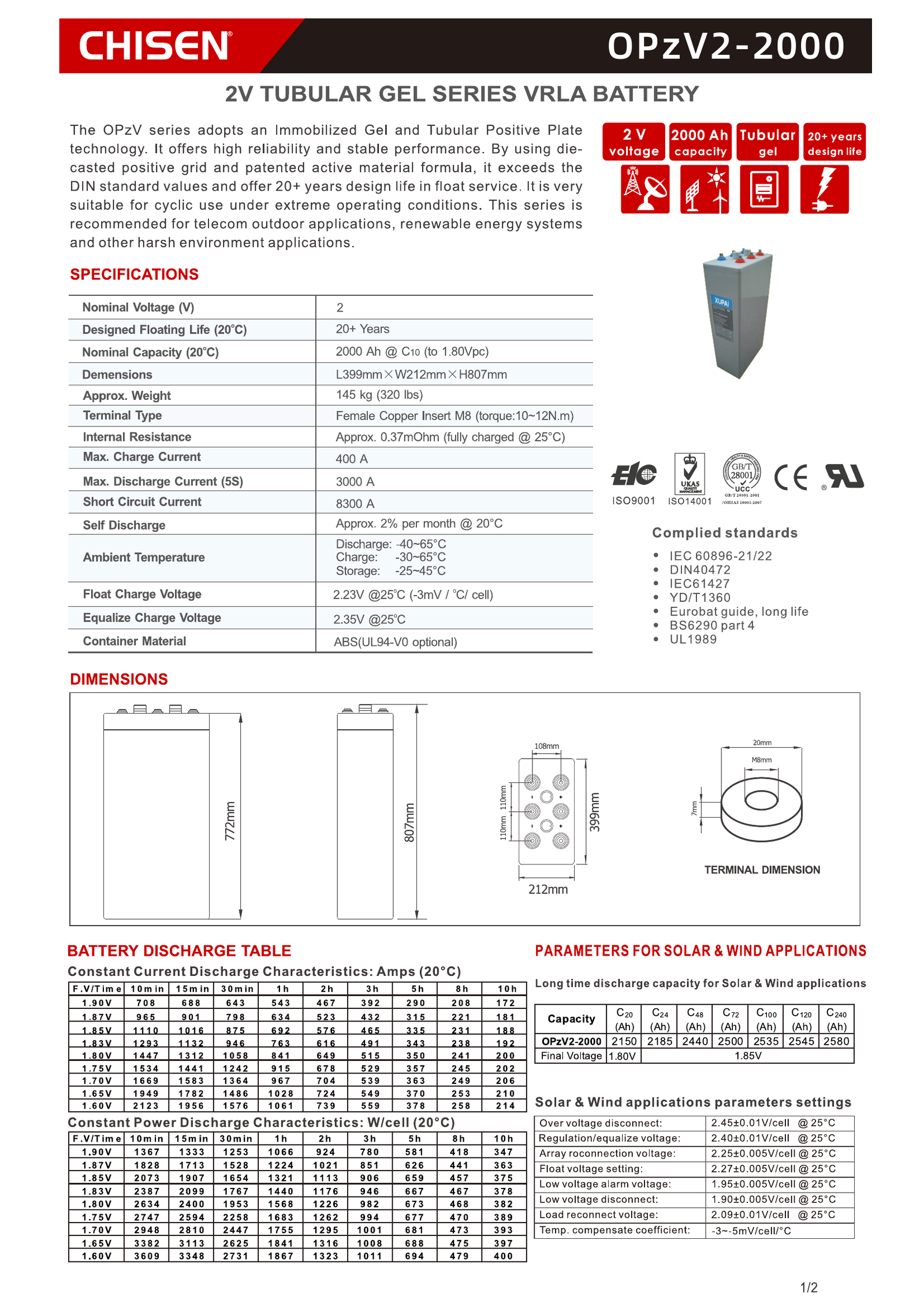
A 2V2000Ah tubular gel cell is the working unit of a DC bus, not a finished battery. The OPzV2-2000 2V2000Ah block is a single 2 V cell with 2000 Ah at the C10 rate (1.80 Vpc end point), 399×212×807 mm and 145 kg per cell, and every runtime figure in a UPS project is derived from how many of these cells are wired in series and how many identical strings are wired in parallel. Sizing the OPzV2-2000 2V2000Ah correctly starts with three numbers the datasheet publishes: 2 V nominal, 2000 Ah at C10, and a maximum charge current of 400 A. Series count sets bus voltage and stored energy; parallel count sets the current each string may carry and the total runtime.
For a 216 V DC bus the arithmetic is direct: 216 V ÷ 2 V = 108 cells in series. One string therefore stores 108 × 2 V × 2000 Ah = 432,000 Wh = 432 kWh nominal, and 108 cells weigh 108 × 145 kg = 15,660 kg. At a 50% depth-of-discharge working point that is 216 kWh usable per string. A 240 V DC bus takes 120 cells and stores 480 kWh nominal per string. These three figures — cell count, nominal kWh and string mass — are the input to every runtime, cabinet layout and thermal calculation that follows.
The published operating window is equally concrete. Float is 2.23 V per cell at 25 °C, equalise is 2.35 V per cell at 25 °C, temperature compensation is −3 mV per °C per cell, internal resistance is approximately 0.37 mΩ per cell at 25 °C, and the design float life is 20+ years at 20 °C. The 20+ year figure belongs to the tubular OPzV2/OPzS2 platform only; it must never be quoted for 12 V VRLA blocks. Current published specifications, verified values and the full OPzV series are listed on this model page and in the full product range.
Key Takeaways
- The cell is 2 V, 2000 Ah at C10 — a 216 V bus needs 108 in series, a 240 V bus needs 120, and one string stores 432 kWh or 480 kWh nominal respectively (Arithmetic from Datasheet values).
- Current per string, not total current, limits the design. The C10 rating of 2000 Ah equals 200 A; keep each parallel string at or below 200 A or the published capacity no longer applies (Arithmetic).
- Internal resistance drives the endgame. 108 cells × 0.37 mΩ = 39.96 mΩ per string, so a 150 A string current costs roughly 6 V of bus drop — 0.057 V per cell (Arithmetic).
- Published setpoints are temperature-corrected. Float 2.23 V and equalise 2.35 V at 25 °C, minus 3 mV/°C/cell, so 35 °C float is 2.20 V and 35 °C equalise is 2.32 V (Arithmetic).
- Maximum charge current is 400 A per cell, which is the charger sizing rule for a parallel string count: 3 strings need a 1,200 A rectifier class (Arithmetic).
- Design float life is 20+ years at 20 °C for tubular OPzV2 gel, with maximum charge current, internal resistance and terminal torque all published for the OPzV2-2000 2V2000Ah cell (Datasheet).
§1 — OPzV2-2000 Quick Specifications
The table below lists only values published by the manufacturer for the OPzV2-2000 cell. Anything the factory has not released is marked as not published, and it should be requested in writing before a bus layout is frozen.
| Parameter | Value | Source |
|---|---|---|
| Nominal voltage | 2 V | Datasheet |
| Capacity | 2000 Ah @ C10 (1.80 Vpc) | Datasheet |
| Dimensions (L×W×H) | 399×212×807 mm | Datasheet |
| Weight | 145 kg | Datasheet |
| Maximum charge current | 400 A | Datasheet |
| Float voltage | 2.23 V @25 °C | Datasheet |
| Equalise voltage | 2.35 V @25 °C | Datasheet |
| Temperature compensation | −3 mV/°C/cell | Datasheet |
| Internal resistance | ~0.37 mΩ @25 °C | Datasheet |
| Design float life | 20+ years @20 °C | Datasheet |
| Terminal | Female Copper Insert M8, 10–12 N·m | Datasheet |
| Capacity at the 1-hour discharge rate | not published | to be requested from the factory |
| Cycle life at given depth of discharge | not published | to be requested from the factory |
§2 — The Pain: Five Sizing Errors That Show Up After Commissioning
Most UPS battery projects are not failed by chemistry. They are failed by arithmetic performed before anyone wrote down the bus voltage, the load profile and the ambient temperature. The OPzV2-2000 2V2000Ah is unforgiving of these errors because its published capacity is tied to a specific rate and a specific end-point voltage.
Error one: quoting nominal Ah as usable Ah. The datasheet rating is 2000 Ah at the C10 rate to 1.80 Vpc. A string that is asked to deliver its rated energy in twenty minutes, or to a 1.50 Vpc end point, will not return 2000 Ah. Capacity at the 1-hour rate and at 1.50 Vpc is not published for the OPzV2-2000 2V2000Ah, so any runtime claim built on those numbers has to be confirmed with the factory before it goes into a tender document.
Error two: sizing on bus voltage alone. A 108-cell string looks identical whether the load is 20 kW or 200 kW. It is not identical: the same string at 200 A and at 400 A behaves completely differently, and only one of those conditions matches the published rating.
Error three: ignoring the voltage drop across 108 cells. Internal resistance is ~0.37 mΩ per cell, so a string measures 39.96 mΩ in total. At 150 A that is 5.99 V of drop, or 0.055 V per cell. A rectifier output tolerance, a cable run and a contactor resistance of the same order will then push the last cell through 1.80 V while the bus still reads nominal on the meter.
Error four: treating a cabinet as if it were a battery. A 108-cell string occupies 68.3 L per cell, so a single-row layout needs 108 × 0.212 m = 22.9 m of rack length. Laid out in two rows of 54 cells the footprint becomes 54 × 0.212 m = 11.45 m of length plus 0.807 m of height per tier, and the floor loading becomes 15,660 kg for a 108-cell string.
Error five: reserving no thermal margin for the charge stage. At the C10 rate of 200 A, dissipation in one string is I²R = 200² × 0.03996 Ω = 1,598 W, and at the published maximum charge current of 400 A it rises to 6,394 W per string. That heat is generated inside a closed cabinet during equalisation, in the hottest months, in the market where ambient is already high.
§3 — The Choice: Three String Architectures for the Same Load
Given a fixed DC bus voltage, the design freedom is in the parallel string count and the depth of discharge you are willing to operate at. The three architectures below are the ones engineers normally compare for the OPzV2-2000 2V2000Ah cell, and each is a different answer to a different constraint.
Architecture A — one string, one bus. The simplest possible arrangement: 108 cells in series, no parallel strings. It gives 432 kWh nominal, 216 kWh usable at 50% depth of discharge, and a maximum continuous string current of 200 A, which caps the supported load at 200 A × 216 V = 43.2 kW. It is the right answer for a small critical load with a modest runtime target, and the wrong answer the moment the load exceeds 43.2 kW.
Architecture B — two strings in parallel. Two identical 108-cell strings give 864 kWh nominal and 432 kWh usable at 50% depth of discharge, and the load is shared: each string carries half of the total current. The cost is a parallel string cabinet, two independent battery strings to maintain, and a redundancy question that must be answered before the order is placed, because a single-cell failure in a parallel string only costs half the runtime.
Architecture C — multiple strings for a load-dominant design. Three strings in parallel give 1,296 kWh nominal and 648 kWh usable at 50% depth of discharge, and each string carries one third of the load current. This is the architecture that lets the project hit a long runtime target without pushing each string above its rated current, and it is also the one where charger sizing and ventilation become non-negotiable.
For all three architectures the arithmetic is the same shape: nominal energy = strings × cells × 2 V × 2000 Ah; usable energy = nominal × depth of discharge; runtime = usable energy ÷ load power. The published figures for the OPzV2-2000 2V2000Ah make the first line exact; the depth of discharge is an engineering choice that should be stated in writing, because it changes both the runtime and the design life the project can claim.
§4 — The Framework: A Seven-Step Method for Sizing an OPzV2-2000 String
The following sequence uses only published OPzV2-2000 2V2000Ah data plus arithmetic, and it produces a bus layout, a runtime figure and a charger rating that can be checked line by line.
Step 1 — fix the bus voltage. A 216 V DC bus takes 216 ÷ 2 = 108 cells in series; a 240 V DC bus takes 240 ÷ 2 = 120 cells; a 480 V DC bus takes 240 cells. Every cell added in series adds 4,000 Wh of stored energy — 2 V × 2000 Ah — so the cell count is the first lever on runtime, not the last.
Step 2 — compute nominal energy per string. For 108 cells: 108 × 2 V × 2000 Ah = 432,000 Wh = 432 kWh. For 120 cells: 480 kWh. For 240 cells: 960 kWh.
Step 3 — set the per-string current limit. The published 2000 Ah C10 rating corresponds to 2000 ÷ 10 h = 200 A. Treat 200 A per string as the ceiling for which the published capacity still applies. A 100 kW load on a 216 V bus with three parallel strings draws 100,000 W ÷ (3 × 216 V) = 154.3 A per string, comfortably inside the rating; the same load on two strings would draw 231.5 A per string and would leave the published capacity regime.
Step 4 — apply the depth of discharge and get the runtime. Nominal energy for three 108-cell strings is 3 × 432 kWh = 1,296 kWh; at 50% depth of discharge that is 648 kWh usable; at a 100 kW load the runtime is 648 kWh ÷ 100 kW = 6.48 h. Change one of the three inputs and the result moves immediately — which is exactly why the depth of discharge and the load profile must be written into the specification.
Step 5 — check the voltage drop. String resistance is 108 × 0.37 mΩ = 39.96 mΩ. At 154.3 A per string the drop is 154.3 A × 0.03996 Ω = 6.17 V across the string, or 0.057 V per cell; a single string carrying 200 A loses 8.0 V. Add cable and contactor losses to this figure when the end-point voltage is set.
Step 6 — size the charger and the cooling. The published maximum charge current is 400 A per cell, so three parallel strings need up to 1,200 A of rectifier capacity; a 216 V three-string arrangement at that limit is 1,200 A × 216 V = 259.2 kW of charging power. Dissipation at that point is 400² A × 0.03996 Ω = 6,394 W per string, which must be removed from the cabinet.
Step 7 — set the setpoints for the ambient. Float 2.23 V at 25 °C and equalise 2.35 V at 25 °C, both compensated by −3 mV/°C/cell. At 35 °C float becomes 2.23 − 0.030 = 2.20 V and equalise becomes 2.35 − 0.030 = 2.32 V; at 15 °C float becomes 2.23 + 0.030 = 2.26 V. Terminal torque is 10–12 N·m on the female M8 copper insert.
§5 — OPzV2-2000 Against Its Siblings: Same Bus, Different Strings
Because all five cells below share the same chemistry, the same 2 V nominal voltage, the same float and equalise setpoints and the same temperature compensation slope, they are interchangeable inside a bus — what changes is the string count needed to deliver the same energy and current. The published values are transcribed from the datasheet; the energy and string columns are arithmetic on those values.
| Model | V | Ah @ C10 | L×W×H mm | Weight | Max charge current | Internal resistance | Energy per cell | Wh/kg | 108-cell string | 108-cell string mass |
|---|---|---|---|---|---|---|---|---|---|---|
| OPzV2-200 | 2 | 200 | 103×206×390 | 17.0 kg | 40 A | ~1.0 mΩ @25 °C | 400 Wh | 23.5 | 43.2 kWh | 1,836 kg |
| OPzV2-500 | 2 | 500 | 166×206×506 | 36.3 kg | 100 A | ~0.56 mΩ @25 °C | 1,000 Wh | 27.5 | 108 kWh | 3,920 kg |
| OPzV2-1000 | 2 | 1000 | 233×210×681 | 73.2 kg | 200 A | ~0.50 mΩ @25 °C | 2,000 Wh | 27.3 | 216 kWh | 7,906 kg |
| OPzV2-1200 | 2 | 1200 | 275×210×681 | 84 kg | 240 A | ~0.46 mΩ @25 °C | 2,400 Wh | 28.6 | 259.2 kWh | 9,072 kg |
| OPzV2-2000 | 2 | 2000 | 399×212×807 | 145 kg | 400 A | ~0.37 mΩ @25 °C | 4,000 Wh | 27.6 | 432 kWh | 15,660 kg |
| OPzV2-2500 | 2 | 2500 | 487×212×807 | 181 kg | 500 A | ~0.30 mΩ @25 °C | 5,000 Wh | 27.6 | 540 kWh | 19,548 kg |
§6 — The Trust: Factory Capacity, Certification and Export Logistics
The OPzV2-2000 2V2000Ah is produced in a plant that runs eight production bases with an annual capacity of 70 million kVAh, and the line that ships tubular gel cells also covers flooded tubular OPzS2 and 12 V VRLA blocks in the 6-DZF, 6-DMF and 6-EVF families of the plant catalogue. The certification set published for the factory is CE, ISO 9001, ISO 14001, UL and IEC, which is the set most African, South American and Asian importers ask for during supplier qualification.
Delivery is arranged from Chinese export ports — Shanghai, Ningbo and Shenzhen are the usual loading points — and the freight cost of a 145 kg cell is a real factor in bus layout decisions, because a 108-cell string of 15,660 kg has to reach the site as a routed shipment rather than as loose units. Buyers in India, Nigeria, Kenya, Vietnam, the Philippines, Brazil, Egypt, Mexico, Indonesia, Pakistan, Bangladesh, the UAE, Turkey and South Africa receive the same drawing, datasheet and inspection records, and the port and destination pairing (Jebel Ali and Dubai for Gulf consignments, Karachi and Mumbai for South Asia, Lagos and Mombasa for East and West Africa, Durban for the southern corridor, Cairo and Port Said for North Africa, Santos and Callao for Latin America) is agreed before production starts.
Every consignment can be verified on arrival by checking the cell label against the datasheet: 2 V nominal, 2000 Ah at C10 to 1.80 Vpc, 399×212×807 mm, 145 kg, female M8 copper insert. The factory also issues measured internal resistance and a self-discharge check on request, so a distributor can confirm the delivered cells rather than accept them on paper alone.
§7 — FAQ
Q1: What are the published nominal voltage and capacity of the OPzV2-2000? 2 V nominal and 2000 Ah at the C10 rate with a 1.80 Vpc end point, per the datasheet. Stored energy per cell is 2 V × 2000 Ah = 4,000 Wh (Datasheet, Arithmetic).
Q2: What float and equalise setpoints does the manufacturer publish for the OPzV2-2000? Float 2.23 V per cell and equalise 2.35 V per cell, both referenced to 25 °C, with temperature compensation of −3 mV/°C/cell. At 35 °C these become 2.20 V and 2.32 V (Datasheet, Arithmetic).
Q3: What is the maximum charging current for the OPzV2-2000? 400 A per cell (Datasheet). For a three-string parallel arrangement the rectifier must therefore be rated for up to 1,200 A.
Q4: What are the case dimensions and weight of the OPzV2-2000? 399×212×807 mm and 145 kg per cell (Datasheet), giving 68.3 L of cell volume and 27.6 Wh/kg (Arithmetic).
Q5: What terminal type and torque does the OPzV2-2000 use? Female copper insert M8, tightened to 10–12 N·m (Datasheet).
Q6: How many cells does a 2V2000Ah string contain and what bus voltage does it give? It depends on the bus: 108 cells give 216 V, 120 cells give 240 V, and 240 cells give a 480 V DC bus (Arithmetic). Each additional cell adds 4,000 Wh to the string.
Q7: What is the published design float life of the OPzV2-2000 and at what temperature? 20+ years of design float life at 20 °C (Datasheet). This figure belongs to the tubular OPzV2 gel platform and does not apply to 12 V VRLA blocks.
Q8: How should an importer verify the OPzV2-2000 on delivery? Check the label against the datasheet values, count the cells against the series plan, confirm the terminal type and measure internal resistance against the published ~0.37 mΩ at 25 °C. Detailed measured figures are available from the factory on request.
Q9: Which certifications does the CHISEN factory behind the OPzV2-2000 hold? CE, ISO 9001, ISO 14001, UL and IEC, with eight production bases and an annual capacity of 70 million kVAh.
Q10: How do I request a quotation or samples for the OPzV2-2000? Send the bus voltage, target load in kW, required runtime in hours and the destination port to the export desk, and a quotation with the cell count, string count, charger rating and shipping estimate follows. Samples and measurement reports are arranged on request.
Expert Summary
The OPzV2-2000 2V2000Ah is a 2 V, 2000 Ah C10 tubular gel cell with 400 A maximum charge current, 0.37 mΩ internal resistance at 25 °C and a 20+ year design float life at 20 °C, so every UPS configuration built on it reduces to published numbers plus arithmetic: cells in series set the bus voltage, parallel strings set the current and the runtime, and nominal energy per string is cells × 4,000 Wh. A 216 V bus with three parallel strings holds 1,296 kWh nominal and 648 kWh usable at 50% depth of discharge, carries 154.3 A per string, loses 6.17 V across 39.96 mΩ of string resistance, and needs a rectifier class of 1,200 A and roughly 6.4 kW of cooling per string at the charge limit. Engineers who fix the bus voltage, the load profile, the depth of discharge and the ambient temperature before ordering, and who take the depth-of-discharge and rate-corrected capacity as written items in the specification, get a bank that matches its datasheet on the day it is commissioned.
Contact CHISEN — 24-Hour Response
Sales enquiries: sales@chisen.cn | Export desk: jack@chisen.cn | WhatsApp: +86 131 6622 6999 | www.chisen.cn
Related CHISEN Buyer Guides
- 12V 100Ah LiFePO4 vs Lead Acid Battery: Cycle Life, Published 6-EVF-100 Specs and Where Ea
- 2V 1000Ah Battery Buyer Guide 2026: Telecom, UPS, and Solar Storage Sourcing
- 6-DMF-52 12V52Ah UPS Battery: Complete Buyer Guide for Data Centres and Telecom
- 6-EVF-120 12V120Ah AGM VRLA Battery for UPS: Specs, Float Charging
- 6-EVF-150 12V150Ah AGM Battery: Published Specs, Parallel String Sizing and EVF Range Comp
