Answer First
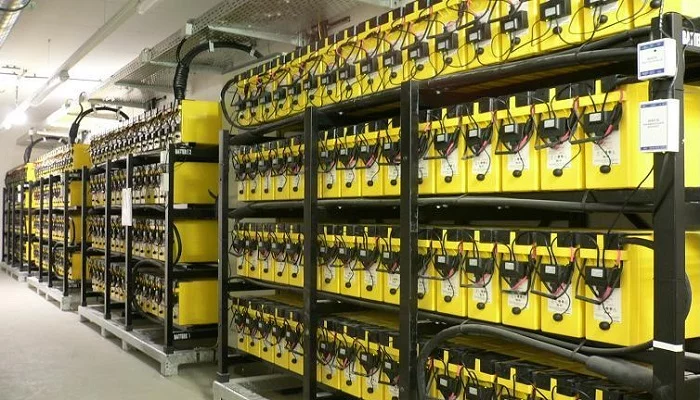
The 6-DMF-52 is a 12 V, 52 Ah C3-rated VRLA (AGM) battery built for standby and shallow-cycle duty in single-phase UPS cabinets, telecom power shelves, small data-centre floor units and emergency lighting boards. The published model record gives 224 × 135 × 175 mm casing, 13.7 ± 0.2 kg, a φ11.8-M6 terminal, a 13.5 V float setpoint and a 14.1 V equalise setpoint, 10.4 A maximum charge current, a 1.75 V/cell cut-off, self-discharge of ≤3 %/month at 25 °C and a −15…50 °C working range. Cycle life is published as 350–600 cycles at 50–80 % depth of discharge. Design life in years is not published for this model, so any statement in years must be treated as unverified by the factory.
For sizing arithmetic, the block stores 12 V × 52 Ah = 624 Wh nominal. Divided by the published weight of 13.7 kg that gives 624 ÷ 13.7 = 45.5 Wh/kg. A 12 V string is 6 × 2 V cells, so the bus voltage is 6 × 2 V = 12.0 V, and 12.0 V ÷ 2 V = 6 cells per battery. Full drawings, dimensions and terminal data are published on this model page.
The buying decision rarely turns on the headline Ah number. It turns on three things: whether the cabinet’s charge current can drive 10.4 A into the string, whether the case footprint and terminal clearance survive the rack you have already bought, and whether the supplier can supply the same 6-DMF-52 again in eighteen months without changing the cell platform. This guide walks through each of those decisions, then places the 6-DMF-52 next to the sibling sizes your engineers will actually ask about.
Key Takeaways
- Published specification set: 12 V, 52 Ah, C3 rate, 224 × 135 × 175 mm, 13.7 ± 0.2 kg, φ11.8-M6 terminal, 13.5 V float, 14.1 V equalise, 10.4 A charge current, 1.75 V/cell cut-off, ≤3 %/month self-discharge, −15…50 °C working temperature, cycle life 350–600 (all values from the factory model record).
- Nominal energy: 12 V × 52 Ah = 624 Wh; 624 ÷ 13.7 kg = 45.5 Wh/kg, a realistic figure for a 6-DMF-series AGM case of this size.
- String arithmetic: 12 V ÷ 2 V = 6 cells per battery, 6 × 2 V = 12.0 V bus, with 6 batteries in series giving 72 V and 312 Ah.
- Charger headroom: the published 10.4 A charge current equals 20 % of the 52 Ah rating, so the UPS charger must be set to 10.4 A per battery or the string will be under-charged on a long tail of runtime events.
- Cut-off discipline: the published 1.75 V/cell cut-off is 10.50 V per battery, which is the number to fix in the discharge table, not the higher values often quoted for tubular designs.
- Design life in years is not published for the 6-DMF-52; use the 350–600 cycle figure and the 2–5 year band stated for the sibling 12 V models, and request a written statement from the factory before you commit to a replacement cycle.
§1 — 6-DMF-52 Quick Specifications
Every row below is copied from the published model record for the 6-DMF-52. Where the factory has not released a figure, the row reads “not published” rather than an estimate.
| Parameter | Published value | Source |
|---|---|---|
| Nominal voltage | 12 V | Model page |
| Nominal capacity | 52 Ah | Model page |
| Capacity rate | C3 | Model page |
| Dimensions L × W × H | 224 × 135 × 175 mm | Model page |
| Weight | 13.7 ± 0.2 kg | Model page |
| Terminal | φ11.8-M6 | Model page |
| Float voltage | 13.5 V | Model page |
| Equalise voltage | 14.1 V | Model page |
| Cycle life | 350–600 cycles (DoD 50–80 %) | Model page |
| Maximum charge current | 10.4 A | Model page |
| Cut-off voltage | 1.75 V/cell | Model page |
| Self-discharge | ≤3 %/month at 25 °C | Model page |
| Working temperature | −15…50 °C | Model page |
| Design life in years | not published | Model page |
| Case material and lid seal | to be requested from the factory | Model page |
| Warranty period in years | to be requested from the factory | Model page |
§2 — The Pain: Why 12V52Ah Standby Procurement Goes Wrong
Most failures in 12 V standby procurement are not chemistry failures. They are specification failures: a cabinet was built for one cell platform, the replacement string arrived with a different case height, and the battery no longer clears the fan wall. The second classic failure is a charger set above what the cell can accept, which drives heat and destroys capacity over time.
A third and less visible failure is the mismatch between the published charge current and the configured charge current. The 6-DMF-52 model record publishes 10.4 A as the charge current, which is 52 Ah × 20 % = 10.4 A. If a UPS is set to recharge at, for example, 20 A per battery because the original string was a different chemistry, the battery is being driven far outside its published envelope. Capacity loss and shortened cycle life follow, and the fault is usually logged as “battery failure” rather than “charger mis-set”.
The fourth failure is documentation. Importers buying 12 V VRLA across borders face three recurring gaps: no written design-life statement, no declared cut-off voltage for the discharge table, and no certificate trail attached to the delivered lot. The 6-DMF-52 published record answers the second question directly (1.75 V/cell) and leaves the first open, which is precisely why a written factory statement is part of the purchase order and not a courtesy request.
§3 — The Choice: Matching the 6-DMF-52 to Your Duty
Choosing among 12 V standby sizes is an exercise in three independent variables: energy per string, physical footprint, and recharge duty. The 6-DMF-52 sits in the middle of the CHISEN 12 V VRLA range, which is shown on the full product range page for the DZF and DMF series.
Energy per string. At 624 Wh nominal the 6-DMF-52 covers a modest but very common duty: one small server or comms cabinet, a telecom remote unit, a branch controller or an emergency lighting board. If your load is an entire row of racks, the string count multiplies and so does the floor space per unit of energy.
Physical footprint. The 224 × 135 × 175 mm case and 13.7 kg mass are the numbers your mechanical drawing must use. Compare that with the taller 175 mm-class cases in the same series and with the wider 230 mm-class case of the 50 Ah unit: the difference decides whether two batteries fit per row in a standard 19-inch shelf or only one, which changes the whole cabinet layout. Mechanical drawings and the full dimension set for this model are on this model page.
Recharge duty. The 10.4 A charge current is the constraint most often missed. A string that must recover from a full-depth discharge within four hours needs a charger able to deliver 10.4 A per battery without current sharing problems across parallel strings.
Terminal and service. The φ11.8-M6 terminal is a stud type that accepts standard lug hardware, which simplifies field replacement in countries where the incumbent cells use a different stud diameter — for example in Nigeria, Kenya, Egypt and Mexico, where 12 V VRLA replacements are often bought as loose units rather than as a matched set.
Second sourcing. If your project will run for years, confirm that the cell platform behind the 6-DMF-52 is stable. The closest sibling in the same series of case dimensions is the 6-DMF-38, whose published dimensions and electrical data are set out on the sibling model page; a supplier that can quote both from the same production line is a lower-risk partner than one that can only quote the single size you asked for today.
§4 — The Framework: A Four-Step Sizing and Acceptance Method
This is the working sequence we use with importers and OEM integrators before a single 6-DMF-52 is ordered. It is deliberately short, because the specification set is published and the arithmetic is fixed.
Step 1 — Fix the string configuration. Decide whether the UPS runs a single 12 V string or a 72 V string. For a 72 V configuration: 72 V ÷ 12 V = 6 batteries in series, and the series capacity stays at 52 Ah, so string energy = 72 V × 52 Ah = 3,744 Wh. For a 24 V configuration: 24 V ÷ 12 V = 2 batteries, string energy = 24 V × 52 Ah = 1,248 Wh. Write the string configuration on the order, because it decides the terminal hardware and the charger model.
Step 2 — Size against measured load, not nameplate. Take the load in watts from the UPS specification, multiply by the required autonomy in hours, and divide by the derating factor your environment demands. A 200 W load with 30 minutes of autonomy needs 200 W × 0.5 h = 100 Wh at the load side; the string delivers 624 Wh, and after a 0.7 temperature and age derating the usable figure is 624 Wh × 0.7 = 437 Wh, which is 437 Wh ÷ 100 Wh = 4.4 times the requirement. The margin is the point: a string that is sized to 1.2 times the load has no room for a capacity fade in year three.
Step 3 — Verify the charger and the temperature. The published maximum charge current is 10.4 A. Confirm the charger supports at least that figure per battery and that the cabinet sits inside the −15…50 °C working range; a shelf that runs at 35 °C in Dubai or Chennai has shorter life than the cycle figure suggests, and that is a mechanical decision made long before the battery order.
Step 4 — Fix the acceptance criteria on paper. Write the published values into the inspection checklist: 224 × 135 × 175 mm, 13.7 ± 0.2 kg, φ11.8-M6 terminal, 13.5 V float, 14.1 V equalise, 10.4 A charge current, 1.75 V/cell cut-off. A lot that fails on case height or terminal type cannot be returned, so the check belongs at the container door, not at installation.
§5 — 6-DMF-52 Against the Sibling 12 V Sizes
The table below uses only the published values of the CHISEN 12 V VRLA series. No cell in this list is described in qualitative terms, because a datasheet comparison is only useful when every cell holds a number you can put into a quotation.
| Model | Capacity | Rate | L × W × H (mm) | Weight | Terminal | Float | Equalise | Cycle life | Charge current | Cut-off | Self-discharge | Working temp | Design life | Source |
|---|---|---|---|---|---|---|---|---|---|---|---|---|---|---|
| 6-DZF-12 | 12 Ah | C2 | 151 × 99 × 99 | 3.6 ± 0.2 kg | φ8.0-M5 | 13.5 V | 14.1 V | 350–600 | 2.4 A | 1.75 V/cell | ≤3 %/month | −15…50 °C | 2–5 years | Model page |
| 6-DZF-20 | 20 Ah | C2 | 180 × 76 × 170 | 6.1 ± 0.2 kg | φ8.8-M5 | 13.5 V | 14.1 V | 350–600 | 4.0 A | 1.75 V/cell | ≤3 %/month | −15…50 °C | 2–5 years | Model page |
| 6-DMF-38 | 38 Ah | C3 | 224 × 106 × 175 | 10.45 ± 0.2 kg | φ9.8-M5 | 13.5 V | 14.1 V | 350–600 | 7.6 A | 1.75 V/cell | ≤3 %/month | −15…50 °C | not published | Model page |
| 6-DMF-45 | 45 Ah | C3 | 224 × 121 × 175 | 12.3 ± 0.2 kg | φ11.8-M5 | 13.5 V | 14.1 V | 350–600 | 9.0 A | 1.75 V/cell | ≤3 %/month | −15…50 °C | 2–5 years | Model page |
| 6-DMF-52 | 52 Ah | C3 | 224 × 135 × 175 | 13.7 ± 0.2 kg | φ11.8-M6 | 13.5 V | 14.1 V | 350–600 | 10.4 A | 1.75 V/cell | ≤3 %/month | −15…50 °C | not published | Model page |
| 6-EVF-50 | 50 Ah | C3 | 230 × 140 × 180 | 15.25 ± 0.2 kg | φ11.8-M6 | 13.5 V | 14.1 V | 350–600 | 10.0 A | 1.75 V/cell | ≤3 %/month | −15…50 °C | 2–5 years | Model page |
| 6-EVF-60 | 60 Ah | C3 | 258 × 170 × 160 | 18.8 ± 0.2 kg | φ14-M6 | 13.5 V | 14.1 V | 350–600 | 12.0 A | 1.75 V/cell | ≤3 %/month | −15…50 °C | 2–5 years | Model page |
| 6-EVF-80 | 80 Ah | C3 | 259 × 170 × 218 | 25.7 ± 0.2 kg | φ16-M6 | 13.5 V | 14.1 V | 350–600 | 16.0 A | 1.75 V/cell | ≤3 %/month | −15…50 °C | 2–5 years | Model page |
| 6-EVF-100 | 100 Ah | C3 | 330 × 170 × 218 | 31.5 ± 0.2 kg | φ20-M8 | 13.5 V | 14.1 V | 350–600 | 20.0 A | 1.75 V/cell | ≤3 %/month | −15…50 °C | 2–5 years | Model page |
| 6-EVF-120 | 120 Ah | C3 | 407 × 170 × 240 | 40 ± 0.2 kg | φ20-M8 | 13.5 V | 14.1 V | 350–600 | 24.0 A | 1.75 V/cell | ≤3 %/month | −15…50 °C | 2–5 years | Model page |
| 6-EVF-150 | 150 Ah | C3 | 483 × 170 × 240 | 48.5 ± 0.2 kg | φ20-M8 | 13.5 V | 14.1 V | 350–600 | 30.0 A | 1.75 V/cell | ≤3 %/month | −15…50 °C | 2–5 years | Model page |
§6 — The Trust: Factory Evidence Behind Every 6-DMF-52 Shipment
CHISEN operates 8 production bases with an annual capacity of 70 million kVAh, and the 12 V VRLA line covers the 6-DZF, 6-DMF and 6-EVF series. The same group builds flooded tubular OPzS2, gel tubular OPzV2 and 12 V VRLA types, so a 6-DMF-52 order can be consolidated with tubular substation or telecom packages instead of shipped separately. Factory certifications held are CE, ISO 9001, ISO 14001, UL and IEC. CHISEN Battery is based in Hangzhou, China, and the export desk handles specification sheets, certificates and shipment documents.
Where the batteries ship. The 6-DMF-52 ships from Chinese ports — Ningbo and Shanghai are the usual loading points — to importers and integrators in India, Nigeria, Kenya, Vietnam, the Philippines, Brazil, Pakistan, Bangladesh, Indonesia, Egypt, Morocco, South Africa, the United Arab Emirates and Mexico. Typical destinations are Mumbai, Chennai, Karachi, Lagos, Mombasa, Durban, Jebel Ali, Port Said, Santos and Callao. Common routes are Ningbo to Mumbai or Chennai, Shanghai to Lagos or Mombasa, and Shenzhen to Jebel Ali for Gulf distribution. We do not publish customer names or order volumes, and we do not need to: the published specification record and the certificate trail are the verifiable part of the claim.
What travels with the goods. Every shipment can be issued with the model datasheet, the applicable test certificates, the packing list and the case marking record. For a 6-DMF-52 lot, request the production date and the case marking photo sheet before the container is sealed, because the case marking is what proves the delivered cells belong to the stated production run.
Pre-shipment verification. A third-party inspection can be scheduled against the published values: 224 × 135 × 175 mm case, 13.7 ± 0.2 kg, φ11.8-M6 terminal, 13.5 V float and 14.1 V equalise printed on the label. These are the same values our engineers quote in the sales specification, which means the inspection sheet and the order sheet read the same way.
§7 — FAQ
Q1: What are the published nominal voltage and capacity of the 6-DMF-52? The factory model record publishes 12 V nominal and 52 Ah at the C3 rate. Nominal energy works out to 12 V × 52 Ah = 624 Wh. Source: Model page.
Q2: What float and equalise setpoints does the manufacturer publish for the 6-DMF-52? Float 13.5 V and equalise 14.1 V, which is 13.5 V ÷ 6 = 2.25 V per cell and 14.1 V ÷ 6 = 2.35 V per cell. Source: Model page.
Q3: What is the maximum charging current for the 6-DMF-52? 10.4 A, equal to 52 Ah × 20 % = 10.4 A. Set the charger to this figure or lower per battery. Source: Model page.
Q4: What are the case dimensions and weight of the 6-DMF-52? 224 × 135 × 175 mm and 13.7 ± 0.2 kg. Source: Model page.
Q5: What terminal type and torque does the 6-DMF-52 use? A φ11.8-M6 stud terminal. The published record confirms the terminal type; the tightening torque is to be requested from the factory for the specific lot.
Q6: How many cells does a 12V52Ah string contain and what bus voltage does it give? 12 V ÷ 2 V = 6 cells per battery, and 6 × 2 V = 12.0 V bus voltage. Six batteries in series give 72 V at 52 Ah, or 72 V × 52 Ah = 3,744 Wh. Arithmetic on the Model page values.
Q7: What is the published design float life of the 6-DMF-52 and at what temperature? Design life in years is not published for the 6-DMF-52; the published cycle life is 350–600 cycles at 50–80 % depth of discharge, and the working temperature range is −15…50 °C. A written float-life statement is to be requested from the factory. Source: Model page.
Q8: How should an importer verify the 6-DMF-52 on delivery? Measure the case and mass against 224 × 135 × 175 mm and 13.7 ± 0.2 kg, confirm the φ11.8-M6 terminal and the printed float and equalise values of 13.5 V and 14.1 V, and photograph the case markings and the production date before the pallet is broken down. Source: Model page.
Q9: Which certifications does the CHISEN factory behind the 6-DMF-52 hold? CE, ISO 9001, ISO 14001, UL and IEC, with 8 production bases and 70 million kVAh of annual capacity. The certificate set is issued with the shipment on request.
Q10: How do I request a quotation or samples for the 6-DMF-52? Send the string configuration, the load in watts, the required autonomy, the target quantity and the destination port to the export desk, and state whether a sample or a full production lot is needed. The reply includes the published specification sheet and the certificate list.
Expert Summary
The 6-DMF-52 is a 12 V, 52 Ah, C3-rated VRLA battery with a published set of 224 × 135 × 175 mm case dimensions, 13.7 ± 0.2 kg mass, φ11.8-M6 terminal, 13.5 V float, 14.1 V equalise, 10.4 A charge current, 1.75 V/cell cut-off, ≤3 %/month self-discharge at 25 °C, a −15…50 °C working range and 350–600 cycles at 50–80 % depth of discharge, with design life in years not published and to be requested from the factory. A single battery holds 12 V × 52 Ah = 624 Wh, or 624 Wh ÷ 13.7 kg = 45.5 Wh/kg, and a 12 V unit is 6 × 2 V cells. Across the published 12 V sizes it delivers the best energy-to-volume compromise of the middle range, and it shares its 224 mm length and 175 mm height with the 38 Ah and 45 Ah siblings, so one shelf footprint can be re-specified later. Procurement risk is concentrated in four places — the 10.4 A charger limit, the 10.50 V cut-off per battery, the 2.25 V and 2.35 V per-cell setpoints and the open design-life figure — and all four are resolved in writing at order stage rather than at installation. From 8 production bases and 70 million kVAh of annual capacity, with CE, ISO 9001, ISO 14001, UL and IEC certifications, CHISEN ships the 6-DMF-52 from Ningbo and Shanghai to importers and integrators across Asia, Africa, Latin America and the Gulf, with full documentation on every lot.
Contact CHISEN — 24-Hour Response
- Email: sales@chisen.cn
- Email: jack@chisen.cn
- WhatsApp: +86 131 6622 6999
- Website: www.chisen.cn
- Company: CHISEN Battery, Hangzhou, China
Related CHISEN Buyer Guides
- 12V 50Ah Motorcycle Battery: Choosing Between the 6-EVF-50, 6-DMF-45 and 6-DMF-52 (2026)
- 12V 100Ah LiFePO4 vs Lead Acid Battery: Cycle Life, Published 6-EVF-100 Specs and Where Ea
- 2V 1000Ah Battery Buyer Guide 2026: Telecom, UPS, and Solar Storage Sourcing
- 6-EVF-120 12V120Ah UPS Battery: Complete Buyer Guide for Data Centres and Telecom
- 6-EVF-150 12V150Ah AGM Battery: Published Specs, Parallel String Sizing and EVF Range Comp
