Answer First
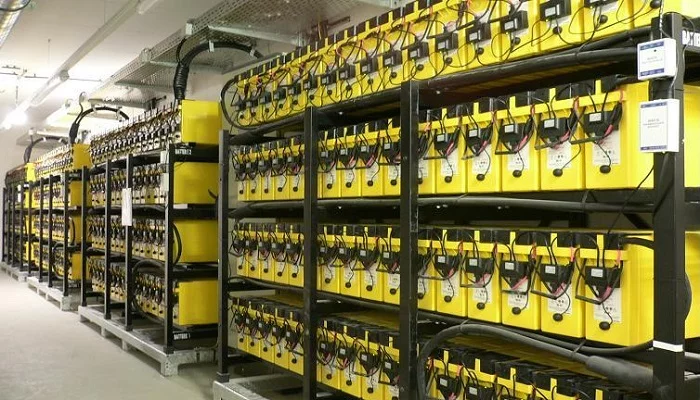
The 6-EVF-120 is a 12 V, 120 Ah sealed VRLA block rated at the C3 discharge rate, and it is the block most often specified for mid-size data-centre UPS cabinets and telecom power rooms. The factory publishes a nominal case of 407×170×240 mm, a weight of 40 ± 0.2 kg, a float setpoint of 13.5 V, an equalise setpoint of 14.1 V, a maximum charge current of 24.0 A, an end-of-discharge cut-off of 1.75 V per cell, a cycle life of 350–600 cycles at 50–80 % depth of discharge, and a design life of 2–5 years. Every one of those values comes from the published data on this model page, not from a marketing range.
The arithmetic that buyers usually need is straightforward. A 12 V block contains six 2 V cells, so the float bus is 6 × 2.25 V = 13.5 V and the equalise bus is 6 × 2.35 V = 14.1 V; stored energy is 12 V × 120 Ah = 1,440 Wh per block. A 240 V UPS string built from 12 V blocks takes twenty blocks in series, giving 120 cells, a float bus of 120 × 2.25 V = 270 V, an equalise bus of 120 × 2.35 V = 282 V, and an end-of-discharge floor of 120 × 1.75 V = 210 V — 240 V × 120 Ah = 28.8 kWh of stored energy per string.
Because the 6-EVF-120 is rated at C3 (3-hour rate), a 40 A discharge is the reference condition. On a 240 V bus carrying a 20 kW load, current is 20,000 W ÷ 240 V = 83.3 A per string; with two strings in parallel each string carries 83.3 ÷ 2 = 41.7 A, which is close to the 40 A reference, so runtime works out at roughly 120 Ah ÷ 41.7 A ≈ 2.9 hours. Size the string count from that figure, not from a catalogue headline.
Key Takeaways
- Published envelope: 407×170×240 mm and 40 ± 0.2 kg for the 6-EVF-120, with φ20-M8 terminals, so rack rails, cabinet depth and floor loading can be fixed at the drawing stage.
- Charge control: float 13.5 V and equalise 14.1 V per 12 V block, maximum charge current 24.0 A (= 0.20 C, because 24.0 ÷ 120 = 0.2), cut-off 1.75 V per cell.
- String arithmetic: six cells per block; a 240 V string = 20 blocks = 120 cells, 270 V float, 282 V equalise, 210 V discharge floor.
- Runtime basis: the C3 rating means 120 Ah ÷ 40 A ≈ 3 h; any larger load must be divided through the parallel string count.
- Thermal envelope: −15…50 °C working range, self-discharge ≤3 % per month at 25 °C — that is 0.03 × 120 Ah = 3.6 Ah per month, or about 5 mA continuous float current per block.
§1 — 6-EVF-120 Quick Specifications
| Parameter | Value | Source |
|---|---|---|
| Nominal voltage | 12 V | Model page |
| Nominal capacity | 120 Ah | Model page |
| Capacity rate | C3 | Model page |
| Dimensions L×W×H | 407×170×240 mm | Model page |
| Weight | 40 ± 0.2 kg | Model page |
| Terminal | φ20-M8 | Model page |
| Float voltage | 13.5 V | Model page |
| Equalise voltage | 14.1 V | Model page |
| Cycle life | 350–600 cycles (DoD 50–80 %) | Model page |
| Maximum charge current | 24.0 A | Model page |
| End-of-discharge cut-off | 1.75 V/cell | Model page |
| Self-discharge | ≤3 %/month @25 °C | Model page |
| Working temperature | −15…50 °C | Model page |
| Design life | 2–5 years | Model page |
| Terminal torque | not published | to be requested from the factory |
§2 — The Pain: Where UPS Battery Buying Projects Go Wrong
Capacity quoted at the wrong rate. A 120 Ah block is an energy store, not a runtime promise. The published rate is C3, so the honest reference is 40 A for three hours. If a consultant sizes on the 20-hour rate, the same block delivers roughly a third of the expected minutes and the failure appears at the first real outage rather than during commissioning. Any runtime quoted for the 6-EVF-120 has to state the discharge rate behind it.
Cells per string decided by capacity instead of bus voltage. The number of cells in a string is fixed by the UPS bus — 240 V DC means 120 cells, which means 20 twelve-volt blocks — and never by the Ah rating. Capacity changes how long the string lasts, not how many blocks it contains. Mixing block sizes inside one string is the classic result: a 6-EVF-100 and a 6-EVF-150 in the same series string will not share current, and the weaker block sets the usable runtime for both.
§3 — The Choice: Sizing the 6-EVF-120 Against Its Closest Siblings
For a 20 kW load on that 240 V bus: 20,000 W ÷ 240 V = 83.3 A per string. One string delivers 83.3 A, which is 120 Ah ÷ 83.3 A ≈ 1.4 h — too short for most sites, and well outside the block’s C3 reference condition. Two strings in parallel put 41.7 A on each, giving 120 Ah ÷ 41.7 A ≈ 2.9 h, which is the intended use window. Three strings reach 27.8 A per string and roughly 4.3 h, at the cost of 60 blocks and 2,400 kg of battery mass.
The same load on a 48 V telecom string looks different because the bus is lower and the current higher: four 6-EVF-120 blocks in series give 24 cells, a 54 V float bus, a 56.4 V equalise bus and a 42 V discharge floor, with 48 V × 120 Ah = 5,760 Wh of stored energy. A 300 W cabinet load draws 300 W ÷ 48 V = 6.25 A, so the runtime is 120 Ah ÷ 6.25 A = 19.2 h — comfortable autonomy from only four blocks.
Capacity choices inside the series can be compared on published numbers. The 6-EVF-100 carries 1,200 Wh in 31.5 kg, the 6-EVF-120 carries 1,440 Wh in 40 kg, and the 6-EVF-150 carries 1,800 Wh in 48.5 kg. Specific energy is 1,200 ÷ 31.5 = 38.1 Wh/kg, 1,440 ÷ 40 = 36.0 Wh/kg and 1,800 ÷ 48.5 = 37.1 Wh/kg — close enough that the decision should be made on autonomy, cabinet depth and terminal compatibility rather than on efficiency. All three blocks share the φ20-M8 terminal, so a site can standardise on one connector across the room. For alternative capacities and the rest of the 12 V VRLA options, the full product range is listed on the full product range, and the closest entry-level block is covered on the sibling model page for the 6-EVF-50.
§4 — The Framework: A Three-Check Acceptance Test for the 6-EVF-120
Buying a 6-EVF-120 is a three-check exercise, and each check has a published number attached to it.
1. Charger setpoints and current. Float 13.5 V, equalise 14.1 V, maximum charge current 24.0 A. That current ceiling is 24.0 A ÷ 120 Ah = 0.20 C, the same ratio the factory publishes across the 6-EVF capacities, so a charger sized for one block size applies to the next. A charger that pushes more than 24.0 A into a 6-EVF-120 is outside the published envelope, whatever the UPS vendor’s default sheet says.
2. Thermal and mechanical fit. The working range is −15…50 °C and the cycle-life figure is quoted at 25 °C, so cabinet layout is a battery-life decision, not a mechanical afterthought. Each block adds 40 ± 0.2 kg to the rack loading and 240 mm of depth before cable bend radius, and a 240 V string of twenty blocks puts 800 kg of battery into one cabinet.
3. String topology. Cells per string follow the bus voltage, never the Ah rating. Parallel strings handle current and redundancy; blocks inside a series string should be the same model and the same age, because the weakest block defines the usable runtime of the whole string. For a 240 V string, twenty 6-EVF-120 blocks give 28.8 kWh; the load and the required autonomy then decide how many strings run in parallel.
§5 — Sibling Comparison: 6-EVF-50 to 6-EVF-150 Against the 6-EVF-120
The published numbers below let a buyer place the 6-EVF-120 between its neighbours without relying on rounded catalogue figures. Capacity, rate, dimensions, weight, charge current and terminal type are factory values; the energy column is arithmetic (12 V × Ah).
| Model | Capacity | Rate | L×W×H mm | Weight | Charge current | Energy (Wh) | Terminal | Source |
|---|---|---|---|---|---|---|---|---|
| 6-EVF-50 | 50 Ah | C3 | 230×140×180 | 15.25 ± 0.2 kg | 10.0 A | 600 | φ11.8-M6 | Model page / Arithmetic |
| 6-EVF-100 | 100 Ah | C3 | 330×170×218 | 31.5 ± 0.2 kg | 20.0 A | 1,200 | φ20-M8 | Model page / Arithmetic |
| 6-EVF-120 | 120 Ah | C3 | 407×170×240 | 40 ± 0.2 kg | 24.0 A | 1,440 | φ20-M8 | Model page / Arithmetic |
| 6-EVF-150 | 150 Ah | C3 | 483×170×240 | 48.5 ± 0.2 kg | 30.0 A | 1,800 | φ20-M8 | Model page / Arithmetic |
§6 — The Trust: Factory, Certifications and Delivery for Import Buyers
Behind the 6-EVF-120, CHISEN Battery operates eight production bases with an annual capacity of 70 million kVAh. The certification set is CE, ISO 9001, ISO 14001, UL and IEC. The product lines cover three charging platforms: flooded tubular OPzS2, gel tubular OPzV2, and the 12 V VRLA blocks covering 6-DZF, 6-DMF and 6-EVF, which means one supplier can cover a telecom room, a data-centre UPS cabinet and a stationary string from the same technical file.
Delivery is by container from the Chinese export ports of Ningbo and Shanghai, and the standard destinations for this block are distributor programmes in India, Nigeria, Kenya, Vietnam, the Philippines and Brazil, with calls at Jebel Ali, Karachi, Mumbai, Lagos, Mombasa, Durban, Port Said, Callao and Santos. Importers in Europe and the Mediterranean receive the same blocks through Rotterdam, Hamburg, Antwerp and Valencia. Whatever the destination, the receiving check on a 6-EVF-120 consignment is the same: verify the 407×170×240 mm case, weigh the block against 40 ± 0.2 kg, confirm the φ20-M8 terminal and the C3 label, and check that the certificate set travels with the goods.
§7 — FAQ
Q1: What are the published nominal voltage and capacity of the 6-EVF-120? The factory publishes 12 V and 120 Ah at the C3 discharge rate (Model page). Stored energy is 12 V × 120 Ah = 1,440 Wh per block, and the reference discharge is 120 Ah ÷ 40 A ≈ 3 hours (Arithmetic).
Q2: What float and equalise setpoints does the manufacturer publish for the 6-EVF-120? Float 13.5 V and equalise 14.1 V per 12 V block, which equals 2.25 V and 2.35 V per cell across the six cells in the block (Model page). Chargers should be configured to those values.
Q3: What is the maximum charging current for the 6-EVF-120? 24.0 A, which is 24.0 A ÷ 120 Ah = 0.20 C (Model page and Arithmetic). The same ratio applies across the 6-EVF sizes, so a charger set for the 6-EVF-100 covers the 6-EVF-120 without rework.
Q4: What are the case dimensions and weight of the 6-EVF-120? 407×170×240 mm and 40 ± 0.2 kg (Model page). One 240 V string of twenty blocks occupies about 800 kg of battery mass and 332 L of volume, so cabinets must be sized from the block data.
Q5: What terminal type and torque does the 6-EVF-120 use? The terminal is φ20-M8, shared with the 6-EVF-100 and 6-EVF-150 (Model page). The tightening torque is not published and has to be requested from the factory before a torque-wrench setting is written into a work instruction.
Q6: How many cells does a 12V120Ah string contain and what bus voltage does it give? Six cells per 12 V block, so a 240 V string needs twenty blocks: 120 cells, 270 V float, 282 V equalise and a 210 V end-of-discharge floor at 1.75 V per cell (Arithmetic from the Model page values).
Q8: How should an importer verify the 6-EVF-120 on delivery? Check the label for 12 V, 120 Ah, C3 and φ20-M8, weigh the block against 40 ± 0.2 kg, measure the case against 407×170×240 mm, confirm the production date, and keep the CE, ISO 9001, ISO 14001, UL and IEC certificates with the shipment.
Q10: How do I request a quotation or samples for the 6-EVF-120? Send the model, the target string voltage, the load in amps and the required autonomy to sales@chisen.cn or jack@chisen.cn, or message the export desk on WhatsApp +86 131 6622 6999. The factory answers within 24 hours and can send samples against a project description.
Expert Summary
The 6-EVF-120 is a 12 V, 120 Ah C3 sealed VRLA block with published dimensions of 407×170×240 mm, a weight of 40 ± 0.2 kg, a φ20-M8 terminal, 13.5 V float, 14.1 V equalise, a 24.0 A (0.20 C) charge current ceiling, a 1.75 V per cell cut-off, 350–600 cycles at 50–80 % depth of discharge, a 2–5 year design life and a −15…50 °C working range. Six cells give 13.5 V float per block, so a 240 V string is twenty blocks, 120 cells, 270 V float, 282 V equalise and 210 V at cut-off, holding 28.8 kWh; twenty blocks weigh 800 kg. Runtime follows 120 Ah ÷ current, and at the C3 reference of 40 A the block delivers about three hours. Terminal torque and the guaranteed cycle curve are not published and must be requested from the factory, while every other figure in this guide comes from the published model documentation.
Contact CHISEN — 24-Hour Response
- Email: sales@chisen.cn | jack@chisen.cn
- WhatsApp: +86 131 6622 6999
- Website: www.chisen.cn
Related CHISEN Buyer Guides
- 12V 100Ah LiFePO4 vs Lead Acid Battery: Cycle Life, Published 6-EVF-100 Specs and Where Ea
- 2V 1000Ah Battery Buyer Guide 2026: Telecom, UPS, and Solar Storage Sourcing
- 6-DMF-52 12V52Ah UPS Battery: Complete Buyer Guide for Data Centres and Telecom
- 6-EVF-150 12V150Ah AGM Battery: Published Specs, Parallel String Sizing and EVF Range Comp
- 6-EVF-50 12V50Ah UPS Battery: Complete Buyer Guide for Data Centres and Telecom
