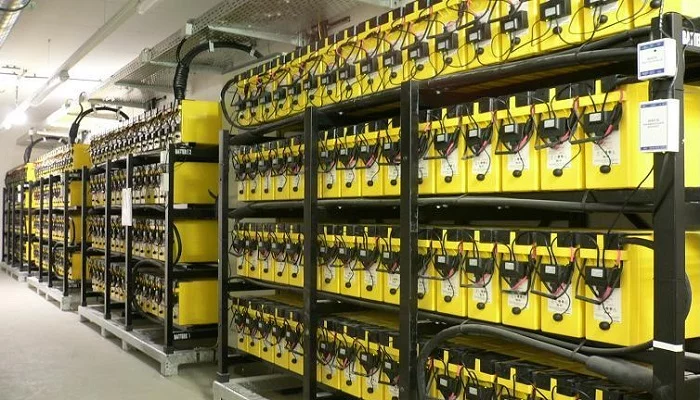
Answer First
The 6-EVF-60 12V60Ah is a 12 V, 60 Ah VRLA battery rated at the C3 rate. Factory-published figures for this model are 258 × 170 × 160 mm, 18.8 ± 0.2 kg, float at 13.5 V, equalise at 14.1 V, maximum charge current 12.0 A, discharge cutoff 1.75 V/cell, self-discharge ≤3 %/month at 25 °C, operating range −15…50 °C, and a design life of 2–5 years. In procurement terms the 6-EVF-60 12V60Ah is the mid-size block of the 6-EVF line: four units in series give a 48 V telecom or data-centre string, and one block stores 12 V × 60 Ah = 720 Wh of nominal energy. It is the correct choice when a cabinet load needs roughly one block of reserve without stepping up to the heavier 80 Ah unit.
Most purchase orders for a “60 Ah” UPS battery are written from a catalogue cover page and omit the three numbers that actually decide the installation: the bus voltage the setpoints assume, the charge current the charger must deliver, and the cutoff voltage the UPS is configured to. Get those three wrong and identical nominal capacity either never reaches full charge or is cut off far too early. Every figure used in this guide is taken from the factory model page for the 6-EVF-60 12V60Ah and is reproduced with its source, so a procurement file can be assembled directly from it.
Key Takeaways
- Published capacity and case size. The 6-EVF-60 12V60Ah is rated 12 V / 60 Ah at C3, measures 258 × 170 × 160 mm and weighs 18.8 ± 0.2 kg — all figures confirmed on the factory model page.
- Charge setpoints are fixed and non-negotiable. Float 13.5 V (2.25 V/cell) and equalise 14.1 V (2.35 V/cell) across the six cells of the 12 V block, with a 1.75 V/cell discharge cutoff.
- The charger must be sized to 12.0 A per battery. Published maximum charge current is 12.0 A, that is 0.2 × 60 Ah; a charger set above this rating shortens plate life.
- String maths for a 48 V cabinet. Four 6-EVF-60 12V60Ah units in series give 4 × 12 V = 48 V nominal, float 4 × 13.5 V = 54.0 V, equalise 4 × 14.1 V = 56.4 V, cutoff 4 × 10.5 V = 42.0 V, while capacity stays at 60 Ah per string.
- Energy content is 720 Wh per block. 12 V × 60 Ah = 720 Wh; at the published 18.8 ± 0.2 kg this is 720 ÷ 18.8 = 38.3 Wh/kg, a useful figure when a cabinet has a weight limit.
§1 — 6-EVF-60 Quick Specifications
The table below is the complete published specification for the 6-EVF-60 12V60Ah as published by the factory. Every row carries its source. Where a value is not published — for example the terminal tightening torque — it is marked for request rather than estimated.
| Parameter | Published value | Source |
|---|---|---|
| Nominal voltage | 12 V | Model page |
| Nominal capacity | 60 Ah | Model page |
| Capacity rate | C3 | Model page |
| Dimensions (L × W × H) | 258 × 170 × 160 mm | Model page |
| Weight | 18.8 ± 0.2 kg | Model page |
| Terminal | φ14-M6 | Model page |
| Float voltage | 13.5 V | Model page |
| Equalise voltage | 14.1 V | Model page |
| Cycle life | 350–600 cycles (DoD 50–80 %) | Model page |
| Maximum charge current | 12.0 A | Model page |
| Discharge cutoff | 1.75 V/cell | Model page |
| Self-discharge | ≤3 %/month at 25 °C | Model page |
| Working temperature | −15…50 °C | Model page |
| Design life | 2–5 years | Model page |
| Cell count per block | 6 cells × 2 V = 12 V nominal | Arithmetic |
| Terminal tightening torque | not published | to be requested from the factory |
| Cycle use, standing performance and case material | not published | to be requested from the factory |
The complete published data set behind this table is on this model page.
§2 — The Pain: The Gap Between a Datasheet and an Installed String
Data-centre and telecom buyers rarely get what they ordered, and the cause is rarely the cell chemistry. It is a specification that stops at the catalogue page. Five items cause most of the disputes we see on 60 Ah VRLA orders.
Charger current. The published maximum charge current for the 6-EVF-60 12V60Ah is 12.0 A, which is 0.2 × 60 Ah. A charger configured above that rating pushes excess ripple into the cells and consumes plate life; one configured far below it never completes a recharge inside the window the UPS allows.
Float and equalise setpoints. Float is 13.5 V and equalise 14.1 V for the block, that is 2.25 V/cell and 2.35 V/cell. Installers frequently copy setpoints from a different case size. On a 48 V string this six-cell block sits at 54.0 V float — correct for this battery, wrong for a 2 V tubular cell.
Cutoff voltage. The published cutoff is 1.75 V/cell, so a 12 V block ends at 10.5 V and a 48 V string at 42.0 V. A shallower cutoff shortens the string; a deeper one cuts usable runtime and pushes the cells into deep discharge.
Temperature. The rated working range is −15…50 °C and self-discharge is quoted at ≤3 %/month at 25 °C. A cabinet in a hot corridor ages faster than a 2–5 year design life suggests.
§3 — The Choice: Sizing the Block Around the 6-EVF-60 12V60Ah
Three sizes bracket the 6-EVF-60 12V60Ah in practice. The 6-EVF-50 gives 50 Ah at 15.25 ± 0.2 kg in a 230 × 140 × 180 mm case; the 6-DMF-52 gives 52 Ah at 13.7 ± 0.2 kg in 224 × 135 × 175 mm; the 6-EVF-80 gives 80 Ah at 25.7 ± 0.2 kg in 259 × 170 × 218 mm.
Choose the 6-EVF-60 12V60Ah when the required runtime per string falls between the 50 Ah and 80 Ah blocks and the cabinet offers 160 mm of usable height — the 80 Ah case grows to 218 mm and therefore needs a different enclosure, not just a different battery. Choose the 50 Ah unit when the load is lighter or floor loading is tight, and the 80 Ah unit when runtime must be extended without increasing the number of parallel strings. The full published data for every size is listed on the full product range, and the closest sibling of the 6-EVF-60 12V60Ah — 50 Ah, 15.25 ± 0.2 kg, 10.0 A charge current — is documented on the sibling model page.
§4 — The Framework: String Configuration, Runtime and Charger Sizing
Work in three steps: string voltage, string count, then charger.
Step 1 — string voltage. The 6-EVF-60 12V60Ah is a six-cell 12 V block: 6 cells × 2 V = 12 V nominal. A 48 V telecom or data-centre bus takes four blocks in series — 4 × 12 V = 48 V nominal, float 4 × 13.5 V = 54.0 V, equalise 4 × 14.1 V = 56.4 V, cutoff 4 × 10.5 V = 42.0 V. Series connection adds voltage but not capacity: each string still delivers 60 Ah.
Step 2 — string count and runtime. One string gives 60 Ah. Two strings in parallel give 2 × 60 Ah = 120 Ah, four give 4 × 60 Ah = 240 Ah. Runtime follows from the measured load: 60 Ah ÷ 20 A = 3.0 h for one string and 120 Ah ÷ 20 A = 6.0 h for two parallel strings. At a 30 A load, one string gives 60 Ah ÷ 30 A = 2.0 h. The energy behind the nameplate is 12 V × 60 Ah = 720 Wh per block, or 720 Wh ÷ 18.8 kg = 38.3 Wh/kg. On a standby string with a 50 % depth-of-discharge budget, usable energy is 720 Wh × 0.5 = 360 Wh per block.
Step 3 — charger. Budget 12.0 A per battery, which is the published 0.2 × 60 Ah figure. A four-battery string therefore needs 4 × 12.0 A = 48.0 A of charger capacity, and two parallel strings need 2 × 48.0 A = 96.0 A. Set the charger to 13.5 V float and 14.1 V equalise per 12 V block, and confirm the cabinet ambient stays inside the published −15…50 °C window.
Before energising the cabinet, run five checks. Verify the case: 258 × 170 × 160 mm, 18.8 ± 0.2 kg per block. Confirm the charger delivers 12.0 A per battery, 4 × 12.0 A = 48.0 A per string, float 13.5 V, equalise 14.1 V. Confirm the UPS cutoff is 1.75 V/cell, so the 48 V string ends at 42.0 V; keep the ambient inside −15…50 °C. A nominal 60 Ah rarely delivers in the cabinet: self-discharge is ≤3 %/month at 25 °C, and a 50 % depth-of-discharge budget leaves 720 Wh × 0.5 = 360 Wh usable per block, so 60 Ah ÷ 20 A = 3.0 h is a design figure, not a guarantee.
§5 — 6-EVF-60 Against the Sibling Sizes, Side by Side
The figures below are published values for each size in the 6-EVF and 6-DMF lines, not estimates. Nominal Wh is 12 V × Ah: 12 × 60 = 720 Wh for the 6-EVF-60, 12 × 50 = 600 Wh for the 6-EVF-50, 12 × 80 = 960 Wh for the 6-EVF-80, 12 × 45 = 540 Wh for the 6-DMF-45, 12 × 52 = 624 Wh for the 6-DMF-52 and 12 × 100 = 1,200 Wh for the 6-EVF-100.
| Model | Capacity | Dimensions (L×W×H mm) | Weight | Charge current | Float / Equalise | Design life | Source |
|---|---|---|---|---|---|---|---|
| 6-DMF-45 | 45 Ah | 224×121×175 | 12.3 ± 0.2 kg | 9.0 A | 13.5 V / 14.1 V | 2–5 years | Model page |
| 6-DMF-52 | 52 Ah | 224×135×175 | 13.7 ± 0.2 kg | 10.4 A | 13.5 V / 14.1 V | not published | Model page |
| 6-EVF-50 | 50 Ah | 230×140×180 | 15.25 ± 0.2 kg | 10.0 A | 13.5 V / 14.1 V | 2–5 years | Model page |
| 6-EVF-60 | 60 Ah | 258×170×160 | 18.8 ± 0.2 kg | 12.0 A | 13.5 V / 14.1 V | 2–5 years | Model page |
| 6-EVF-80 | 80 Ah | 259×170×218 | 25.7 ± 0.2 kg | 16.0 A | 13.5 V / 14.1 V | 2–5 years | Model page |
| 6-EVF-100 | 100 Ah | 330×170×218 | 31.5 ± 0.2 kg | 20.0 A | 13.5 V / 14.1 V | 2–5 years | Model page |
Two things stand out. First, the case footprint: the 6-EVF-60 12V60Ah is 160 mm high against 180 mm for the 6-EVF-50 and 218 mm for the 6-EVF-80, which is often the decisive constraint in a 19-inch cabinet. Second, weight per ampere-hour: 18.8 kg ÷ 60 Ah = 0.313 kg/Ah for the 6-EVF-60 against 15.25 kg ÷ 50 Ah = 0.305 kg/Ah for the 6-EVF-50 and 25.7 kg ÷ 80 Ah = 0.321 kg/Ah for the 6-EVF-80, so the middle block is close to the line on transport weight per unit of reserve.
§6 — The Trust: Verified Numbers, Certified Production, Documented Delivery
Every figure in this guide comes from the factory model page for the 6-EVF-60 12V60Ah, and the same data set backs the quotation. CHISEN runs 8 production bases with an annual capacity of 70 million kVAh and holds CE, ISO 9001, ISO 14001, UL and IEC certifications across the flooded tubular OPzS2, gel tubular OPzV2 and 12 V VRLA lines. Export containers leave from Shanghai and Ningbo for distributors and OEM integrators in India, Nigeria, Kenya, Vietnam, the Philippines, Brazil, Egypt, Mexico, Pakistan, the UAE and Turkey, with logistics hubs in Dubai, Lagos, Mombasa and Karachi. On arrival, match the label against the table in §1, measure the open-circuit voltage of every block, and confirm the manufacturing date before the warranty clock starts.
§7 — FAQ
Q1: What are the published nominal voltage and capacity of the 6-EVF-60? 12 V and 60 Ah at the C3 rate, as published on the factory model page.
Q2: What float and equalise setpoints does the manufacturer publish? 13.5 V float (2.25 V/cell) and 14.1 V equalise (2.35 V/cell), source: Model page.
Q3: What is the maximum charging current? 12.0 A, that is 0.2 × 60 Ah, source: Model page.
Q4: What are the case dimensions and weight? 258 × 170 × 160 mm and 18.8 ± 0.2 kg, source: Model page.
Q5: Which terminal does it use, and at what torque? Terminal φ14-M6; the tightening torque is not published and is to be requested from the factory.
Q6: How many cells in a 12 V 60 Ah string, and what bus voltage results? 6 cells × 2 V = 12 V nominal; four blocks in series give 48 V nominal, 54.0 V float and 42.0 V cutoff.
Q7: What is the published design life, and at what temperature? 2–5 years; self-discharge is quoted at ≤3 %/month at 25 °C, within a −15…50 °C working range.
Q8: How should an importer verify the batteries on delivery? Match the label data against the model page, measure open-circuit voltage per block, and check the manufacturing date.
Q9: Which certifications does the factory behind this model hold? CE, ISO 9001, ISO 14001, UL and IEC.
Q10: How do I request a quotation or samples? Email sales@chisen.cn or jack@chisen.cn, or use WhatsApp +86 131 6622 6999.
Expert Summary
The 6-EVF-60 12V60Ah is a 60 Ah C3 VRLA block, 258 × 170 × 160 mm and 18.8 ± 0.2 kg, with 13.5 V float, 14.1 V equalise, 12.0 A charge current and a 1.75 V/cell cutoff. One block stores 12 V × 60 Ah = 720 Wh, or 38.3 Wh/kg, and four in series give a 48 V string at 54.0 V float with 42.0 V cutoff. One string holds 60 Ah ÷ 20 A = 3.0 h, and the charger must deliver 4 × 12.0 A = 48.0 A per string. Published design life is 2–5 years within −15…50 °C.
Contact CHISEN — 24-Hour Response
CHISEN Battery, Hangzhou, China — quotation, technical data and samples for the 6-EVF-60 12V60Ah. Email: sales@chisen.cn · jack@chisen.cn · WhatsApp: +86 131 6622 6999 · www.chisen.cn
Related CHISEN Buyer Guides
- 12V 100Ah LiFePO4 vs Lead Acid Battery: Cycle Life, Published 6-EVF-100 Specs and Where Ea
- 2V 1000Ah Battery Buyer Guide 2026: Telecom, UPS, and Solar Storage Sourcing
- 6-EVF-150 12V150Ah AGM Battery: Published Specs, Parallel String Sizing and EVF Range Comp
- 6-EVF-50 12V50Ah UPS Battery: Complete Buyer Guide for Data Centres and Telecom
- OPzS2-100 2V100Ah Flooded Tubular Battery: Published Specs, 48 V String Sizing and Sibling
