Answer First
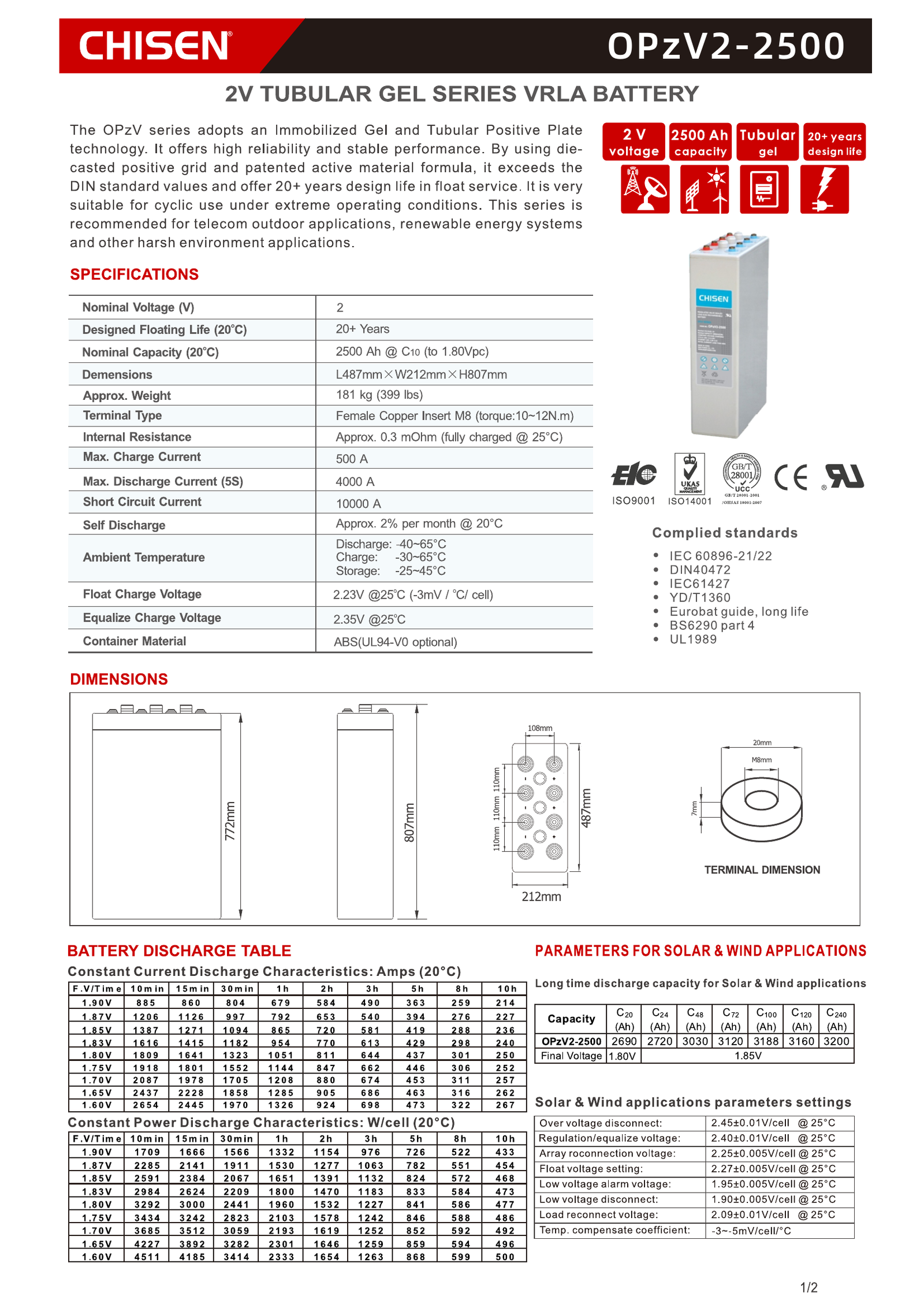
The OPzV2-2500 is a 2 V, 2,500 Ah tubular gel battery for data-centre UPS cabinets and telecom power plants. Its published envelope is 487 × 212 × 807 mm at 181 kg, the maximum charge current is 500 A, internal resistance about 0.30 mΩ at 25 °C, and design float life 20+ years @20 °C. On the 24-cell series string used for a 48 V bus, that cell gives 48.00 V nominal, a 53.52 V float bus, 7.20 mΩ of string resistance and 120,000 Wh of nominal energy.
Three published figures settle the comparison against flooded tubular or 12 V VRLA: the 20+ years @20 °C float life, the −3 mV/°C/cell compensation, and the 181 kg cell weight that sets the floor loading and cabinet layout. The 2.35 V equalise setpoint matters too, because it lets a maintenance team recover capacity in situ.
Full specifications sit on the OPzV2-2500 product page, and the wider model range on the OPzV tubular gel battery range. Three checks decide whether a shipment is usable: the case footprint against the cabinet drawing, the terminal torque, and the capacity test at the 10-hour rate to 1.80 Vpc.
Key Takeaways
- Published output: 2 V nominal, 2,500 Ah at C10 to 1.80 Vpc, in a 487 × 212 × 807 mm case weighing 181 kg (Datasheet).
- Charging envelope: maximum charge current 500 A, float 2.23 V and equalise 2.35 V per cell at 25 °C, compensation −3 mV/°C/cell (Datasheet).
- Service life: 20+ years @20 °C design float life applies to the tubular OPzV2 class, never to a 12 V VRLA cell (Datasheet).
- 48 V string arithmetic: 24 cells give 48.00 V nominal, a 53.52 V float bus, 7.20 mΩ of string resistance and 120,000 Wh (Arithmetic).
- Cabinet reality: 24 × 181 kg = 4,344 kg of battery mass per string, against 24 × 145 kg = 3,480 kg for the next size down (Arithmetic).
- Acceptance on delivery: verify the case footprint, the M8 female copper insert terminals at 10–12 N·m, and capacity at the 10-hour rate to 1.80 Vpc.
§1 — OPzV2-2500 Quick Specifications
Every figure below comes from the manufacturer datasheet for the OPzV2-2500; nothing has been rounded by a distributor or interpolated from a neighbouring cell size.
| Parameter | Value | Source |
|---|---|---|
| Nominal voltage | 2 V | Datasheet |
| Capacity @ C10 (1.80 Vpc) | 2,500 Ah | Datasheet |
| Case dimensions (L×W×H) | 487 × 212 × 807 mm | Datasheet |
| Weight | 181 kg | Datasheet |
| Maximum charge current | 500 A | Datasheet |
| Float voltage | 2.23 V @25 °C | Datasheet |
| Equalise voltage | 2.35 V @25 °C | Datasheet |
| Temperature compensation | −3 mV/°C/cell | Datasheet |
| Internal resistance | ~0.30 mΩ @25 °C | Datasheet |
| Design float life | 20+ years @20 °C | Datasheet |
| Terminal | Female Copper Insert M8, 10–12 N·m | Datasheet |
The 500 A maximum is a per-cell rating, so because every cell in a series string carries the same current, 500 A is also the ceiling for the finished 48 V string. Float and equalise are quoted at 25 °C.
§2 — The Pain: A 24-Cell String Is a Structural, Thermal and Logistics Problem
Most battery problems reaching a purchasing desk are specification problems, not chemistry problems: the cell ordered is not the cell drawn, the cabinet was designed around a different footprint, or the shipment was accepted on visual inspection and only measured months later.
The physical constraint is straightforward. A 24-cell string weighs 4,344 kg before the enclosure and the links, and that mass has to sit on the raised floor of a data hall or the plinth of a telecom power room. A 181 kg cell also cannot be carried up a stairwell by two technicians, so unloading and handling equipment belong in the procurement decision.
The thermal constraint is subtler. With −3 mV/°C/cell compensation, a room held at 20 °C floats each cell roughly 0.015 V lower than the 25 °C reference. Ventilation, aisle clearance and setpoint discipline are therefore part of the battery specification.
§3 — The Choice: Tubular Gel Against Flooded Tubular and 12 V VRLA
Three constructions are normally shortlisted for this duty, and the OPzV2-2500 belongs to the tubular gel branch.
Tubular gel (OPzV2). A gel electrolyte in a rigid case with tubular plates. It needs no spilling electrolyte, so it installs in a general equipment room rather than a battery room ventilated for acid mist, and it carries the 20+ years @20 °C design float life of the tubular class.
Flooded tubular (OPzS2). The same tubular plate architecture with liquid sulphuric acid, the traditional choice where electrolyte addition and specific-gravity checks are routine. It requires a ventilated enclosure and must be commissioned with electrolyte first.
12 V VRLA (6-DZF, 6-DMF, 6-EVF). A sealed block that is simple to ship and install, but its design float life is 2–5 years, not 20+ years — and that published lifetime decides what a 20-year site pays per year of service.
On a 48 V bus a 12 V block needs 4 units where a 2 V cell needs 24, and it adds connector resistance the 2 V architecture does not have. A European gel-brand benchmark and a market-priced industrial supplier are compared on published data, not on the label.
§4 — The Framework: A Five-Step Specification Method
A team that follows the same five steps for every candidate cell removes most specification risk before the purchase order is raised.
Step 1 — Fix the duty and the bus. Record the load, the autonomy in minutes, the generator behaviour and the DC bus voltage. A 48 V bus fixes the string at 24 cells of 2 V.
Step 2 — Lay out the string arithmetic on paper. For the OPzV2-2500 at 24 cells in series:
- Nominal bus: 24 × 2.00 V = 48.00 V
- Float bus: 24 × 2.23 V = 53.52 V
- Equalise bus: 24 × 2.35 V = 56.40 V
- Nominal energy: 48.00 V × 2,500 Ah = 120,000 Wh
- String mass: 24 × 181 kg = 4,344 kg
- String resistance: 24 × 0.30 mΩ = 7.20 mΩ
Step 3 — Set the thermal and control parameters. Fix the room temperature, apply the −3 mV/°C/cell compensation, and treat float 2.23 V and equalise 2.35 V per cell at 25 °C as the reference points. Confirm the charger holds the 56.40 V equalise bus within the 500 A cell limit.
Step 4 — Solve the mechanical and logistics questions. Check 487 × 212 × 807 mm against the cabinet drawing, confirm the M8 female copper insert terminals and the 10–12 N·m torque, and plan the route for a 181 kg cell from the container to the plinth.
Step 5 — Write the acceptance test into the contract. A 10-hour discharge to 1.80 Vpc at 250 A is the natural check on a 2,500 Ah cell, since 2,500 Ah ÷ 10 h = 250 A. Pair it with a float-voltage check and a torque record, and acceptance becomes objective.
§5 — OPzV2-2500 Against the Rest of the Tubular Gel Range
Sizing decisions are easier when the OPzV2-2500 is read against the models that bracket it, because the range moves in predictable steps. The table lists published datasheet values only.
| Model | Ah @ C10 | L×W×H mm | Weight | Max charge current | Internal resistance | Design float life |
|---|---|---|---|---|---|---|
| OPzV2-200 | 200 | 103 × 206 × 390 | 17.0 kg | 40 A | ~1.0 mΩ @25 °C | 20+ years @20 °C |
| OPzV2-500 | 500 | 166 × 206 × 506 | 36.3 kg | 100 A | ~0.56 mΩ @25 °C | 20+ years @20 °C |
| OPzV2-1000 | 1000 | 233 × 210 × 681 | 73.2 kg | 200 A | ~0.50 mΩ @25 °C | 20+ years @20 °C |
| OPzV2-1200 | 1200 | 275 × 210 × 681 | 84 kg | 240 A | ~0.46 mΩ @25 °C | 20+ years @20 °C |
| OPzV2-2000 | 2000 | 399 × 212 × 807 | 145 kg | 400 A | ~0.37 mΩ @25 °C | 20+ years @20 °C |
| OPzV2-2500 | 2500 | 487 × 212 × 807 | 181 kg | 500 A | ~0.30 mΩ @25 °C | 20+ years @20 °C |
Height. The OPzV2-2000 and the OPzV2-2500 share the same 807 mm height and 212 mm width, so a cabinet drawn around the OPzV2-2000 can accept the OPzV2-2500 — but only if the depth grows from 399 mm to 487 mm and the inter-cell spacing is re-checked.
Weight per amp-hour. For the OPzV2-2500, 5,000 Wh ÷ 181 kg = 27.6 Wh/kg; the OPzV2-200 gives 400 Wh ÷ 17.0 kg = 23.5 Wh/kg, the OPzV2-1000 gives 2,000 Wh ÷ 73.2 kg = 27.3 Wh/kg, and the OPzV2-1200 gives 2,400 Wh ÷ 84 kg = 28.6 Wh/kg. The 2,500 Ah cell sits in the same band as the middle of the range.
String mass. At 24 cells per 48 V string the arithmetic is 24 × 17.0 kg = 408 kg for the OPzV2-200, 24 × 73.2 kg = 1,756.8 kg for the OPzV2-1000, 24 × 145 kg = 3,480 kg for the OPzV2-2000 and 24 × 181 kg = 4,344 kg for the OPzV2-2500. Smaller members such as the OPzV2-200 2V200Ah suit plants distributed across many small cabinets.
Charge current. Maximum charge current scales close to capacity: 40 A on a 200 Ah cell, 500 A on the 2,500 Ah cell, which makes a 250 A ten-hour acceptance test realistic.
§6 — The Trust: Factory Capacity, Certification and Acceptance
The OPzV2-2500 is produced by CHISEN Battery in Hangzhou, China, operating 8 production bases with an annual capacity of 70 million kVAh across four product lines: flooded tubular OPzS2, gel tubular OPzV2, 12 V VRLA in the 6-DZF, 6-DMF and 6-EVF ranges, and energy storage systems. The base holds CE, ISO 9001, ISO 14001, UL and IEC certifications, and the export desk serves importers and OEM partners in Germany, India, Brazil, Nigeria, the UAE and Singapore.
Acceptance discipline turns that into a reliable supply chain. Before the container is unloaded, check the model marking and date code against the purchase order, measure the case against the 487 × 212 × 807 mm drawing, and photograph every cell face. On commissioning, record each cell’s float voltage against the 2.23 V reference, confirm the links are torqued to 10–12 N·m, and run the 10-hour discharge to 1.80 Vpc at 250 A.
§7 — FAQ
Q1: What are the published nominal voltage and capacity of the OPzV2-2500? Datasheet: 2 V nominal, 2,500 Ah at the 10-hour rate to 1.80 Vpc.
Q2: What float and equalise setpoints does the manufacturer publish for the OPzV2-2500? Float 2.23 V per cell, equalise 2.35 V per cell, both at 25 °C, with −3 mV/°C/cell compensation applied by the charger (Datasheet).
Q3: What is the maximum charging current for the OPzV2-2500? 500 A per cell, so 500 A for a series string, since every cell carries the same current; two strings in parallel give 2 × 500 A = 1,000 A (Datasheet, Arithmetic).
Q4: What are the case dimensions and weight of the OPzV2-2500? The case measures 487 × 212 × 807 mm and weighs 181 kg, so a 24-cell string on a 48 V bus weighs 4,344 kg (Datasheet, Arithmetic).
Q5: What terminal type and torque does the OPzV2-2500 use? Female copper insert M8 terminals tightened to 10–12 N·m, the published torque for the tubular gel range (Datasheet).
Q6: How many cells does a 2V2500Ah string contain and what bus voltage does it give? Twenty-four cells in series: 48.00 V nominal, 53.52 V on float, 56.40 V on equalise, 2,500 Ah and 120,000 Wh nominal energy (Arithmetic).
Q7: What is the published design float life of the OPzV2-2500 and at what temperature? The datasheet states 20+ years @20 °C design float life for the tubular gel class. A 12 V VRLA cell carries a 2–5 year design life (Datasheet).
Q8: How should an importer verify the OPzV2-2500 on delivery? Check the marking and date code, measure the case against the 487 × 212 × 807 mm drawing, photograph every cell, then run a 10-hour discharge to 1.80 Vpc at 250 A (Datasheet, Arithmetic).
Q9: Which certifications does the CHISEN factory behind the OPzV2-2500 hold? The Hangzhou plant operates 8 production bases with 70 million kVAh annual capacity and holds CE, ISO 9001, ISO 14001, UL and IEC certifications (Datasheet).
Q10: How do I request a quotation or samples for the OPzV2-2500? Send the duty, bus voltage, autonomy and delivery window to the export desk, which quotes against published OPzV2-2500 datasheet values and can arrange sample cells for testing.
Expert Summary
The OPzV2-2500 is a 2 V, 2,500 Ah tubular gel cell with a fully published datasheet: 487 × 212 × 807 mm, 181 kg, 500 A maximum charge current, ~0.30 mΩ internal resistance at 25 °C, float 2.23 V, equalise 2.35 V, −3 mV/°C/cell compensation and 20+ years @20 °C design float life. On a 48 V bus the 24-cell string gives 48.00 V nominal, 53.52 V on float, 120,000 Wh, 7.20 mΩ and 4,344 kg. Risk on a cell this heavy and this long-lived sits in three places — the cabinet drawing, the thermal environment and the acceptance test — and each is settled by published numbers.
Contact CHISEN — 24-Hour Response
Sales enquiries, quotations and sample requests for the OPzV2-2500 are answered within 24 hours by the export desk in Hangzhou.
- Email: sales@chisen.cn
- Direct: jack@chisen.cn
- WhatsApp: +86 131 6622 6999
- Website: www.chisen.cn
Related CHISEN Buyer Guides
- 12V 100Ah LiFePO4 vs Lead Acid Battery: Cycle Life, Published 6-EVF-100 Specs and Where Ea
- 2V 1000Ah Battery Buyer Guide 2026: Telecom, UPS, and Solar Storage Sourcing
- 6-EVF-150 12V150Ah AGM Battery: Published Specs, Parallel String Sizing and EVF Range Comp
- OPzS2-100 2V100Ah Flooded Tubular Battery: Published Specs, 48 V String Sizing and Sibling
- OPzS2-150 2V150Ah Flooded Tubular Cell: Published Specs and Sizing
