Answer First
A 2V 200Ah battery is a single 2V tubular cell that delivers 200 amp-hours at the C10 rate, and it is the cell on which almost every serious stationary installation is built: telecom DC plants, solar storage strings, railway and substation backup, and large UPS installations. Two chemistries dominate the class, and they are not interchangeable. The OPzS2-200 is a flooded tubular cell published at 103 × 206 × 409 mm and 13.0 kg without electrolyte or 17.5 kg with electrolyte; the OPzV2-200 is a gel tubular cell published at 103 × 206 × 390 mm and 17.0 kg. Both charge at 2.23 V float and 2.35 V equalisation with −3 mV/°C/cell compensation and both carry a 20+ year design float life at 20 °C. Twenty-four cells in series give a 48V string of 48 V × 200 Ah = 9,600 Wh. This guide compares the two on published data only — capacity, geometry, weight, charge settings, internal resistance and string arithmetic — so that a buyer can decide between them before asking a factory for a quotation.
Key Takeaways
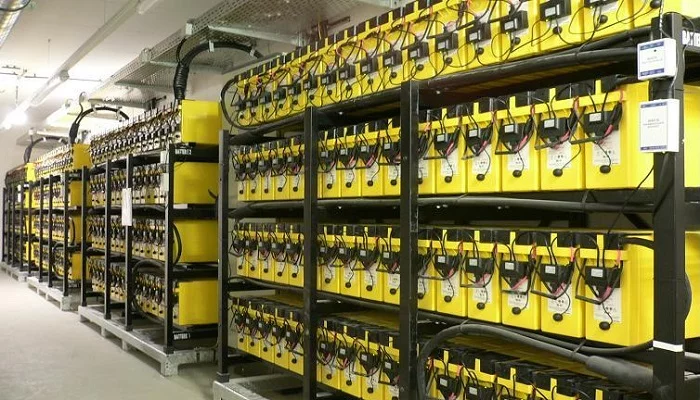
- A 2V 200Ah battery is one 2V cell, not a 12V block; a 48V string needs 24 of them, and a 24-cell string gives 48 V × 200 Ah = 9,600 Wh.
- The OPzS2-200 flooded cell publishes 13.0 kg without electrolyte and 17.5 kg with electrolyte, so a 24-cell string weighs 312 kg dry or 420 kg filled.
- The OPzV2-200 gel cell publishes 17.0 kg with no filling step, so the same 24-cell string weighs 408 kg — 12 kg lighter than the flooded string and far simpler to install.
- Both cells accept a 40 A maximum charge current, which is 40 A ÷ 200 Ah = 0.2 C, and a 24-cell string therefore needs 24 × 40 A = 960 A.
- Float is 2.23 V @25 °C and equalisation is 2.35 V @25 °C for both; in solar and wind service the equalisation setting moves to 2.40 ± 0.01 V/cell.
- Internal resistance differs and so does its reference temperature: the flooded cell is published at ~0.95 mΩ @20 °C, the gel cell at ~1.0 mΩ @25 °C.
- Design float life is 20+ years at 20 °C — the figure is tied to 20 °C, not to 25 °C, and it belongs to the tubular class only.
§1 — 2V 200Ah Battery Specifications
All values in this table are taken from the manufacturer datasheets for the two cells. Derived rows carry their formulas.
| Specification | OPzS2-200 (flooded) | OPzV2-200 (gel) | Source |
|---|---|---|---|
| Nominal voltage | 2V | 2V | Datasheet |
| Rated capacity at C10 (1.80 Vpc) | 200 Ah | 200 Ah | Datasheet |
| Dimensions L × W × H | 103 × 206 × 409 mm | 103 × 206 × 390 mm | Datasheet |
| Weight without electrolyte | 13.0 kg | not applicable — gel cells are supplied filled | Datasheet |
| Weight with electrolyte | 17.5 kg | 17.0 kg | Datasheet |
| Maximum charge current | 40 A | 40 A | Datasheet |
| Float charge voltage | 2.23 V @25 °C | 2.23 V @25 °C | Datasheet |
| Equalisation charge voltage | 2.35 V @25 °C | 2.35 V @25 °C | Datasheet |
| Temperature compensation | −3 mV/°C/cell | −3 mV/°C/cell | Datasheet |
| Internal resistance | ~0.95 mΩ @20 °C | ~1.0 mΩ @25 °C | Datasheet |
| Design float life | 20+ years @20 °C | 20+ years @20 °C | Datasheet |
| Terminal | Female copper insert M8, 10-12 N·m | Female copper insert M8, 10-12 N·m | Datasheet |
| Solar and wind equalisation | 2.40 ± 0.01 V/cell @25 °C | 2.40 ± 0.01 V/cell @25 °C | Datasheet |
| Solar and wind float | 2.25 ± 0.005 V/cell @25 °C | 2.27 ± 0.005 V/cell @25 °C | Datasheet |
| Solar and wind compensation | −4 mV/cell/°C | −3 to −5 mV/cell/°C | Datasheet |
| Charge current as a fraction of capacity | 40 A ÷ 200 Ah = 0.2 C | 40 A ÷ 200 Ah = 0.2 C | Arithmetic |
| Energy per cell | 2 V × 200 Ah = 400 Wh | 2 V × 200 Ah = 400 Wh | Arithmetic |
One datasheet detail deserves to be flagged because it changes how the capacity figure is read. The OPzS2-200 publishes a discharge-rate table measured to a 1.85 V final voltage: C24 = 226 Ah, C48 = 248 Ah, C72 = 260 Ah, C100 = 270 Ah, C120 = 274 Ah and C240 = 280 Ah. Those are higher than the 200 Ah C10 figure because the C10 rating is measured down to 1.80 Vpc while the rate table is measured to a higher cut-off. A buyer comparing a 2V 200Ah battery against a quoted “260 Ah” figure is almost always comparing two different cut-off voltages, not two different cells.
§2 — The Pain
Three problems recur on 2V 200Ah orders, and each of them starts with an incomplete line on a purchase order.
The first is weight stated without electrolyte. A flooded 2V 200Ah cell is published at 13.0 kg without electrolyte and 17.5 kg with electrolyte. Quote the 13.0 kg figure to a structural engineer and the rack design is 108 kg light across a 24-cell string, because 24 × 4.5 kg = 108 kg of electrolyte has not been counted. Quote 17.5 kg to an installer who is planning a manual handling lift and you have promised the wrong thing in the other direction. The order line must state which figure applies.
The second is the charge setpoint. A 2V cell floats at 2.23 V @25 °C and equalises at 2.35 V @25 °C, with −3 mV/°C/cell compensation. These are tight tolerances and they are not the same as the 2.27 V and 2.35 V bands printed on generic lead-acid literature. A 48V string of 24 cells floating at 2.27 V/cell is sitting 0.96 V above the intended float across the string, which over years is a material loss of life on a cell that was specified for 20+ years of float at 20 °C.
The third is chemistry mismatch inside a string. A series string of 2V cells must be built from cells of the same chemistry, the same model and, ideally, one production batch. Fitting a gel OPzV2-200 and a flooded OPzS2-200 into the same 24-cell string is a genuine engineering error, not a saving: the cells have different electrolyte, different self-discharge behaviour, different internal resistance and different equalisation behaviour, and a string cannot be charged for both.
There is a commercial dimension too. Buyers sourcing for Rotterdam, Jebel Ali, Santos, Lagos or Chennai often receive quotations for “2V 200Ah tubular” with no datasheet reference, no chemistry statement and no charge settings — which makes it impossible to compare two factories properly and impossible to re-order against the same specification two years later.
§3 — The Choice
The decision between a flooded and a gel 2V 200Ah battery is not a preference; it is a set of operating consequences. The string arithmetic below shows what each choice costs and delivers in a 24-cell 48V installation.
| 48V string build | OPzS2-200 flooded | OPzV2-200 gel | Source |
|---|---|---|---|
| Cells in series | 24 × 2 V = 48 V | 24 × 2 V = 48 V | Arithmetic |
| String energy | 48 V × 200 Ah = 9,600 Wh | 48 V × 200 Ah = 9,600 Wh | Arithmetic |
| String weight with electrolyte | 24 × 17.5 kg = 420 kg | 24 × 17.0 kg = 408 kg | Arithmetic |
| String weight before filling | 24 × 13.0 kg = 312 kg | not applicable | Arithmetic |
| Electrolyte mass per string | 24 × 4.5 kg = 108 kg | none | Arithmetic |
| String internal resistance | 24 × 0.95 mΩ = 22.8 mΩ | 24 × 1.0 mΩ = 24.0 mΩ | Arithmetic |
| Maximum charge current | 24 × 40 A = 960 A | 24 × 40 A = 960 A | Arithmetic |
| Charger rating | 960 A | 960 A | Arithmetic |
| Float set point | 2.23 V/cell | 2.23 V/cell | Datasheet |
| Equalisation set point | 2.35 V/cell | 2.35 V/cell | Datasheet |
| Installation step | electrolyte filling and density setting required | none | Datasheet |
| Published full specification | OPzS2-200 model page | OPzV2-200 model page | Model page |
Read the two columns against each other and the trade becomes concrete.
The flooded OPzS2-200 is lighter to handle before filling and cheaper to ship, because the electrolyte travels separately and is added on site. It demands a controlled filling procedure, a density measurement of every cell, a watering routine on a published schedule, and ventilation, because it is designed to release gas during charge. It also publishes a slightly lower internal resistance, 0.95 mΩ against 1.0 mΩ, which matters marginally in a high-current string.
The gel OPzV2-200 arrives filled and sealed, needs no watering and no on-site filling step, and can be installed in an enclosed room without the same gas-evacuation requirement. Its string is 12 kg lighter — 420 kg against 408 kg across 24 cells — because the electrolyte is held in gel rather than as free liquid. Its datasheet also carries the solar and wind float setting of 2.27 ± 0.005 V/cell and compensation of −3 to −5 mV/cell/°C, which is a wider, more forgiving adjustment band than the −4 mV/cell/°C published for the flooded cell.
For a telecom DC plant in Jebel Ali or Chennai, where space and maintenance access are constrained, the gel route removes a whole service operation from the asset, because there is no filling or watering step on any 2V cell in the string. For a ground-mounted solar site in Santos or Durban where ventilation is available and the budget is tighter, the flooded route is a legitimate choice with a well-understood service regime.
The wider flooded tubular range, including the 2V cells from 100 Ah to 3000 Ah, is indexed on the CHISEN flooded tubular battery page.
§4 — The Framework
Seven checks turn a 2V 200Ah enquiry into an order that can be built, shipped and defended.
1. State the chemistry on the order line. “OPzS2-200 flooded” and “OPzV2-200 gel” are different products with different part numbers. Never order them as “2V 200Ah tubular”, which is an instruction to buy whichever the factory has that week.
2. State the weight basis. For a flooded cell, write both 13.0 kg without electrolyte and 17.5 kg with electrolyte. For a gel cell, write 17.0 kg. Then apply the string factor: 24 cells gives 312 kg and 420 kg for the flooded string, or 408 kg for the gel string.
3. State the charge settings to three decimals of a volt. Float 2.23 V @25 °C, equalisation 2.35 V @25 °C, compensation −3 mV/°C/cell, and for solar and wind service the equalisation at 2.40 ± 0.01 V/cell @25 °C with float 2.25 ± 0.005 V/cell (flooded) or 2.27 ± 0.005 V/cell (gel). Put these in the charger configuration table, not in a general note.
4. Confirm the charger rating from the published charge current. 40 A per cell gives 24 × 40 A = 960 A for the string. A 960 A charger is a real specification item with real consequences for the rectifier, the cable sizing and the switchgear.
5. Require batch consistency. Ask for cells from one production batch within a string, and require the batch reference on every cell and on the packing list. For shipments into Santos, Jebel Ali, Lagos, Port Said or Mombasa, this is the document that resolves a mismatch without a laboratory argument.
6. Confirm the case and the rack. 103 × 206 × 409 mm flooded against 103 × 206 × 390 mm gel. The footprint is the same and the height differs by 19 mm, which matters in a stacked rack with limited clearance. The M8 female copper insert at 10-12 N·m is common to both.
7. Agree the arrival test. A sample capacity check at C10 to 1.80 Vpc, a float voltage check across the string, and for flooded cells an electrolyte density check, with a named laboratory for re-inspection. For long sea routes, agree the state-of-charge at shipment, because self-discharge over a 30-day voyage is real money on a 9,600 Wh string.
§5 — The Trust
The OPzS2 and OPzV2 tubular ranges are produced inside a manufacturer that operates 8 production bases with an annual capacity of 70 million kVAh, under a quality management system certified to ISO 9001, with ISO 14001 covering the environmental system, and CE, UL and IEC conformity for the destination markets. Every figure in this article is taken from the individual datasheet for each cell rather than from a marketing summary, and the complete flooded tubular range is indexed on the CHISEN flooded tubular page.
Two points deserve emphasis for a buyer who will be asked to pay for assurance.
First, a certificate covers a management system, a scope and a date. ISO 9001 confirms that the plant runs documented procedures and acts on non-conformity; it does not confirm that a particular cell holds 200 Ah at C10. That is the job of the datasheet, the type test and the acceptance test. Ask for the certificate number, the scope statement, the registered address and the validity dates, then verify the cell on its own published data.
Second, the 20+ year float life figure has a precise condition attached to it: it is a design life at 20 °C. A string operated in a container in Jebel Ali or a plant room in Chennai sees a higher average temperature, and the life figure moves with temperature even though the label does not. That is not a weakness in the cell; it is the reason the datasheet states the temperature. Use the figure as a design input, and state the operating temperature on the order so the supplier can confirm what they stand behind.
§6 — FAQ
Q1. Is a 2V 200Ah battery the same as a 12V 200Ah battery? No, and this is a frequent source of confusion. A 2V 200Ah battery is a single 2V cell, and a 12V 200Ah battery is normally six 2V cells in series with a common case and a common set of terminals. The six-cell version weighs 12V × 200 Ah = 2,400 Wh against 2 V × 200 Ah = 400 Wh for one cell, and it cannot be opened for individual cell maintenance. For stationary strings, engineers normally specify the 2V cell so that individual cells can be replaced; for small enclosures, the 12V block is more convenient.
Q2. How many 2V 200Ah batteries do I need for a 48V system? Twenty-four. 24 × 2 V = 48 V, and the string capacity is 48 V × 200 Ah = 9,600 Wh. The string needs a charger rated at 24 × 40 A = 960 A. For a 72V system, use 36 cells for 72 V × 200 Ah = 14,400 Wh, and a charger of 36 × 40 A = 1,440 A.
Q3. What is the difference between a flooded OPzS2-200 and a gel OPzV2-200? Chemistry and installation. The flooded cell is published at 13.0 kg without electrolyte and 17.5 kg with electrolyte, needs filling and density setting on site, needs watering on a published schedule, and needs ventilation. The gel cell is published at 17.0 kg supplied filled and sealed, needs no filling and no watering, and can be installed in an enclosed room. Both are 2V 200 Ah cells at 103 mm × 206 mm in plan, both float at 2.23 V @25 °C and equalise at 2.35 V @25 °C with −3 mV/°C/cell compensation, and both carry a 20+ year design float life at 20 °C.
Q4. Why does the datasheet show both 200 Ah and 280 Ah for the same cell? Because the discharge rate and the final voltage differ. The C10 rating of 200 Ah is measured down to 1.80 Vpc. The rate table on the OPzS2-200 datasheet is measured to a 1.85 V final voltage, which returns more: C24 = 226 Ah, C48 = 248 Ah, C72 = 260 Ah, C100 = 270 Ah, C120 = 274 Ah and C240 = 280 Ah. Always compare two cells at the same rate and the same cut-off voltage, or the comparison is meaningless.
Q5. What charge voltage should I set for a 2V 200Ah battery? For standby service, 2.23 V @25 °C float with 2.35 V @25 °C equalisation and −3 mV/°C/cell compensation. For solar and wind service, the datasheet moves equalisation to 2.40 ± 0.01 V/cell @25 °C, with float at 2.25 ± 0.005 V/cell for the flooded cell and 2.27 ± 0.005 V/cell for the gel cell. Confirm the setting against the datasheet for the exact cell on your order rather than against a general lead-acid chart.
Q6. How much does a 48V string of 2V 200Ah batteries weigh? For the flooded OPzS2-200, 24 × 17.5 kg = 420 kg with electrolyte, or 24 × 13.0 kg = 312 kg before filling, with 24 × 4.5 kg = 108 kg of electrolyte to add. For the gel OPzV2-200, 24 × 17.0 kg = 408 kg delivered filled. The structural check for a rack in Hamburg, Rotterdam or Durban should be made on the filled figure, not on the shipping figure.
Q7. Can I mix flooded and gel cells in the same string? No. A series string must be built from cells of the same chemistry, the same model and ideally one production batch. A flooded cell and a gel cell have different internal resistance, different self-discharge rates, different equalisation behaviour and different gas output, so the string cannot be charged correctly for both. Build the string from one chemistry and keep spare cells of the same model and batch for replacement.
Q8. What should be on the purchase order for a 2V 200Ah battery? The exact model and chemistry, the terminal and torque, the float and equalisation voltages with their reference temperature, the temperature compensation coefficient, the maximum charge current, the design float life and its reference temperature, the case dimensions, the weight basis and tolerance, the batch reference, the required test certificate, and the acceptance procedure on arrival. For container shipments to Santos, Jebel Ali, Lagos or Port Said, add the agreed laboratory and the state-of-charge requirement at shipment.
Expert Summary
A 2V 200Ah battery is fully specified in public. The OPzS2-200 flooded cell publishes 103 × 206 × 409 mm, 13.0 kg without electrolyte and 17.5 kg with electrolyte, 40 A maximum charge current, 2.23 V float at 25 °C, 2.35 V equalisation, −3 mV/°C/cell compensation, ~0.95 mΩ @20 °C and 20+ years of design float life at 20 °C. The OPzV2-200 gel cell publishes 103 × 206 × 390 mm, 17.0 kg, the same charge settings, ~1.0 mΩ @25 °C and the same 20+ year float life. Twenty-four of either give 48 V × 200 Ah = 9,600 Wh.
Three numbers decide most of the projects, and all three follow directly from the published 2V cell data. The 960 A charger requirement follows directly from the 40 A cell rating. The 420 kg versus 408 kg string weight difference decides whether a rack in Rotterdam or a raised floor in Hamburg passes its structural check. And the electrolyte figure — 24 × 4.5 kg = 108 kg of acid per flooded string — decides whether the site has the filling capability and the drainage to take it.
The buyer who writes those three numbers onto the order line, together with the charge setpoints and the batch reference, has a specification that any qualified factory can quote against and any inspector can check at the port. That is a short document, and it is the whole difference between a defensible purchase and a dispute.
Contact CHISEN
Send the application, the string voltage and cell count, the required capacity, the installation environment and the quantity to the CHISEN export desk, and you will receive a quotation built on the published datasheet, the current lead time and the certification documents for your destination market.
- Email: jack@chisen.cn or sales@chisen.cn
- WhatsApp: +86 131 6622 6999
- Flooded tubular index: https://www.chisen.cn/en/Tubularfloodedbattery/OPzS.html
- OPzS2-200 model page: https://www.chisen.cn/en/OPzS2-200/2V200Ah.html
- OPzV2-200 model page: https://www.chisen.cn/en/OPzV2-200/2V200Ah.html
Related reading on the CHISEN knowledge centre: tubular cell charge setpoints, electrolyte filling and density procedures, string-level cell matching, and reserve capacity calculation for telecom DC plants.
CHISEN Battery — flooded and gel tubular lead-acid cells for telecom, solar, UPS, railway and substation applications. 8 production bases, 70 million kVAh annual capacity, ISO 9001 and ISO 14001 certified.
Related CHISEN Buyer Guides
- OPzV Battery China: How to Vet a Tubular Gel Supplier Before You Wire 30% (2026 Buyer Guid
- OPzV2-100 2V100Ah Tubular GEL VRLA Battery for Telecom Access, Small UPS and Off-Grid Sola
- OPzV2-1000 2V1000Ah Tubular Gel Battery: Telecom / UPS / Solar Buyer Guide 2026
- OPzV2-150 2V150Ah Tubular Gel Battery — Telecom / UPS / Solar Backup Buyer’s Guide 2
- OPzV2-200 2V200Ah Tubular Gel Battery: Industrial Buyer’s Guide for 48V Telecom, Sol
