Answer First
The 6-DMF-52 is CHISEN’s 12 V 52 Ah VRLA AGM module for telecom cabinets, base-station backup and small UPS strings. Its published figures are fixed and quotable: 12 V nominal, 52 Ah at the C3 rate, case size 224×135×175 mm, weight 13.7 ± 0.2 kg, float 13.5 V, equalise 14.1 V, end-of-discharge cutoff 1.75 V per cell, maximum charging current 10.4 A, self-discharge ≤3 % per month at 25 °C and a working temperature window of −15…50 °C (Model page).
One 6-DMF-52 stores 12 V × 52 Ah = 624 Wh nominal. Series connection raises voltage and keeps amp-hour capacity; parallel connection raises amp-hours and keeps voltage. A 24 V string of two units therefore delivers 2 × 624 = 1,248 Wh at 52 Ah, and a 48 V string of four units delivers 4 × 624 = 2,496 Wh at 52 Ah. That is the arithmetic behind the typical telecom application: four 6-DMF-52 units in series carry a 48 V bus at 52 Ah, and two units in parallel on a 12 V bus carry 104 Ah.
For every other number — cycle life of 350–600 at DoD 50–80 %, terminal φ11.8-M6, and the absence of a published design-life figure for this model — the answer is the same: the cycle-life range and the working window come from the Model page, while the design life for the 6-DMF-52 is not published and must be requested from the factory. Full verified numbers sit on this model page.
Key Takeaways
- The 6-DMF-52 is a published 12 V 52 Ah C3 module — 224×135×175 mm, 13.7 ± 0.2 kg, terminal φ11.8-M6, and the full set of values on the Model page.
- Charging discipline is fixed: float 13.5 V (2.25 V/cell), equalise 14.1 V (2.35 V/cell), cutoff 1.75 V/cell, maximum charge current 10.4 A.
- One unit = 624 Wh: 2 units in series give a 24 V / 52 Ah string, 4 units in series give 48 V / 52 Ah, 4 units in parallel give 12 V / 208 Ah.
- Cycle life 350–600 cycles at DoD 50–80 % and self-discharge ≤3 %/month at 25 °C, with a −15…50 °C working window; design life for this model is not published.
- Shelf and cabinet fit is predictable — every dimension in the comparison table below is a published Model page value, not an estimate.
- Supply is industrial: eight production bases, 70 million kVAh annual capacity, CE, ISO 9001, ISO 14001, UL and IEC.
§1 — 6-DMF-52 Quick Specifications
| Parameter | Published value | Source |
|---|---|---|
| Nominal voltage | 12 V | Model page |
| Capacity | 52 Ah | Model page |
| Capacity rate | C3 | Model page |
| Dimensions (L×W×H) | 224×135×175 mm | Model page |
| Weight | 13.7 ± 0.2 kg | Model page |
| Terminal | φ11.8-M6 | Model page |
| Float voltage | 13.5 V (2.25 V/cell) | Model page |
| Equalise voltage | 14.1 V (2.35 V/cell) | Model page |
| Cycle life | 350–600 cycles (DoD 50–80 %) | Model page |
| Maximum charge current | 10.4 A | Model page |
| End-of-discharge cutoff | 1.75 V/cell | Model page |
| Self-discharge | ≤3 %/month @25 °C | Model page |
| Working temperature | −15…50 °C | Model page |
| Design life | Not published — to be requested from the factory | Model page |
| Nominal energy (1 unit) | 12 V × 52 Ah = 624 Wh | Arithmetic from Model page |
| 24 V string (2 in series) | 2 × 624 = 1,248 Wh at 52 Ah | Arithmetic from Model page |
| 48 V string (4 in series) | 4 × 624 = 2,496 Wh at 52 Ah | Arithmetic from Model page |
| 12 V bank (4 in parallel) | 4 × 624 = 2,496 Wh at 208 Ah | Arithmetic from Model page |
§2 — The Pain: Telecom and Base Station Backup Is a Space, Heat and Discharge Problem
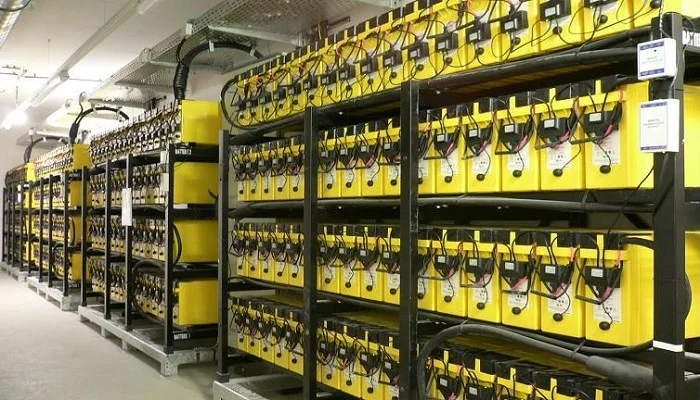
In most telecom cabinets the battery is the only piece of equipment that must work when everything else fails. Three constraints shape every procurement decision.
Space and mass. A cabinet shelf has a fixed footprint and a fixed load rating. The 6-DMF-52 occupies 224×135×175 mm and weighs 13.7 ± 0.2 kg per unit, so a 48 V string of four units measures 224×135×175 mm per case and carries 4 × 13.7 = 54.8 kg of battery mass on the shelf (Arithmetic from Model page). Where the cabinet designer needs half a case-width more, a 6-DMF-45 or 6-DMF-38 gives the same chemistry in a narrower envelope — see the sibling model page.
Heat. A sealed VRLA cabinet in a hot climate loses life long before it loses voltage reading. The published working window for the 6-DMF-52 is −15…50 °C, and float life is quoted at 25 °C (Model page). Sites in Karachi, Chennai, Cairo, Lagos and Durban routinely sit above the 25 °C reference point, which is exactly why a published working range and a published float voltage matter more than catalogue adjectives.
Discharge depth. Grid outages are not rare in many markets, so the string is discharged repeatedly. The published cycle life of the 6-DMF-52 is 350–600 cycles at DoD 50–80 % (Model page). Treating that range as a design ceiling — sizing runtime on 50 % DoD rather than on 80 % — is what keeps a site running when the outage becomes an overnight event.
§3 — The Choice: Series, Parallel, Redundancy and Chemistry
The first choice is topology, and it is arithmetic, not preference.
- Two units in series give a 24 V bus at 52 Ah and 1,248 Wh.
- Four units in series give a 48 V bus at 52 Ah and 2,496 Wh.
- Four units in parallel keep a 12 V bus and lift capacity to 208 Ah, still 2,496 Wh.
Runtime then follows directly. For a 48 V string of four 6-DMF-52 units powering a 500 W load: usable energy at 80 % DoD = 2,496 Wh × 0.80 = 1,997 Wh; 1,997 ÷ 500 W = ≈ 4.0 hours. The same string on a 50 % DoD basis = 2,496 × 0.50 = 1,248 Wh; 1,248 ÷ 500 = ≈ 2.5 hours. Both figures assume the 1.75 V/cell cutoff published for the model (Model page).
The second choice is redundancy. A telecom site normally runs two parallel strings so that one string can be serviced while the other carries the load. For a 48 V site that means eight 6-DMF-52 units: 8 × 13.7 kg = 109.6 kg of battery mass and 8 × 624 Wh = 4,992 Wh installed (Arithmetic from Model page). Check that figure against the cabinet shelf rating before ordering.
The third choice is chemistry and format. Flooded, gel and AGM options all exist for telecom duty, and each carries a different tolerance for heat, mounting orientation and maintenance access. The 6-DMF-52 sits in the 12 V VRLA AGM format covered by the full product range, where the same 13.5 V float, 14.1 V equalise, 1.75 V/cell cutoff and ≤3 %/month self-discharge apply across the 6-DZF, 6-DMF and 6-EVF series. That consistency is what allows one charger program and one spare-parts policy for an entire cabinet.
§4 — The Framework: Five Checks Before a 6-DMF-52 Order Is Placed
Importers who avoid warranty disputes on telecom batteries run the same five checks, in this order.
1. Fix the topology from the load, not from the datasheet. Start with the DC bus voltage the cabinet actually runs on (24 V or 48 V in most deployments), the average draw in watts, and the required backup hours. Only then choose 2 units in series, 4 units in series, or parallel banks of 2 and 4. Every later number inherits this decision.
2. Match the charger program to the published setpoints. The 6-DMF-52 floats at 13.5 V, equalises at 14.1 V and ends discharge at 1.75 V/cell (Model page). A rectifier set to a different float band changes both the cycle life and the water balance of the string; treat 13.5 V as a hard requirement in the purchase specification, and confirm the equalise stage is temperature-compensated where the cabinet runs hot.
3. Verify mechanical and thermal fit before shipping. Compare 224×135×175 mm and 13.7 ± 0.2 kg against the shelf drawing, and check the −15…50 °C working window against the site ambient (Model page). For sites above 35 °C, ventilation matters more than cell selection.
4. Size the charging path. The published maximum charge current is 10.4 A per 6-DMF-52 (Model page). A 48 V string of four units therefore needs a rectifier able to deliver at least 4 × 10.4 = 41.6 A to restore capacity after a deep discharge; anything below that extends the recovery window.
5. Set the acceptance test on delivery. Measure open-circuit voltage per cell (a healthy 12 V unit reads roughly 12.4–12.7 V after float), check terminal torque on the φ11.8-M6 post, confirm the printed label voltage against the delivery note, and log case weight against the 13.7 ± 0.2 kg figure. Record everything at receipt, because the transport and storage period before installation is where the warranty clock starts.
§5 — 6-DMF-52 Against the Sibling 12 V Modules
The table below uses published values only. The Wh column is arithmetic: nominal voltage 12 V × published capacity.
| Model | V | Capacity | Rate | L×W×H mm | Weight | Terminal | Float | Equalise | Charge current | Cutoff | Design life | Nominal Wh |
|---|---|---|---|---|---|---|---|---|---|---|---|---|
| 6-DZF-20 | 12 | 20 Ah | C2 | 180×76×170 | 6.1 ± 0.2 kg | φ8.8-M5 | 13.5 V | 14.1 V | 4.0 A | 1.75 V/cell | 2–5 years | 240 Wh |
| 6-DMF-38 | 12 | 38 Ah | C3 | 224×106×175 | 10.45 ± 0.2 kg | φ9.8-M5 | 13.5 V | 14.1 V | 7.6 A | 1.75 V/cell | Not published | 456 Wh |
| 6-DMF-45 | 12 | 45 Ah | C3 | 224×121×175 | 12.3 ± 0.2 kg | φ11.8-M5 | 13.5 V | 14.1 V | 9.0 A | 1.75 V/cell | 2–5 years | 540 Wh |
| 6-DMF-52 | 12 | 52 Ah | C3 | 224×135×175 | 13.7 ± 0.2 kg | φ11.8-M6 | 13.5 V | 14.1 V | 10.4 A | 1.75 V/cell | Not published | 624 Wh |
| 6-EVF-50 | 12 | 50 Ah | C3 | 230×140×180 | 15.25 ± 0.2 kg | φ11.8-M6 | 13.5 V | 14.1 V | 10.0 A | 1.75 V/cell | 2–5 years | 600 Wh |
| 6-EVF-60 | 12 | 60 Ah | C3 | 258×170×160 | 18.8 ± 0.2 kg | φ14-M6 | 13.5 V | 14.1 V | 12.0 A | 1.75 V/cell | 2–5 years | 720 Wh |
| 6-EVF-80 | 12 | 80 Ah | C3 | 259×170×218 | 25.7 ± 0.2 kg | φ16-M6 | 13.5 V | 14.1 V | 16.0 A | 1.75 V/cell | 2–5 years | 960 Wh |
Two readings stand out. First, the 6-DMF-52 shares its 224 mm length and 175 mm height with the 6-DMF-38 and 6-DMF-45, so a cabinet shelf designed around one of them accepts the 6-DMF-52 without a mechanical change — only the width grows from 106 mm to 121 mm to 135 mm as capacity rises. Second, the 6-EVF-50 is the near neighbour by energy (600 Wh versus 624 Wh) but it is larger in every dimension and heavier at 15.25 ± 0.2 kg versus 13.7 ± 0.2 kg, so the 6-DMF-52 buys about 4 % more nominal energy in a smaller case. Charge current scales in step: 10.4 A for the 6-DMF-52 against 10.0 A for the 6-EVF-50.
§6 — The Trust: Factory Capacity, Certification and Delivery
The 6-DMF-52 comes from CHISEN Battery in Hangzhou, China, operating eight production bases with an annual capacity of 70 million kVAh. That scale matters to a telecom importer because the same platform produces flooded tubular OPzS2, gel tubular OPzV2 and the 12 V VRLA AGM range that includes the 6-DMF-52 — a single supplier can therefore cover a mixed cabinet BOM rather than a single cell type. Certification is held at factory level: CE, ISO 9001, ISO 14001, UL and IEC (source: factory profile, §D).
Delivery is routine containerised freight. CHISEN ships VRLA modules to telecom and power-system distributors in India, Nigeria, Kenya, Vietnam, the Philippines, Brazil, Egypt, Mexico, Indonesia and Pakistan, loading mainly from Shanghai and Ningbo, with Shenzhen, Xiamen and Guangzhou available as alternate origins. Buyers in Western Europe receive the same cells through Shanghai, Rotterdam or Antwerp; Middle East orders move through Jebel Ali and Port Said; Latin American shipments typically clear at Callao or Santos. The export desk for the 6-DMF-52 and the rest of the range is sales@chisen.cn and jack@chisen.cn.
What an importer should not have to guess: the design life of the 6-DMF-52 is not published, and neither is the cycle-life curve in this document — the published figure is the 350–600 cycle range at DoD 50–80 % (Model page). Requests for the design-life statement, the warranty terms or a written float-voltage confirmation go to the factory desk, which answers within one working day.
§7 — FAQ
Q1: What are the published nominal voltage and capacity of the 6-DMF-52? 12 V nominal and 52 Ah at the C3 rate, from the Model page. One unit stores 12 V × 52 Ah = 624 Wh nominal (Arithmetic).
Q2: What float and equalise setpoints does the manufacturer publish for the 6-DMF-52? Float 13.5 V (2.25 V/cell) and equalise 14.1 V (2.35 V/cell), Model page.
Q3: What is the maximum charging current for the 6-DMF-52? 10.4 A per unit, Model page. A 48 V string of four units therefore needs at least 41.6 A of rectifier capacity (Arithmetic).
Q4: What are the case dimensions and weight of the 6-DMF-52? 224×135×175 mm and 13.7 ± 0.2 kg, Model page.
Q5: What terminal type and torque does the 6-DMF-52 use? Terminal φ11.8-M6, Model page. The exact tightening torque is not published and should be requested from the factory.
Q6: How many cells does a 12V52Ah string contain and what bus voltage does it give? A 12 V unit contains 6 cells; 2 units in series give a 24 V bus at 52 Ah, 4 units in series give 48 V at 52 Ah, and 4 in parallel give 12 V at 208 Ah (Arithmetic from the published 12 V / 52 Ah rating).
Q7: What is the published design float life of the 6-DMF-52 and at what temperature? Design life is not published for this model and must be requested from the factory. The published working range is −15…50 °C and float voltage is quoted at 25 °C, Model page.
Q8: How should an importer verify the 6-DMF-52 on delivery? Check label voltage against the delivery note, measure open-circuit voltage per unit (roughly 12.4–12.7 V after float), verify terminal condition on the φ11.8-M6 post, and record case weight against the 13.7 ± 0.2 kg published figure.
Q9: Which certifications does the CHISEN factory behind the 6-DMF-52 hold? CE, ISO 9001, ISO 14001, UL and IEC, per the factory profile.
Q10: How do I request a quotation or samples for the 6-DMF-52? Send the required quantity, destination port and target voltage string to sales@chisen.cn or jack@chisen.cn, or via WhatsApp +86 131 6622 6999. The factory desk responds within 24 hours.
Expert Summary
The 6-DMF-52 is a 12 V 52 Ah C3 VRLA AGM module with published figures for every decision that matters on a telecom project: 224×135×175 mm case, 13.7 ± 0.2 kg, φ11.8-M6 terminal, float 13.5 V, equalise 14.1 V, 10.4 A maximum charge current, 1.75 V/cell cutoff, ≤3 %/month self-discharge at 25 °C, −15…50 °C working window and 350–600 cycles at DoD 50–80 %. One unit is 624 Wh; two in series give a 24 V / 52 Ah string of 1,248 Wh; four in series give 48 V / 52 Ah at 2,496 Wh; four in parallel give 12 V / 208 Ah at the same 2,496 Wh. A 500 W load on a 48 V four-unit string therefore runs about 4.0 hours at 80 % DoD and about 2.5 hours at 50 % DoD, and the rectifier must deliver at least 41.6 A to restore that string. The 6-DMF-52 keeps the 224 mm length and 175 mm height of the 6-DMF-38 and 6-DMF-45, so shelf drawings carry over, while carrying more energy than the 6-EVF-50 in a smaller case. Design life for this model is not published and is obtained from the factory, which runs eight bases at 70 million kVAh a year under CE, ISO 9001, ISO 14001, UL and IEC and ships through Shanghai, Ningbo, Shenzhen, Jebel Ali, Rotterdam, Callao and Santos.
Contact CHISEN — 24-Hour Response
- Email: sales@chisen.cn | jack@chisen.cn
- WhatsApp: +86 131 6622 6999
- Website: www.chisen.cn
- Model reference: 6-DMF-52, 12V52Ah — quote the model reference with your enquiry for the fastest response.
Related CHISEN Buyer Guides
- 12V 50Ah Motorcycle Battery: Choosing Between the 6-EVF-50, 6-DMF-45 and 6-DMF-52 (2026)
- 12V 150Ah Battery: Deep-Cycle Sizing for Solar Storage, AGV Fleets and Telecom Backup (202
- 6-EVF-60 12V60Ah Telecom and Base Station Backup Power
- OPzV2-100 OPzV Battery for Telecom Backup Power: Technical Guide
- OPzV Battery for Telecom Backup Power
