Answer First
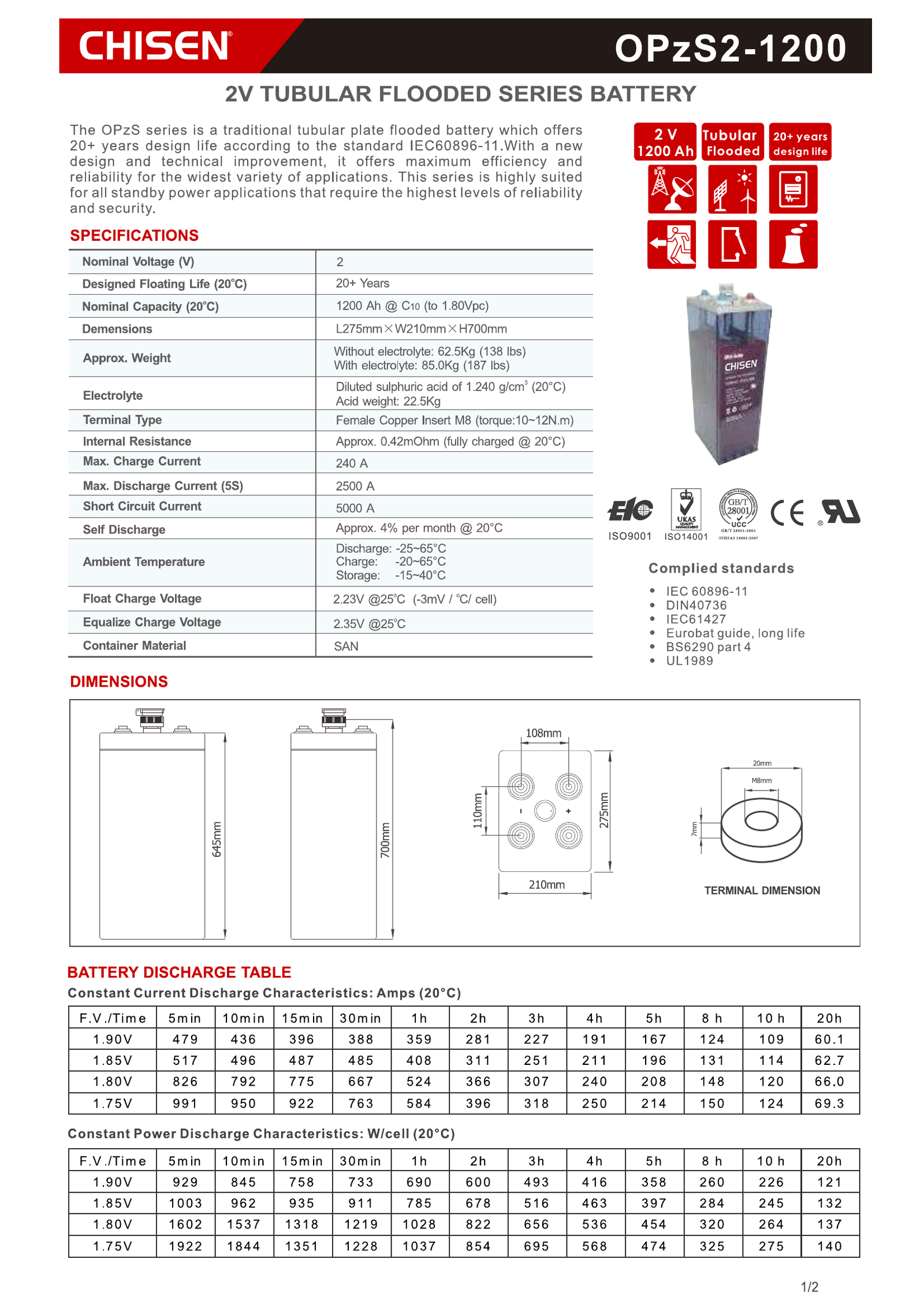
The OPzS2-1200 2V1200Ah is a 2 V, 1,200 amp-hour flooded tubular vented lead-acid cell rated at the 10-hour rate — 120 A for 10 hours to 1.80 V per cell at 20 °C — and it is the correct cell when a telecom DC plant, a substation or a renewable-powered cabinet needs a 48 V bus holding roughly 57.6 kWh nominal per string, and when somebody on site will still top up water and read a hydrometer once a quarter.
It is not a sealed cabinet. It is a component of a room. Hydrogen venting, acid-proof flame-retardant vent plugs, scheduled water top-up and periodic equalisation are part of the product, not optional extras, and a project that treats the OPzS2-1200 2V1200Ah as a drop-in sealed block discovers the difference in the first hot season.
Five numbers decide most projects:
- 275 × 210 mm footprint, 700 mm over terminals, 62.5 kg dry and 85.0 kg filled. A 24-cell 48 V string is 2,040 kg of battery on the floor before racks, busbar and the room.
- Maximum charging current 240 A, which is 0.20 C10. That single limit caps what a solar array can push into the string at about 11.5 kW at 48 V nominal.
- Float 2.23 V per cell at 25 °C with −3 mV/°C/cell compensation; equalise 2.35 V per cell at 25 °C. Charge controllers for renewable duty need the separate setpoint table in §4, not the generic defaults.
- Designed floating life 20+ years at 20 °C. The float life holds at 20 °C and falls away sharply above it, which is the most expensive lesson in this chemistry.
- Internal resistance ≈0.42 mΩ fully charged at 20 °C; short-circuit current 5,000 A. A 24-cell string presents about 10.08 mΩ in series.
The OPzS2-1200 2V1200Ah sits between the OPzS2-1000 and the OPzS2-1500 in the same flooded tubular product line. That position is deliberate: it is the capacity at which the platform still absorbs 240 A per cell, which is what a 48 V string with a meaningful solar array needs.
Key Takeaways
- 1,200 Ah at C10, delivering 120 A for 10 hours to 1.80 V per cell at 20 °C. Size the string on C10, not on the higher short-duration figures a distributor quotes without a rate.
- 62.5 kg dry, 85.0 kg with electrolyte, 22.5 kg of acid. Handling is a two-person job with a trolley, and the floor loading must be checked before the plinth is poured.
- Maximum charging current 240 A per cell (0.20 C10). A 24-cell series string carries that same 240 A through every cell, which is about 11.5 kW at 48 V nominal.
- Float 2.23 V, equalise 2.35 V per cell, −3 mV/°C/cell compensation, 20+ years float life at 20 °C. Renewable duty needs a different setpoint table entirely — see §4.
- Internal resistance ≈0.42 mΩ, short-circuit current 5,000 A, maximum discharge 2,500 A for 5 s. Protection coordination and cable sizing follow directly from these two numbers.
§1 — OPzS2-1200 2V1200Ah Published Specifications
Every figure below is read from the CHISEN OPzS2-1200 factory datasheet. Where a value is a calculation rather than a printed figure, the source column says so. Values the datasheet does not print are written as “not published” rather than estimated, because an estimate on a procurement sheet becomes an engineering assumption that nobody re-checks.
| Parameter | Published value | Source |
|---|---|---|
| Model | OPzS2-1200 | Datasheet |
| Chemistry and construction | Flooded tubular vented lead-acid: die-cast Pb-Sb tubular positive plate, pasted lead-calcium negative plate, low-resistance PVC composite separator, transparent SAN container, high-strength ABS cover | Datasheet |
| Nominal voltage | 2 V per cell | Datasheet |
| Rated capacity (C10) | 1,200 Ah, 120 A for 10 h to 1.80 V per cell at 20 °C | Datasheet |
| Cell footprint | 275 × 210 mm | Datasheet |
| Container (jar) height | 645 mm | Datasheet |
| Total height over terminals | 700 mm | Datasheet |
| Terminal centre spacing | 108 mm × 110 mm | Datasheet |
| Weight without electrolyte | 62.5 kg (138 lbs) | Datasheet |
| Weight with electrolyte | 85.0 kg (187 lbs) | Datasheet |
| Electrolyte (acid) weight | 22.5 kg at 1.240 g/cm³ (20 °C) | Datasheet |
| Internal resistance | ≈0.42 mΩ fully charged at 20 °C | Datasheet |
| Short-circuit current | 5,000 A | Datasheet |
| Maximum discharge current | 2,500 A for 5 s | Datasheet |
| Maximum charging current | 240 A | Datasheet |
| Charge characteristic | Constant current then constant voltage, tapering to 0.15 CA below the float voltage | Datasheet |
| Float charge voltage | 2.23 V per cell at 25 °C, −3 mV/°C/cell temperature compensation | Datasheet |
| Equalise charge voltage | 2.35 V per cell at 25 °C | Datasheet |
| Self-discharge | ≈4 % per month at 20 °C | Datasheet |
| Ambient temperature, discharge | −25 °C to 65 °C | Datasheet |
| Ambient temperature, charge | −20 °C to 65 °C | Datasheet |
| Ambient temperature, storage | −15 °C to 40 °C | Datasheet |
| Designed floating life | 20+ years at 20 °C | Datasheet |
| Terminal type | Female copper insert, M8 thread, 20 mm outer diameter, 7 mm thread depth | Datasheet |
| Terminal tightening torque | 10–12 N·m | Datasheet |
| Applicable standards | IEC 60896-11, DIN 40736, IEC 61427, Eurobat long-life guide, BS 6290 part 4, UL 1989 | Datasheet |
| Certifications | ISO 9001, ISO 14001, GB/T 28001 (OHSAS 18001:2007), CE, RU, TLC | Datasheet |
For renewable duty the useful capacity is quoted at a lower cut-off voltage, because the controller protects the battery long before the cell reaches 1.80 V. The datasheet publishes the following capacities at a 1.85 V cut-off.
| Rate | Capacity at 1.85 V per cell | Source |
|---|---|---|
| C24 | 1,356 Ah | Datasheet |
| C48 | 1,488 Ah | Datasheet |
| C72 | 1,560 Ah | Datasheet |
| C100 | 1,620 Ah | Datasheet |
| C120 | 1,644 Ah | Datasheet |
| C240 | 1,680 Ah | Datasheet |
§2 — The Pain: Why This Purchase Goes Wrong
The capacity number is a trap. The OPzS2-1200 2V1200Ah is rated at C10. A distributor who quotes “1,200 Ah” without the rate is quoting a number that does not describe your duty. At a one-hour discharge the cell delivers roughly half its C10 capacity; at a ten-hour discharge it delivers the full figure. A cabinet that must carry a five-minute ride-through at high load sees far less. Specify the rate and the cut-off voltage with the capacity, always together.
Flooded means a room, not a cabinet. Hydrogen evolves from the negative plates during charging and it needs a path out. Acid-proof flame-retardant vent plugs handle the ignition source; they do not handle the accumulation. Every OPzS2-1200 2V1200Ah installation needs mechanical ventilation sized for the worst-case float and equalisation charge, plus a person with a hydrometer and a top-up bottle on a schedule.
Charge acceptance quietly caps the whole project. The published maximum charging current for the OPzS2-1200 2V1200Ah is 240 A, which is 0.20 C10. At 48 V nominal that is about 11.5 kW. An array sized on the load rather than on the battery is an array the battery cannot absorb. The excess goes into float losses, extended equalisation, or an over-voltage disconnect that trips the inverter out of service.
The float life is temperature-bound, and the datasheet is specific about it. The designed floating life of 20+ years is stated at 20 °C, and it is roughly halved for every 10 °C above that. A power room in Chennai, Durban or Karachi that runs at 30 °C ambient all year is looking at a life closer to ten years, not twenty, and no controller precision changes that. Room cooling is a battery decision, not a comfort decision.
The physical envelope is not negotiable. 275 mm long, 210 mm wide and 700 mm tall over terminals, with 85.0 kg in the cell once filled. Rack pitch, aisle width, door clearance and the lifting route for a single cell all have to be confirmed against the drawing before the plinth is poured. Substituting a guess is how a delivery arrives that cannot be installed.
§3 — The Choice: Where the OPzS2-1200 Sits
The alternative to the OPzS2-1200 2V1200Ah is rarely another chemistry. In the telecom, substation and containerised-renewable markets where this cell is specified, the real choice is the same flooded platform at a different capacity, the gel variant of the same platform, or a sealed VRLA block of a lower capacity.
| Parameter | OPzS2-1000 2V1000Ah | OPzS2-1200 2V1200Ah | OPzS2-1500 2V1500Ah |
|---|---|---|---|
| Rated capacity (C10) | 1,000 Ah | 1,200 Ah | 1,500 Ah |
| Cell footprint | 233 × 210 mm | 275 × 210 mm | 275 × 210 mm |
| Total height over terminals | 700 mm | 700 mm | 850 mm |
| Weight without electrolyte | 53.5 kg | 62.5 kg | 71.0 kg |
| Weight with electrolyte | 73.5 kg | 85.0 kg | 98.0 kg |
| Electrolyte weight | 20 kg | 22.5 kg | 27 kg |
| Internal resistance at 20 °C | 0.45 mΩ | 0.42 mΩ | 0.40 mΩ |
| Short-circuit current | 4,500 A | 5,000 A | 5,400 A |
| Maximum discharge current (5 s) | 2,500 A | 2,500 A | 2,500 A |
| Maximum charging current | 200 A | 240 A | 300 A |
Read that table column by column rather than row by row. The OPzS2-1200 2V1200Ah is the only one of the three whose maximum charging current, 240 A, is exactly 0.20 C10 of its own capacity. The 1,000 Ah cell accepts 200 A, which is also 0.20 C10, but 240 A is 20 % more absolute current for 20 % more absolute energy. The 1,500 Ah cell accepts 300 A, which is the same 0.20 C10 ratio but 25 % more current than the 1,200 Ah cell, and it is 13.0 kg heavier per cell — 312 kg more across a 24-cell string.
Footprint is the second lesson. The OPzS2-1200 2V1200Ah and the OPzS2-1500 2V1500Ah share the same 275 × 210 mm footprint, but the 1,500 Ah cell is 850 mm over terminals against 700 mm, so the rack pitch is not interchangeable. The 1,000 Ah cell is narrower at 233 mm and fits a different pitch. Cell width is not a free variable when the cabinet is already drawn.
The third lesson is internal resistance, because it is the number that decides how a string behaves on a step load. At 0.42 mΩ the OPzS2-1200 2V1200Ah is the middle of the three, and for a 24-cell string the arithmetic is 24 × 0.42 mΩ = 10.08 mΩ in series, against 24 × 0.45 mΩ = 10.80 mΩ for the 1,000 Ah build and 24 × 0.40 mΩ = 9.60 mΩ for the 1,500 Ah build. A 500 A load step on a 48 V string produces a voltage step of 500 A × 10.08 mΩ = 5.04 V across the string, or 0.21 V per cell, which sits comfortably inside the ride-through window a controller expects. The 1,000 Ah build steps 5.40 V and the 1,500 Ah build 4.80 V.
The full physical and electrical data for the OPzS2-1200 2V1200Ah sits on the CHISEN OPzS2-1200 model page, the next size down is documented on the OPzS2-1000 model page, and the wider flooded tubular range is indexed on the CHISEN OPzS tubular battery page.
§4 — The Framework: Five Hard Numbers for Sizing and Acceptance
1. Size on C10, then check it against the real discharge. A 24-cell string at the C10 rate delivers 48 V × 1,200 Ah = 57,600 Wh nominal. At the C24 rate published for renewable duty, the same string holds 24 × 1,356 Ah = 32,544 Ah measured down to a 1.85 V per cell cut-off. That figure sits above the 1,200 Ah nominal rating because the discharge is slower and the cut-off voltage is higher, so it is not directly comparable to C10. Quote the nominal 57,600 Wh for a ride-through duty and the renewable figure for a solar cabinet; they answer different questions.
2. Check charge acceptance against the array, not against the load. Maximum charging current is 240 A per cell. Because the 24 cells sit in series, the string carries that same 240 A through every cell, so at 48 V nominal it absorbs 240 A × 48 V = 11,520 W. Where several strings run in parallel, the installed cell-level charge-acceptance total is 24 × 240 A = 5,760 A per string, and the rectifier has to be sized on the parallel sum rather than on one string. Size the array on 0.20 C10 and the rest follows.
3. Confirm the floor, the rack and the lifting route. A filled 24-cell string weighs 24 × 85.0 kg = 2,040 kg, plus 24 × 62.5 kg = 1,500 kg of dry cell mass and 24 × 22.5 kg = 540 kg of acid. The acid alone is 540 kg of electrolyte that has to be handled if a cell is ever replaced.
4. Write the equalisation schedule into the acceptance test. Equalisation runs at 2.35 V per cell at 25 °C, which is 24 × 2.35 V = 56.4 V across a 48 V string, and it is the point at which cell imbalance shows up. A string that has never been equalised has never shown its capacity spread, and that spread is what decides whether the last cell in the string runs out of life first.
5. Set the renewable controller to the published table, not to a default. The datasheet prints a dedicated setpoint list for solar and wind duty.
| Solar and wind setpoint | Published setting | Source |
|---|---|---|
| Over voltage disconnect | 2.47 ± 0.01 V/cell at 25 °C | Datasheet |
| Regulation / equalise voltage | 2.40 ± 0.01 V/cell at 25 °C | Datasheet |
| Array reconnection voltage | 2.23 ± 0.005 V/cell at 25 °C | Datasheet |
| Float voltage setting | 2.25 ± 0.005 V/cell at 25 °C | Datasheet |
| Low voltage alarm voltage | 1.95 ± 0.005 V/cell at 25 °C | Datasheet |
| Low voltage disconnect | 1.90 ± 0.005 V/cell at 25 °C | Datasheet |
| Load reconnect voltage | 2.09 ± 0.01 V/cell at 25 °C | Datasheet |
| Temperature compensation coefficient | −4 mV/cell/°C | Datasheet |
Note the deliberate difference between the float table in §1 and the renewable table here. The general float setting is 2.23 V per cell at 25 °C with −3 mV/°C/cell compensation, while the renewable controller runs a float setting of 2.25 ± 0.005 V per cell with −4 mV/cell/°C compensation. A controller left on a generic profile will hold the string below the renewable float setpoint and quietly shorten life.
§5 — The Trust: How to Test the Delivery
The first test is the paperwork, not the pallet. A battery quote should arrive with the datasheet behind it, and the datasheet should carry the cell model, the rated capacity with its rate, the charge voltage setpoints, the standards and the certifications. If the quotation carries only a capacity and a table number, ask for the datasheet before the price conversation continues.
Check the production base, not the trading company. The CHISEN OPzS2-1200 2V1200Ah is produced inside a manufacturer operating 8 production bases with an annual capacity of 70 million kVAh, under a quality management system certified to ISO 9001 with ISO 14001 covering the environmental system and GB/T 28001 for occupational health and safety, with CE, UL and IEC conformity for the destination markets. A trader who cannot name the base that cast the plate is selling you somebody else’s cell.
Ask for the serial-level traceability and the type-test evidence. IEC 60896-11 and DIN 40736 are the applicable standards for this flooded tubular platform, and UL 1989 is the North American reference. A supplier who supplies the certificate index without the report is supplying the index.
Watch the certification claims on the nameplate. Every published certificate on the OPzS2-1200 2V1200Ah datasheet appears with a standard reference beside it: IEC 60896-11, DIN 40736, IEC 61427, the Eurobat long-life guide, BS 6290 part 4 and UL 1989. If a supplier quotes a certification that is not in that list, ask for the document.
Ask what happens at the first hot season. A power room in Mombasa or Valencia in August runs above 30 °C ambient, and the 20+ year float life at 20 °C is the figure that no longer holds. A supplier who quotes 20+ years without the temperature is quoting a marketing number; a supplier who quotes it at 20 °C is quoting the datasheet.
And insist on the handover documents. A complete delivery for the OPzS2-1200 2V1200Ah includes the test report, the packing list with the acid weight per cell, the installation and ventilation drawing, the charging setpoint sheet and the warranty terms. The setpoint sheet matters more than it looks: the float and equalise values, the temperature compensation and the maximum charging current are the settings that determine whether the 20+ year design life is real or not.
§6 — FAQ
Q1. What does 2V1200Ah mean on the OPzS2-1200? It means one cell of 2 volts nominal delivering 1,200 amp-hours at the 10-hour rate, which is 120 A for 10 hours down to 1.80 V per cell at 20 °C. A 48 V string is 24 of these cells in series, so the string is 48 V × 1,200 Ah = 57,600 Wh nominal.
Q2. Can I run the OPzS2-1200 2V1200Ah in parallel with another set? Yes, in strings of equal length and equal age, but the parallel strings must be on the same bus, the same controller profile and the same equalisation schedule, and the state of charge must be matched before the strings are connected. Unequal-length strings on a shared bus will not share current evenly.
Q3. What charger do I need for a 48 V string? A 48 V charger with a current rating no higher than the published maximum charging current of the string, which is 24 × 240 A = 5,760 A of theoretical cell acceptance but practically 0.20 C10. Confirm the setpoints: float 2.23 V per cell at 25 °C, equalise 2.35 V per cell at 25 °C, and −3 mV/°C/cell temperature compensation.
Q4. Does the OPzS2-1200 2V1200Ah need a temperature-compensated charger? Yes. The datasheet specifies −3 mV/°C/cell compensation for general duty and −4 mV/cell/°C for solar and wind duty, and a fixed-voltage charger in a room that swings from 10 °C to 35 °C will over-charge the string in winter and under-charge it in summer.
Q5. How much water does an OPzS2-1200 2V1200Ah cell need over its life? Each cell holds 22.5 kg of electrolyte at 1.240 g/cm³, and water loss is topped up through the vent plugs. The published self-discharge rate is ≈4 % per month at 20 °C, which is mostly water loss in a flooded cell. Establish the top-up interval and the instrument before the string is commissioned.
Q6. Is 20+ years float life realistic for the OPzS2-1200 2V1200Ah? It is the designed floating life stated at 20 °C, and it is a float-life figure for a standby duty, not a cycle-life figure. It also depends on the room staying close to 20 °C, on float voltage being held at 2.23 V per cell and on equalisation being done on schedule.
Q7. What is the difference between the OPzS2-1200 2V1200Ah and a 1,200 Ah sealed VRLA block? The OPzS2-1200 2V1200Ah is flooded and vented, so it needs a ventilated room, water top-up and periodic equalisation, and in exchange it gives a 20+ year float life at 20 °C with a published 5,000 A short-circuit current. A sealed block needs no room service but has a shorter float life and a lower short-circuit capability.
Q8. Can the OPzS2-1200 2V1200Ah be used for solar storage? Yes, and the datasheet publishes renewable-specific data for it: long-time discharge capacities of 1,356 Ah at C24 rising to 1,680 Ah at C240 on a 1.85 V cut-off, plus a dedicated controller setpoint table with a 2.47 ± 0.01 V over-voltage disconnect and a 2.40 ± 0.01 V regulation voltage. Use those setpoints rather than a generic profile.
Expert Summary
The OPzS2-1200 2V1200Ah is a 2 V flooded tubular lead-acid cell rated 1,200 Ah at C10 — 120 A for 10 hours to 1.80 V per cell at 20 °C — built for telecom DC plant, substation and renewable storage duties where somebody will maintain it. Its published physical envelope is a 275 × 210 mm footprint, 700 mm over terminals, 62.5 kg dry and 85.0 kg filled with 22.5 kg of acid; its published electrical envelope is float 2.23 V per cell at 25 °C with −3 mV/°C/cell compensation, equalise 2.35 V per cell at 25 °C, maximum charging current 240 A, internal resistance ≈0.42 mΩ at 20 °C, short-circuit current 5,000 A, maximum discharge 2,500 A for 5 s, self-discharge ≈4 % per month at 20 °C, and a designed floating life of 20+ years at 20 °C. It complies with IEC 60896-11, DIN 40736, IEC 61427, the Eurobat long-life guide, BS 6290 part 4 and UL 1989, and carries ISO 9001, ISO 14001, GB/T 28001, CE, RU and TLC. In a 24-cell 48 V string it holds 57,600 Wh nominal, weighs 2,040 kg filled, accepts 24 × 240 A = 5,760 A, and presents 24 × 0.42 mΩ = 10.08 mΩ in series. It sits between the OPzS2-1000 and OPzS2-1500 in the same flooded tubular product line, and the choice between them is a question of array size, rack height and string weight, not of chemistry.
Contact CHISEN
Request the OPzS2-1200 2V1200Ah datasheet, the type-test report for your destination market and a string layout for your bus voltage and load profile from the CHISEN export team.
- Product page: OPzS2-1200 2V1200Ah
- Adjacent capacity: OPzS2-1000 2V1000Ah
- Range index: OPzS flooded tubular batteries
- Email: sales@chisen.cn | jack@chisen.cn
- WhatsApp: +86 131 6622 6999
Lead-acid tubular batteries for telecom DC plant, substation and renewable storage projects. State the bus voltage, the load, the ambient temperature range and the required float life in your enquiry, and the quotation will carry the matching string arithmetic rather than a cell price alone.
Related CHISEN Buyer Guides
- OPzV Tubular Gel Battery for Southeast Asia Telecom: 6-Country Procurement Guide (2026)
- OPzS2-1000 2V1000Ah: 108 V and 216 V DC Plant Sizing for Hybrid Renewable and Telecom Site
- OPzS2-200 2V200Ah Flooded Tubular Battery for Telecom DC Plants
- OPzS2-2500 2V 2500Ah Flooded Tubular Battery: Sizing and Maintenance for Railway and Telec
- OPzS2-420 2V420Ah Flooded Tubular Battery: Manned-Room versus Unattended Site Selection
