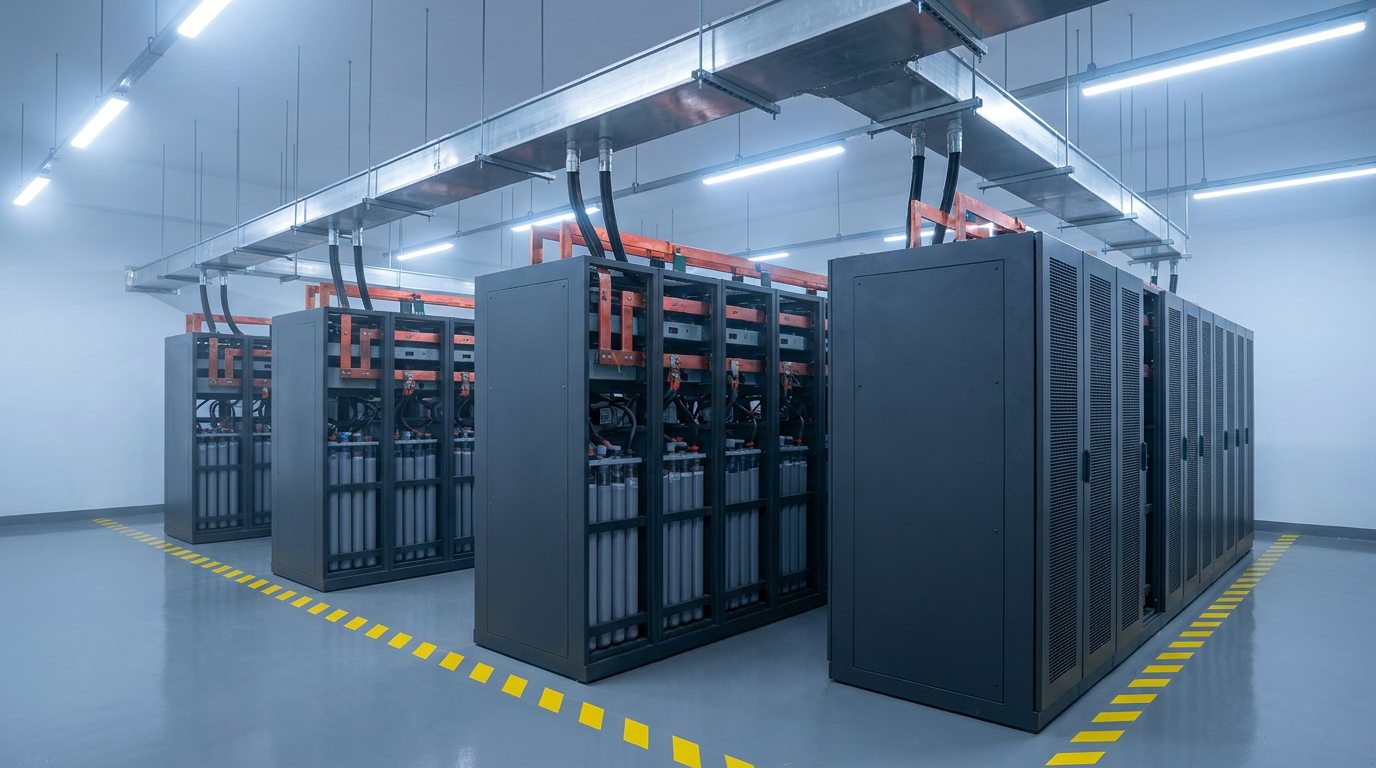
Answer First
The OPzS2-600 2V600Ah is a 2 V, 600 Ah (C10) flooded tubular lead-acid cell built for float service: 145 × 206 × 645 mm, 700 mm over terminals, 2.23 V float and 2.35 V equalise per cell (2.40 V for solar and wind regulation), 120 A maximum charge current, 1,500–2,500 cycles at 80 % depth of discharge and a 20-plus-year float design life at 20 °C. It is the right cell when you are building a 108 V or 216 V DC string for a telecom power room, a railway signalling substation or a metro traction auxiliary feed, and it is the wrong cell when the room is unreachable, when space is the constraint, or when nobody will ever top up electrolyte.
One number decides most projects: 600 Ah at the ten-hour rate. A 54-cell string of OPzS2-600 2V600Ah cells holds 54 × 2 V × 600 Ah = 64.8 kWh of nominal energy, and a 108-cell string holds 129.6 kWh. That is roughly four to six hours of backup for a 20–25 kW telecom DC load at 50 % depth of discharge, which is where most of these installations actually sit.
Key Takeaways
- Rated 600 Ah at C10, not C20. The OPzS2-600 2V600Ah reaches 600 Ah when discharged over ten hours to 1.80 V per cell. A buyer who reads 600 Ah as a twenty-hour figure will size the string roughly 20 % short for a short-duration duty.
- 108 V means 54 cells, 216 V means 108 cells. Every string voltage is a cell count multiplied by 2 V: 24 cells for 48 V, 54 cells for 108 V, 108 cells for 216 V.
- String charge current is capped by the cell, not by the rectifier. Each OPzS2-600 2V600Ah cell accepts 120 A maximum; a 54-cell string therefore pulls up to 6,480 A of charging current, and the rectifier must be sized for that or the string will never recover capacity after a deep discharge.
- Float current is 3.0 A per cell. At 5 mA per amp-hour, one cell draws 3.0 A on float. Over a 54-cell string that is 162 A of continuous float draw that the generator or PV array has to carry for the life of the plant.
- The maintenance burden is the real differentiator. Flooded tubular cells need periodic electrolyte checks, specific-gravity readings and topping up, and a ventilated room. If the site cannot be visited quarterly, gel is the correct choice even at a higher price per amp-hour.
§1 — OPzS2-600 2V600Ah Quick Specifications Table
| Parameter | OPzS2-600 2V600Ah published value | Why it matters in a string |
|---|---|---|
| Nominal voltage | 2 V per cell | 54 cells give 108 V, 108 cells give 216 V |
| OPzS2-600 rated capacity | 600 Ah at C10, to 1.80 V/cell | Defines usable energy at a 6-hour-plus discharge |
| OPzS2-600 dimensions (L × W × H) | 145 × 206 × 645 mm | Sets rack pitch and room length for a 54-cell string |
| OPzS2-600 cell weight | 32.0 kg without electrolyte; 42.8 kg with electrolyte (10.8 kg acid) | Floor loading, lifting and freight cost for a 54-cell string |
| OPzS2-600 height over terminals | 700 mm | Include 50–80 mm clearance above terminals for ventilation |
| OPzS2-600 terminal | Φ20-M8, torque 10–12 N·m (Φ16-M6 and Φ24-M10 options) | Interconnect cable sizing follows the bolt size, not the current |
| Technology | Flooded tubular lead-acid | Electrolyte is visible; the cell needs periodic topping up |
| Float voltage | 2.23 V/cell at 25 °C (datasheet float; 2.25 V float setting for solar) | 54 × 2.23 V = 120.42 V at the busbar at 25 °C |
| Equalise voltage | 2.35 V/cell at 25 °C (2.40 V for solar and wind regulation) | Equalisation is a controlled weekly or bi-weekly event |
| Temperature compensation | −3 mV/°C/cell float (datasheet); the solar settings table lists −4 mV/°C/cell | A 40 °C room cuts float voltage by roughly 0.045 V per cell |
| Maximum charging current | 120 A per cell | A 54-cell string can demand up to 6,480 A on recharge |
| Cycle life | 1,500–2,500 cycles at 80 % DoD; 2,500–4,000 at 50 % DoD; 4,500–6,500 at 30 % DoD | Depth of discharge, not age, drives replacement |
| Float design life | 20+ years at 20 °C (datasheet) | Halves roughly for every 10 °C above 20 °C |
| Discharge temperature | −40 °C to 60 °C | Cold cranking is not the limit; charging is |
| Charge temperature | −30 °C to 55 °C | Below −30 °C the cell will not accept charge |
| Storage temperature | −25 °C to 45 °C | A cell stored hot and shipped to a cool site needs re-equalising |
| Internal resistance | 0.60 mΩ fully charged at 25 °C | Sets the voltage drop under high-current discharge |
| Short-circuit current | 3,700 A per cell | Plan fusing and touch protection on every string |
| Electrolyte specific gravity | 1.24 ± 0.01 g/cm³ fully charged | The reference point for every field density check |
| Certifications | IEC 60896-11:2002, DIN 40736-1:1985, GB/T 19638.2-2014, YD/T 1360, Eurobat Long Life, BS 6290 Part 4, UL 1989 | Covers the stationary, telecom and export markets |
§2 — The Pain
A DC plant fails in one of two ways, and both start long before the batteries are visibly old.
The first is a string that was sized for nominal energy instead of usable energy. A 54-cell string of OPzS2-600 2V600Ah cells delivers 64.8 kWh nominal, but at 50 % depth of discharge and a 2.00 V/cell end-point the bank gives you closer to 24–26 kWh of usable energy at the load terminals once you subtract float-current losses, cable drop and cell temperature. If the tender documents only quote 600 Ah and 108 V, two suppliers can bid 15 % apart and both be honest.
The second is a string that cannot recharge. The OPzS2-600 2V600Ah accepts 120 A per cell on charge, and the common failure in the field is a rectifier sized for the load rather than for the battery. A 54-cell string of OPzS2-600 2V600Ah cells that has been deeply discharged needs thousands of amps to recover in the time the generator is available, and a cell that is never fully recovered ages for reasons that have nothing to do with its age. Short the recharge and the cell sulphates, capacity falls, float voltage sags, the end cells age first, and within three years you are replacing cells in a string that was specified for twenty.
There is a third, quieter problem: the language of the page you are reading. Many of these cells are sold with a single capacity number and no rate basis. The same 600 Ah label is quoted at the ten-hour rate by some suppliers and the twenty-hour rate by others, and the difference shows up as a 10–15 % shortfall in a real discharge test.
§3 — The Choice
Once the duty is float-dominant and the room is accessible, flooded tubular is hard to beat on cost per stored kilowatt-hour. When the room is not accessible, or the site is hot, or the space is tight, gel or sealed VRLA wins even though the cell costs more per amp-hour.
| Selection metric | OPzS2-600 2V600Ah (flooded tubular) | Tubular gel OPzV2 equivalent | Sealed AGM VRLA equivalent |
|---|---|---|---|
| Rated capacity basis | 600 Ah at C10 | 500 Ah at C10 in the next larger step | 12 V blocks, 100–250 Ah at C10 |
| Float voltage per cell | 2.23 V | 2.23 V | 2.27 V |
| Equalise voltage per cell | 2.35 V | 2.35 V | 2.35 V |
| Maximum charging current | 120 A per cell (0.2 C10) | 0.2 C10 per cell | 0.25 C10 |
| Cycle life at 80 % DoD | 1,500–2,500 cycles | ≥1,500 cycles | Not published on the model page |
| Float design life | 20+ years at 20 °C | 20+ years at 20 °C | 12 years at 20 °C |
| Discharge temperature range | −40 °C to 60 °C | −40 °C to 65 °C | −20 °C to 60 °C |
| Service actions per year | Electrolyte density checks and topping up, typically quarterly | Visual inspection and cleaning, no watering | Visual inspection and cleaning, no watering |
| Installation requirement | Ventilated room, spill containment | Sealed, no spill, no ventilation for hydrogen | Sealed, no spill, no ventilation for hydrogen |
| Cell mass per stored kWh | Lowest of the three, because the plastic case is a tube | Moderate | High, because of the thicker case and more lead |
| Field failure mode | Water loss, terminal corrosion, density stratification | Overcharge heat at high ambient, loss of capacity | Thermal runaway from poor cooling, loss of capacity |
The table above is built from published CHISEN data for each chemistry; where a figure is not published it is marked as such rather than estimated. The commercial conclusion is physical rather than financial. A flooded OPzS2-600 2V600Ah string of 54 cells stores 64.8 kWh nominal in about 11.2 m³ of rack volume including interconnects and clearances, while a sealed string of the same energy needs materially more case volume and heavier handling gear. Where a power room has to be built inside an existing building, that difference decides the design.
For the wider flooded tubular range, the OPzS series is published from 100 Ah up to 3,000 Ah, with a shared platform, terminal standard and case footprint, so a plant can be built from one supplier with one set of spares and one maintenance procedure. The OPzS flooded tubular battery hub lists the full range and the model datasheets.
§4 — The Framework
Fix the rate basis before the capacity. Write 600 Ah at C10 to 1.80 V/cell into the specification and require the supplier to state the rate on the datasheet. Capacity quoted without a rate and an end-point voltage is not a number you can order against.
Count cells, not volts. A 108 V DC system is 54 cells of 2 V. A 216 V system is 108 cells. Ask for the cell count per string, the string count and the end-point voltage, then check that the arithmetic delivers the autonomy you need at 50 % depth of discharge rather than at the nameplate.
Check the charge path against the published 120 A. Multiply the rectifier’s current limit by the number of strings and compare it with the recovery time you need after a full discharge. If the recharge window is four hours for a 54-cell string, the rectifier must be able to deliver close to 6,480 A into that string, which is 120 A for every OPzS2-600 2V600Ah cell. Most site faults are rectifier faults, not cell faults.
Design the room for the cell, not for the battery. At 700 mm over terminals, a 54-cell string on a two-tier rack needs roughly 1.6 m of wall length, floor loading for the full weight of the filled cells, a clear maintenance aisle in front of every tier, and ventilation sized for hydrogen from the cells under equalisation charge.
Budget the maintenance visits. A flooded cell loses water through electrolysis and evaporation. Quarterly visits for density readings, topping up, terminal cleaning and torque checks are the minimum, and the cost of those visits belongs in the ten-year comparison, not just the cell price.
Set the temperature compensation rule. At −3 mV per °C per cell, a room that sits at 35 °C needs roughly 0.03 V less per cell than a 25 °C room. Put the compensation in the rectifier settings and re-check it after every seasonal change.
Demand the data trail. Ask for the incoming inspection report, the initial charge record, the first specific-gravity readings at 30, 90 and 180 days, and the annual density trend. Without that trail, a warranty claim on a twenty-year asset becomes an argument about who held the data.
§5 — The Trust
There are three things a buyer should check before signing, and one of them is on the supplier’s own website.
The first is the consistency of the published datasheet. The product page for the OPzS2-600 2V600Ah carries the dimensions 145 × 206 × 645 mm with a total height of 700 mm in the specification table, while a later section of the same page repeats 103 × 206 × 409 mm and a 12.6 kg cell weight, and the FAQ section repeats 145 × 206 × 700 mm. Those three statements do not agree. A 600 Ah flooded tubular cell of this format is a large, heavy piece of equipment, and a 12.6 kg figure is not credible for the OPzS2-600 2V600Ah. Treat the specification table as the controlling document, and have weight and dimensions confirmed in writing on a signed CHISEN spec sheet before the shipping calculation, the rack design and the floor loading check are frozen. This is exactly the kind of small documentation defect that destroys a project schedule six months later.
The second is the equalisation procedure. Equalising a flooded string at 2.35 V per cell, or 2.40 V in solar and wind regulation, raises cell temperature and produces hydrogen. A room that cannot remove that gas cannot be equalised safely, and a string that is never equalised develops capacity spread until the weakest cell drags the busbar down. Define the equalisation interval in the maintenance contract, the gas removal rate in the room design, and who signs off the density readings.
The third is the acceptance test. Require a discharge test on the delivered string to the agreed end-point voltage at the agreed rate, with the initial specific gravities and cell voltages recorded cell by cell. A string that passes at the factory and fails at site is usually a transport, connection or temperature problem, and it is much easier to diagnose with the acceptance data in hand.
One more caution on comparisons: some suppliers publish a single 600 Ah number for a smaller cell than the OPzS2-600 2V600Ah, or quote cycle life figures measured at 30 % depth of discharge and present them as 80 % figures. Compare on the same rate basis, the same depth of discharge and the same temperature.
§6 — FAQ
Q1. What is the rated capacity of the OPzS2-600 2V600Ah, and at what rate? 600 Ah at the ten-hour rate (C10), measured to an end-point of 1.80 V per cell at 25 °C. If you need 600 Ah at a twenty-hour rate, this cell does not deliver it, and the string must be sized accordingly.
Q2. How many cells make a 108 V DC system? 54 cells of 2 V. A 48 V system uses 24 cells and a 216 V system uses 108 cells. The float busbar voltage at 25 °C is 120.42 V for a 54-cell string at 2.23 V per cell.
Q3. What charge current does the cell accept? 120 A maximum per cell, which is 0.2 C10. A 54-cell string can therefore accept up to 6,480 A. Size the rectifier for that or accept a slow recharge after a deep discharge.
Q4. Does the OPzS2-600 2V600Ah need electrolyte topping up? Yes. It is a flooded cell with a transparent case, so electrolyte level, specific gravity and stratification are visible and must be inspected periodically, typically quarterly.
Q5. How long does the float life last? The published float design life is 20+ years at 20 °C. As an engineering rule of thumb, float life is roughly halved for every 10 °C above 20 °C, so a 30 °C room should be planned at around 12–13 years, and that assumption belongs in the tender document.
Q6. What cycle life should I expect at 80 % depth of discharge? 1,500–2,500 cycles at 80 % depth of discharge, 2,500–4,000 cycles at 50 %, and 4,500–6,500 cycles at 30 %. Float service in a DC plant is much gentler than cycling, so the 20-year float figure dominates in telecom and signalling applications.
Q7. Can I use the cell at high ambient temperature? Discharge is rated from −40 °C to 60 °C and charging from −30 °C to 55 °C, but float life shortens with temperature, so the room cooling design is part of the battery specification.
Q8. What happens if the string is deeply discharged and recharge is too slow? The cell sulphates, capacity and internal resistance drift, and the end cells age first. The published 120 A maximum charge current is the threshold above which the cell cannot take charge cleanly, and the internal resistance of 0.60 mΩ rises as the cell ages.
Q9. Which certifications can be supplied? IEC 60896-11:2002, DIN 40736-1:1985, GB/T 19638.2-2014, YD/T 1360, Eurobat Long Life, BS 6290 Part 4 and UL 1989, with RoHS, REACH and WEEE handled in the destination market.
Q10. How do I request a sizing sheet and a quotation? Send the string voltage, the load in kW, the required autonomy in hours, the minimum end-point voltage, the room temperature and the delivery port — Shanghai, Ningbo, Jebel Ali, Santos, Rotterdam, Hamburg, Valencia, Mersin, Chattogram, Mombasa or Tema all have the same operating logic, and we reply with a cell count, an energy budget and a float-current figure within one working day.
Expert Summary
The OPzS2-600 2V600Ah is a 2 V, 600 Ah C10 flooded tubular cell for float duty, published at 145 × 206 × 645 mm and 700 mm over terminals, with 2.23 V float and 2.35 V equalise per cell (2.40 V for solar and wind regulation), 120 A maximum charge current, 3.0 A float current per cell, 0.60 mΩ internal resistance, 32.0 kg without electrolyte and 42.8 kg with electrolyte, a 20-plus-year float life at 20 °C and 1,500–2,500 cycles at 80 % depth of discharge. A 54-cell string holds 64.8 kWh nominal and a 108-cell string 129.6 kWh. Three decisions define the installation: the capacity rate basis, which must be written as C10 to 1.80 V/cell rather than a bare amp-hour figure; the charge path, where the 120 A per-cell limit means a 54-cell string can demand 6,480 A and the rectifier must be sized accordingly; and the maintenance regime, because a flooded cell needs quarterly density checks, topping up and terminal service in a ventilated room. Where the room is accessible, flooded tubular wins on cost per stored kilowatt-hour and on the number of cells a rack can hold. Where the room is unreachable or the space is constrained, sealed gel or AGM is the correct answer even at a higher price per amp-hour, because the 20-year float life only materialises with the temperature compensation, the ventilation and the inspection regime that the float service assumes. Buyers should also require the signed datasheet: the published product page carries three conflicting dimension and weight statements; the datasheet values are 145 × 206 × 645 mm with 700 mm over terminals, 32.0 kg without electrolyte and 42.8 kg with electrolyte (10.8 kg of acid), and those datasheet figures should be confirmed in writing before the rack, the floor loading and the shipping plan are fixed.
Contact CHISEN — 24-Hour Response
Send us the string voltage, the DC load in kW, the required autonomy, the minimum end-point voltage, the room temperature and the delivery port, and we will return a cell count, an energy budget, a float-current figure and a string charging recommendation for the OPzS2-600 2V600Ah flooded tubular cell.
WhatsApp: https://wa.me/861316226999 Email: sales@chisen.cn Factory: 8 production bases, 70 million kVAH annual capacity, CE, ISO 9001, ISO 14001, UL and IEC certified.
Related reading: the full OPzS flooded tubular battery range from 100 Ah to 3,000 Ah, and how CHISEN builds and certifies every cell.
This article is published on leadacidbattery.cn.
Related CHISEN Buyer Guides
- Data Center UPS Battery Selection 2026 — OPzS2-600 for Tier II/III Facilities in Emerging
- Data Center UPS Battery Selection 2026 — OPzS2-600 for Tier II/III Facilities in Emerging
- Data Center UPS Battery Selection 2026 — OPzS2-600 for Tier II/III Facilities in Emerging
- Data Center UPS Battery Selection 2026 — OPzS2-600 for Tier II/III Facilities in Emerging
- Data Center UPS Battery Selection 2026 — OPzS2-600 for Tier II/III Facilities in Emerging
