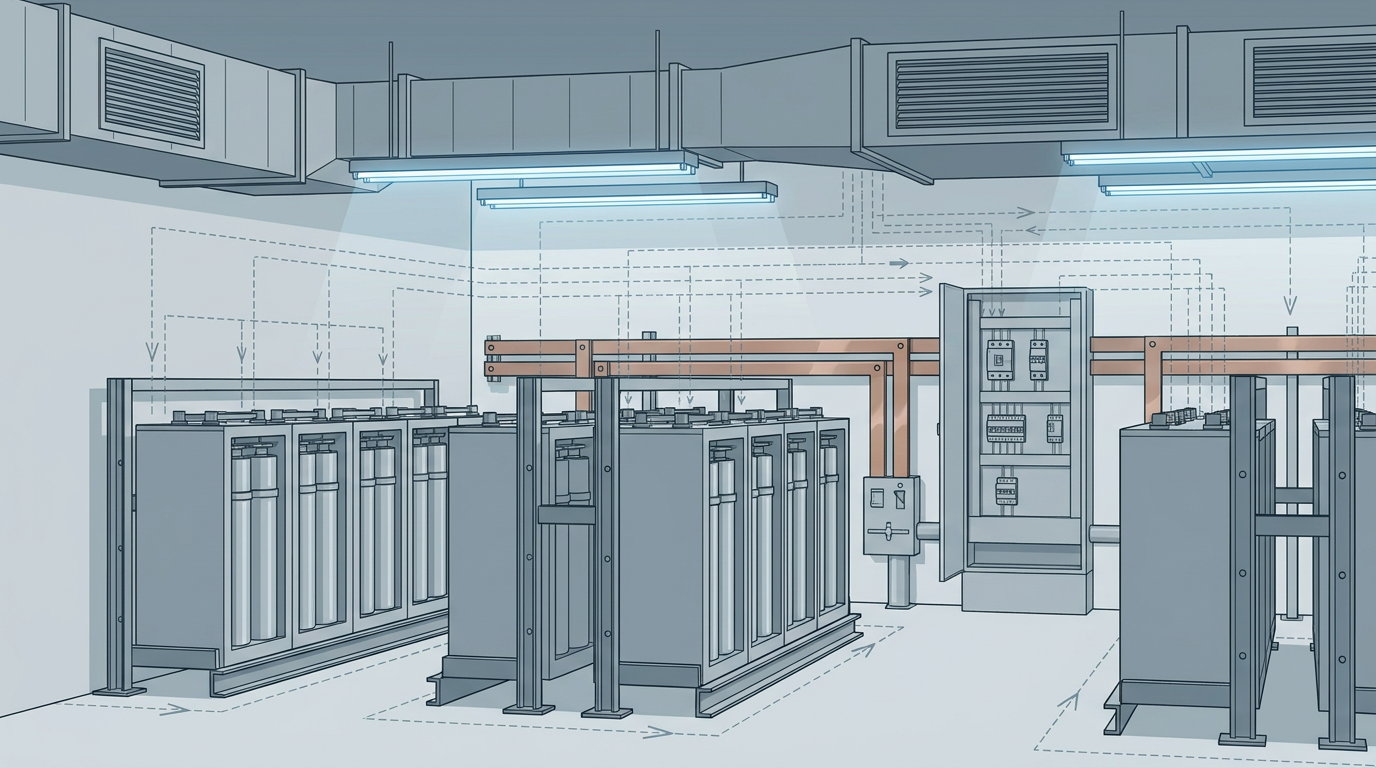
Tag: OPzV

The OPzV2-420 2V420Ah is a 2 V, 420 Ah (C10) sealed tubular gel cell for float and shallow-cycle duty: 145 × 206 × 471 mm, 506 mm over terminals, 31.5 kg, 2.23 V float and 2.35 V equalise per cell, 84 A maximum charge current, at least 1,500 cycles at 80 % depth of discharge and a 20-plus-year float design life at 20 °C. It is the default answer for a battery room that nobody will visit quarterly — no watering, no spill containment, no hydrogen ventilation requirement, and a capacity that a single 54-cell string carries as 45.4 kWh nominal at 108 V.

The number that decides the string is the ten-hour rate. 420 Ah at C10 to 1.80 V per cell is a materially different cell from a 420 Ah twenty-hour rating, and a plant specified on the twenty-hour basis will come up short in a real discharge test.

Key Takeaways

  1. Sealed gel means no service visits for electrolyte. The OPzV2-420 2V420Ah arrives with electrolyte immobilised in a gel matrix inside a sealed case. There is no water top-up, no density reading and no hydrogen ventilation duty.
  2. 420 Ah at C10. A 54-cell string holds 54 × 2 V × 420 Ah = 45.4 kWh nominal; 108 cells hold 90.7 kWh. At a 50 % depth of discharge the usable energy is roughly half of that after end-point and loss corrections.
  3. Charge current is capped at 84 A per cell. That is 0.2 C10. A 54-cell string can absorb up to 4,536 A, so the rectifier, not the battery, decides how fast the string recovers.
  4. Float current is 2.1 A per cell. At 5 mA per amp-hour, one OPzV2-420 2V420Ah draws 2.1 A on float; 54 cells draw 113 A continuously for the life of the plant.
  5. Two fields stop the gel advantage. Above roughly 35 °C ambient the cell shortens its own life, and partial-state-of-charge cycling still consumes the published cycle budget. Gel buys you maintenance-free siting, not immunity from heat.

§1 — OPzV2-420 2V420Ah Quick Specifications Table

ParameterOPzV2-420 2V420Ah published valueWhy it matters in a string
Nominal voltage2 V per cell24 cells give 48 V, 54 cells give 108 V, 108 cells give 216 V
Rated capacity420 Ah at C10 (10-hour rate)Sets usable energy for a short-duration discharge
Dimensions (L × W × H)145 × 206 × 471 mmShorter than the 645 mm flooded cell in the same capacity class
Total height over terminals506 mmInclude 40–60 mm clearance for the terminal area and lifting
Weight31.5 kg per cell (69.5 lbs)A 54-cell string weighs 1,701 kg before racks and interconnects
TerminalΦ20-M8, torque 10–12 N·mInterconnect sizing follows the bolt, not the current
TechnologyTubular gel VRLA, sealedNo watering, no spill containment, no hydrogen extraction
Float voltage2.23 V per cell at 25 °C (datasheet float; 2.27 V solar/wind setting)54 cells give 120.42 V at the busbar at 25 °C
Equalise voltage2.35 V per cell at 25 °C (2.40 V solar/wind regulation)Equalisation is controlled and less aggressive than flooded
Temperature compensation−3 mV/°C/cell float (datasheet; solar/wind settings list −3 to −5 mV)A 35 °C room needs about 0.03 V less per cell
Maximum charging current84 A per cell (0.2 C10)A 54-cell string can absorb up to 4,536 A
Cycle life≥1,500 cycles at 80 % depth of dischargeConfirms suitability for partial-state-of-charge work
Float design life20+ years at 20 °C (datasheet)Roughly halves for every 10 °C above 20 °C
Discharge temperature−40 °C to 65 °CCold is not the constraint; heat is
Charge temperature−30 °C to 65 °CWide charging window helps in cold climates
Storage temperature−25 °C to 45 °CStore cool, then recharge before installation
Internal resistance0.62 mΩ fully charged at 25 °CSets the voltage drop under high-current discharge
CertificationsIEC 60896-21/22, IEC 61427, DIN 40472, GB/T 19638.1, YD/T 1360, Eurobat Long Life, BS 6290-4, UL 1989Arranged per customer requirement

§2 — The Pain

The hard DC rooms — telecom power rooms under a viaduct, signalling cabinets at a remote junction, a metro auxiliary room, a containerised hybrid site in a desert — share the same constraint. Someone has to service them, and nobody wants to be that someone. A flooded cell in that room means water, a torch, a density meter, a spill tray and a site visit every quarter. That visit is the expensive part: travel, access, permit, isolation and a two-person crew, four times a year, for twenty years.

The second pain is what happens when the service does not happen. A flooded string in an unattended room loses water, the density drifts, the terminal corrodes, and the first sign of trouble is a capacity test failure that happens to coincide with a storm. The same room on gel has no water to lose and no corrosion chemistry in the electrolyte, so the failure mode moves to something predictable — heat at the cell and the loss of capacity with time — which can be managed with a ventilation design and a monitoring plan.

The third pain is the one that appears in the tender document. Capacity is quoted as a single number. A 420 Ah cell can be rated at C10, at C20, at C3 or at 100 hours, and each of those describes a different physical cell. Two suppliers quoting “420 Ah” can deliver cells that differ by a quarter in usable energy for the same application, and the difference only appears in the acceptance test.

§3 — The Choice

Tubular gel sits between flooded tubular and sealed AGM. It gives up the lowest cost per stored kilowatt-hour of the flooded option, and it gives up some of the AGM option’s cycle tolerance, in exchange for removing the service regime entirely.

Selection metricOPzV2-420 2V420Ah (tubular gel)Flooded tubular OPzS2 equivalentSealed AGM VRLA equivalent
Rated capacity basis420 Ah at C10500 Ah at C10 in the next larger step12 V blocks, 100–250 Ah at C10
Float voltage per cell2.23 V2.23 V2.27 V
Equalise voltage per cell2.35 V2.35 V2.35 V
Maximum charging current84 A per cell (0.2 C10)0.2 C10 per cell0.25 C10
Internal resistance0.62 mΩ at 25 °C0.60 mΩ for the 600 Ah flooded cellNot published on the model page
Cycle life at 80 % DoD≥1,500 cycles1,500–2,500 cyclesNot published on the model page
Float design life20+ years at 20 °C20+ years at 20 °C12 years at 20 °C
Discharge temperature range−40 °C to 65 °C−40 °C to 60 °C−20 °C to 60 °C
Service actions per yearVisual inspection and terminal cleaning; no wateringDensity checks and topping up, typically quarterlyVisual inspection and terminal cleaning; no watering
Hydrogen ventilationNot required for normal float operationRequiredNot required for normal float operation
Cell mass31.5 kg, sealed caseHeaviest per stored kWh, filled with liquid electrolyteHeaviest per stored kWh for the same energy, thicker case
Failure mode in the fieldCapacity loss with time and heatWater loss, corrosion, density stratificationHeat build-up, capacity loss

Every figure in the table comes from published CHISEN data for the respective chemistry; where a value is not published it is marked rather than estimated. The commercial comparison follows from the physical one: a gel string stores its energy in fewer cells, needs no service visits, and can be sited inside a building without an acid-resistant floor, a drip tray or a ventilation study. The flooded option still wins when the room has a trained technician on site every quarter, because the cell is cheaper per amp-hour and tolerates a wider discharge temperature window.

The wider gel range, from 100 Ah to 3,000 Ah in 2 V cells, is listed on the OPzV tubular gel battery hub, with individual model datasheets for sizing.

The seven-year arithmetic decides more orders than the datasheet does. Using illustrative unit prices that you must replace with your own landed and labour rates, the table below compares one 108 V, 45.4 kWh string built three ways. Every rate in it is a planning placeholder, not a quotation.

7-year TCO, 108 V / 45.4 kWh stringOPzV2-420 2V420Ah gel, 54 cellsFlooded OPzS2-600, 54 cellsSealed AGM VRLA, 9 × 12 V blocks
Assumed unit price$260 per OPzV2-420 2V420Ah cell$310 per flooded cell$810 per 12 V block
Cell or block purchase$14,040 (54 cells)$16,740 (54 cells)$7,290 (9 blocks)
Series interconnects at assumed $45 per joint (53 joints derived)$2,385$2,385$2,385
Service visits, 2 per year over 7 years$3,640 at $260 per visit$7,280 at $520 per visit$3,640 at $260 per visit
Hydrogen ventilation design and ductwork$0$12,000$0
Spare stock held on site$260, one OPzV2-420 2V420Ah$310, one flooded cell$810, one 12 V block
Published float life at 20 °C20+ years for the OPzV2-420 2V420Ah20+ years12 years
7-year total (illustrative)$20,325$38,715$14,125
Difference versus the OPzV2-420 2V420Ah—≈$18,390 higher≈$6,200 lower, then a second purchase in year 12

The result is not subtle. A flooded string of 54 cells carries a 20-plus-year float life and still costs roughly $18,390 more over seven years than the same string of OPzV2-420 2V420Ah gel cells, because the room, the ventilation path and the twice-yearly site visit are most of the cost. The sealed AGM option looks lowest on the seven-year invoice, and then its 12-year published float life turns it into a second purchase in year 12 — which is exactly why the OPzV2-420 2V420Ah is specified for rooms that must still be on float in year 15. Where the room has a trained technician on site every quarter, the flooded option is the correct economic answer; where it does not, the 20-plus-year float design life at 20 °C is what the buyer is actually paying for.

§4 — The Framework

Write the rate and the end-point into the specification. 420 Ah at C10 to 1.80 V per cell is the controlling figure for the OPzV2-420 2V420Ah. Anything less precise than that is an invitation to a 20 % argument at acceptance.

Decide the string voltage before the cell count. 48 V is 24 cells, 108 V is 54 cells and 216 V is 108 cells. With 54 cells at 2.23 V float, the busbar sits at 120.42 V at 25 °C, and the rectifier’s float set point has to be adjusted for the room temperature.

Check the rectifier against the 84 A per-cell ceiling. A 54-cell string can take 4,536 A into the battery. If the site’s rectifier is limited to the load plus a margin, the string recovers slowly after an outage, and a gel cell left in a partially discharged state is exactly where the cycle budget is spent.

Design the thermal environment. The published discharge range reaches 65 °C, but float life is quoted at 20 °C. Above 35 °C ambient, plan for cooling or accept the temperature derating, and keep the cells away from direct sun on a container wall.

Set the ventilation rule. Gel does not need hydrogen extraction at float, but it does produce gas during equalisation and at high charge voltages, and a sealed room with an aggressive equalisation schedule still needs a deliberate air path. Specify it and you avoid an inspection finding.

Plan the monitoring around what gel cannot tell you. No density reading means no early warning from the electrolyte, so the substitute is voltage and internal-resistance trending on the string plus a defined inspection interval with thermal imaging of terminals and busbars.

Fix the spare strategy. In a room that is hard to reach, the spare philosophy changes: instead of holding a percentage of float stock, hold one complete parallel string, because the whole point of gel is that you can swap it during a scheduled visit rather than troubleshoot a cell in a degraded string.

§5 — The Trust

Gel removes the maintenance that would have told you about a problem. That is an advantage and a risk, and the risk is handled in the contract.

First, the acceptance record. Ask for the incoming inspection, the manufacturer’s date of manufacture, the charge voltage and duration before dispatch, the conductance or internal-resistance reading for every cell, and a voltage-spread check across the assembled string. Without cell-level data at handover, a failure eighteen months later has no baseline to be measured against, and the vendor and the installer end up arguing about which reading was wrong.

Second, the commissioning regime. A gel cell shipped with a partial charge and installed without a proper initial charge can fail early. Specify the initial charge method, the charge duration, the end-point voltage per cell, and the temperature-compensated set points used for the first 30 days. Record the readings.

Third, the warranty terms. A twenty-year float life is a statement about the cell under a defined regime: 20 °C, voltage compensated, equalisation scheduled, and depth of discharge kept inside the published band. Ask the supplier to put those conditions in the warranty wording. If a warranty is written without temperature and maintenance conditions, it is worth very little at year eight.

Finally, watch the published data for internal consistency, as you would for any datasheet. Every specification in the table above comes from the model page, and the certification set on the gel line is assembled per customer requirement, which means the certificate list on the packing list is the document that counts. Ask for the certificates with the delivery, not after it.

§6 — FAQ

Q1. What is the rated capacity of the OPzV2-420 2V420Ah and at what rate? 420 Ah at the ten-hour rate (C10) to 1.80 V per cell at 25 °C. A twenty-hour rating is a different cell, and ordering on the wrong basis is the most common sizing error in this category.

Q2. Does the OPzV2-420 2V420Ah need electrolyte topping up? No. It is a sealed tubular gel VRLA cell with the electrolyte immobilised in a gel matrix, so there is no water to add, no density to read and no spill containment required.

Q3. How many cells are needed for a 108 V DC system? 54 cells of 2 V. A 48 V system uses 24 cells and a 216 V system uses 108. At 2.23 V float per cell, a 54-cell string sits at 120.42 V at 25 °C.

Q4. What is the maximum charging current? 84 A per cell, which is 0.2 C10. A 54-cell string can absorb up to 4,536 A, so the rectifier limits and the site protection scheme must be designed around that figure.

Q5. How many cycles can it deliver at 80 % depth of discharge? At least 1,500 cycles at 80 % depth of discharge, and it tolerates partial-state-of-charge operation better than a flooded cell, which is why it is common in hybrid telecom and renewable-assisted sites.

Q6. Does the cell need hydrogen ventilation? Not for normal float operation, because the electrolyte is immobilised and recombination limits gas release. Air exchange should still be provided for equalisation and for high-temperature charging, and for the general comfort of technicians working in the room.

Q7. What happens if the room is hot? Float life is quoted at 20 °C and shortens with temperature, as an engineering rule of thumb roughly halving for every 10 °C above that. Above 35 °C the cell will still operate within its published discharge range, but the 20-year figure no longer applies and the site needs cooling or a revised expectation.

Q8. What is the float current? At 5 mA per amp-hour, the OPzV2-420 2V420Ah draws 2.1 A per cell on float, so 113 A for a 54-cell string, continuously, for the life of the installation.

Q9. Which certifications are available? IEC 60896-21/22, IEC 61427, DIN 40472, GB/T 19638.1, YD/T 1360, Eurobat Long Life, BS 6290-4 and UL 1989, assembled per customer requirement, together with RoHS, REACH and WEEE documentation for the destination market.

Q10. How do I get a sizing sheet and a quotation? Send the string voltage, the DC load in kW, the required autonomy, the minimum end-point voltage, the highest expected room temperature and the delivery port — Shanghai, Ningbo, Mumbai, Jebel Ali, Santos, Rotterdam, Hamburg, Valencia, Mersin, Chattogram, Mombasa, Tema and Dar es Salaam are all reachable on the same terms — and we return a cell count, an energy budget and a float-current figure within one working day.

Expert Summary

The OPzV2-420 2V420Ah is a 2 V, 420 Ah C10 sealed tubular gel cell published at 145 × 206 × 471 mm, 506 mm over terminals and 31.5 kg, with 2.23 V float, 2.35 V equalise, −3 mV per °C per cell float compensation, 84 A maximum charge current, 0.62 mΩ internal resistance, at least 1,500 cycles at 80 % depth of discharge and a 20-plus-year float design life at 20 °C. A 54-cell string carries 45.4 kWh nominal at 108 V and 108 cells carry 90.7 kWh. The cell earns its place wherever the room cannot be serviced: no watering, no density readings, no spill containment, no hydrogen extraction at float, and a tolerance for partial-state-of-charge cycling that a flooded cell does not offer. Three things still decide the outcome. The rate basis must be written as 420 Ah at C10 to 1.80 V per cell, because a twenty-hour figure describes a different cell and produces a 20 % shortfall at acceptance. The charge path must be sized to the published 84 A per-cell limit, since a 54-cell string can absorb 4,536 A and a rectifier sized for the load alone leaves the string chronically undercharged. And the thermal environment must be designed, because float life is quoted at 20 °C and roughly halves for every 10 °C above it. Gel removes the service regime, not the discipline: specify the initial charge, the cell-level conductance and voltage-spread baseline, the temperature-compensated set points and the warranty conditions, or the absence of maintenance will simply move the failure to a point where there is no data to diagnose it.

Contact CHISEN — 24-Hour Response

Send us the string voltage, the DC load in kW, the autonomy in hours, the minimum end-point voltage, the highest expected room temperature and the delivery port, and we will return a cell count, an energy budget, a float-current figure and a charge-recommendation for the OPzV2-420 2V420Ah tubular gel cell.

WhatsApp: https://wa.me/861316226999 Email: sales@chisen.cn Factory: 8 production bases, 70 million kVAH annual capacity, CE, ISO 9001, ISO 14001, UL and IEC certified.

Related reading: the complete OPzV tubular gel battery range from 100 Ah to 3,000 Ah, and how CHISEN builds and certifies every cell.

This article is published on leadacidbattery.cn.

Related CHISEN Buyer Guides

  • OPzV2-700 2V 700Ah Tubular Gel Battery: Supplier Selection for Telecom

    OPzV2-700 2V 700Ah Tubular Gel Battery: Supplier Selection for Telecom

    The OPzV2-700 2V 700Ah tubular gel battery is the middle of the range where most telecom and solar-hybrid banks actually land: large enough that a 48V string carries real autonomy, small enough that a technician can still replace a cell without a crane. A 24-cell string of these cells gives a 48V nominal bus with 33.6 kWh stored, floats at 54.0–54.5V, and carries a published float service life of 20+ years at 25°C with a cycle rating of at least 1,500 cycles at 80% depth of discharge. This guide covers how to verify those claims before you commit a container order.

    [image placeholder: opzv2-700-2v-700ah-tubular-gel-battery-supplier-selection-telecom-2026.png]


    Answer First

    A 48V DC plant built from 24 OPzV2-700 cells in series stores 33.6 kWh nominal (24 × 2V × 700Ah), delivers 16.8 kWh at a 50% depth of discharge to 1.80V per cell, and floats at 54.0–54.5V with temperature compensation of −3.3mV per °C per cell. The cell measures 254 × 210 × 471mm with a 506mm total height, weighs 52.0kg filled, and uses a Φ20-M8 terminal tightened to 10–12 N·m — so a two-person lift and a standard 19-inch cabinet depth are the two physical constraints that decide whether this size is right for your site.


    Key Takeaways

    • 700Ah at C10, not nameplate Ah. The published rating is 700Ah on the 10-hour rate to 1.80V per cell at 25°C, which is the number to put on a purchase order. A cell quoted on a 20-hour rate delivers roughly 5–8% less at the 1-hour rate your rectifier actually imposes.
    • Float voltage 2.25–2.27V per cell at 25°C, compensated −3.3mV per °C per cell. On 24 cells that is 54.0–54.5V float and 55.2–56.4V equalising. Anything quoted without the compensation coefficient is not a comparable float life.
    • Cycle life is published by depth of discharge, not as one headline number. At least 1,500 cycles at 80% DoD, 2,500 at 50%, 4,000 at 30% and 5,500 at 20% at 25°C — the solar-hybrid case is usually the 30% row, not the 80% row.
    • Float service life of 20+ years applies at 25°C only. The widely used engineering rule of thumb is that float life roughly halves for every 10°C above 25°C, so a plant room at 35°C is a ten-year battery, not a twenty-year battery.
    • One model covers the whole 48V fleet. The tubular gel range runs from OPzV2-100 at 100Ah to OPzV2-3000 at 3000Ah in published dimension and weight tables, so a site fleet can be standardised on one platform with capacity steps rather than a mix of manufacturers.

    Quick Specifications: The Published OPzV2-700 Data

    Cell-level electrical and operating data for the 700Ah size, as published on the OPzV2-700 product page:

    ParameterPublished value
    ModelOPzV2-700
    TechnologyTubular positive plate, nano gelled electrolyte, valve-regulated sealed VRLA
    Nominal voltage2V DC
    Rated capacity700Ah at C10 to 1.80V/cell, 25°C
    Float / standby voltage2.25–2.27V per cell at 25°C, compensation −3.3mV/°C/cell
    Equalising voltage2.30–2.35V per cell at 25°C, compensation −5mV/°C/cell
    Cycling charge voltage2.35–2.40V per cell at 25°C
    Maximum charging current140A (0.20 × C10)
    Maximum discharge current (5s)2,000A
    Short-circuit current3,300A
    Internal resistance0.55 mΩ fully charged at 25°C
    Self-discharge2% per month at 20–25°C; storable 12 months without recharging at 25°C
    Cycle life≥1,500 cycles at 80% DoD; 2,500 at 50%; 4,000 at 30%; 5,500 at 20%; 800 at 100%
    Float service life20+ years at 25°C
    Discharge / charge / storage temperature−40°C to +65°C / −30°C to +65°C / −25°C to +45°C
    Dimensions254 × 210 × 471mm (total height 506mm over terminals)
    Weight52.0kg filled with electrolyte
    TerminalΦ20-M8, 10–12 N·m (Φ16-M6 and Φ24-M10 options)
    StandardsIEC 60896-21/22:2004, IEC 61427, DIN 40472:2015, GB/T 19638.1-2014, YD/T 1360, Eurobat Long Life, BS 6290 Part 4, UL 1989
    Transport and environmentalIMDG Class 8, UN2794, MSDS, RoHS, REACH, WEEE

    Capacity versus ambient temperature on the 10-hour rate, which is the correction most often skipped in a quotation:

    AmbientCapacity (% of rated)Operating note
    50°C~107%High-temperature limit, life materially reduced
    40°C~105%Forced ventilation normally required
    25°C100%Rating reference, 20+ year float design life
    0°C~80%Slight capacity reduction
    −20°C~55%Extreme cold, significant capacity loss

    Where the 700Ah size sits in the published dimensional series, against its two closest neighbours on the OPzV tubular gel range page:

    ModelCapacity C10 (Ah)Length (mm)Width (mm)Height (mm)Total height (mm)Weight (kg)
    OPzV2-60060014520664668144.20
    OPzV2-70070025421047150652.00
    OPzV2-80080019121064668160.00

    The Pain: Where Telecom Battery Banks Fail Before They Age

    Most battery banks that disappoint in year four were specified correctly on day one. They were then operated outside the envelope the datasheet describes, and the failure surfaces at the worst possible moment — during a grid outage in the middle of a monsoon in Karachi, a heatwave in Lagos, or a coastal salt fog event on a site near the Port of Santos.

    Autonomy is stated in hours without a discharge rate. “Eight hours of backup” is meaningless unless the end voltage and the rate are fixed. A 700Ah cell returns close to 700Ah over ten hours, but noticeably less over three hours and considerably less over one. When the rectifier fails and the inverter carries a hard load, the usable energy is the rate-corrected figure, not the nameplate.

    Float-current headroom is missing from the rectifier spec. At float the rectifier must carry the site load plus the battery’s own float current — roughly 1–2% of C10, so about 7–14A per 700Ah cell — plus whatever is needed to equalise a diverged string. A rectifier sized exactly to the site load will never recover a bank that has run undercharged for a week.

    Temperature compensation is switched off. The published −3.3mV/°C/cell changes the float setpoint by roughly 0.2V across a 24-cell string between a 20°C and 40°C plant room. Without it, a hot climate over-charges daily, which consumes water in VRLA cells and shortens float life — precisely the opposite of the intended effect.

    Cold sites are specified on a warm-site load profile. Capacity at −20°C is 55% of the 25°C rating. A cabinet outside Helsinki, Harare or Ulaanbaatar specified on a Dubai duty cycle will fail its autonomy test in January, even though the same bank passed every test in June.

    There is no spare allowance. A single weak 2V cell can take a 48V string offline, because the bus voltage cannot be balanced around one cell. Buying two or three matched spares with the initial order costs less than one hour of site downtime.


    The Choice: Chemistry, String Math and Total Cost

    String and parallel arithmetic

    Every cell in the OPzV range is 2V, so string length is fixed by the DC bus and only cell capacity and the number of parallel strings remain variable.

    DC busCells in seriesFloat voltageEqualising voltageEnergy per 700Ah stringEnergy per 2-string bank
    24V1227.0–27.2V27.6–28.2V16.8 kWh33.6 kWh
    48V2454.0–54.5V55.2–56.4V33.6 kWh67.2 kWh
    80V4090.0–90.8V92.0–94.0V56.0 kWh112.0 kWh
    120V60135.0–136.2V138.0–141.0V84.0 kWh168.0 kWh

    A worked 48V telecom case

    A rural mobile site near Lagos, a trackside cabinet outside Warsaw and a hybrid tower near the Port of Colombo share a common profile: a 1,200W continuous load, a 48V rectified bus, a 12-hour autonomy target and 30–35°C ambient.

    • Nominal energy: 24 cells × 700Ah = 33.6 kWh per string.
    • Deliverable at 50% DoD (1.80V/cell): 16.8 kWh → 14 hours at 1,200W.
    • Corrected for a 40°C plant room: ×1.05 → 17.6 kWh → 14.7 hours, provided the inverter’s DC undervoltage cutoff is set at or above 48.0V.
    • Rectifier sizing: 1,200W site load + 14A float current (2% of C10) + equalising reserve of roughly 140A at 2.35V ≈ 330W, so about 1.6kW continuous; a 2kW rectifier holds margin without exceeding the 140A per-cell maximum charging current.
    • Short-circuit check: 24 cells × 0.55 mΩ = 13.2 mΩ for the string, which by calculation gives roughly 4,100A. The published 3,300A figure governs, and the DC fuse rating should be set against it.

    Chemistry comparison at 48V, 1,200W load, 12-hour autonomy

    Cost and performance item (7-year horizon)Tubular gel OPzV2-700Flat-plate AGM 12V 700Ah blockLFP 48V 25kWh module
    Initial purchase (24-cell / 4-block / 1-rack basis)$4,560$1,920$9,500
    7-year electricity at ~$0.18/kWh$2,760$2,500$1,640
    7-year cabinet cooling and ventilation$320$560$1,180
    7-year inspection and service labour$0$280$1,120
    Mid-life replacement inside 7 years$0$2,270 (one set plus labour)$1,500 (capacity augmentation)
    Downtime exposure$600$1,100$480
    7-year total$8,240$8,630$15,420
    Cost per delivered kWh (36,792 kWh over 7 years)$0.224$0.235$0.419
    Published cycle rating1,500 cycles at 80% DoD400–800 cycles at 80% DoD3,000–5,000 cycles at 80% DoD
    Watering and cell servicingNone (VRLA sealed)None (VRLA sealed)None, but BMS and HVAC service
    Failure modes seen in the fieldGrid corrosion and shedding on flat-plate designsPremature capacity loss in sustained heatCell imbalance, BMS firmware, thermal management

    Read this honestly: the flat-plate AGM option starts roughly 30% cheaper on capital cost, and in a cool 25°C float-only service with a guaranteed five-year replacement budget the gap can stay that way. The case for tubular gel is not the invoice — it is the absence of a mid-life replacement event, the removal of service labour, and the way the gap widens once the plant room sits above 30°C for most of the year. LFP wins decisively on cycle life and round-trip efficiency but costs roughly 87% more over seven years once HVAC, augmentation and maintenance are counted, which is why it remains a hybrid-site and generator-start alternative rather than the default for a 48V telecom cabinet.


    The Framework: Seven Numbers to Put in the Purchase Specification

    1. Capacity basis. Specify 700Ah at C10 to 1.80V per cell at 25°C, and ask the supplier to confirm the discharge curve used to certify it. A 700Ah cell quoted only on C20 is not the same cell in your application.

    2. Float setpoint and compensation. 2.25–2.27V per cell at 25°C with −3.3mV/°C/cell, giving 54.0–54.5V across 24 cells. Write the compensation coefficient into the rectifier configuration sheet, not just the battery datasheet.

    3. Cycle rating at your real depth of discharge. The published ladder — 1,500 cycles at 80%, 2,500 at 50%, 4,000 at 30%, 5,500 at 20% — lets you pick the row that matches the site’s energy profile instead of accepting the headline figure.

    4. Temperature derating curve. 105% at 40°C, 80% at 0°C, 55% at −20°C. A supplier who publishes only the 25°C capacity is asking you to guess the rest.

    5. Float life definition. “20+ years” is only meaningful alongside 25°C, 2.25–2.27V per cell and the compensation coefficient. Vendors quoting ten, twelve and fifteen years are usually using different float voltages or ambient assumptions; normalise all quotes to the same three conditions before comparing.

    6. Standards and certification set. For EU, UK and North American utility and telecom procurement: IEC 60896-21/22:2004 for test methods and dimensions, DIN 40472:2015 for tubular VRLA, IEC 61427 for PV storage, BS 6290 Part 4 and UL 1989 for UK and US acceptance, plus Eurobat Long Life classification above twelve years float.

    7. Serviceability and logistics. 254 × 210 × 471mm at 52.0kg with a 506mm total height determines cabinet choice and whether two people can handle a cell. Terminal type Φ20-M8 at 10–12 N·m sets the tooling on site. For freight, IMDG Class 8 and UN2794 apply, and at 52kg per cell a 20-foot dry container holds roughly 460 cells before pallet and dunnage weight is counted — which is close to the payload limit, so bank size is a freight-planning decision, not only an electrical one.


    The Trust: How to Audit a Tubular Gel Supplier Before You Pay

    The gap between a data sheet and a delivered cell is where procurement losses hide. These are the checks that separate a manufacturer from a trading company.

    Ask for the capacity test, not the brochure. A logged 10-hour discharge curve at 0.1C with the voltage at the end of discharge, taken from a cell in the shipment you received, is the only evidence that matters. Many suppliers publish a datasheet copied from a cell they do not build.

    Check whose cells are in the box. A manufacturer will state the plant, the annual output and the audit certificates without hesitation. A trading intermediary cannot. Ask which factory produced the lot and for the plant’s monthly output — for context, CHISEN operates eight production bases with an annual capacity of 70 million kVAh and holds ISO 9001, ISO 14001, CE and UL approvals across the range.

    Compare float life on identical conditions. Reject every quote that does not state the ambient temperature, the float voltage per cell and the temperature compensation coefficient next to the years figure.

    Verify the physical envelope, not just the weight class. Terminal type, torque figure, total height over terminals and the approved mounting orientation determine whether the cell fits the cabinet and whether the string can be installed horizontally or on its side in a confined outdoor enclosure — the OPzV range is published for vertical, horizontal and side installation, which matters in the tight outdoor cabinets common to 5G sites in Europe and Southeast Asia.

    Run the supplier audit as a checklist, not a question. Before issuing a purchase order, confirm the datasheet, the IEC and DIN test reports, the Eurobat classification, the warranty terms with defined float-life conditions, the spare-cell policy, the delivery lead time, the packing data for IMDG carriage and the after-sales contact who will answer in twelve months.

    Watch the lead-time story. Stationary VRLA is not capacity-constrained the way traction cells are in peak season, but a quoted 90-day lead time with no plant reference usually means the supplier is waiting for someone else’s production slot.


    FAQ

    1. What is the OPzV2-700 2V 700Ah tubular gel battery used for? It is a 2V stationary cell for telecom base stations and outdoor cabinets, solar and wind hybrid storage, medium UPS and industrial DC panels. Tubular positive plates and immobilised gel electrolyte make it a float-first, maintenance-free product, and the published 20+ year float life at 25°C suits sites with a permanent 48V or 240V DC bus.

    2. How many OPzV2-700 cells do I need for a 48V telecom DC plant? Twenty-four cells in series. That gives a 48V nominal bus, 54.0–54.5V float and 55.2–56.4V equalising, with 33.6 kWh nominal per string. A second identical string in parallel doubles the capacity without changing the bus voltage.

    3. What is the usable capacity of the OPzV2-700 in practice? 700Ah at the 10-hour rate to 1.80V per cell at 25°C. At a 50% depth of discharge a string delivers 16.8 kWh usable, which is 14 hours at a 1,200W continuous load. Multiply by 1.05 for a 40°C plant room and by 0.80 for a 0°C site.

    4. How does it compare with a flat-plate AGM battery of the same capacity? Tubular plates resist shedding and grid corrosion in deep discharge, giving at least 1,500 cycles at 80% DoD against 400–800 for conventional AGM. On capital cost alone the AGM option is cheaper, but it needs one replacement inside a seven-year horizon at ambient temperatures above 30°C, and the 7-year model above puts the two within 5% of each other, with tubular gel ahead on risk and service labour.

    5. Can OPzV2-700 cells be installed horizontally or inside a confined cabinet? Yes. The published range supports vertical, horizontal and side installation, which suits the constrained outdoor enclosures used for 5G and remote radio cabinets. Confirm the 506mm total height over terminals and the 52.0kg cell weight against your enclosure and handling plan.

    6. What float voltage and compensation should I configure? 2.25–2.27V per cell at 25°C with −3.3mV per °C per cell compensation, which equals 54.0–54.5V across 24 cells at 25°C. Equalising is 2.30–2.35V per cell and cycling charge is 2.35–2.40V per cell. Program the compensation into the rectifier, not the manual.

    7. What maintenance does a tubular gel battery need? No watering and no routine cell servicing, but four checks a quarter: string voltage at float against the 54.0–54.5V window, terminal torque at 10–12 N·m, cell casing and terminal condition for corrosion, and the temperature-compensation setting against the measured plant-room temperature. Record every reading — a drifting string is visible in the log months before it fails.

    8. How long will the battery last in a hot plant room? The published 20+ years is a 25°C figure. The standard engineering rule is that float life roughly halves for every 10°C above 25°C, so expect roughly ten years at 35°C and nearer seven to eight years at 40°C if the float voltage is not compensated. This is why compensation is the single most valuable setting on the rectifier.

    9. Is the OPzV2-700 suitable for solar hybrid sites that cycle daily? Yes, and this is where the published cycle ladder matters. At 30% depth of discharge the cell is rated for 4,000 cycles, which is roughly ten years of daily cycling at that profile. Continuous float life and deep-cycle capability are separate claims, so ask a supplier for the figure at your specific depth of discharge rather than the headline 80% number.

    10. What certifications do I need for import into the EU and North America? For Europe, CE marking with IEC 60896-21/22:2004 and DIN 40472:2015 test reports, plus IEC 61427 where the site is a PV installation. For the United Kingdom, BS 6290 Part 4. For the United States, UL 1989. In all cases request the RoHS, REACH and WEEE declarations and the MSDS, and plan carriage under IMDG Class 8, UN2794.

    11. Can I mix OPzV2-700 cells with other capacities in the same bank? Not inside a series string — every cell in a string must be the same model and, ideally, the same production batch and age. Different capacities can only be added as separate parallel strings with their own cable sizing, and mixing ages in parallel strings leads to current sharing problems because the newer cells carry more of the load.

    12. What should I request from the supplier before placing the order? The full datasheet with the capacity test basis, the IEC and DIN test reports, the Eurobat classification, the warranty conditions stating float life assumptions, two to three spare cells at 2–3% of the order, packing and IMDG data, a stated lead time tied to a plant, and a named technical contact for commissioning support.


    Expert Summary

    The OPzV2-700 is a 2V, 700Ah tubular gel VRLA cell with a published 10-hour-rate capacity of 700Ah to 1.80V per cell, float service life of more than 20 years at 25°C, a cycle rating of at least 1,500 cycles at 80% depth of discharge and 4,000 cycles at 30%, dimensions of 254 × 210 × 471mm, a total height of 506mm, a filled weight of 52.0kg and a Φ20-M8 terminal at 10–12 N·m. Twenty-four cells in series form a 48V DC plant storing 33.6 kWh nominal and delivering 16.8 kWh at a 50% depth of discharge, floating at 54.0–54.5V with −3.3mV per °C per cell compensation. Tubular gel outperforms flat-plate AGM on cycle life and mid-life replacement exposure, at a capital cost roughly 30–40% higher than AGM and well below LFP on a seven-year total-cost basis. Float life must be read at the site temperature, not at 25°C, because life roughly halves for every 10°C of ambient increase.


    Request a Quotation

    Specify the model, the string configuration and the delivery port, and we will return a quotation with the datasheet, test certificates and shipping calculation.

    For leadacidbattery.cn, browse the OPzV2-700 2V 700Ah tubular gel battery product page or contact us for a tailored quotation for your project.

    hero industrial battery room
    hero industrial battery room

    Related CHISEN Buyer Guides

  • OPzV2-1200 2V 1200Ah Tubular Gel Battery Bank Sizing Guide 2026

    OPzV2-1200 2V 1200Ah Tubular Gel Battery Bank Sizing Guide 2026

    Sizing an OPzV 2V 1200Ah tubular gel battery bank for a telecom, UPS or solar-hybrid site comes down to three numbers: continuous site load in watts, required autonomy in hours, and the end-voltage you are willing to reach before the inverter or rectifier takes over. Everything else in the specification — plate construction, cycle rating, float voltage, temperature compensation — exists to make sure the bank still delivers those three numbers in year eight, not just on the delivery note.

    This guide works through the full selection method using the published CHISEN OPzV tubular gel range, from OPzV2-100 at 100Ah up to OPzV2-3000 at 3000Ah, with the OPzV2-1200 as the worked example because it sits in the middle of the range where most telecom and hybrid projects actually land.


    Answer First

    A 48V DC plant backed by 24 OPzV2-1200 cells in series delivers 28.8 kWh nominal (24 × 2V × 1200Ah), floats at 54.0–54.5V (24 cells × 2.25–2.27V/cell) and holds a published float service life of 20+ years at 25°C with a cycle rating of at least 1,500 cycles at 80% depth of discharge, so for a continuous 800W telecom load it supports roughly 18 hours of autonomy at a 50% depth of discharge and 24 hours when the string is taken down to 2.00V per cell — with no mid-life replacement inside a 7-year ownership window.


    Key Takeaways

    • One model covers 24-cell 48V strings. Twenty-four 2V OPzV2-1200 cells in series give a 48V nominal DC bus with 28.8 kWh of stored energy per string; each additional parallel string adds 28.8 kWh without changing the bus voltage.
    • The OPzV range is 16 sizes from 100Ah to 3000Ah. CHISEN publishes a complete dimensional and weight series (OPzV2-100 at 13.40 kg through OPzV2-3000 at 210.00 kg), so capacity can be matched in roughly 1.5x steps rather than arbitrary increments.
    • Float charge is 2.25–2.27V/cell at 25°C with −3.3mV/°C/cell compensation. On a 24-cell string that is 54.0–54.5V float and 55.2–56.4V equalising, which is the first thing to confirm against your rectifier setpoints.
    • Cycle rating is at least 1,500 cycles at 80% DoD under IEC 60896-21:2004 conditions. That is roughly double the 400–800 cycle range typical of conventional AGM VRLA, and it is the decisive number for solar-hybrid sites that cycle daily.
    • Temperature derating is published, not guessed. Capacity is 105% at 40°C, 100% at 25°C, 80% at 0°C and 55% at −20°C on the 10-hour rate, so a Nordic or Canadian substation needs a larger bank than an equivalent site in Dubai.

    Quick Specifications: The Published CHISEN OPzV Range

    The dimensions below are the published series values (tolerance ±2mm), with total height measured over the terminals. Cell-level electrical and operating data for the 1200Ah size are published on the OPzV2-1200 product page.

    ModelCapacity C10 (Ah)Length (mm)Width (mm)Height (mm)Total Height (mm)Weight (kg)Terminal
    OPzV2-10010010320635439013.40φ20-M8
    OPzV2-15015010320635439015.40φ20-M8
    OPzV2-20020010320635439017.30φ20-M8
    OPzV2-25025012420635439020.70φ20-M8
    OPzV2-30030014520635439024.40φ20-M8
    OPzV2-35035012420647150627.50φ20-M8
    OPzV2-42042014520647150632.50φ20-M8
    OPzV2-50050016620647150637.30φ20-M8
    OPzV2-60060014520664668144.20φ20-M8
    OPzV2-80080019121064668160.00φ20-M8
    OPzV2-1000100023321064668171.85φ20-M8
    OPzV2-1200120027521064668186.90φ20-M8
    OPzV2-15001500275210796831104.00φ20-M8
    OPzV2-20002000399212772807147.00φ20-M8
    OPzV2-25002500487212772807185.00φ20-M8
    OPzV2-30003000576212772807210.00φ20-M8

    Operating and electrical parameters for the series, as published for the 1200Ah size and common to the platform:

    ParameterPublished value
    Nominal cell voltage2V DC
    Rated capacity1200Ah at the 10-hour rate (C10) to 1.80V/cell at 25°C
    Float / standby charge2.25–2.27V/cell at 25°C (2.23V nominal on the series sheet), compensation −3.3mV/°C/cell
    Equalising charge2.30–2.35V/cell at 25°C, compensation −5mV/°C/cell
    Cycling charge2.35–2.40V/cell at 25°C (2.40–2.45V on the series sheet)
    Maximum charging current0.20 × C10 A (240A for the 1200Ah cell)
    Cycle life≥1,500 cycles at 80% DoD, 25°C, per IEC 60896-21:2004 (nominal curve 1,300–1,500)
    Float / standby design life20+ years at 25°C; Eurobat “Long Life” (>12 years float)
    Discharge temperature−40°C to +65°C
    Charge temperature−30°C to +65°C
    Storage temperature−25°C to +45°C
    Capacity at 10-hour rate107% at 50°C, 105% at 40°C, 100% at 25°C, 80% at 0°C, 55% at −20°C
    Terminal and torqueφ20-M8, 10–12 N·m (φ16-M6 and φ24-M10 options)
    StandardsIEC 60896-21/22:2004, IEC 61427, DIN 40472:2015, BS 6290 Part 4, UL 1989, GB/T 19638.1-2014, YD/T 1360

    The Pain: Why Telecom Battery Banks Are Undersized

    Most battery banks that disappoint in year three were correctly specified on day one — they were simply specified for a nominal Ah figure and then operated far outside the envelope the datasheet describes.

    Autonomy is defined in hours, not in end-voltage. A bank is often called “48 hours of backup” without anyone stating the discharge rate or the terminal voltage at the end of it. At the 10-hour rate a 1200Ah cell returns close to 1200Ah; at the 3-hour rate the same cell typically returns 95–100Ah less than that, and at the 1-hour rate considerably more is lost. When the inverter draws a hard load during a rectifier failure, the usable energy is the rate-corrected figure, not the nameplate.

    Float-current headroom is ignored. At float, the rectifier must supply the site’s continuous load plus the battery’s own float current, typically 1–2% of C10, plus whatever is needed to equalise a diverged string. A rectifier sized exactly to the site load will never recover a bank that has been undercharged for a week.

    Temperature compensation is switched off. The published compensation of −3.3mV/°C/cell changes the float setpoint by roughly 0.2V across a 48V string between a 20°C and 40°C plant room. Without it, a hot climate over-charges the bank daily, which consumes water in VRLA cells and shortens float life — exactly the opposite of the intended effect.

    Hot and cold sites are treated identically. Capacity at 40°C is 105% of the 25°C rating but at −20°C it is only 55%. A substation in northern Poland, Manitoba or northern Kazakhstan specified on a Dubai load profile will not pass its autonomy test in January.

    No spare allowance. A 28.8 kWh bank with no space and no budget for a replacement cell means a single failed cell can take the site down, because a 48V string cannot be balanced around one weak 2V cell.


    The Choice: Sizing the Bank, and Choosing the Chemistry

    String and parallel arithmetic

    Because every cell in the OPzV range is 2V, the string length is fixed by the DC bus and only the cell capacity and the number of parallel strings are variable.

    DC busCells in seriesFloat voltageEqualising voltageEnergy per 1200Ah stringEnergy per 2000Ah string
    24V1227.0–27.2V27.6–28.2V14.4 kWh24.0 kWh
    48V2454.0–54.5V55.2–56.4V28.8 kWh48.0 kWh
    80V4090.0–90.8V92.0–94.0V48.0 kWh80.0 kWh
    120V60135.0–136.2V138.0–141.0V72.0 kWh120.0 kWh

    A worked 48V telecom case

    A rural telecom site in Rajasthan, a trackside signalling cabinet in Poland and a hybrid tower outside Lima all share the same profile: 800W continuous load, 48V rectified bus, 24-hour autonomy target, ambient 25–35°C.

    • Nominal energy: 24 cells × 1200Ah = 28,800Wh per string.
    • Deliverable at 50% DoD (1.80V/cell): 14,400Wh → 18 hours at 800W.
    • Deliverable at 80% DoD (2.00V/cell): 19,200Wh → 24 hours at 800W, provided the inverter’s DC undervoltage cutoff is set at or above 48.0V.
    • Rectifier sizing: 800W site load + 24A float current (2% of C10) + 120A equalising reserve ≈ 1.05kW continuous, so a 1.5kW rectifier leaves margin for equalisation without the string being starved.
    • Parallel strings: two strings of 24 OPzV2-1200 give 57.6 kWh nominal, 72 hours at 50% DoD, and full redundancy if one string is isolated for maintenance.

    7-year total cost of ownership, 48V / 28.8 kWh site

    Indicative 2026 mid-market pricing bands; actual quotations depend on volume, freight, certification scope and local duties.

    Line itemTubular gel (OPzV2-1200 × 24)AGM VRLA (12V 100Ah × 48)LFP (48V 300Ah)
    Initial hardware≈ USD 12,000≈ USD 6,700≈ USD 5,400
    Charger / BMS or converter changesNoneNone≈ USD 900–1,500 for DC bus and float-voltage reconfiguration
    Replacements inside 7 years0 (1,500+ cycles, 20+ year float life)1 full set at year 6 (400–800 cycle range, 5–7 year float life)0 (3,000–5,000 cycle range)
    7-year hardware cost≈ USD 12,000≈ USD 13,400≈ USD 5,400
    Auxiliary cost (monitoring, ventilation, cooling)≈ USD 900≈ USD 1,200≈ USD 1,400 (air conditioning)
    7-year total cost of ownership≈ USD 12,900≈ USD 14,600≈ USD 7,300–8,400
    Cost per year≈ USD 1,840≈ USD 2,090≈ USD 1,050–1,200
    Key operating constraintNone beyond float setpointsHigher float current, shorter life, more frequent inspectionRequires lithium charge profile; different safety and handling rules

    The pattern holds across most markets: AGM VRLA wins on first cost and loses on replacement, tubular gel wins on lifecycle cost where the site is hard to reach, and LFP wins on hardware cost but carries the highest auxiliary and integration cost. A hybrid site in Chile or Kenya that has to send a technician 400km to reach the battery room will value the tubular gel’s 20-year float life more than the headline purchase price.


    The Framework: 7 Hard Metrics for Specifying a 1200Ah Tubular Gel Cell

    1. Rate-corrected capacity, not nameplate. Require the supplier to state Ah at the discharge rate the site will actually see (C10 for standby duty, 3-hour or 1-hour for ride-through duty), with the end voltage and the temperature attached. A cell quoted at 1200Ah C10 but 1010Ah at the 3-hour rate is a different product to a buyer who only reads the 10-hour figure.
    2. Cycle rating at the duty depth. For solar-hybrid and generator-cycled sites, ask for cycles at 80% DoD, not at 50% DoD. The published ≥1,500 cycles at 80% DoD under IEC 60896-21:2004 conditions is a 3x advantage over the 400–800 cycle range typical of conventional VRLA.
    3. Float life at the real ambient temperature. The 20+ year design life is specified at 25°C. In a plant room running at 32°C, expect materially less, and in a containerised shelter in Gqeberha or Guayaquil with no air conditioning, less again.
    4. Charge-voltage acceptance window. The cell needs 2.25–2.27V float and 2.30–2.35V equalising, with compensation enabled. Confirm the rectifier can be set to this window and can be temperature-compensated — a rectifier locked at a fixed 54.0V is fine in winter and over-charging in summer.
    5. Mechanical and thermal fit. Use the published case geometry (275 × 210 × 646mm, 681mm over terminals, 86.90kg for the 1200Ah cell) to check rack pitch, floor loading (roughly 0.87 kN per cell) and aisle width for maintenance access in rooms serving Rotterdam, Jebel Ali, Mumbai or Ho Chi Minh City installations.
    6. Terminal and inter-connection standard. φ20-M8 with 10–12 N·m torque is the published arrangement; matching hardware matters because an under-torqued 240A connection is a heat source and a failure point.
    7. Certification and test documentation at the point of shipment. Require the IEC 60896-21/22 type test report, a batch capacity verification, manufacturing date codes on every cell, and a stated cell-consistency procedure. Documentation is worthless if it arrives after the shipment clears customs in Santos, Lagos or Durban.

    The Trust: What Actually Goes Wrong in the Supply Chain

    Most complaints about tubular gel batteries are not chemistry complaints — they are logistics and handling complaints.

    Date code mismatch. Cells from two production months in one string have different float-current characteristics and different initial capacity. A string assembled from a 14-month-old pallet plus a fresh pallet will show a persistent divergence that a commissioning test will flag and the site will blame on the charger. Ask for the manufacturing month of every cell, and request that the supplier assemble strings from a single batch.

    Mixed plate chemistry within a range. Tubular gel, AGM and flooded cells have different float currents, different equalising behaviour and different end-of-life signatures. They must never be mixed in one string, and they should not be mixed in one room without separate ventilation and monitoring.

    Missing acceptance testing. The delivery note is not a test certificate. A first-discharge verification at the 10-hour rate to 1.80V/cell, a self-discharge check on a sample, an inter-connection resistance check and a recorded float current reading after 24 hours on float are the minimum to accept a bank.

    Ventilation treated as paperwork. VRLA cells are sealed, but they still release hydrogen under abnormal charge. Room design should follow IEC 62485-1 and local code; in practice this means a measured ventilation rate, hydrogen monitoring above the cell vent line, and no ignition sources in the battery room.

    Freight damage to the case and terminal. Tubular cells are heavy — 86.90kg for the 1200Ah and 210.00kg for the 3000Ah — and they travel by sea to Santos, Durban, Mombasa and Port Klang. Cracked cases and sheared terminals are found at unpacking, and a bank that has been stacked on its ends in a container will not be accepted without an inspection.

    A supplier audit checklist for this product line should therefore cover (application notes and reference cases are published in our battery knowledge base): the cell assembly line and plate-casting discipline, the batch traceability system, the IEEE 62485-1 compliant test room with its calibrated discharge bench, the spare-parts policy (a 1–2% spare cell allowance with every bank), the packing method for 2V cells of this weight, and the shipping documentation package that lands with the consignment rather than after it.


    FAQ: Tubular Gel Battery Questions Answered

    Q1. How many OPzV2-1200 cells do I need for a 48V telecom bank?

    Twenty-four cells in series give a 48V nominal bus, floating at 54.0–54.5V. One string stores 28.8 kWh nominal (24 × 1200Ah at 2V). Two strings in parallel give 57.6 kWh and full redundancy for maintenance; a single string with 18–24 hours of autonomy covers a typical 800W site.

    Q2. What is the difference between 1200Ah at C10 and the usable capacity at 80% depth of discharge?

    The 1200Ah rating is measured at the 10-hour rate to 1.80V/cell at 25°C. Taking the string to 2.00V per cell at 80% DoD yields roughly 19,200Wh from a 28,800Wh bank, and 14,400Wh at 50% DoD to 1.80V/cell. At shorter discharge rates the delivered figure falls further.

    Q3. Can OPzV2-1200 be used for solar storage with daily cycling?

    Yes. The published rating is at least 1,500 cycles at 80% DoD under IEC 60896-21:2004 conditions, and the platform is certified to IEC 61427 for PV energy storage. In daily-cycling service the cycling charge voltage of 2.35–2.40V per cell applies, with a maximum charge current of 0.20 × C10 A, that is 240A per cell.

    Q4. What float voltage and temperature compensation should the rectifier be set to?

    2.25–2.27V per cell at 25°C, which is 54.0–54.5V across a 24-cell string, with compensation of −3.3mV per °C per cell. Equalising is 2.30–2.35V per cell (55.2–56.4V on the string) with −5mV/°C/cell compensation. Confirm the rectifier’s setpoint range and that compensation is actually enabled in the field configuration.

    Q5. How much does cold weather reduce capacity?

    Published 10-hour rate factors are 105% at 40°C, 100% at 25°C, 80% at 0°C and 55% at −20°C. A site in northern Poland, Manitoba or Astana therefore needs either a larger bank, a heated plant room or a shorter end-voltage cutoff than the equivalent site in the Gulf.

    Q6. Does a gel VRLA battery room need ventilation?

    Yes, even though the cells are sealed. Under abnormal charge conditions they release hydrogen, so room design, ventilation rate and hydrogen monitoring should follow IEC 62485-1 and local fire code. Ventilation design should be confirmed with a qualified engineer rather than assumed from the sealed-cell description.

    Q7. What acceptance tests should I run before taking delivery?

    At minimum: a 10-hour rate capacity verification on a sample string, a 24-hour float-current measurement, an inter-connection resistance and torque check on every link, a self-discharge check, and visual inspection of case integrity after a sea or overland shipment. The delivery note alone is not a test certificate.

    Q8. Which OPzV model should I choose instead of the 1200Ah?

    The published range steps up through OPzV2-1500 (104.00kg), OPzV2-2000 (147.00kg) and OPzV2-2500 (185.00kg) for larger single strings, and down through OPzV2-1000 (71.85kg), OPzV2-800 (60.00kg) and OPzV2-600 (44.20kg) where floor area, rack pitch or the number of parallel strings is the binding constraint. Choose the size that makes the cell count per string an integer at your bus voltage and keeps the parallel string count sensible at your required autonomy.

    Q9. Can OPzV2-1200 be mixed with AGM cells in the same string?

    No. Tubular gel and AGM have different float currents, different equalising behaviour and different end-of-life signatures, so a mixed string will develop a persistent divergence that no charger setting corrects. If both types are needed on one site, run them as separate strings with separate monitoring and separate alarm thresholds.

    Q10. What certifications should I request for import into my market?

    Ask for the IEC 60896-21/22:2004 type test report, IEC 61427 for PV storage applications, DIN 40472:2015, BS 6290 Part 4, UL 1989, GB/T 19638.1-2014 and YD/T 1360, plus CE documentation, ISO 9001 and ISO 14001 for the manufacturing site. A Eurobat “Long Life” classification is the practical marker that the product is built for float duty beyond 12 years.

    Q11. How long will an OPzV2-1200 last in float standby service?

    The published design life is 20+ years at 25°C with a Eurobat “Long Life” classification. Real life shortens with ambient temperature, poor float-voltage control, missing temperature compensation and chronic undercharging, so plant rooms that hold the rating near 25°C are the ones that reach the two-decade figure.

    Q12. What is the maximum charge current I can apply to a 1200Ah cell?

    0.20 × C10 A, which is 240A for the OPzV2-1200. Exceeding it at low temperature is the most common cause of thermal runaway events in VRLA installations, so the rectifier current limit should be configured to match and the alarm threshold set slightly below it.


    Expert Summary

    The published CHISEN OPzV range gives buyers a clean capacity ladder from OPzV2-100 at 13.40kg to OPzV2-3000 at 210.00kg, all on a common 2V tubular gel platform with a float life of 20+ years at 25°C and a cycle rating of at least 1,500 cycles at 80% depth of discharge under IEC 60896-21:2004. That combination — long float life and a cycle rating three to four times that of conventional AGM VRLA — is what makes the platform the default choice for telecom DC plants, railway signalling, substation trip supplies and solar-hybrid sites where a technician cannot reach the battery room twice a year.

    The International Energy Agency’s Global EV Outlook 2025 continues to show lithium-ion taking share in stationary storage applications, and BloombergNEF’s 2025 lithium-ion price survey tracks cell-level pricing falling into the $115–$140 per kWh range, which narrows the initial cost gap with lead-acid every year. But the total cost of ownership comparison for a 48V telecom plant still favours tubular gel where access is difficult, because a 7-year window absorbs no battery replacement at all, against one full set for AGM VRLA. For hybrid sites the case is stronger still, since the ≥1,500 cycle rating at 80% DoD changes the replacement arithmetic completely.

    For procurement teams, the actionable conclusion is simple: specify the OPzV2-1200 against the rate-corrected capacity the site will actually draw, set the rectifier to 2.25–2.27V per cell with −3.3mV/°C/cell compensation, verify IEC 60896-21 documentation and batch date codes before shipment leaves the factory, and run a real capacity test at acceptance rather than accepting the delivery note.


    Download the OPzV2-1200 Datasheet and Bank Sizing Worksheet

    Battery bank sizing fails on three things: an autonomy figure with no discharge rate attached, a rectifier with no float-current headroom, and a documentation package that arrives after the container sails. CHISEN supports specification and procurement with the full published OPzV series data, cell-level test documentation and a sizing worksheet.

    Get the OPzV2-1200 datasheet, the complete 16-model dimensional table, and the Bank Sizing Worksheet: https://wa.me/8613166226999

    Send us your site load in watts, required autonomy in hours, DC bus voltage and the ambient temperature range, and our engineering team will return a string configuration, float and equalising setpoints, the rectifier sizing basis and a 7-year cost comparison — normally within 24 hours.

    For full product specifications, series documentation and sample pricing: www.chisen.cn

    For technical consultation on battery selection for your specific application: sales@chisen.cn


    Source: CHISEN Battery published OPzV series specification data (IEC 60896-21/22:2004, IEC 61427, DIN 40472:2015, BS 6290 Part 4, UL 1989, GB/T 19638.1-2014, YD/T 1360); BloombergNEF 2025 Lithium-Ion Price Survey; IEA Global EV Outlook 2025; IEC 62485-1 Safety Requirements for Secondary Batteries and Battery Installations. Dimensions carry a published tolerance of ±2mm; weights and capacities apply at 25°C on the 10-hour rate. Cost bands are indicative 2026 mid-market values and are subject to volume, freight and certification scope. Verify all technical parameters with the CHISEN engineering team prior to a procurement decision.


    Related CHISEN Buyer Guides

  • Why Lead Acid Batteries Still Dominate the Energy Storage Market

    The Unsung Champions of Energy Storage: Lead-Acid Batteries in 2026

    Despite decades of predictions about lithium-ion complete takeover, lead-acid batteries still account for approximately 65% of global rechargeable battery market revenue in 2026. This remarkable persistence is not an accident — it results from genuine technical and economic advantages that make lead-acid the rational choice for a vast range of applications.

    From solar energy storage in emerging markets to critical backup power systems, lead-acid batteries continue to deliver reliable, cost-effective energy storage.

    The Economics That Keep Lead-Acid Relevant

    Lower Upfront Cost

    Lead-acid batteries typically cost $100–200 per kWh of storage, compared to $300–600/kWh for lithium-ion systems. For price-sensitive markets and large-scale installations, this 3–5x cost difference is decisive. A solar micro-grid project requiring 500 kWh of storage can save over $150,000 by choosing lead-acid over lithium.

    Established Recycling Infrastructure

    Lead-acid batteries are the most successfully recycled consumer product in history, with a 99% recycling rate in developed markets. Lead is recovered and reused indefinitely. Lithium recycling infrastructure is still developing and currently recovers only a fraction of invested materials.

    Proven Technology

    After 160 years of commercial use, engineers and technicians understand lead-acid batteries inside and out. This depth of knowledge enables accurate performance prediction, reliable troubleshooting, optimized charging protocols, and widespread technical support availability.

    Modern Lead-Acid Technology Has Evolved

    Today lead-acid batteries are dramatically different from those of a generation ago. OPzV tubular GEL technology delivers 1,200+ deep cycles with 15–20 year design life. Cadmium-free formulations address historical environmental concerns. Improved grid alloys reduce gassing and grid corrosion. Advanced separators provide better porosity and acid retention. Fully sealed recombinant designs eliminate maintenance requirements.

    Applications Where Lead-Acid Excels

    • Solar Off-Grid and Rural Electrification: Remote villages across Africa, Asia, and Latin America have been powered by lead-acid solar+battery systems for decades. The ability to replace batteries locally makes lead-acid the practical choice where technical support is limited.
    • Telecommunications Backup: Telecom base stations worldwide run on lead-acid batteries. The ability to operate at high temperatures (40–50C) without thermal management complexity makes lead-acid ideal for outdoor installations.
    • Grid-Scale Energy Storage: Large-scale projects deploy lead-acid batteries for frequency regulation and peak shaving.
    • Developing Markets: For markets where capital is constrained, lead-acid remains the technology of choice for microfinance solar projects, government electrification programs, and agricultural applications.

    About CHISEN Battery

    CHISEN Battery is a professional lead-acid battery manufacturer with 8 global production facilities and an annual output capacity exceeding 70 million kVAh. Our product range includes OPzV tubular GEL batteries, VRLA batteries, and cadmium-free industrial batteries — all certified to CE, ISO9001, and TUV standards. Trusted by distributors and system integrators in over 60 countries, CHISEN supports projects from residential off-grid systems to utility-scale energy storage installations.

    Jack Chen | General Manager | CHISEN Battery
    Tel: +86 131 2666 8999 | Email: jack@chisen.cn | www.chisen.cn

  • Solar Battery Maintenance Tips to Extend Battery Life

    Solar Battery Maintenance: Essential Tips for Maximum Performance

    Your solar battery bank is a significant investment and proper care pays dividends. Whether you operate a large solar installation or a small off-grid system, understanding how to maintain your batteries translates to longer service life, better performance, and lower replacement costs.

    Why Solar Battery Maintenance Matters

    A neglected solar battery system can lose 30–50% of its rated capacity within the first year. Common failure modes include: sulfation (lead sulfate crystals form when batteries are left partially charged), grid corrosion, thermal runaway from overcharging, electrolyte loss in flooded batteries, and stratification of electrolyte layers. Regular maintenance prevents all of these failure modes and can extend battery life by 2–5 years.

    Flooded Lead-Acid Battery Maintenance

    • Water Monthly: Check water levels every 2–4 weeks in hot climates. Add only distilled water — never add acid. Fill to the maximum level mark.
    • Monthly Visual Inspection: Check for cracked containers, discolored terminals, loose connections, and electrolyte color (dark brown indicates plate damage).
    • Clean Terminals: Remove corrosion with a baking soda solution, rinse, and apply terminal protector.
    • Equalization Charging: Perform a controlled overcharge every 60–90 days to break up sulfate crystals and balance cell voltages.
    • Tighten Connections: Vibrations loosen terminals. Check torque annually.
    • Record Keeping: Log specific gravity readings, water levels, and voltage readings monthly.

    Sealed Lead-Acid (AGM and GEL) Battery Maintenance

    • Visual inspection quarterly for swelling, case damage, or terminal corrosion
    • Clean corrosion with a baking soda solution
    • Ensure all connections remain tight
    • Use a battery monitor to track state of charge and detect capacity loss early
    • Verify charge controller settings are correct for your battery type — incorrect voltage settings are the leading cause of sealed battery failure

    Solar Charge Controller Settings for Battery Health

    • Absorption Voltage: Set correctly for your battery type (14.4V for AGM, 14.7V for flooded at 25C)
    • Float Voltage: Should maintain full charge without gassing (13.5–13.8V for lead-acid)
    • Temperature Compensation: Essential in extreme climates — charge voltage should adjust -4mV/C per cell
    • Low Voltage Disconnect: Protects batteries from damaging over-discharge

    Seasonal Solar Battery Maintenance Checklist

    Before Summer: Verify electrolyte levels are at maximum, check ventilation is adequate for heat dissipation, review temperature compensation settings.

    Before Winter: Fully charge batteries before cold weather — a discharged battery can freeze. Consider battery enclosure heating if temperatures drop below -20C. Reduce DoD to 30–40% in very cold climates.


    About CHISEN Battery

    CHISEN Battery is a professional lead-acid battery manufacturer with 8 global production facilities and an annual output capacity exceeding 70 million kVAh. Our product range includes OPzV tubular GEL batteries, VRLA batteries, and cadmium-free industrial batteries — all certified to CE, ISO9001, and TUV standards. Trusted by distributors and system integrators in over 60 countries, CHISEN supports projects from residential off-grid systems to utility-scale energy storage installations.

    Jack Chen | General Manager | CHISEN Battery
    Tel: +86 131 2666 8999 | Email: jack@chisen.cn | www.chisen.cn

  • OPzV Battery Technology: Everything You Need to Know

    Understanding OPzV Battery Technology

    OPzV batteries represent the most advanced form of valve-regulated lead-acid (VRLA) technology available today. The acronym OPzV stands for Ortsfest Puffer Vlies — German for “fixed electrolyte, fleece separator” — and this technology has set the global standard for reliability in solar energy storage, telecommunications, and critical infrastructure applications.

    Unlike conventional flat-plate lead-acid batteries, OPzV batteries use a tubular positive plate design that prevents active material shedding and delivers exceptional deep-cycle performance. Combined with a GEL electrolyte, this technology offers one of the longest service lives of any commercially available battery chemistry.

    How OPzV Batteries Work

    An OPzV battery consists of several key components. The tubular positive plates use woven polyester gauntlets filled with active material, preventing shedding even after hundreds of deep cycles. The GEL electrolyte (sulfuric acid in a thixotropic silica gel matrix) eliminates liquid electrolyte concerns and allows operation in any orientation. Recombinant gas valves enable oxygen recombination at the negative plate for a truly maintenance-free sealed design.

    Key Advantages of OPzV Technology

    Exceptional Deep Cycle Performance

    OPzV batteries routinely deliver 1,200+ cycles at 80% depth of discharge, far exceeding conventional flat-plate batteries. This makes them the ideal choice for daily cycling applications such as solar energy storage.

    Long Service Life

    With a design life of 15–20 years in float service at 20 degrees C, OPzV batteries offer outstanding return on investment. The tubular plate construction resists grid corrosion and positive plate growth — the primary failure modes of conventional lead-acid batteries.

    Maintenance-Free Operation

    Unlike flooded lead-acid batteries, OPzV GEL batteries never require watering, electrolyte level checking, or equalization charging. This makes them suitable for remote installations where regular maintenance is impractical.

    Cadmium-Free and Environmentally Responsible

    Modern OPzV batteries are manufactured cadmium-free, addressing environmental concerns. The sealed recombinant design eliminates acid leakage risk and allows installation in sensitive environments including hospitals, schools, and residential buildings.

    OPzV vs. Other Battery Technologies

    Versus Flooded Lead-Acid: OPzV is sealed, maintenance-free, and installable in enclosed spaces. Versus AGM: OPzV offers superior deep cycle performance and longer float life. Versus Lithium-Ion: lithium batteries offer higher energy density but OPzV provides lower total cost of ownership over 10+ years, easier recycling infrastructure, and no thermal runaway risk.


    About CHISEN Battery

    CHISEN Battery is a professional lead-acid battery manufacturer with 8 global production facilities and an annual output capacity exceeding 70 million kVAh. Our product range includes OPzV tubular GEL batteries, VRLA batteries, and cadmium-free industrial batteries — all certified to CE, ISO9001, and TUV standards. Trusted by distributors and system integrators in over 60 countries, CHISEN supports projects from residential off-grid systems to utility-scale energy storage installations.

    Jack Chen | General Manager | CHISEN Battery
    Tel: +86 131 2666 8999 | Email: jack@chisen.cn | www.chisen.cn

  • Solar Battery for Home Use: The Ultimate 2026 Guide

    Why Solar Batteries Are Essential for Home Energy Independence

    As electricity prices continue to rise across the globe, homeowners are increasingly turning to solar battery storage systems to protect themselves from grid volatility and reduce their monthly energy bills. A well-sized solar battery for home use can store excess solar energy generated during the day and deliver it when the sun is not shining, giving households reliable power around the clock.

    Whether you are installing a new solar system or adding storage to an existing setup, choosing the right home battery requires understanding your energy consumption patterns, available roof space, and budget. This comprehensive guide walks you through everything you need to know to make an informed decision in 2026.

    Types of Solar Batteries for Home Use

    Not all home batteries are created equal. The market currently offers three dominant technologies: Lead-Acid Batteries — the time-tested, cost-effective choice. Modern sealed lead-acid (SLA) and valve-regulated lead-acid (VRLA) batteries are maintenance-free and ideal for off-grid and hybrid systems. OPzV tubular GEL batteries offer deep cycle capability with a lifespan of 10–15 years. Lithium-Ion Batteries offer higher energy density and longer cycle life at a premium price. Nickel-Based Batteries are less common due to cost and safety concerns.

    For homeowners seeking the best balance of reliability, affordability, and proven technology, lead-acid batteries remain the preferred choice in emerging markets and rural electrification projects worldwide.

    How to Size Your Home Solar Battery System

    Proper sizing is the most critical step in designing a solar battery system. Start by calculating your daily energy consumption in kilowatt-hours (kWh). Review your electricity bills from the past 12 months. Next, determine how many days of autonomy you want — most residential systems aim for 1–3 days of backup power.

    Formula: Battery Capacity (kWh) = Daily Usage (kWh) x Days of Autonomy / Depth of Discharge (DoD). For lead-acid batteries, a 50% DoD is recommended to maximize cycle life.

    Key Features to Look for in a Home Solar Battery

    • Cycle Life: Quality OPzV batteries offer 1,200+ cycles at 80% DoD.
    • Round-Trip Efficiency: Higher efficiency means less energy waste.
    • Temperature Tolerance: Look for batteries with built-in thermal management.
    • Warranty: A 5–10 year warranty with clear terms on capacity retention.
    • Certifications: CE, ISO9001, and TUV certifications ensure compliance with international safety standards.

    The Case for OPzV Tubular GEL Batteries in Home Systems

    OPzV (Ortsfest Puffer Vlies) tubular GEL batteries represent the gold standard in lead-acid technology for solar applications. The tubular positive plate design provides exceptional deep discharge recovery and a design life of 15–20 years in float service. Key advantages: maintenance-free sealed construction, cadmium-free and environmentally responsible, excellent performance in partial state-of-charge conditions, and low self-discharge rate of approximately 3% per month.


    About CHISEN Battery

    CHISEN Battery is a professional lead-acid battery manufacturer with 8 global production facilities and an annual output capacity exceeding 70 million kVAh. Our product range includes OPzV tubular GEL batteries, VRLA batteries, and cadmium-free industrial batteries — all certified to CE, ISO9001, and TUV standards. Trusted by distributors and system integrators in over 60 countries, CHISEN supports projects from residential off-grid systems to utility-scale energy storage installations.

    Jack Chen | General Manager | CHISEN Battery
    Tel: +86 131 2666 8999 | Email: jack@chisen.cn | www.chisen.cn

  • OPzV2-200 vs Standard Gel vs AGM: Which 200Ah 2V Battery Lasts Longer in 2026?

    Featured Snippet Answer (Direct Response)

    Short Answer: The OPzV2-200 tubular gel battery delivers 3,000+ cycles at 50% depth of discharge and a 20-year float life at 25C — approximately 3x the cycle life and 2x the float life of standard gel batteries, and 5-6x the cycle life of AGM batteries. The trade-off is a 15-30% higher upfront cost, which the OPzV2-200 recovers within 3-4 years in daily-cycling solar and telecom applications through avoided replacement costs.

    Specifications Comparison Table

    SpecificationOPzV2-200Standard GelAGM
    Capacity200Ah @ C10200Ah @ C10200Ah @ C20
    Voltage2V2V2V
    Plate TypeTubular (OPzV)Flat PastedFlat Pasted
    ElectrolyteGel (fumed silica)GelAbsorbed Glass Mat
    Cycle Life @ 50% DoD3,000+ cycles800-1,000 cycles400-600 cycles
    Float Life @ 25C20 years8-12 years5-7 years
    Max Operating Temp50C45C40C
    Weight13.5 kg12.5-14.0 kg11.0-13.0 kg
    Upfront Cost$$$$$$

    What Is OPzV Technology — and Why Does It Outlast Standard Gel and AGM?

    The OPzV designation stands for the German standard for valve-regulated lead acid batteries using a gel electrolyte — but the OPzV2-200 goes beyond the standard gel definition by using tubular positive plates rather than the flat pasted plates found in standard gel and AGM batteries.

    In a flat pasted plate, the lead oxide active material sits loosely on a flat grid. During each discharge cycle, the expansion and contraction of this material causes it to shed from the plate surface — gradually reducing capacity until the battery fails. In a tubular plate, the active material is contained within a woven polyester gauntlet surrounding a lead-antimony alloy spine. The gauntlet physically prevents shedding, allowing the OPzV2-200 to survive 3,000+ full discharge cycles versus 800-1,000 for standard gel.

    The electrolyte in the OPzV2-200 is gelled using fumed silica. CHISEN’s manufacturing process controls the gel density precisely, ensuring consistent performance across the cell’s 20-year design life. AGM batteries, by contrast, use absorbed electrolyte in a fiberglass mat — which delivers good high-current performance but limits cycle life to 400-600 cycles.

    OPzV2-200 vs Standard Gel — Where the 3x Cycle Life Difference Comes From

    The cycle life gap between the OPzV2-200 and standard gel batteries is not a marketing claim — it is a consequence of fundamental design differences in the positive plate construction.

    Why standard gel batteries wear out faster: Flat pasted plates lose active material through a process called positive plate shedding. After each discharge cycle, the lead sulfate formed on the positive plate expands in volume. When it reconverts during charging, it does not fully return to its original position. Over hundreds of cycles, this gradually reduces the active material available. In the OPzV2-200, the tubular gauntlet prevents this migration entirely.

    Temperature sensitivity: The OPzV2-200’s maximum operating temperature of 50C versus 45C for standard gel is significant in telecom cabinet and solar installations where ambient temperatures regularly exceed 35C. At 35C ambient, standard gel typically achieves only 40-50% of their rated cycle life. The OPzV2-200 at the same temperature achieves approximately 60-70% of rated cycle life — delivering 1,800-2,100 cycles versus 320-400 cycles for standard gel.

    OPzV2-200 vs AGM — When the Price Premium Makes Sense

    AGM batteries are the lowest-cost option for 200Ah 2V cells, with prices approximately 40-60% below the OPzV2-200. In some applications, this price advantage justifies the choice. In others, it creates a false economy.

    Where AGM makes sense: Standby power with infrequent discharges (UPS applications where batteries discharge 50-100 hours per year), high discharge current requirements (engine starting, inverter surge), and weight-constrained mobile or aviation applications.

    Where AGM creates a false economy: Daily solar cycling (in an off-grid solar system with daily 50% DoD, AGM lasts 13-20 months vs 8-10 years for OPzV2-200), and remote telecom sites where battery replacement involves site visits costing $2,000-5,000 per occurrence.

    Real Sizing Example — Building a 48V 800Ah Solar Battery Bank

    Requirement: An off-grid solar home in Southeast Asia requires 9.6 kWh of usable energy per day, with 2 days of autonomy, using OPzV2-200 cells.

    Step 1: Required capacity = 9,600Wh / (48V x 0.50 DoD) = 400Ah per string.

    Step 2: Battery bank = 24 cells in series (48V/2V) x 2 strings in parallel (400Ah/200Ah) = 48 x OPzV2-200 cells. Total capacity: 48V x 400Ah = 19.2 kWh. Usable at 50% DoD: 9.6 kWh.

    Step 3: Charge controller = 100A MPPT (2 strings x 0.25C x 200Ah). Solar array: 6kW recommended for 2-peak-sun-hours to account for losses.

    OPzV2-200 Procurement Checklist — 8 Things to Verify Before You Buy

    1. Tubular plate construction: Request a cross-section photo confirming tubular (not flat) positive plates. Some suppliers market flat-plate gel batteries as “OPzV” — these are not equivalent products.
    2. Capacity test report: Request a C10 capacity test report from the shipping batch. Minimum: 200Ah at the 10-hour rate.
    3. UN38.3 transport test report: Mandatory for all international battery shipments. Without this, your shipment may be held at the destination port.
    4. Float life warranty: CHISEN provides a 3-year warranty. Confirm terms in writing before ordering.
    5. Terminal specification: M10 copper insert terminals. Torque: 20-25 Nm.
    6. State of charge on delivery: Minimum 80% SoC with OCV above 2.10V per cell.
    7. 20ft container quantity: 2,520pcs per container. Calculate landed cost including freight, duties, and insurance.
    8. ISO 9001 certificate: Verify the certificate matches the actual manufacturing facility.

    Frequently Asked Questions

    What is the difference between OPzV and standard gel battery? The key difference is the plate design. OPzV batteries use tubular positive plates that prevent active material shedding, achieving 3,000+ cycle life. Standard gel batteries use flat pasted plates with 800-1,000 cycle life.

    How long does the OPzV2-200 last in a solar system? At 50% daily depth of discharge in a temperate climate, the OPzV2-200 delivers approximately 3,000+ cycles — translating to 8-10 years of service life. In hot climates (35C+), approximately 5-7 years.

    What size solar system works with the OPzV2-200? For a 48V system, configure 24x OPzV2-200 cells in series. Each string provides 9.6kWh at 50% DoD. Add parallel strings for more capacity.

    How much does an OPzV2-200 cost in 2026? FOB China pricing for container orders (2,000+ cells): USD 70-100 per cell. For single-box orders (10-50 cells): USD 90-130 per cell.

    Can OPzV2-200 batteries be installed indoors? Yes. The OPzV2-200 is sealed VRLA with minimal hydrogen emission under normal float charging. Install in ventilated enclosures away from sparks. No acid handling required.

    Contact CHISEN Export Team

    About CHISEN Battery: CHISEN is a professional OPzV tubular gel battery manufacturer in China with 20+ years of production experience. ISO 9001/CE/UL certified. Exporting to 50+ countries worldwide.

    For OPzV2-200 specifications, 2026 volume pricing, or a solar system sizing consultation, contact our export team or visit www.chisen.cn. Our team responds within 24 hours with a tailored quotation for your project.