Answer First
A 2V lead acid battery wholesale programme is decided on two documents that most importers never request. The first is the manufacturer datasheet, because the cell you are buying is specified in volts per cell, charge voltage, temperature compensation, capacity at a stated discharge rate and certification, not in amp-hours. The second is the packing and documentation set, because a 2V cell is a two volt building block and the order you place becomes a string of 24, 48 or 96 units that must arrive with a matching certificate, a matching label and a matching quantity.
The published figures that govern the decision are these. Float charge voltage 2.23 V per cell at 25 °C. Equalise charge voltage 2.35 V per cell at 25 °C. Temperature compensation −3 mV/°C/cell. Design float life 20+ years @ 20 °C. On a 2V 500 Ah cell: 104 x 206 x 399 mm, 13.0 kg of dry mass, 17.5 kg with electrolyte, 4.5 kg of acid, 0.95 mΩ internal resistance at 20 °C and 100 A of maximum charge current. A wholesale price quoted without those values attached is a price for an undefined object.
Key Takeaways
- Quote on the datasheet, not on the amp-hour number. The capacity rate, the charge regime and the certification determine whether the cell can be sold into your market at all.
- A 2V cell is a string component, not a battery. Twenty-four cells make 48 V, forty-eight make 96 V, and the string arithmetic is the buyer’s responsibility.
- Flooded cells carry acid and travel as regulated cargo. Gel cells do not. That single fact changes the freight cost, the paperwork and the loading plan more often than the unit price does.
- Order quantities follow from string voltage, not from the delivery van. A 48 V string of 2V 500 Ah cells needs 24 units per string, and the weight is 24 x 17.5 kg = 420 kg per string.
- Inspect on arrival and record it. The receiving record, not the order acknowledgement, is the evidence that supports a later claim.
§1 — Quick Specifications Table
The reference cell for this guide is the 2V 500 Ah flooded tubular cell, with the gel equivalent alongside it because the two are quoted against each other constantly in 2V lead acid battery wholesale discussions.
| Parameter | OPzS2-500, flooded | OPzV2-500, gel | Source |
|---|
| Nominal voltage | 2 V | 2 V | Datasheet |
| Nominal capacity | 500 Ah at C10 | 500 Ah at C10 | Datasheet |
| Dimensions | 104 x 206 x 399 mm | 166 x 206 x 506 mm | Datasheet |
| Weight without electrolyte | 13.0 kg | 36.3 kg (80.0 lbs) | Datasheet |
| Weight as shipped | 17.5 kg | 36.3 kg (80.0 lbs) | Datasheet |
| Electrolyte | 4.5 kg, 1.240 g/cm3 sulphuric acid | Gelled, no free liquid | Datasheet |
| Float charge voltage | 2.23 V @ 25 °C | 2.23 V @ 25 °C | Datasheet |
| Equalise charge voltage | 2.35 V @ 25 °C | 2.35 V @ 25 °C | Datasheet |
| Design float life | 20+ years @ 20 °C | 20+ years @ 20 °C | Datasheet |
| Temperature compensation | −3 mV/°C/cell | −3 mV/°C/cell | Datasheet |
| Internal resistance | approx. 0.95 mΩ at 20 °C | approx. 0.56 mΩ at 25 °C | Datasheet |
| Max. charge current | 100 A | 100 A | Datasheet |
| Self-discharge | approx. 4 % per month at 20 °C | approx. 2 % per month at 20 °C | Datasheet |
| Discharge temperature range | −25 to 65 °C | −40 to 65 °C | Datasheet |
| Charge temperature range | −20 to 65 °C | −30 to 65 °C | Datasheet |
| Storage temperature range | −15 to 40 °C | −25 to 45 °C | Datasheet |
| Terminal | Female copper insert M8 | Female copper insert M8 | Datasheet |
| Standards | IEC 60896-11, DIN 40736, IEC 61427, BS 6290 part 4, UL 1989, Eurobat | IEC 60896-21/22, DIN 40472, IEC 61427, YD/T 1360, BS 6290 part 4, UL 1989, Eurobat | Datasheet |
| 24-cell string weight | 24 x 17.5 kg = 420 kg | 24 x 36.3 kg = 871.2 kg | Arithmetic |
| 48-cell string weight | 48 x 17.5 kg = 840 kg | 48 x 36.3 kg = 1,742.4 kg | Arithmetic |
| 24-cell string resistance | 24 x 0.95 mΩ = 22.8 mΩ | 24 x 0.56 mΩ = 13.44 mΩ | Arithmetic |
| 24-cell nominal energy | 24 x 2 V x 500 Ah = 24,000 Wh | 24 x 2 V x 500 Ah = 24,000 Wh | Arithmetic |
The solar and wind parameter set on the same datasheets differs from the telecom float set, and it is the parameter set that decides whether the cell can be sold into a solar programme.
| Setting | Value | Source |
|---|
| Over-voltage disconnect | 2.47 +/- 0.01 V per cell at 25 °C | Datasheet |
| Regulation and equalise voltage | 2.40 +/- 0.01 V per cell at 25 °C | Datasheet |
| Array reconnection voltage | 2.23 +/- 0.005 V per cell at 25 °C | Datasheet |
| Float voltage setting | 2.25 +/- 0.005 V per cell at 25 °C, flooded | Datasheet |
| Float voltage setting | 2.27 +/- 0.005 V per cell at 25 °C, gel | Datasheet |
| Low voltage alarm | 1.95 +/- 0.005 V per cell at 25 °C | Datasheet |
| Low voltage disconnect | 1.90 +/- 0.005 V per cell at 25 °C | Datasheet |
| Load reconnect voltage | 2.09 +/- 0.01 V per cell at 25 °C | Datasheet |
| Temperature compensation coefficient | −4 mV per cell per degree Celsius, flooded solar table | Datasheet |
| Temperature compensation coefficient | −3 to −5 mV per cell per degree Celsius, gel solar table | Datasheet |
| Charge condition | Constant charge 0.15 CA to 2.40 V at 20 °C | Datasheet |
Grading across the 2V range is published, which is what makes a volume order comparable between suppliers.
| Model | Type | Capacity | Dimensions (mm) | Weight | Internal resistance | Max. charge current | Source |
|---|
| OPzS2-150 | Flooded | 150 Ah | 103 x 206 x 409 | 14.5 kg with electrolyte | 1.2 mΩ at 20 °C | 30 A | Datasheet |
| OPzS2-200 | Flooded | 200 Ah | 103 x 206 x 409 | 17.5 kg with electrolyte | 0.95 mΩ at 20 °C | 40 A | Datasheet |
| OPzS2-500 | Flooded | 500 Ah | 104 x 206 x 399 | 17.5 kg with electrolyte | 0.95 mΩ at 20 °C | 100 A | Datasheet |
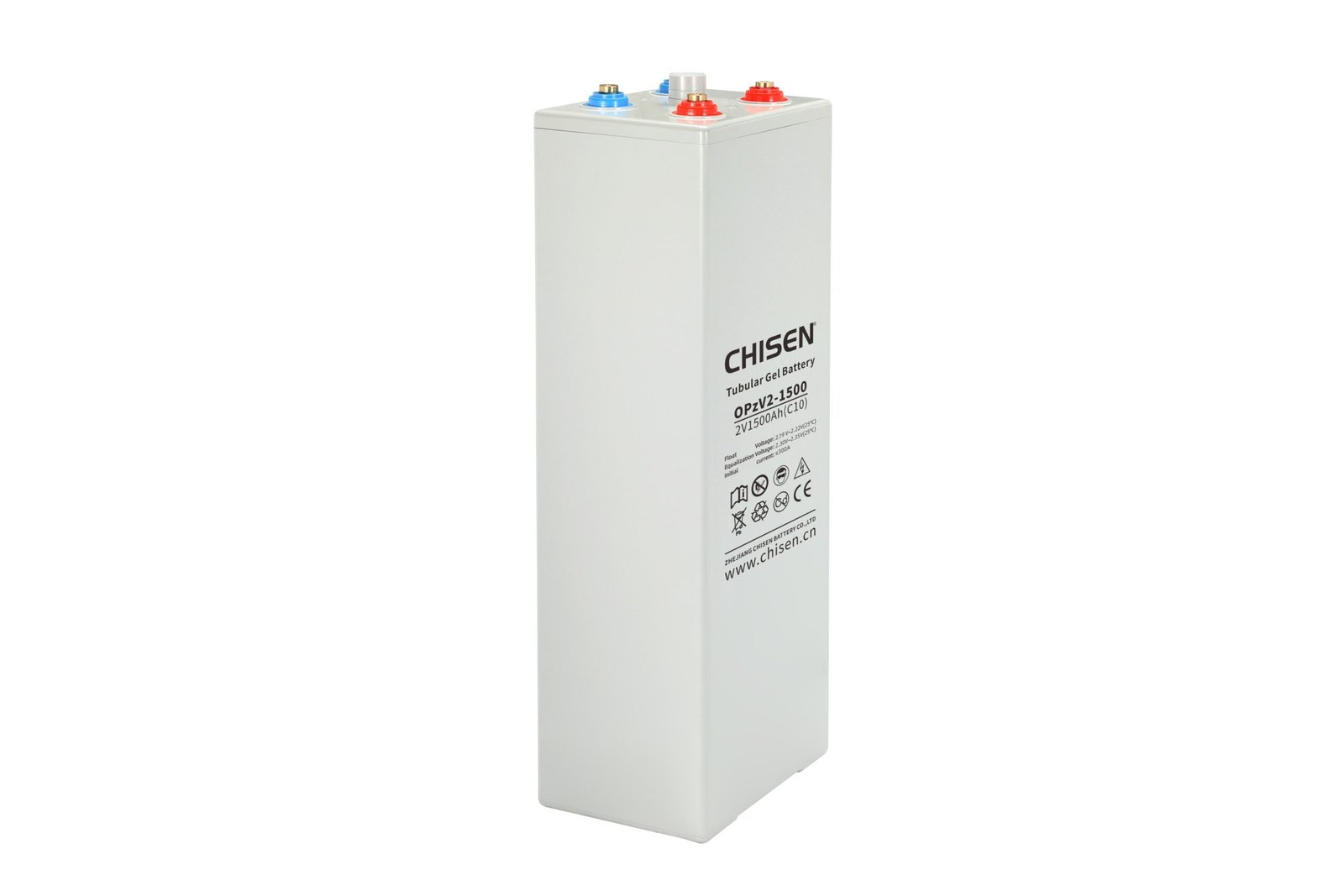
| OPzS2-1500 | Flooded | 1,500 Ah | 275 x 210 x 850 | 98.0 kg with electrolyte | 0.40 mΩ at 20 °C | 300 A | Datasheet |
| OPzS2-2500 | Flooded | 2,500 Ah | 487 x 212 x 826 | 183 kg with electrolyte | 0.30 mΩ at 20 °C | 500 A | Datasheet |
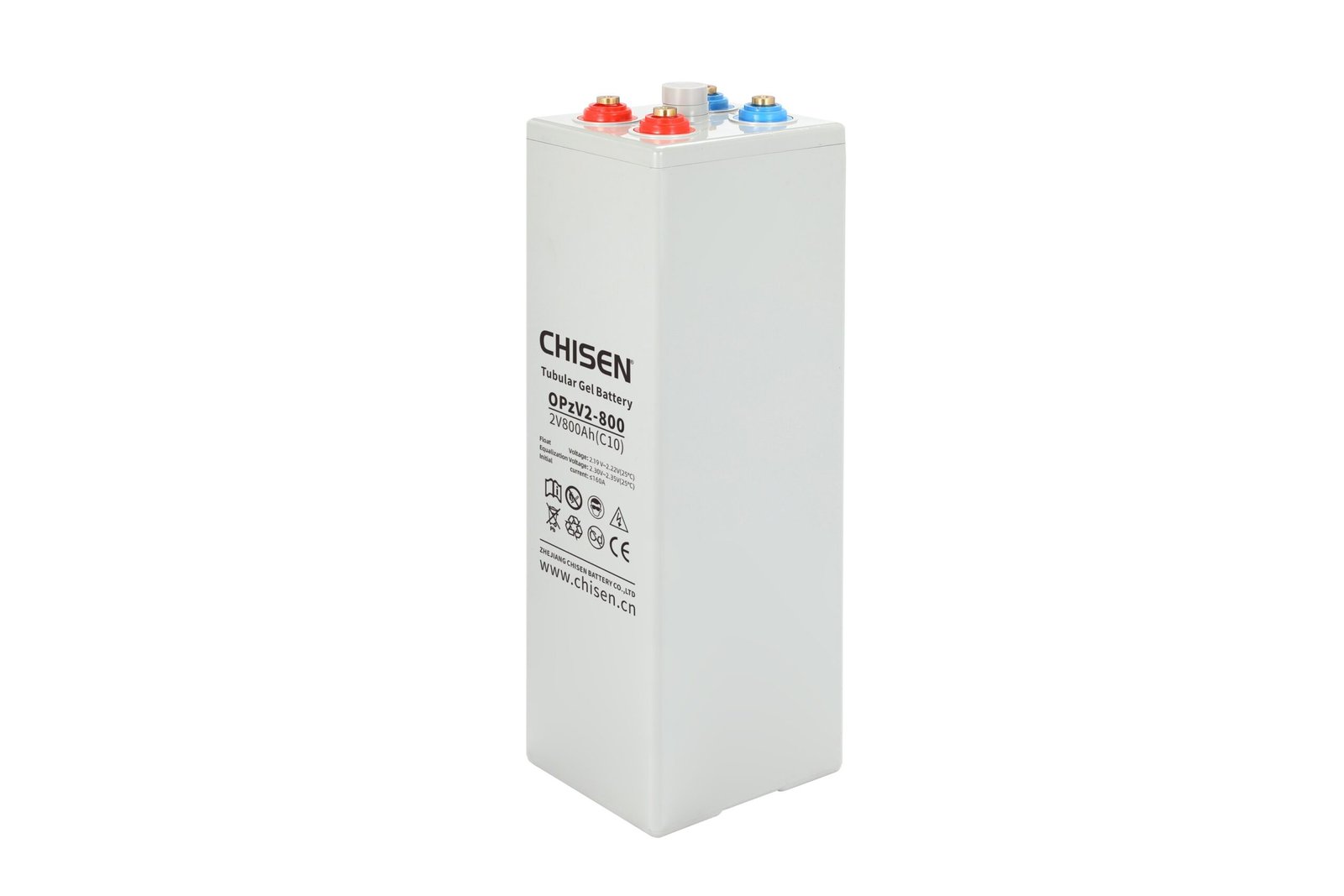
| OPzV2-500 | Gel | 500 Ah | 166 x 206 x 506 | 36.3 kg | 0.56 mΩ at 25 °C | 100 A | Datasheet |
| OPzV2-1000 | Gel | 1,000 Ah | 233 x 210 x 681 | 73.2 kg | 0.5 mΩ at 25 °C | 200 A | Datasheet |
| OPzV2-2500 | Gel | 2,500 Ah | 487 x 212 x 807 | 181 kg | 0.3 mΩ at 25 °C | 500 A | Datasheet |
The OPzS2-500 flooded tubular cell page carries the same published rating, which is a useful cross-check on any quotation you receive.
§2 — The Pain
Importing 2V lead acid cells in volume is one of the few activities where the unit price is almost never the largest number in the calculation, and yet it is the only number most importers fixate on.
The order is specified in cells, not in volts. A 48 V telecom site with four parallel strings needs 96 cells. A 96 V solar site with three strings needs 144. The importer who orders by the tonne rather than by the string ends up with the wrong quantity, because the same tonnage can be built from a different number of strings at different voltages. Every cell count in the order has to be reconciled against the string architecture at the destination, and that reconciliation happens before the container is loaded.
The freight classification is decided by the electrolyte, not by the invoice. A flooded cell arrives with 4.5 kg of sulphuric acid per unit and is handled as regulated cargo for the sea leg. A gel cell contains no free liquid electrolyte and is not. This affects the booking, the cost, the packing and the insurance, and it affects whether the shipment can be moved onward by your local distributor without a second formalities exercise.
The documentation arrives separately from the goods. Test certificates, the packing list, the certificate of origin, the material safety data for the acid version and the warranty registration are five different documents, produced by three different functions inside the factory, and they do not always travel together. In a 2V lead acid battery wholesale programme the importer usually discovers the gap when the container has already cleared the port of Shanghai or Ningbo.
The labelling is written for the factory’s market. A cell destined for a DC plant in Tema or Durban may arrive labelled in a format the local authority does not recognise, and the relabelling cost then falls on the importer because the original labels cannot be removed without damaging the case. The same applies to the shipment itself: a distributor in Chennai, Karachi, Jakarta or Manila needs the case marking, the safety data and the packing list in a form its own clearance agent can read, and a factory that only prints for its home market will not provide it.
The customs broker needs the technical description, not the trade name. “Lead acid battery” is not a tariff line. What the broker needs is the voltage, the capacity, the electrolyte type and the construction, which is exactly the block of values that appears on the datasheet. Importers who hand their broker a trade name end up with a classification query, a delay and, in the worst case, a duty assessment that is later corrected but only after the stock is in the warehouse.
The arrival inspection is skipped because the container was opened in transit. The battery case is a heavy steel or plastic vessel with a fragile terminal. Handling damage in the yard, a dropped pallet and a cracked terminal cover all look trivial on an invoice and all end up as an underperformant string. Recording the state of the batch at unloading is cheap and takes an hour.
§3 — The Choice
The first choice is the construction, and it is decided by the freight regime and the maintenance regime at the destination rather than by the cell itself. The comparison below is drawn from the published ratings of the 2V 500 Ah flooded and gel cells.
| Landed cost element | Flooded, OPzS2-500 | Gel, OPzV2-500 | Source |
|---|
| Mass per cell | 17.5 kg with electrolyte | 36.3 kg | Datasheet |
| Cells per 48 V string | 24 | 24 | Arithmetic |
| Mass per 48 V string | 24 x 17.5 kg = 420 kg | 24 x 36.3 kg = 871.2 kg | Arithmetic |
| Mass per 96 V string | 48 x 17.5 kg = 840 kg | 48 x 36.3 kg = 1,742.4 kg | Arithmetic |
| Free liquid acid per cell | 4.5 kg | None | Datasheet |
| Sea freight classification | Regulated cargo | General cargo | Datasheet |
| Self-discharge at 20 °C | approx. 4 % per month | approx. 2 % per month | Datasheet |
| Storage temperature range | −15 to 40 °C | −25 to 45 °C | Datasheet |
| Site maintenance | Watering and inspection | None | Datasheet |
| Internal resistance | 0.95 mΩ at 20 °C | 0.56 mΩ at 25 °C | Datasheet |
Two lines in that table carry most of the commercial weight. The gel cell is more than twice the mass of the flooded cell at the same nominal capacity, and mass is charged for in every mode of transport. The flooded cell carries free liquid acid, and that acid is what turns a sea booking into a regulated cargo movement with its own packing, documentation and insurance consequences. The gel cell carries no free liquid electrolyte, so it moves as general cargo and can be forwarded to a local distributor without a second formalities exercise.
The second choice is the capacity grade, and here the ordering discipline matters more than the price. A 48 V string of 500 Ah cells needs 24 units, a 48 V string of 1,000 Ah cells needs 24 units, and both carry the same nominal energy of 24,000 Wh at the string terminals. The choice between them is a choice about the battery room, the handling equipment and the parallel strings, not about the energy. What changes is the string resistance, the string mass and the fault behaviour of a single cell.
| Model | Capacity | 24-cell string mass | 24-cell string resistance | Max. charge current | Source |
|---|
| OPzS2-150 | 150 Ah | 24 x 14.5 kg = 348 kg | 24 x 1.2 mΩ = 28.8 mΩ | 30 A | Arithmetic |
| OPzS2-200 | 200 Ah | 24 x 17.5 kg = 420 kg | 24 x 0.95 mΩ = 22.8 mΩ | 40 A | Arithmetic |
| OPzS2-500 | 500 Ah | 24 x 17.5 kg = 420 kg | 24 x 0.95 mΩ = 22.8 mΩ | 100 A | Arithmetic |
| OPzS2-1500 | 1,500 Ah | 24 x 98.0 kg = 2,352 kg | 24 x 0.40 mΩ = 9.6 mΩ | 300 A | Arithmetic |
| OPzS2-2500 | 2,500 Ah | 24 x 183 kg = 4,392 kg | 24 x 0.30 mΩ = 7.2 mΩ | 500 A | Arithmetic |
| OPzV2-1000 | 1,000 Ah | 24 x 73.2 kg = 1,756.8 kg | 24 x 0.5 mΩ = 12.0 mΩ | 200 A | Arithmetic |
| OPzV2-2500 | 2,500 Ah | 24 x 181 kg = 4,344 kg | 24 x 0.3 mΩ = 7.2 mΩ | 500 A | Arithmetic |
The third choice is the specification, and it is the one that must be locked before any price is discussed. Every quotation in a 2V lead acid battery wholesale programme should carry the same block of values so that the quotations can be set side by side.
| Specification line | Value to insert | Source |
|---|
| Float charge voltage | 2.23 V per cell at 25 °C | Datasheet |
| Equalise charge voltage | 2.35 V per cell at 25 °C | Datasheet |
| Design float life | 20+ years @ 20 °C | Datasheet |
| Temperature compensation | −3 mV/°C/cell | Datasheet |
| Nominal capacity | 500 Ah at C10 to 1.80 V per cell | Datasheet |
| Internal resistance | 0.95 mΩ at 20 °C, flooded | Datasheet |
| Terminal | Female copper insert M8, 10 to 12 N·m | Datasheet |
| Certification | IEC 60896-11, DIN 40736, IEC 61427, BS 6290 part 4, UL 1989 | Datasheet |
| Solar charge recipe | Float 2.25 +/- 0.005 V, regulation 2.40 +/- 0.01 V, compensation −4 mV per cell per degree Celsius | Datasheet |
| Warranty registration | Batch reference and serial range | Model page |
When that block is identical across every quotation, the comparison stops being about price and starts being about the things that actually differ: the certification, the warranty, the delivery terms and the factory.
§4 — The Framework
Seven steps turn a 2V lead acid battery wholesale enquiry into an order that can be cleared, delivered and installed without a dispute.
1. Fix the string architecture before the order. Write down the bus voltage, the number of parallel strings and the cell grade at the destination. Every quantity in the order follows from that sheet, and a mismatch between the order and the architecture is the most common cause of a short shipment.
2. Lock the specification from the datasheet. Insert the block above into the request for quotation so that every supplier answers the same question. Add the long-time discharge table and the cycle life curve as line items.
3. Choose the construction against the freight regime. Flooded cells move as regulated cargo with free liquid acid; gel cells move as general cargo. If the destination distributor cannot handle regulated goods, that settles the construction before the price is discussed.
4. Size the order in cells and in strings. Twenty-four cells per 48 V string, forty-eight per 96 V string, and 24 x 17.5 kg = 420 kg of flooded cells per 48 V string. Order in whole strings where the destination will accept it, because a partial string is difficult to place and impossible to test in isolation.
5. Fix the documentation set before the deposit. Test certificates, the packing list, the certificate of origin, the safety data for the acid version and the warranty registration all have to be named in the contract. Ask for them as documents, not as assurances.
6. Plan the receiving operation. Confirm the cell count against the packing list at unloading, measure the open circuit voltage across the batch to establish the spread, inspect the terminals for handling damage, and for flooded cells confirm the electrolyte level. Record all of it.
7. Register the warranty against the batch reference. A warranty that is not registered against the serial range of the delivered batch is a warranty that will be argued about at the first claim.
§5 — The Trust
Volume sourcing has its own characteristic risks, and they show up at the boundaries of the transaction rather than in the cell itself.
The substitution. A manufacturer may ship a cell of a different grade because the specified one is short. A 2V 500 Ah cell and a 2V 200 Ah cell fit the same application in a string only if the string count changes, and a string count that changes without a matching charge controller setting produces a site that never reaches its float voltage. Insist on the exact model designation on the packing list and on the case label, and check both at unloading.
The mixed pallet. Two grades packed on the same pallet, distinguished only by a label, is a common source of a string that does not balance. If your distributor breaks pallets for distribution, ask for grade separation at the factory.
The certificate that belongs to a different model. A certificate covering a 2 V 500 Ah flooded cell does not cover a gel cell, and a certificate covering the 500 Ah grade does not cover the 1,500 Ah grade. Check the model designation inside the certificate against the model on the packing list, not just the certificate title.
The warranty written around the site, not the cell. Exclusions for operation outside the published charge voltage window, for cells run without temperature compensation and for physical damage are standard. They are also the three failure modes a distributor most often causes, so the warranty and the operating instructions should reach the installer together.
The label that the local authority rejects. The label should carry the model, the nominal voltage, the capacity, the terminal torque warning where applicable and the importer identification. Ask for a draft label before the order so that relabelling never becomes a cost line in the warehouse.
§6 — FAQ
Q1. What is the smallest order that makes sense for a 2V lead acid battery wholesale programme? One complete string. Twenty-four cells for a 48 V site and forty-eight for a 96 V site. A partial string cannot be tested against the published capacity and cannot be installed cleanly, so it either waits in the warehouse or is sold on at a reduced price to a buyer who has no way to verify it.
Q2. Why do flooded and gel 2V cells differ so much in mass at the same capacity? The gel cell holds the electrolyte in a gelled matrix with a separator assembly, which occupies more volume than free liquid. A 2V 500 Ah gel cell measures 166 x 206 x 506 mm and weighs 36.3 kg, while the flooded equivalent measures 104 x 206 x 399 mm with a 13.0 kg dry mass plus 4.5 kg of acid.
Q3. Does the freight classification really differ between the two? Yes, and it follows from the electrolyte. A flooded cell contains free liquid sulphuric acid at 1.240 g/cm3 and is handled as regulated cargo for the sea leg. A gel cell contains no free liquid electrolyte and moves as general cargo. Confirm the classification with your forwarder against the safety data before the booking, not after.
Q4. Which documentation does the customs broker actually need? The technical description rather than the trade name. Voltage, capacity, electrolyte type, construction and the applicable standard numbers, all of which are on the datasheet. Add the certificate of origin and the packing list showing the cell count and the gross mass.
Q5. How do I check a delivered batch for damage? Compare the cell count against the packing list, inspect every terminal for impact damage or a cracked cover, measure the open circuit voltage of each cell and compare the spread across the batch against the manufacturer’s tolerance, and for flooded cells confirm the electrolyte level. Record the results at unloading, whether the discharge port is Santos, Durban, Nhava Sheva or Chattogram.
Q6. What is the warranty registration process and why does it matter? The supplier issues a batch reference covering the serial range of the cells supplied, and the warranty attaches to that range. Without registration, a claim years later has no link to the delivered goods and no link to the factory. Register at delivery, not at the end of the installation programme.
Q7. Can I mix 2V grades in one string? Not in a single series string. A series string requires identical cells of the same grade, because series cells share the same current and the same float voltage, and a cell of a different capacity behaves differently under the same load. Parallel strings may be matched as a group if they are of the same grade and age.
Q8. What should a first trial order look like? One complete string of the grade you intend to standardise on, ordered with the full documentation set, inspected on arrival and put into service on a monitored string so that the measured capacity can be compared against the published curve. A trial order of this kind is worth more than a much larger first shipment that has not been tested.
Expert Summary
A 2V lead acid battery wholesale programme is controlled by two documents, the manufacturer datasheet and the shipping documentation set, and the commercial value of getting them right is larger than the value of negotiating the unit price. The datasheet has to carry the block of values that define the cell. Float charge voltage of 2.23 V per cell at 25 °C. Equalise charge voltage of 2.35 V per cell at 25 °C. Temperature compensation of −3 mV/°C/cell. Design float life of 20+ years @ 20 °C. Capacity at a stated rate, with the final voltage that applies at each rate, from 1.90 V per cell below 0.05 C to 1.60 V per cell between 1 C and 2 C. Internal resistance at a stated reference temperature, 0.95 mΩ at 20 °C on the flooded 500 Ah cell and 0.56 mΩ at 25 °C on the gel equivalent. Self-discharge of about 4 % per month for a flooded cell against about 2 % for a gel cell. The solar charge recipe, which is a different set again: float 2.25 +/- 0.005 V per cell on the flooded table and 2.27 +/- 0.005 V on the gel table, regulation at 2.40 +/- 0.01 V, over-voltage disconnect at 2.47 +/- 0.01 V and compensation at −4 mV per cell per degree Celsius on the flooded solar table. And the certification, IEC 60896-11, DIN 40736, IEC 61427, BS 6290 part 4, UL 1989 and Eurobat for the flooded cell, with IEC 60896-21/22, DIN 40472, YD/T 1360 and the same base standards for the gel cell. Alongside that sit the two numbers that decide the logistics: 17.5 kg per flooded cell and 36.3 kg per gel cell, which becomes 420 kg for a 48 V string of flooded 500 Ah cells and 871.2 kg for the gel equivalent, and the 4.5 kg of free liquid acid in each flooded cell, which is what makes the sea leg a regulated cargo movement. Order in whole strings, twenty-four cells for 48 V and forty-eight for 96 V, quote every supplier against the identical specification block, confirm the terminal specification of female copper insert M8 at 10 to 12 N·m, register the warranty against the batch serial range, and record the open circuit voltage spread at unloading. That is a programme a distributor can run for years.
Contact CHISEN — 24-Hour Response
Send us the bus voltage, the number of parallel strings, the cell grade, the ambient temperature at the site and the discharge profile, and you will receive a sizing sheet with the cell quantity, the string arithmetic and the charge settings for your installation, within 24 hours.
- Sales: sales@chisen.cn
- General enquiries: jack@chisen.cn
- WhatsApp: +86 131 6622 6999
- Product reference: OPzS2-500 flooded tubular, 2V 500Ah
Related reading: the gel cell used for comparison on this page and the OPzS flooded tubular battery range.