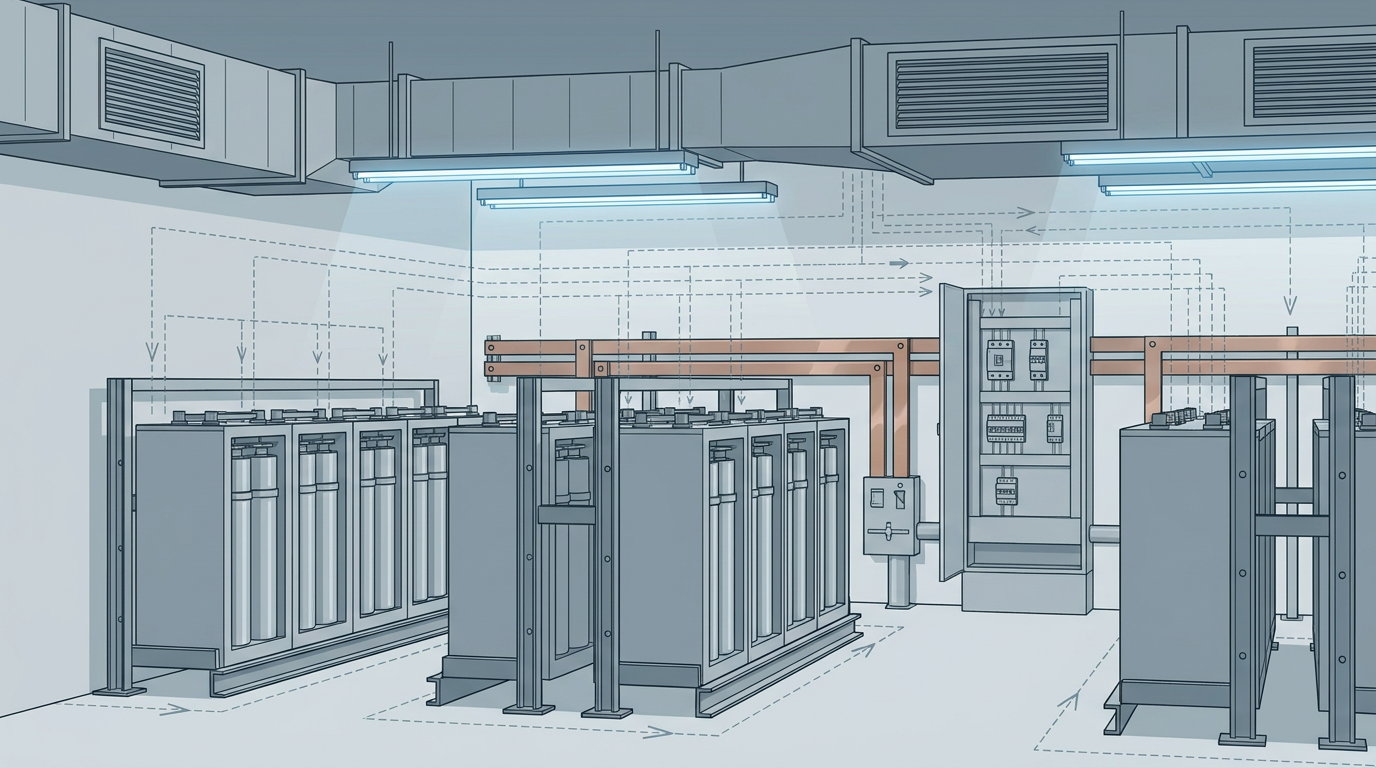
The OPzV2-700 2V 700Ah tubular gel battery is the middle of the range where most telecom and solar-hybrid banks actually land: large enough that a 48V string carries real autonomy, small enough that a technician can still replace a cell without a crane. A 24-cell string of these cells gives a 48V nominal bus with 33.6 kWh stored, floats at 54.0–54.5V, and carries a published float service life of 20+ years at 25°C with a cycle rating of at least 1,500 cycles at 80% depth of discharge. This guide covers how to verify those claims before you commit a container order.
[image placeholder: opzv2-700-2v-700ah-tubular-gel-battery-supplier-selection-telecom-2026.png]
Answer First
A 48V DC plant built from 24 OPzV2-700 cells in series stores 33.6 kWh nominal (24 × 2V × 700Ah), delivers 16.8 kWh at a 50% depth of discharge to 1.80V per cell, and floats at 54.0–54.5V with temperature compensation of −3.3mV per °C per cell. The cell measures 254 × 210 × 471mm with a 506mm total height, weighs 52.0kg filled, and uses a Φ20-M8 terminal tightened to 10–12 N·m — so a two-person lift and a standard 19-inch cabinet depth are the two physical constraints that decide whether this size is right for your site.
Key Takeaways
- 700Ah at C10, not nameplate Ah. The published rating is 700Ah on the 10-hour rate to 1.80V per cell at 25°C, which is the number to put on a purchase order. A cell quoted on a 20-hour rate delivers roughly 5–8% less at the 1-hour rate your rectifier actually imposes.
- Float voltage 2.25–2.27V per cell at 25°C, compensated −3.3mV per °C per cell. On 24 cells that is 54.0–54.5V float and 55.2–56.4V equalising. Anything quoted without the compensation coefficient is not a comparable float life.
- Cycle life is published by depth of discharge, not as one headline number. At least 1,500 cycles at 80% DoD, 2,500 at 50%, 4,000 at 30% and 5,500 at 20% at 25°C — the solar-hybrid case is usually the 30% row, not the 80% row.
- Float service life of 20+ years applies at 25°C only. The widely used engineering rule of thumb is that float life roughly halves for every 10°C above 25°C, so a plant room at 35°C is a ten-year battery, not a twenty-year battery.
- One model covers the whole 48V fleet. The tubular gel range runs from OPzV2-100 at 100Ah to OPzV2-3000 at 3000Ah in published dimension and weight tables, so a site fleet can be standardised on one platform with capacity steps rather than a mix of manufacturers.
Quick Specifications: The Published OPzV2-700 Data
Cell-level electrical and operating data for the 700Ah size, as published on the OPzV2-700 product page:
| Parameter | Published value |
|---|---|
| Model | OPzV2-700 |
| Technology | Tubular positive plate, nano gelled electrolyte, valve-regulated sealed VRLA |
| Nominal voltage | 2V DC |
| Rated capacity | 700Ah at C10 to 1.80V/cell, 25°C |
| Float / standby voltage | 2.25–2.27V per cell at 25°C, compensation −3.3mV/°C/cell |
| Equalising voltage | 2.30–2.35V per cell at 25°C, compensation −5mV/°C/cell |
| Cycling charge voltage | 2.35–2.40V per cell at 25°C |
| Maximum charging current | 140A (0.20 × C10) |
| Maximum discharge current (5s) | 2,000A |
| Short-circuit current | 3,300A |
| Internal resistance | 0.55 mΩ fully charged at 25°C |
| Self-discharge | 2% per month at 20–25°C; storable 12 months without recharging at 25°C |
| Cycle life | ≥1,500 cycles at 80% DoD; 2,500 at 50%; 4,000 at 30%; 5,500 at 20%; 800 at 100% |
| Float service life | 20+ years at 25°C |
| Discharge / charge / storage temperature | −40°C to +65°C / −30°C to +65°C / −25°C to +45°C |
| Dimensions | 254 × 210 × 471mm (total height 506mm over terminals) |
| Weight | 52.0kg filled with electrolyte |
| Terminal | Φ20-M8, 10–12 N·m (Φ16-M6 and Φ24-M10 options) |
| Standards | IEC 60896-21/22:2004, IEC 61427, DIN 40472:2015, GB/T 19638.1-2014, YD/T 1360, Eurobat Long Life, BS 6290 Part 4, UL 1989 |
| Transport and environmental | IMDG Class 8, UN2794, MSDS, RoHS, REACH, WEEE |
Capacity versus ambient temperature on the 10-hour rate, which is the correction most often skipped in a quotation:
| Ambient | Capacity (% of rated) | Operating note |
|---|---|---|
| 50°C | ~107% | High-temperature limit, life materially reduced |
| 40°C | ~105% | Forced ventilation normally required |
| 25°C | 100% | Rating reference, 20+ year float design life |
| 0°C | ~80% | Slight capacity reduction |
| −20°C | ~55% | Extreme cold, significant capacity loss |
Where the 700Ah size sits in the published dimensional series, against its two closest neighbours on the OPzV tubular gel range page:
| Model | Capacity C10 (Ah) | Length (mm) | Width (mm) | Height (mm) | Total height (mm) | Weight (kg) |
|---|---|---|---|---|---|---|
| OPzV2-600 | 600 | 145 | 206 | 646 | 681 | 44.20 |
| OPzV2-700 | 700 | 254 | 210 | 471 | 506 | 52.00 |
| OPzV2-800 | 800 | 191 | 210 | 646 | 681 | 60.00 |
The Pain: Where Telecom Battery Banks Fail Before They Age
Most battery banks that disappoint in year four were specified correctly on day one. They were then operated outside the envelope the datasheet describes, and the failure surfaces at the worst possible moment — during a grid outage in the middle of a monsoon in Karachi, a heatwave in Lagos, or a coastal salt fog event on a site near the Port of Santos.
Autonomy is stated in hours without a discharge rate. “Eight hours of backup” is meaningless unless the end voltage and the rate are fixed. A 700Ah cell returns close to 700Ah over ten hours, but noticeably less over three hours and considerably less over one. When the rectifier fails and the inverter carries a hard load, the usable energy is the rate-corrected figure, not the nameplate.
Float-current headroom is missing from the rectifier spec. At float the rectifier must carry the site load plus the battery’s own float current — roughly 1–2% of C10, so about 7–14A per 700Ah cell — plus whatever is needed to equalise a diverged string. A rectifier sized exactly to the site load will never recover a bank that has run undercharged for a week.
Temperature compensation is switched off. The published −3.3mV/°C/cell changes the float setpoint by roughly 0.2V across a 24-cell string between a 20°C and 40°C plant room. Without it, a hot climate over-charges daily, which consumes water in VRLA cells and shortens float life — precisely the opposite of the intended effect.
Cold sites are specified on a warm-site load profile. Capacity at −20°C is 55% of the 25°C rating. A cabinet outside Helsinki, Harare or Ulaanbaatar specified on a Dubai duty cycle will fail its autonomy test in January, even though the same bank passed every test in June.
There is no spare allowance. A single weak 2V cell can take a 48V string offline, because the bus voltage cannot be balanced around one cell. Buying two or three matched spares with the initial order costs less than one hour of site downtime.
The Choice: Chemistry, String Math and Total Cost
String and parallel arithmetic
Every cell in the OPzV range is 2V, so string length is fixed by the DC bus and only cell capacity and the number of parallel strings remain variable.
| DC bus | Cells in series | Float voltage | Equalising voltage | Energy per 700Ah string | Energy per 2-string bank |
|---|---|---|---|---|---|
| 24V | 12 | 27.0–27.2V | 27.6–28.2V | 16.8 kWh | 33.6 kWh |
| 48V | 24 | 54.0–54.5V | 55.2–56.4V | 33.6 kWh | 67.2 kWh |
| 80V | 40 | 90.0–90.8V | 92.0–94.0V | 56.0 kWh | 112.0 kWh |
| 120V | 60 | 135.0–136.2V | 138.0–141.0V | 84.0 kWh | 168.0 kWh |
A worked 48V telecom case
A rural mobile site near Lagos, a trackside cabinet outside Warsaw and a hybrid tower near the Port of Colombo share a common profile: a 1,200W continuous load, a 48V rectified bus, a 12-hour autonomy target and 30–35°C ambient.
- Nominal energy: 24 cells × 700Ah = 33.6 kWh per string.
- Deliverable at 50% DoD (1.80V/cell): 16.8 kWh → 14 hours at 1,200W.
- Corrected for a 40°C plant room: ×1.05 → 17.6 kWh → 14.7 hours, provided the inverter’s DC undervoltage cutoff is set at or above 48.0V.
- Rectifier sizing: 1,200W site load + 14A float current (2% of C10) + equalising reserve of roughly 140A at 2.35V ≈ 330W, so about 1.6kW continuous; a 2kW rectifier holds margin without exceeding the 140A per-cell maximum charging current.
- Short-circuit check: 24 cells × 0.55 mΩ = 13.2 mΩ for the string, which by calculation gives roughly 4,100A. The published 3,300A figure governs, and the DC fuse rating should be set against it.
Chemistry comparison at 48V, 1,200W load, 12-hour autonomy
| Cost and performance item (7-year horizon) | Tubular gel OPzV2-700 | Flat-plate AGM 12V 700Ah block | LFP 48V 25kWh module |
|---|---|---|---|
| Initial purchase (24-cell / 4-block / 1-rack basis) | $4,560 | $1,920 | $9,500 |
| 7-year electricity at ~$0.18/kWh | $2,760 | $2,500 | $1,640 |
| 7-year cabinet cooling and ventilation | $320 | $560 | $1,180 |
| 7-year inspection and service labour | $0 | $280 | $1,120 |
| Mid-life replacement inside 7 years | $0 | $2,270 (one set plus labour) | $1,500 (capacity augmentation) |
| Downtime exposure | $600 | $1,100 | $480 |
| 7-year total | $8,240 | $8,630 | $15,420 |
| Cost per delivered kWh (36,792 kWh over 7 years) | $0.224 | $0.235 | $0.419 |
| Published cycle rating | 1,500 cycles at 80% DoD | 400–800 cycles at 80% DoD | 3,000–5,000 cycles at 80% DoD |
| Watering and cell servicing | None (VRLA sealed) | None (VRLA sealed) | None, but BMS and HVAC service |
| Failure modes seen in the field | Grid corrosion and shedding on flat-plate designs | Premature capacity loss in sustained heat | Cell imbalance, BMS firmware, thermal management |
Read this honestly: the flat-plate AGM option starts roughly 30% cheaper on capital cost, and in a cool 25°C float-only service with a guaranteed five-year replacement budget the gap can stay that way. The case for tubular gel is not the invoice — it is the absence of a mid-life replacement event, the removal of service labour, and the way the gap widens once the plant room sits above 30°C for most of the year. LFP wins decisively on cycle life and round-trip efficiency but costs roughly 87% more over seven years once HVAC, augmentation and maintenance are counted, which is why it remains a hybrid-site and generator-start alternative rather than the default for a 48V telecom cabinet.
The Framework: Seven Numbers to Put in the Purchase Specification
1. Capacity basis. Specify 700Ah at C10 to 1.80V per cell at 25°C, and ask the supplier to confirm the discharge curve used to certify it. A 700Ah cell quoted only on C20 is not the same cell in your application.
2. Float setpoint and compensation. 2.25–2.27V per cell at 25°C with −3.3mV/°C/cell, giving 54.0–54.5V across 24 cells. Write the compensation coefficient into the rectifier configuration sheet, not just the battery datasheet.
3. Cycle rating at your real depth of discharge. The published ladder — 1,500 cycles at 80%, 2,500 at 50%, 4,000 at 30%, 5,500 at 20% — lets you pick the row that matches the site’s energy profile instead of accepting the headline figure.
4. Temperature derating curve. 105% at 40°C, 80% at 0°C, 55% at −20°C. A supplier who publishes only the 25°C capacity is asking you to guess the rest.
5. Float life definition. “20+ years” is only meaningful alongside 25°C, 2.25–2.27V per cell and the compensation coefficient. Vendors quoting ten, twelve and fifteen years are usually using different float voltages or ambient assumptions; normalise all quotes to the same three conditions before comparing.
6. Standards and certification set. For EU, UK and North American utility and telecom procurement: IEC 60896-21/22:2004 for test methods and dimensions, DIN 40472:2015 for tubular VRLA, IEC 61427 for PV storage, BS 6290 Part 4 and UL 1989 for UK and US acceptance, plus Eurobat Long Life classification above twelve years float.
7. Serviceability and logistics. 254 × 210 × 471mm at 52.0kg with a 506mm total height determines cabinet choice and whether two people can handle a cell. Terminal type Φ20-M8 at 10–12 N·m sets the tooling on site. For freight, IMDG Class 8 and UN2794 apply, and at 52kg per cell a 20-foot dry container holds roughly 460 cells before pallet and dunnage weight is counted — which is close to the payload limit, so bank size is a freight-planning decision, not only an electrical one.
The Trust: How to Audit a Tubular Gel Supplier Before You Pay
The gap between a data sheet and a delivered cell is where procurement losses hide. These are the checks that separate a manufacturer from a trading company.
Ask for the capacity test, not the brochure. A logged 10-hour discharge curve at 0.1C with the voltage at the end of discharge, taken from a cell in the shipment you received, is the only evidence that matters. Many suppliers publish a datasheet copied from a cell they do not build.
Check whose cells are in the box. A manufacturer will state the plant, the annual output and the audit certificates without hesitation. A trading intermediary cannot. Ask which factory produced the lot and for the plant’s monthly output — for context, CHISEN operates eight production bases with an annual capacity of 70 million kVAh and holds ISO 9001, ISO 14001, CE and UL approvals across the range.
Compare float life on identical conditions. Reject every quote that does not state the ambient temperature, the float voltage per cell and the temperature compensation coefficient next to the years figure.
Verify the physical envelope, not just the weight class. Terminal type, torque figure, total height over terminals and the approved mounting orientation determine whether the cell fits the cabinet and whether the string can be installed horizontally or on its side in a confined outdoor enclosure — the OPzV range is published for vertical, horizontal and side installation, which matters in the tight outdoor cabinets common to 5G sites in Europe and Southeast Asia.
Run the supplier audit as a checklist, not a question. Before issuing a purchase order, confirm the datasheet, the IEC and DIN test reports, the Eurobat classification, the warranty terms with defined float-life conditions, the spare-cell policy, the delivery lead time, the packing data for IMDG carriage and the after-sales contact who will answer in twelve months.
Watch the lead-time story. Stationary VRLA is not capacity-constrained the way traction cells are in peak season, but a quoted 90-day lead time with no plant reference usually means the supplier is waiting for someone else’s production slot.
FAQ
1. What is the OPzV2-700 2V 700Ah tubular gel battery used for? It is a 2V stationary cell for telecom base stations and outdoor cabinets, solar and wind hybrid storage, medium UPS and industrial DC panels. Tubular positive plates and immobilised gel electrolyte make it a float-first, maintenance-free product, and the published 20+ year float life at 25°C suits sites with a permanent 48V or 240V DC bus.
2. How many OPzV2-700 cells do I need for a 48V telecom DC plant? Twenty-four cells in series. That gives a 48V nominal bus, 54.0–54.5V float and 55.2–56.4V equalising, with 33.6 kWh nominal per string. A second identical string in parallel doubles the capacity without changing the bus voltage.
3. What is the usable capacity of the OPzV2-700 in practice? 700Ah at the 10-hour rate to 1.80V per cell at 25°C. At a 50% depth of discharge a string delivers 16.8 kWh usable, which is 14 hours at a 1,200W continuous load. Multiply by 1.05 for a 40°C plant room and by 0.80 for a 0°C site.
4. How does it compare with a flat-plate AGM battery of the same capacity? Tubular plates resist shedding and grid corrosion in deep discharge, giving at least 1,500 cycles at 80% DoD against 400–800 for conventional AGM. On capital cost alone the AGM option is cheaper, but it needs one replacement inside a seven-year horizon at ambient temperatures above 30°C, and the 7-year model above puts the two within 5% of each other, with tubular gel ahead on risk and service labour.
5. Can OPzV2-700 cells be installed horizontally or inside a confined cabinet? Yes. The published range supports vertical, horizontal and side installation, which suits the constrained outdoor enclosures used for 5G and remote radio cabinets. Confirm the 506mm total height over terminals and the 52.0kg cell weight against your enclosure and handling plan.
6. What float voltage and compensation should I configure? 2.25–2.27V per cell at 25°C with −3.3mV per °C per cell compensation, which equals 54.0–54.5V across 24 cells at 25°C. Equalising is 2.30–2.35V per cell and cycling charge is 2.35–2.40V per cell. Program the compensation into the rectifier, not the manual.
7. What maintenance does a tubular gel battery need? No watering and no routine cell servicing, but four checks a quarter: string voltage at float against the 54.0–54.5V window, terminal torque at 10–12 N·m, cell casing and terminal condition for corrosion, and the temperature-compensation setting against the measured plant-room temperature. Record every reading — a drifting string is visible in the log months before it fails.
8. How long will the battery last in a hot plant room? The published 20+ years is a 25°C figure. The standard engineering rule is that float life roughly halves for every 10°C above 25°C, so expect roughly ten years at 35°C and nearer seven to eight years at 40°C if the float voltage is not compensated. This is why compensation is the single most valuable setting on the rectifier.
9. Is the OPzV2-700 suitable for solar hybrid sites that cycle daily? Yes, and this is where the published cycle ladder matters. At 30% depth of discharge the cell is rated for 4,000 cycles, which is roughly ten years of daily cycling at that profile. Continuous float life and deep-cycle capability are separate claims, so ask a supplier for the figure at your specific depth of discharge rather than the headline 80% number.
10. What certifications do I need for import into the EU and North America? For Europe, CE marking with IEC 60896-21/22:2004 and DIN 40472:2015 test reports, plus IEC 61427 where the site is a PV installation. For the United Kingdom, BS 6290 Part 4. For the United States, UL 1989. In all cases request the RoHS, REACH and WEEE declarations and the MSDS, and plan carriage under IMDG Class 8, UN2794.
11. Can I mix OPzV2-700 cells with other capacities in the same bank? Not inside a series string — every cell in a string must be the same model and, ideally, the same production batch and age. Different capacities can only be added as separate parallel strings with their own cable sizing, and mixing ages in parallel strings leads to current sharing problems because the newer cells carry more of the load.
12. What should I request from the supplier before placing the order? The full datasheet with the capacity test basis, the IEC and DIN test reports, the Eurobat classification, the warranty conditions stating float life assumptions, two to three spare cells at 2–3% of the order, packing and IMDG data, a stated lead time tied to a plant, and a named technical contact for commissioning support.
Expert Summary
The OPzV2-700 is a 2V, 700Ah tubular gel VRLA cell with a published 10-hour-rate capacity of 700Ah to 1.80V per cell, float service life of more than 20 years at 25°C, a cycle rating of at least 1,500 cycles at 80% depth of discharge and 4,000 cycles at 30%, dimensions of 254 × 210 × 471mm, a total height of 506mm, a filled weight of 52.0kg and a Φ20-M8 terminal at 10–12 N·m. Twenty-four cells in series form a 48V DC plant storing 33.6 kWh nominal and delivering 16.8 kWh at a 50% depth of discharge, floating at 54.0–54.5V with −3.3mV per °C per cell compensation. Tubular gel outperforms flat-plate AGM on cycle life and mid-life replacement exposure, at a capital cost roughly 30–40% higher than AGM and well below LFP on a seven-year total-cost basis. Float life must be read at the site temperature, not at 25°C, because life roughly halves for every 10°C of ambient increase.
Request a Quotation
Specify the model, the string configuration and the delivery port, and we will return a quotation with the datasheet, test certificates and shipping calculation.
- Request a quotation: sales@chisen.cn
- Technical and project discussion: jack@chisen.cn
- WhatsApp: +86 131 6622 6999
- Full specifications for this model: OPzV2-700 2V 700Ah product page
- The complete tubular gel range: OPzV series overview
- Need a supplier audit checklist or the cell datasheet pack? Ask for the audit checklist, IEC 60896 and DIN 40472 test reports, Eurobat classification and the full OPzV dimensional series with your enquiry.
For leadacidbattery.cn, browse the OPzV2-700 2V 700Ah tubular gel battery product page or contact us for a tailored quotation for your project.

Related CHISEN Buyer Guides
- OPzV Tubular Gel Battery for Southeast Asia Telecom: 6-Country Procurement Guide (2026)
- OPzV Tubular Gel Battery for Southeast Asia Telecom: 6-Country Procurement Guide (2026)
- OPzV Tubular Gel Battery for Southeast Asia Telecom: 6-Country Procurement Guide (2026)
- OPzV Tubular Gel Battery for Southeast Asia Telecom: 6-Country Procurement Guide (2026)
- OPzV Tubular Gel Battery for Southeast Asia Telecom: 6-Country Procurement Guide (2026)