UPS Battery Sizing Guide 2026: Calculate Runtime, Capacity, and Never Under-Spec Again
A UPS system is only as good as its battery bank. Get it wrong and you either overspend or leave your critical equipment exposed. This guide gives you the exact formulas to size any lead-acid UPS battery correctly — with a worked example you can use immediately.
Why UPS Battery Sizing Goes Wrong
The most common sizing mistake: engineers use the UPS’s rated VA or kW as the load, then divide by the battery voltage to get Ah — without accounting for the inverter efficiency, the battery’s discharge characteristics, and the desired runtime.
The result is batteries that last 18 months instead of 5 years, or UPS systems that deliver 8 minutes instead of the 30 minutes required for orderly shutdown.
The Correct Sizing Formula
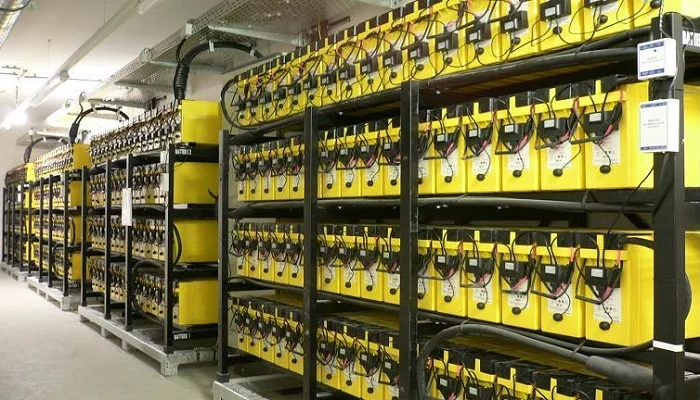
!ups-data-center-battery-room-lead-acid-banks.jpg

Step 1: Establish the Actual Load
True Load (W) = UPS Capacity (VA) × Power Factor × Utilisation Rate
Example: A 10kVA UPS with 0.8 power factor running at 70% load:
True Load = 10,000 × 0.8 × 0.70 = 5,600W Step 2: Account for Inverter Efficiency
Effective Load (W) = True Load (W) ÷ Inverter Efficiency
Most UPS inverters operate at 88–94% efficiency. Use 90% as a conservative estimate:
Effective Load = 5,600W ÷ 0.90 = 6,222W Step 3: Calculate Required Battery Capacity
Battery Capacity (Ah) = (Effective Load × Runtime hours) ÷ (Battery Voltage × DoD Limit)
For lead-acid UPS batteries, limit Depth of Discharge to 50% to maximise cycle life:
Battery Capacity = (6,222W × 0.5 hours) ÷ (480V × 0.50) Battery Capacity = 3,111Wh ÷ 240V = 12.96Ah → Round up to 20Ah For a 480V system (standard for large UPS), this requires a 40-cell string at 12V per cell.
Step 4: Calculate the Number of Battery Strings
Number of Strings = Required Capacity ÷ Selected Battery Capacity
If using 12V 100Ah batteries (each battery = 100Ah at the 10-hour rate):
Number of Strings = 12,960Wh ÷ (12V × 100Ah × 0.90) = 12,960Wh ÷ 1,080Wh = 12 strings Runtime Estimation Formula
Once battery capacity is determined, estimate actual runtime:
Runtime (hours) = (Battery Ah × Battery Voltage × DoD × Inverter Efficiency) ÷ Load (W)
Example: 100Ah, 480V battery bank (40 × 12V batteries) at 5,600W load:
Runtime = (100 × 480 × 0.50 × 0.90) ÷ 5,600W Runtime = 21,600Wh ÷ 5,600W = 3.86 hours Temperature Derating — The Factor Most People Miss
Battery capacity decreases as temperature rises above 25°C. For every 1°C above 25°C, lead-acid capacity decreases by approximately 0.6% per hour.
If your UPS battery room operates at 35°C:
Derating Factor = 1 - (10°C × 0.006) = 1 - 0.06 = 0.94 Adjusted Capacity = 100Ah × 0.94 = 94Ah CHISEN UPS AGM batteries are rated for operation up to 40°C with published temperature derating curves — demand these curves from your supplier.
Battery Type Selection for UPS Applications
| Factor | Flooded Lead-Acid | AGM VRLA | Lithium LiFePO4 |
|---|
|

发表回复