Your Electric Scooter Died Mid-Ride? 5 Real Reasons Behind Lead-Acid Battery Failure
You’re three blocks from home, you accelerate through an intersection, and then — nothing. The scooter cuts out like someone pulled the plug. You’re stranded, pushing a 25kg machine down the sidewalk, wondering what just happened. This is one of the most common and most frustrating experiences for electric scooter riders worldwide — and more often than not, the culprit is hiding inside the battery compartment. In cities across Southeast Asia, Europe, Africa, and the Americas, riders face this exact scenario, and in the vast majority of cases, the issue traces back to the lead-acid battery that powers their vehicle.
Lead-acid batteries are the workhorse of budget and mid-range electric scooters. They’re reliable, inexpensive, and relatively forgiving — but they have clear limits that every rider should understand. Understanding why your battery fails mid-ride is the first step to preventing it. Here are the five most common reasons this happens.
The “Fully Charged” Myth: How Voltage Sag Tricks Your Scooter
You plugged in last night, the charger showed green, and you hit the road with confidence. What you didn’t know is that a lead-acid battery can show 13-14V at rest immediately after charging, but drop to 10V under load — a phenomenon called voltage sag. A healthy 36V system (three 12V batteries in series) should stay above 31.5V under normal load. If it drops below 31V under acceleration, your battery is struggling. If it drops below 27V, the controller will cut power to protect the battery — and that’s your mid-ride shutdown.
The scooter’s low-voltage cutoff typically kicks in at around 10.5V per 12V module. If your battery has degraded plates — from age, sulfation, or previous over-discharge — the voltage sag is severe enough to trigger this cutoff even when the dashboard still shows a full charge. The “full charge” you see is resting voltage, not load voltage. Under the high current draw of acceleration, the battery voltage collapses. This is one of the most commonly misdiagnosed battery failures — riders often believe their battery is fine because the indicator shows charge, when in reality the battery is barely able to deliver power under load.
The fix: invest in a cheap multimeter ($10-15) and check battery voltage under load. Have a helper hold the scooter securely, set the meter to DC voltage, and watch the reading while twisting the throttle. If it drops below 10.5V per 12V module under acceleration, your battery has excessive internal resistance — from sulfation, age, or loose connections.
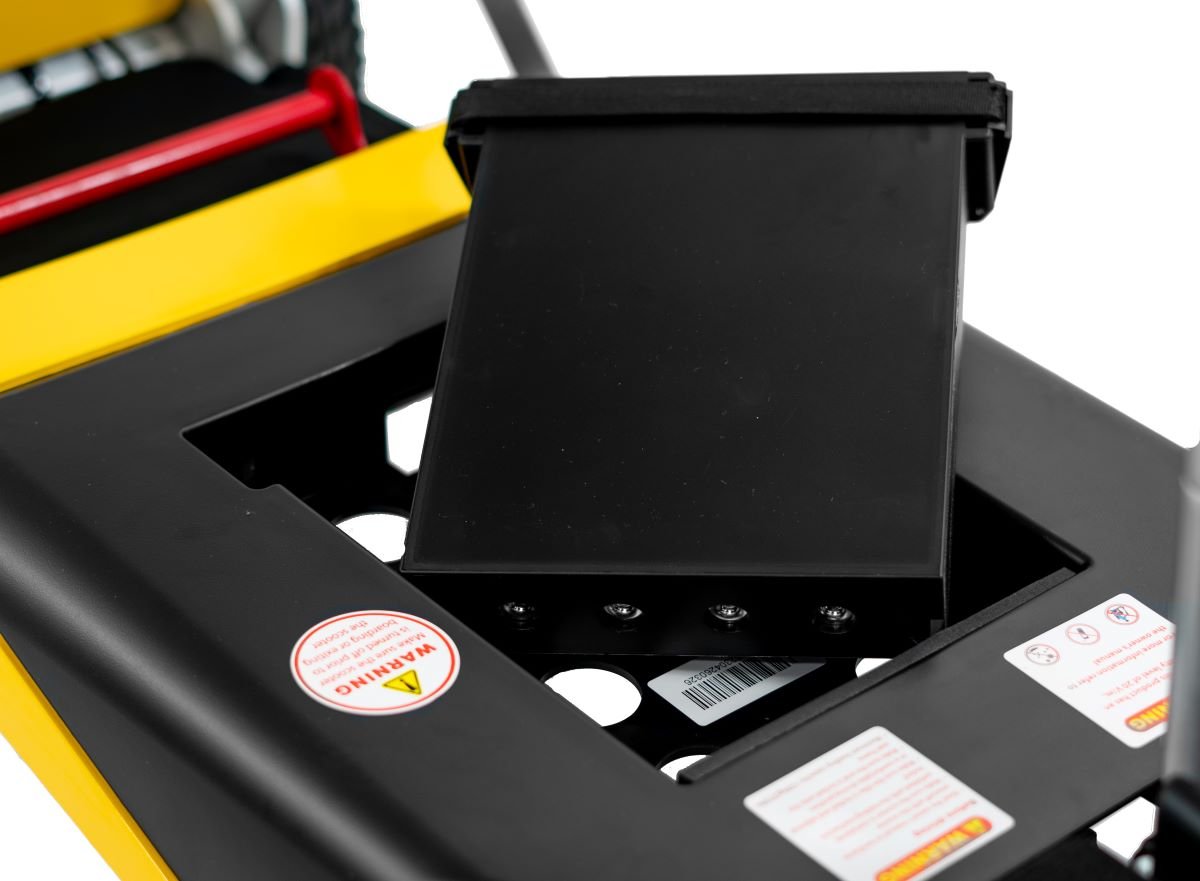
!electric-scooter-lithium-battery-pack-close-up.jpg

Sulfation: The Silent Range Killer Costing You Kilometers Every Week
Lead-acid batteries develop sulfation when they’re left partially discharged for extended periods. Sulfate crystals form on the battery plates, reducing the active surface area available for chemical reactions. A lightly sulfated battery loses capacity gradually — you might notice your range dropping from 30km to 25km, then to 20km. A severely sulfated battery can lose 50-80% of its rated capacity and develop enough internal resistance to overheat under load.
Sulfation is the leading cause of premature lead-acid battery death in electric scooters, accounting for an estimated 60-70% of all battery failures. If your scooter has ever sat for more than two weeks without a full charge — and this happens often with seasonal riders, students who leave scooters in garages over holidays, or delivery riders who skip charging for a few days — there’s a good chance some degree of sulfation has already started.
The colder the weather, the faster sulfation progresses. In Nordic countries, Canada, and northern China where winter temperatures regularly drop below 0°C, sulfation accelerates significantly. A battery that used to give you 30km of range in summer might deliver only 15km in winter — and sulfation is usually a significant contributor to this seasonal decline. The solution is straightforward: never leave your battery below 50% state of charge for more than 48 hours, and perform a full charge at least monthly, even during storage.
Loose or Corroded Connectors: The Most Overlooked Cause of Power Cuts
Not every mid-ride failure is a battery problem. The electrical connections between your battery pack and the scooter’s controller are just as critical as the battery itself. If the Anderson connectors, XT60 bullet terminals, or wiring harness are loose, corroded, or frayed, the scooter will experience intermittent power cuts that look exactly like battery failure.
Corrosion appears as white, greenish, or bluish powder on the terminals. It’s caused by hydrogen gas interacting with moisture in the air, and it’s especially common in humid tropical climates (Southeast Asia, West Africa, the Caribbean), coastal cities (with salt air), and anywhere you’ve ever ridden in the rain. A loose connection doesn’t just cause power cuts — it generates heat at the resistance point, which can melt connectors or, in extreme cases, start an electrical fire.
The solution takes 15 minutes: mix baking soda with water to create a paste, apply it to the corroded terminals with an old toothbrush, scrub thoroughly, rinse with clean water, dry completely, and apply a thin coat of petroleum jelly or commercial battery terminal anti-corrosion spray. Tighten all connections to proper torque. This single maintenance task eliminates an estimated 20-30% of apparent “battery failures” that are actually connector problems.
Over-discharge: The Invisible Damage You Can’t Feel Until It’s Too Late
Deep discharging a lead-acid battery below 10.5V per 12V unit (for a 36V system: below 31.5V total) causes irreversible damage to the plates. The active material sheds from the plate grids, the battery’s internal resistance increases permanently, and the capacity loss is cumulative and non-recoverable. What makes this especially dangerous is that you often don’t notice the damage until it’s too late — the scooter still starts and runs for a few minutes, then suddenly cuts out when the battery voltage collapses under load.
Many riders unknowingly over-discharge their batteries by continuing to ride after the first low-battery warning. When you hear the scooter’s speed start to reduce — called torque limiting, when the controller deliberately reduces power to protect the battery — you’ve already stressed it significantly. The safe practice: when the first low-battery warning appears, find a charging point immediately. Continuing to ride from the first warning to complete cutoff can reduce your battery’s cycle life by 5-10% per incident.
For delivery riders and commuters in high-traffic cities — whether navigating Bangkok’s gridlocked streets, Jakarta’s busy avenues, Lagos’s crowded markets, or Mexico City’s vast urban sprawl — the temptation to push through that warning is understandable. But the cost of one over-discharge event ($0 worth of replaced range gained) vs the cost of a premature battery replacement ($80-200) makes ignoring the warning a false economy.
Physical Damage and Thermal Runaway: When to Stop Using Your Battery Immediately
Lead-acid batteries are sealed, but they’re not indestructible. Physical damage from dropping the scooter, riding over large potholes, or storing the battery in extreme temperatures can rupture internal cells. Once a cell is breached, the battery begins venting electrolyte, losing capacity rapidly, and becoming a safety concern.
In rare cases, thermal runaway can occur if a shorted cell generates heat faster than the battery can dissipate it. This is more common in older batteries, those that have been consistently overcharged, or batteries that have been physically damaged. Thermal runaway usually announces itself through warning signs well before a catastrophic failure: a strong sulfur smell, visible swelling or bulging of the battery case, the battery becoming abnormally hot to the touch during charging (above 45°C / 113°F), or hissing/gurgling sounds from within the case.
If you notice any of these warning signs, stop using and charging the battery immediately. Disconnect it from the scooter (or bring the entire scooter to a service point), and do not attempt to open, puncture, or continue using the battery. In markets across the EU, UK, Australia, and the United States, there are specific disposal regulations for damaged lead-acid batteries — contact your local hazardous waste authority or return the battery to the place of purchase.
The good news: with proper care and awareness, lead-acid batteries in electric scooters are remarkably reliable. The five failure modes above are all preventable or manageable with basic knowledge and consistent maintenance habits. Your battery will last longer, your range will be more predictable, and you’ll avoid the frustration of a mid-ride breakdown.

发表回复