Electric Scooter Battery Voltage Sag: Why It Happens and How to Fix
You’re at a traffic light on your electric scooter, ready to accelerate, and instead of the usual pickup you expected — nothing. Or worse, the scooter cuts out entirely just a few hundred meters into your ride. The battery indicator shows half a charge. So why does your scooter feel so weak? The answer is almost always voltage sag, and understanding it can save you from an expensive — and unnecessary — battery replacement.
Voltage sag is one of the most misunderstood phenomena in electric scooter batteries. Most riders think their battery is dead when they experience severe sag, but in many cases the battery is still functional. The key is knowing how to tell the difference between normal sag and problematic sag that signals a real battery problem.
What Voltage Sag Actually Is (and Why Every Rider Should Understand It)
A lead-acid battery’s voltage is not static. When a load (like your scooter’s motor) draws current, the battery’s terminal voltage drops temporarily. This drop is called voltage sag, and it’s a completely normal electrochemical behavior. Under no load, a healthy 12V lead-acid battery will read 12.7–12.9V. Under a moderate load, that voltage might drop to 11.5–12.0V. Under a heavy load — like accelerating up a hill — it might drop further to 10.5–11.0V.
The scooter’s controller is calibrated with a low-voltage cutoff (LVCO), typically set at 10.5V per 12V module. For a 36V system (three batteries in series), that cutoff fires at about 31.5V total. If your battery voltage sags below that threshold even momentarily, the controller cuts power — which feels exactly like a dead battery, even if the battery would recover to normal voltage once the load is removed.
Here’s a practical example: a brand-new 48V 20Ah lead-acid battery pack on a flat road might sag from 54.6V to 52.0V under acceleration — barely noticeable. An older, slightly sulfated battery under the same conditions might sag from 54.6V all the way to 46.0V — enough to trigger the LVCO and cut out your scooter at the worst possible moment.
Measuring Voltage Sag: A Step-by-Step Diagnostic Anyone Can Do
You don’t need professional equipment to diagnose voltage sag — just a cheap multimeter ($10–$20) and a methodical approach.
Step 1: Measure open-circuit voltage first. Turn off your scooter and let the battery rest for at least 30 minutes. A healthy 12V unit should read 12.7–12.9V. If it reads 12.4–12.6V, it’s at about 80% charge. Below 12.0V, it’s significantly discharged.
Step 2: Measure voltage under load. Have a helper hold the scooter securely (or brace it), set the multimeter to DC voltage, and have another person twist the throttle to full acceleration while you watch the meter. A healthy battery should stay above 10.5V under full load. If it drops to 9.0–10.5V, you have moderate sag. Below 9.0V under load means severe internal resistance — the battery is in trouble.
Step 3: Compare after rest. After the load test, wait 30 seconds and measure again. A healthy battery recovers to within 0.5V of its open-circuit resting voltage. A battery with high internal resistance or sulfation will recover very slowly or not at all.
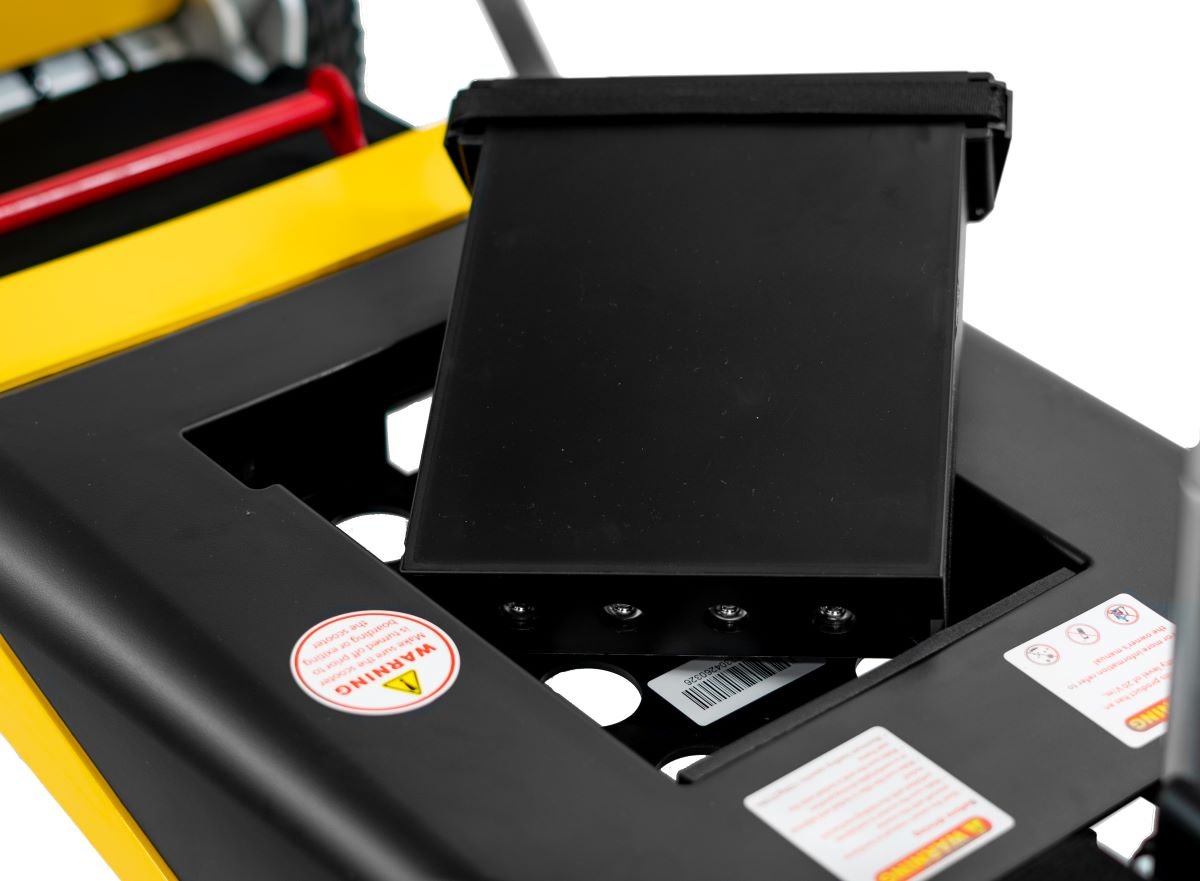
!electric-scooter-lithium-battery-pack-close-up.jpg

The Four Main Causes of Excessive Voltage Sag
1. Sulfation (the most common cause). As lead sulfate crystals accumulate on the battery plates over time, they reduce the active surface area available for chemical reactions. A sulfated battery has higher internal resistance, which causes a much larger voltage drop under load. Sulfation is most commonly caused by leaving the battery at low state of charge for extended periods, or by repeated undercharging.
2. Loose or corroded connectors. If the Anderson connectors, bullet terminals, or wiring between your battery and controller are loose, corroded, or frayed, they add significant resistance to the circuit. This resistance causes voltage to drop before it even reaches the motor — making it look exactly like battery failure. Corrosion appears as white, greenish, or bluish powder on terminals. A loose connection can also generate dangerous heat under load.
3. Cold temperatures. Lead-acid batteries are highly temperature-sensitive. At 0°C (32°F), a lead-acid battery delivers only about 70–80% of its rated capacity, and voltage sag under load is significantly worse. At -20°C (-4°F), you might see only 50% capacity. If your scooter performed fine in summer but feels weak in winter, cold-temperature voltage sag is almost certainly the culprit — not a dead battery.
4. Aged battery with high internal resistance. All lead-acid batteries degrade over time. The positive grid corrodes, the active material sheds from the plates, and the electrolyte gradually loses conductivity. A 3-year-old battery in daily use may have lost 30–50% of its rated capacity, and its voltage sag under load will reflect that. This is normal wear — not a defect.
How to Fix Voltage Sag (and When the Battery Needs Replacing)
For loose or corroded connectors: clean terminals with a baking soda and water paste, scrub with a wire brush, rinse, dry thoroughly, and apply a thin coat of petroleum jelly or anti-corrosion spray. Tighten all connections to the proper torque. This alone can eliminate a surprising amount of apparent sag.
For sulfation: try an extended slow charge (24–48 hours at C/20 rate, about 1–2 amps for a 20Ah battery), which can sometimes partially reverse early-stage sulfation. Some smart chargers have a desulfation mode that pulses the battery with controlled overvoltage. For severe sulfation, the battery typically needs replacing.
For cold temperature: store and charge the battery at room temperature. In winter, consider a battery with slightly higher Ah rating than your minimum requirement — the extra capacity gives you a buffer against cold-weather sag.
For aged battery: if the battery is more than 2–3 years old with heavy daily use, and voltage sag is severe even with clean connectors, replacement is the practical solution. No charger or technique will restore a battery whose plates have physically degraded.

发表回复