Lead-Acid Electric Scooter Battery Maintenance: Best Practices Most Riders Ignore
Lead-acid batteries are often described as “maintenance-free,” and while it’s true that sealed AGM and gel batteries don’t require you to add water, the phrase has led millions of riders to treat their batteries with a carelessness that cuts their lifespan in half. The truth is that lead-acid batteries — even sealed ones — respond dramatically to proper care. A few minutes of monthly attention can add 12–18 months of useful life to your battery pack, and that translates directly into money saved.
This guide covers the maintenance practices that actually matter for electric scooter lead-acid batteries, separating the essentials from the marketing fluff.
Why “Maintenance-Free” Is a Misleading Term
When manufacturers call a battery “maintenance-free,” they mean that you don’t need to add water to it — the electrolyte is sealed inside and cannot be accessed without destroying the battery. What they don’t mean is that you can ignore it entirely. Sealed Lead-Acid (SLA) batteries, including AGM (Absorbed Glass Mat) and gel variants, still require voltage monitoring, proper charging discipline, and environmental care.
The three biggest maintenance mistakes riders make with “maintenance-free” batteries:
Mistake 1: Never checking voltage. Without a multimeter, you have no idea whether your battery is truly full, genuinely low, or somewhere in between. Most cheap e-scooter battery indicators are simply voltage sensors — and they become increasingly inaccurate as the battery ages. A battery that reads “full” on the dashboard may actually be at 60% SOC, delivering only half the expected range.
Mistake 2: Always using the same charger. If your scooter’s original charger failed and you replaced it with a generic “12V battery charger,” you may be charging at the wrong voltage. A 12V lead-acid battery needs 14.4–14.7V for bulk charging (2.4–2.45V per cell). A charger set to 13.8V (for standby use) will never fully charge your battery. Over weeks and months, chronic undercharging causes progressive sulfation.
Mistake 3: Storing the scooter for weeks at low charge. This is the single most damaging practice. A lead-acid battery left at 20–30% SOC for more than 2 weeks will develop significant sulfation. A battery left at 0% SOC for a month may not accept a charge at all without professional intervention.
Monthly Maintenance Checklist for Electric Scooter Lead-Acid Batteries
1. Measure resting voltage (once a month). Use a cheap multimeter ($10). Turn the scooter off and wait at least 30 minutes after your last ride. Probe the battery terminals directly. Read and record the voltage. Interpreting the results:
- 12.7–12.9V: Fully charged (100% SOC)
- 12.4–12.6V: About 75% SOC
- 12.0–12.3V: About 50% SOC — charge soon
- 11.8–12.0V: About 25% SOC — charge immediately
- Below 11.8V: Critically low — may be damaged
2. Inspect physical condition (every 2 weeks). Look for: swelling or bulging of the battery case (indicates overcharge or defect), cracks in the casing, corrosion on terminals (white/green/blue powder), leakage around seals or vent caps, and heat discoloration on the casing (dark patches near terminals indicate sustained high-temperature operation). Any of these signs warrant immediate attention.
3. Clean terminals and connectors (monthly). Mix baking soda with water to make a paste. Apply to corroded terminals with an old toothbrush. Scrub thoroughly. Rinse with clean water and dry completely. Apply a thin layer of petroleum jelly or commercial battery terminal protector. This single practice can prevent 30–50% of connector-related power problems.
4. Verify charger output voltage (every 3 months). Set your multimeter to DC voltage. With the charger connected to the battery (or probe the charger output terminals directly), measure the charging voltage. A 48V lead-acid charger should show 58.8–59.2V during bulk charging. If it shows below 57.6V, the charger isn’t delivering enough voltage to fully charge the battery. If it exceeds 62V, the charger is overcharging — a serious fire and damage risk.
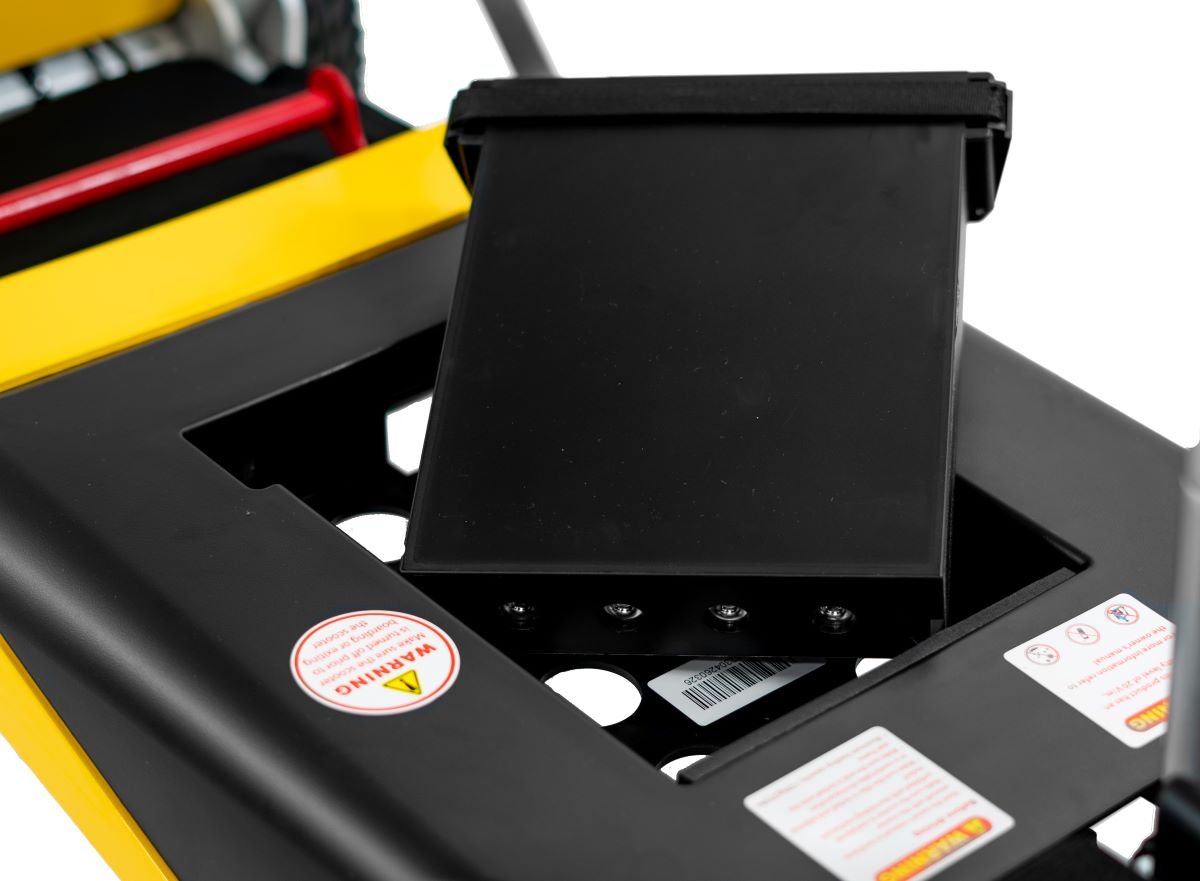
!electric-scooter-lithium-battery-pack-close-up.jpg

Flooded Lead-Acid Batteries: The Maintenance That Actually Matters
If your electric scooter uses a flooded (wet) lead-acid battery — most commonly 6V or 12V EV-series batteries that are user-accessible — water level maintenance is critical and non-negotiable. AGM and gel batteries are sealed and do not require watering, but flooded batteries lose water during every charge cycle through gassing.
When to add water: Check water level every 4–6 weeks in summer (high temperatures accelerate water loss) and every 6–8 weeks in winter. Only check when the battery is fully charged. Remove the vent caps — the water level should be about 10–15mm above the top of the plates. If the plates are exposed, add distilled water until they’re submerged.
What water to use: Always use distilled or deionized water. Tap water contains minerals that reduce battery performance and can cause permanent damage to the plates. A gallon of distilled water costs about $1 and can extend your battery life by months.
Never overfill. The battery case expands slightly when hot, and the electrolyte can overflow if filled too high when cold. Leave at least 5mm of space below the vent well.
Equalization Charging: The Secret Maintenance Technique Professionals Use
Equalization is a controlled overcharge that deliberately drives the battery to 2.5V per cell (slightly above the normal 2.4V/cell bulk charge voltage) for an extended period — typically 12–24 hours. Its purpose is to:
- Equalize the charge across all cells (some cells naturally charge faster than others)
- Break down sulfate crystals that have formed on the plates
- Re-stratify the electrolyte in flooded batteries
Not all chargers have an equalization mode. Smart chargers with a “repair” or “desulfation” mode will perform this automatically. If your charger doesn’t have this function, you can equalize manually by charging with a variable voltage power supply set to 2.45–2.5V per cell for 12–24 hours, monitoring the battery temperature throughout.
How often: Once a month for batteries in daily use. Once every 3 months for batteries in occasional use. Never equalize a battery that is swelling, leaking, or has a cracked case.
Seasonal Maintenance: Preparing Your Battery for Winter and Summer
Before winter / cold season:
- Perform a full equalization charge
- Bring the battery indoors for charging (not a cold garage)
- Store at 50–60% SOC (not full, not empty)
- If storing the scooter for months: disconnect the battery from the scooter wiring to eliminate parasitic drain from the controller
- Check every 4–6 weeks and recharge if resting voltage drops below 12.4V per 12V unit
Before summer / hot season:
- Verify charger voltage is within spec (heat accelerates overcharge damage)
- Clean all connectors and apply anti-corrosion spray
- Check that battery mounting is secure (heat causes expansion, loosening fasteners)
- Consider a battery temperature monitor if you live in a region above 35°C ambient
The most important seasonal habit: In hot climates, your battery degrades roughly twice as fast at 35°C ambient as at 20°C. If you live in a hot region, every 10°C increase in operating temperature roughly halves the battery’s expected lifespan. This makes summer maintenance not optional but essential.

发表回复