分类: Industry News

  • Marine Battery Selection Guide 2026: Boat and Yacht Energy Storage

    Marine batteries operate in a uniquely demanding environment — vibration, salt spray, humidity, and often limited ventilation. This guide covers everything you need to select the right battery for your boat or yacht.

    Marine Battery Types

    • Starting (cranking) batteries: High cold cranking amps (CCA), thin plates. Designed for brief high-current discharge to start engines. Not for deep cycling.
    • Deep cycle marine batteries: Thick plates designed for repeated deep discharge. For trolling motors, house loads, and onboard systems.
    • Dual-purpose batteries: Compromise between starting and deep cycle. Suitable for smaller boats with limited space.

    Marine Battery Sizing

    • House bank (sailboat/motorboat): Size for 2–3 days of house load without charging
    • Trolling motor: Size for 8–10 hours runtime at desired speed
    • Starting battery: Match CCA rating to engine manufacturer specification

    Example sailboat: 400Wh/day house load, 2-day autonomy = 800Wh. At 24V: 800/(24 x 0.50) = 67Ah house bank. Use 2x 12V 100Ah AGM in series = 24V 100Ah.

    Marine-Specific Requirements

    • Vibration resistance: Look for IEC 60068 shock and vibration ratings
    • Salt spray rating: Required for offshore and coastal use
    • Terminal type: SAE terminals for most marine applications; threaded posts for large banks
    • AH rating: C20 rating is the marine standard (not C5 or C100)

    CHISEN Marine-Compatible Batteries

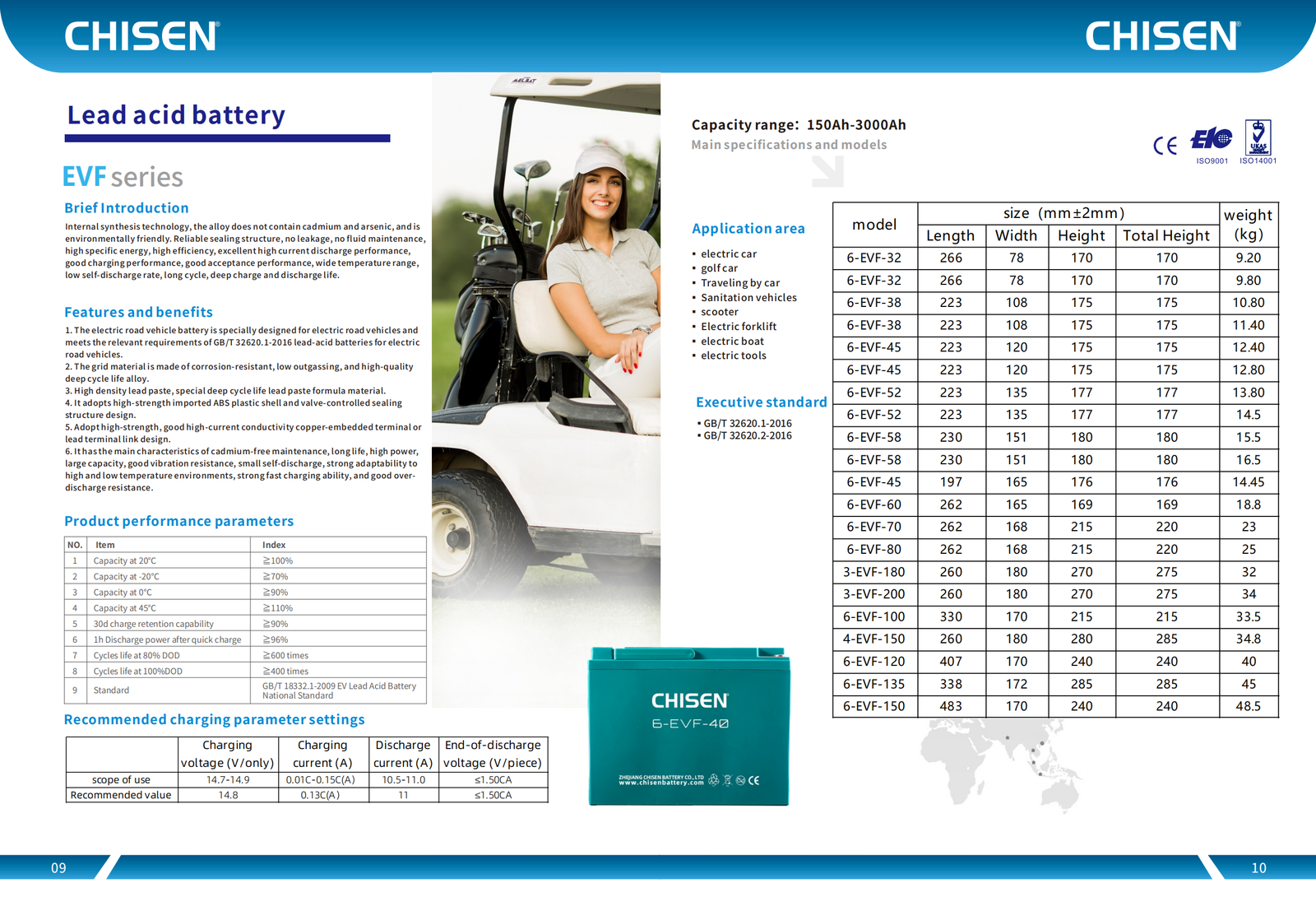
    The CHISEN EVF series is well-suited for marine house banks and electric propulsion systems, with models from 6V 180Ah to 12V 120Ah, designed for repeated deep cycle discharge in demanding environments.


    Get a Free Battery Sizing Proposal

    CHISEN Battery — 8 global factories, 70M kVAh/year. OPzV and OPzS from 100Ah to 3000Ah. CE, ISO9001, TUV certified.

    Tel: +86 131 2666 8999 | Email: jack@chisen.cn | Web: www.chisen.cn
  • Lead Acid Battery Voltage Chart: Complete 12V, 24V, 48V Reference Guide

    Understanding battery voltage is fundamental to designing and maintaining any energy storage system. This complete reference guide covers charging, float, and discharge voltages for all common system configurations.

    12V Battery System Voltages

    • Bulk/Absorb charge: 14.4–14.8V (AGM: 14.4–14.7V, Gel: 14.1–14.4V, OPzV: 14.1–14.4V)
    • Float charge: 13.5–13.8V (AGM: 13.6–13.8V, Gel: 13.5–13.8V, OPzV: 13.5–13.8V)
    • Discharge cutoff: 10.5V per battery (never go below this)
    • Resting voltage (full): 12.7–12.8V after 1 hour rest
    • Resting voltage (50% DoD): 12.2V
    • Resting voltage (80% DoD): 11.8V

    24V Battery System Voltages

    • Bulk/Absorb: 28.8–29.6V (2 x 12V batteries in series)
    • Float: 27.0–27.6V
    • Discharge cutoff: 21.0V (2 x 10.5V)
    • Resting voltage (full): 25.4–25.6V

    48V Battery System Voltages

    • Bulk/Absorb: 57.6–59.2V (4 x 12V batteries or 24 x 2V cells)
    • Float: 54.0–55.2V
    • Discharge cutoff: 42.0V (4 x 10.5V)
    • Resting voltage (full): 50.8–51.2V

    2V Cell Voltages (per cell)

    • Bulk charge: 2.40–2.45V/cell
    • Float: 2.25–2.30V/cell
    • Discharge cutoff: 1.75V/cell (never go below 1.75V)
    • Resting full: 2.10–2.15V/cell

    Critical rule: Always use voltage settings for your specific battery type. Wrong voltage damages batteries and void warranties.

    Temperature Compensation

    All voltages above are at 25C (77F). Add +4mV per cell per degree C below 25C. Subtract -4mV per cell per degree C above 25C.


    Get a Free Battery Sizing Proposal

    CHISEN Battery — 8 global factories, 70M kVAh/year. OPzV and OPzS from 100Ah to 3000Ah. CE, ISO9001, TUV certified.

    Tel: +86 131 2666 8999 | Email: jack@chisen.cn | Web: www.chisen.cn

  • Solar Battery Bank Sizing Calculator: Off-Grid and Hybrid Systems 2026

    This guide provides a step-by-step battery bank sizing methodology used by professional solar engineers. Includes worksheets for both off-grid homes and hybrid grid-tie systems.

    The Four Sizing Variables

    1. Daily consumption (Wh): Total energy used per day from all appliances
    2. System voltage: 12V, 24V, or 48V DC bus voltage
    3. Depth of discharge: How much capacity you use each cycle
    4. Days of autonomy: How many days the bank must supply power without solar input

    Step 1: Calculate Daily Wh

    Use an electricity meter or estimate from appliance nameplates:

    • LED lighting (home, 10 x 10W, 5 hrs/day): 500Wh
    • Refrigerator (A+ rated, 150W, 24hrs x 0.35 duty): 1,260Wh
    • TV and entertainment: 300Wh
    • Pumps and fans: 400Wh
    • Mobile and laptop charging: 200Wh
    • Total daily: 2,660Wh

    Step 2: Battery Bank Ah

    Bank Ah = (Daily Wh x Autonomy) / (System Voltage x DoD x 0.95)

    Example: 48V system, 2,660Wh/day, 1-day autonomy, 80% DoD:

    Bank Ah = (2660 x 1) / (48 x 0.80 x 0.95) = 69.3Ah

    Use 4x CHISEN OPzV2-200 = 48V 200Ah (allows 3.2 days full backup)

    Step 3: Solar Panel Oversizing

    Design solar array to fully recharge the battery in 1 good day:

    Panel Wp = (Daily Wh) / (Sun hours) x 1.3 (derating factor)

    Example: 2,660Wh, 4 peak sun hours: (2660/4) x 1.3 = 865Wp minimum

    Recommended: 1,200–1,500Wp panels for 48V 200Ah battery bank

    Off-Grid vs Hybrid Sizing

    • Off-grid: Size for 2–3 days autonomy. Higher battery cost, complete independence.
    • Hybrid: Size for 1 day. Lower battery cost. Grid provides backup for extended cloudy periods.

    Get a Free Battery Sizing Proposal

    CHISEN Battery — 8 global factories, 70M kVAh/year. OPzV and OPzS from 100Ah to 3000Ah. CE, ISO9001, TUV certified.

    Tel: +86 131 2666 8999 | Email: jack@chisen.cn | Web: www.chisen.cn
  • Golf Cart Battery Guide 2026: Selection, Sizing, and Maintenance

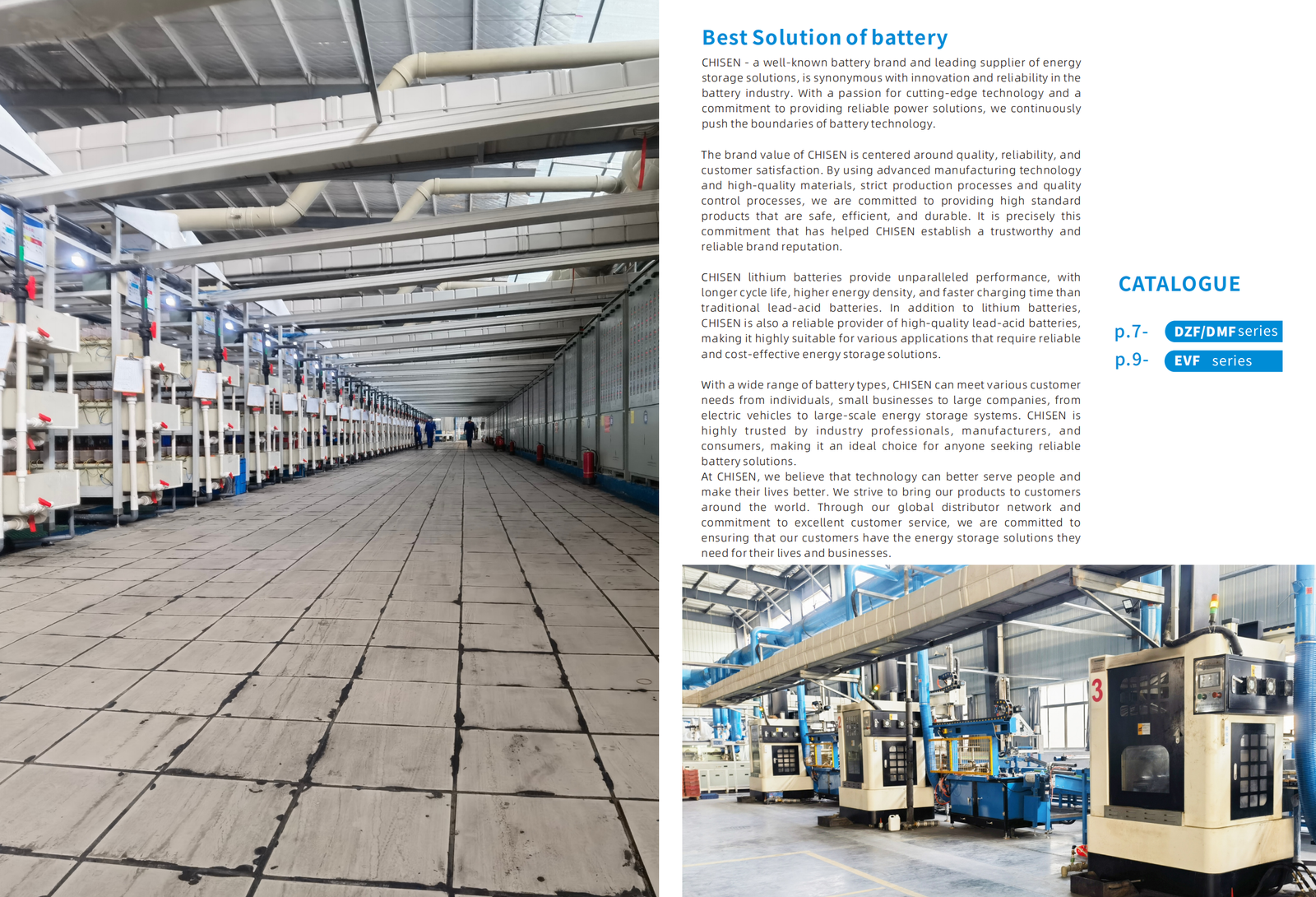
    CHISEN EVF Series Battery — Golf Cart and Electric Vehicle
    CHISEN EVF Series Battery — Golf Cart and Electric Vehicle

    Golf cart batteries are specialized deep cycle batteries for electric vehicles. This guide covers selection, sizing, and maintenance for fleet operators to maximize uptime and minimize cost.

    Golf Cart Voltage Systems

    • 36V system: 6 x 6V batteries — common in older Yamaha and Club Car carts
    • 48V system: 8 x 6V or 4 x 12V — most common in newer fleet carts
    • 72V system: 6 x 12V batteries — performance and lifted carts

    Lead-Acid vs Lithium for Golf Carts

    • Lead-acid: $800–1,500 upfront (48V). 500–800 cycles. 200–300kg. 6–10 hour charge time.
    • Lithium: $3,000–6,000 upfront. 3,000–5,000 cycles. 30–60kg. 2–4 hour charge time.

    For budget-conscious fleet operators, AGM deep cycle batteries offer the best value. For premium applications, lithium delivers longer life and faster charging.

    CHISEN EVF Series Golf Cart Batteries

    • EVF 6V series: 180Ah, 200Ah, 210Ah — for 36V and 48V conversions
    • EVF 8V series: 150Ah, 170Ah — for 48V premium golf carts
    • EVF 12V series: 100Ah, 120Ah — for 48V and 72V performance carts
    • Deep cycle design: engineered for repeated 50–80% depth of discharge
    • Heavy-duty plates: thick positive plates for golf cart duty cycle

    Maintenance Guide

    • Water level: Check monthly. Top up with distilled water after a full charge.
    • Terminal cleaning: Every 3 months. Use baking soda solution.
    • Charging: Always fully charge after use. Partial charging causes sulfation.
    • Storage: Fully charge before seasonal storage. Recharge every 2 months.

    Need a Custom Battery Solution?

    CHISEN Battery — 8 global factories, 70M kVAh/year. OPzV and OPzS from 100Ah to 3000Ah. CE, ISO9001, TUV certified.

    Tel: +86 131 2666 8999 | Email: jack@chisen.cn | Web: www.chisen.cn

  • Industrial UPS Battery Selection Guide 2026: Mission-Critical Power Protection

    CHISEN OPzV 2V 1000Ah — Industrial UPS Power
    CHISEN OPzV 2V 1000Ah — Industrial UPS Power

    Industrial UPS systems protect critical infrastructure: hospitals, data centers, telecom networks, and manufacturing. The right UPS battery determines whether your facility stays operational during a grid failure.

    UPS Battery Types Compared

    • AGM VRLA: Small UPS, IT rooms. 10–30 min runtime. 400–600 cycles. No maintenance.
    • GEL VRLA: Medium UPS, hospitals. 30–120 min. 600–800 cycles.
    • OPzV Tubular GEL: Large UPS, critical infrastructure. 1–8 hour runtimes. 1,200–1,500 cycles.
    • LiFePO4: Premium UPS. Flexible runtime. 3,000–5,000 cycles. Higher cost.

    Battery Sizing Formula

    Req. Ah = (UPS kVA x PF x Runtime hrs) / (System Voltage x DoD x Inv. Efficiency)

    Example: 100kVA UPS, PF=0.8, need 30 min backup at 48V, DoD=50%:

    = (100 x 0.8 x 0.5) / (48 x 0.50 x 0.95) = 40 / 22.8 = 1,754Ah required

    CHISEN recommendation: 24x OPzV2-2000 (2V 2000Ah) = 48V 2000Ah system. Runtime at full load: ~2 hours.

    N+1 Redundancy Checklist

    • N+1 design: Always install one extra parallel string. If one fails, system stays protected.
    • Battery monitoring: Install BMS for large banks. Monitor cell voltages, resistance, temperature.
    • Temperature compensation: Connect charger temp probe to battery bank directly.
    • DC breaker sizing: 1.25x maximum DC charge/discharge current.
    • Load bank testing: Test full UPS annually. Verify actual runtime.

    CHISEN OPzV batteries: 15–20 year design life, wide temperature range, sealed recombinant design. Ideal for industrial UPS in telecom, healthcare, and utilities.


    Need a Custom Battery Solution?

    CHISEN Battery — 8 global factories, 70M kVAh/year. OPzV and OPzS from 100Ah to 3000Ah. CE, ISO9001, TUV certified.

    Tel: +86 131 2666 8999 | Email: jack@chisen.cn | Web: www.chisen.cn

  • Solar Hybrid Inverter Battery Compatibility Guide 2026

    CHISEN OPzV — Compatible with All Major Hybrid Inverters
    CHISEN OPzV — Compatible with All Major Hybrid Inverters

    Not all batteries work with all hybrid inverters. Voltage mismatch and incorrect charge settings are the most common causes of solar system failure. Here is what to verify before purchasing.

    Voltage Compatibility

    • 3–5kW inverter: 24V or 48V battery → 12 or 24 cells in series → CHISEN OPzV2-200
    • 5–8kW inverter: 48V battery → 24 cells → CHISEN OPzV2-300
    • 8–15kW inverter: 48V or 96V → CHISEN OPzV2-500 strings
    • 15–30kW inverter: 96V or 192V → CHISEN OPzV2-800 strings

    Communication Protocols

    • Lead-acid (voltage mode): No BMS needed. Set bulk/absorb/float voltages manually on the inverter. CHISEN OPzV works with any inverter.
    • CAN bus (lithium): High-speed communication. Inverter reads SOC, max current, temperatures.
    • RS485: Serial MODBUS communication.

    Major Inverter Brand Compatibility

    • Victron Energy: Yes (voltage mode, 600Ah max)
    • Growatt: Yes (voltage mode, 999Ah max)
    • SMA Sunny Island: Yes (native lead-acid algorithms)
    • Solax: Yes (voltage mode, popular in Asia-Pacific)
    • Huawei SUN2000: Yes (manual voltage setup)
    • Sungrow: Yes (voltage mode, strong telecom presence)

    Correct Voltages for CHISEN OPzV

    • Bulk/Absorb: 28.2–28.8V (24V system) or 56.4–57.6V (48V system)
    • Float: 27.0–27.6V (24V) or 54.0–55.2V (48V)
    • Low voltage disconnect: 22.0V (24V) or 44.0V (48V)

    Always use voltage settings from the CHISEN specification sheet for your exact model.


    Need a Custom Battery Solution?

    CHISEN Battery — 8 global factories, 70M kVAh/year. OPzV and OPzS from 100Ah to 3000Ah. CE, ISO9001, TUV certified.

    Tel: +86 131 2666 8999 | Email: jack@chisen.cn | Web: www.chisen.cn

  • How to Choose the Right Battery Capacity: Complete Sizing Guide 2026

    CHISEN OPzV 2V 500Ah Battery — Popular Solar Capacity
    CHISEN OPzV 2V 500Ah Battery — Popular Solar Capacity

    Choosing the correct battery capacity is the most important decision in any energy storage project. Undersize your battery bank and you face premature failures. Oversize it and you waste money. This guide gives you the exact formula used by professional solar engineers worldwide.

    The Battery Sizing Formula

    Battery Bank (Ah) = Daily Wh / (System Voltage x DoD x Inverter Efficiency)

    For OPzV batteries, design at 80% depth of discharge.

    Step 1: Calculate Daily Energy Consumption

    List all appliances and their watt-hours per day. Example for a typical home:

    • LED lights (10x 10W, 5 hrs): 500Wh
    • Refrigerator (inverter-type, 150W, 24hrs x 0.4 duty): 1,440Wh
    • TV (50W, 4 hrs): 200Wh
    • Laptop (30W, 5 hrs): 150Wh
    • Total: 2,290Wh/day

    Step 2: Apply the Formula

    Example: 48V system, 2,290Wh/day, 80% DoD, 95% inverter efficiency:

    Required Ah = 2,290 / (48 x 0.80 x 0.95) = 62.8Ah

    Round up to 4x CHISEN OPzV2-200 in series = 48V 200Ah system.

    Step 3: Add Days of Autonomy

    • Grid-tied with backup: 1–2 days of autonomy
    • Standard off-grid: 2–3 days
    • Remote off-grid: 3–5 days
    • Critical infrastructure: 5–7 days

    5 Common Sizing Mistakes

    • Sizing at 100% DoD: Never go below 80% DoD for OPzV — this cuts cycle life dramatically.
    • Ignoring inverter efficiency: Always include the 92–96% factor.
    • No autonomy days: One cloudy day can strand you without backup.
    • Mixing old and new: Never combine cells of different ages.
    • Ignoring temperature: Add 20–30% capacity in hot climates (above 35C).

    Sizing Examples by System

    Small cabin (2,000Wh/day): 48V, 1 day = 52Ah → 4x OPzV2-200 = 48V 200Ah. Budget: $600–900.

    Residential (5,000Wh/day): 48V, 1 day = 130Ah → 4x OPzV2-300 = 48V 300Ah. Budget: $900–1,400.

    Small business (10,000Wh/day): 48V, 2 days = 547Ah → 4x OPzV2-300 x 4 parallel strings = 48V 1200Ah. Budget: $3,000–5,000.

    Large off-grid (20,000Wh/day): 48V, 3 days = 1563Ah → 24x OPzV2-1000 = 48V 1000Ah x 2 parallel strings.


    Need a Custom Battery Solution?

    CHISEN Battery — 8 global factories, 70M kVAh/year. OPzV and OPzS from 100Ah to 3000Ah. CE, ISO9001, TUV certified.

    Tel: +86 131 2666 8999 | Email: jack@chisen.cn | Web: www.chisen.cn

  • Battery Temperature Management in Solar Systems: The Critical Factor Nobody Talks About

    CHISEN Battery Factory — Professional Temperature-Managed Installation
    CHISEN Battery Factory — Professional Temperature-Managed Installation

    Most solar installers focus on capacity and cycle life. But the factor that kills batteries fastest — and receives the least attention — is heat. Temperature management is the hidden variable that determines whether your 10-year battery lasts 5 years or 15 years.

    How Heat Destroys Batteries

    High temperature accelerates two destructive chemical processes:

    • Grid corrosion: The positive grid corrodes faster at high temperature, destroying the plate structure.
    • Water loss: Electrolyte drying increases dramatically above 35C.
    • Self-discharge: At 40C, self-discharge triples vs 25C — causing chronic undercharging.

    Temperature vs. Battery Life

    Rule: Every 10C above 25C approximately halves float life of lead-acid batteries.

    • At 20C: OPzV float life = 18–20 years
    • At 25C: OPzV float life = 15–18 years
    • At 30C: OPzV float life = 10–12 years
    • At 35C: OPzV float life = 7–9 years
    • At 40C: OPzV float life = 5–7 years

    Temperature Management Strategies

    1. Battery Room Design: Insulate from direct sun. Use reflective paint. Install temperature-triggered exhaust fans (activate above 30C). Never install near heat-generating equipment.

    2. Temperature-Compensated Charging: Most quality charge controllers have a temperature probe input — use it. Compensation rate: -4mV per cell per degree C above 25C.

    Why OPzV Excels in Hot Climates

    • Operating range: -40C to +60C
    • Gelled electrolyte: superior heat dissipation
    • Tubular plate: tolerates thermal cycling without shedding failure
    • Low water loss rate: minimizes electrolyte drying

    Need a Custom Battery Solution?

    CHISEN Battery — 8 global factories, 70M kVAh/year. OPzV and OPzS from 100Ah to 3000Ah. CE, ISO9001, TUV certified.

    Tel: +86 131 2666 8999 | Email: jack@chisen.cn | Web: www.chisen.cn

  • Solar Hybrid Inverter Battery Compatibility Guide 2026

    CHISEN OPzV — Compatible with All Major Hybrid Inverters
    CHISEN OPzV — Compatible with All Major Hybrid Inverters

    Not all batteries work with all hybrid inverters. Voltage mismatch and incorrect charge settings are the most common causes of solar system failure. Here is what to verify before purchasing.

    Voltage Compatibility

    • 3–5kW inverter: 24V or 48V battery → 12 or 24 cells in series → CHISEN OPzV2-200
    • 5–8kW inverter: 48V battery → 24 cells → CHISEN OPzV2-300
    • 8–15kW inverter: 48V or 96V → CHISEN OPzV2-500 strings
    • 15–30kW inverter: 96V or 192V → CHISEN OPzV2-800 strings

    Communication Protocols

    • Lead-acid (voltage mode): No BMS needed. Set bulk/absorb/float voltages manually on the inverter. CHISEN OPzV works with any inverter.
    • CAN bus (lithium): High-speed communication. Inverter reads SOC, max current, temperatures.
    • RS485: Serial MODBUS communication.

    Major Inverter Brand Compatibility

    • Victron Energy: Yes (voltage mode, 600Ah max)
    • Growatt: Yes (voltage mode, 999Ah max)
    • SMA Sunny Island: Yes (native lead-acid algorithms)
    • Solax: Yes (voltage mode, popular in Asia-Pacific)
    • Huawei SUN2000: Yes (manual voltage setup)
    • Sungrow: Yes (voltage mode, strong telecom presence)

    Correct Voltages for CHISEN OPzV

    • Bulk/Absorb: 28.2–28.8V (24V system) or 56.4–57.6V (48V system)
    • Float: 27.0–27.6V (24V) or 54.0–55.2V (48V)
    • Low voltage disconnect: 22.0V (24V) or 44.0V (48V)

    Always use voltage settings from the CHISEN specification sheet for your exact model.


    Need a Custom Battery Solution?

    CHISEN Battery — 8 global factories, 70M kVAh/year. OPzV and OPzS from 100Ah to 3000Ah. CE, ISO9001, TUV certified.

    Tel: +86 131 2666 8999 | Email: jack@chisen.cn | Web: www.chisen.cn

  • Golf Cart Battery Guide 2026: Selection, Sizing, and Maintenance

    CHISEN EVF Series Battery — Golf Cart and Electric Vehicle
    CHISEN EVF Series Battery — Golf Cart and Electric Vehicle

    Golf cart batteries are specialized deep cycle batteries for electric vehicles. This guide covers selection, sizing, and maintenance for fleet operators to maximize uptime and minimize cost.

    Golf Cart Voltage Systems

    • 36V system: 6 x 6V batteries — common in older Yamaha and Club Car carts
    • 48V system: 8 x 6V or 4 x 12V — most common in newer fleet carts
    • 72V system: 6 x 12V batteries — performance and lifted carts

    Lead-Acid vs Lithium for Golf Carts

    • Lead-acid: $800–1,500 upfront (48V). 500–800 cycles. 200–300kg. 6–10 hour charge time.
    • Lithium: $3,000–6,000 upfront. 3,000–5,000 cycles. 30–60kg. 2–4 hour charge time.

    For budget-conscious fleet operators, AGM deep cycle batteries offer the best value. For premium applications, lithium delivers longer life and faster charging.

    CHISEN EVF Series Golf Cart Batteries

    • EVF 6V series: 180Ah, 200Ah, 210Ah — for 36V and 48V conversions
    • EVF 8V series: 150Ah, 170Ah — for 48V premium golf carts
    • EVF 12V series: 100Ah, 120Ah — for 48V and 72V performance carts
    • Deep cycle design: engineered for repeated 50–80% depth of discharge
    • Heavy-duty plates: thick positive plates for golf cart duty cycle

    Maintenance Guide

    • Water level: Check monthly. Top up with distilled water after a full charge.
    • Terminal cleaning: Every 3 months. Use baking soda solution.
    • Charging: Always fully charge after use. Partial charging causes sulfation.
    • Storage: Fully charge before seasonal storage. Recharge every 2 months.

    Need a Custom Battery Solution?

    CHISEN Battery — 8 global factories, 70M kVAh/year. OPzV and OPzS from 100Ah to 3000Ah. CE, ISO9001, TUV certified.

    Tel: +86 131 2666 8999 | Email: jack@chisen.cn | Web: www.chisen.cn