分类: Industry News

  • Solar Battery Maintenance Tips to Extend Battery Life

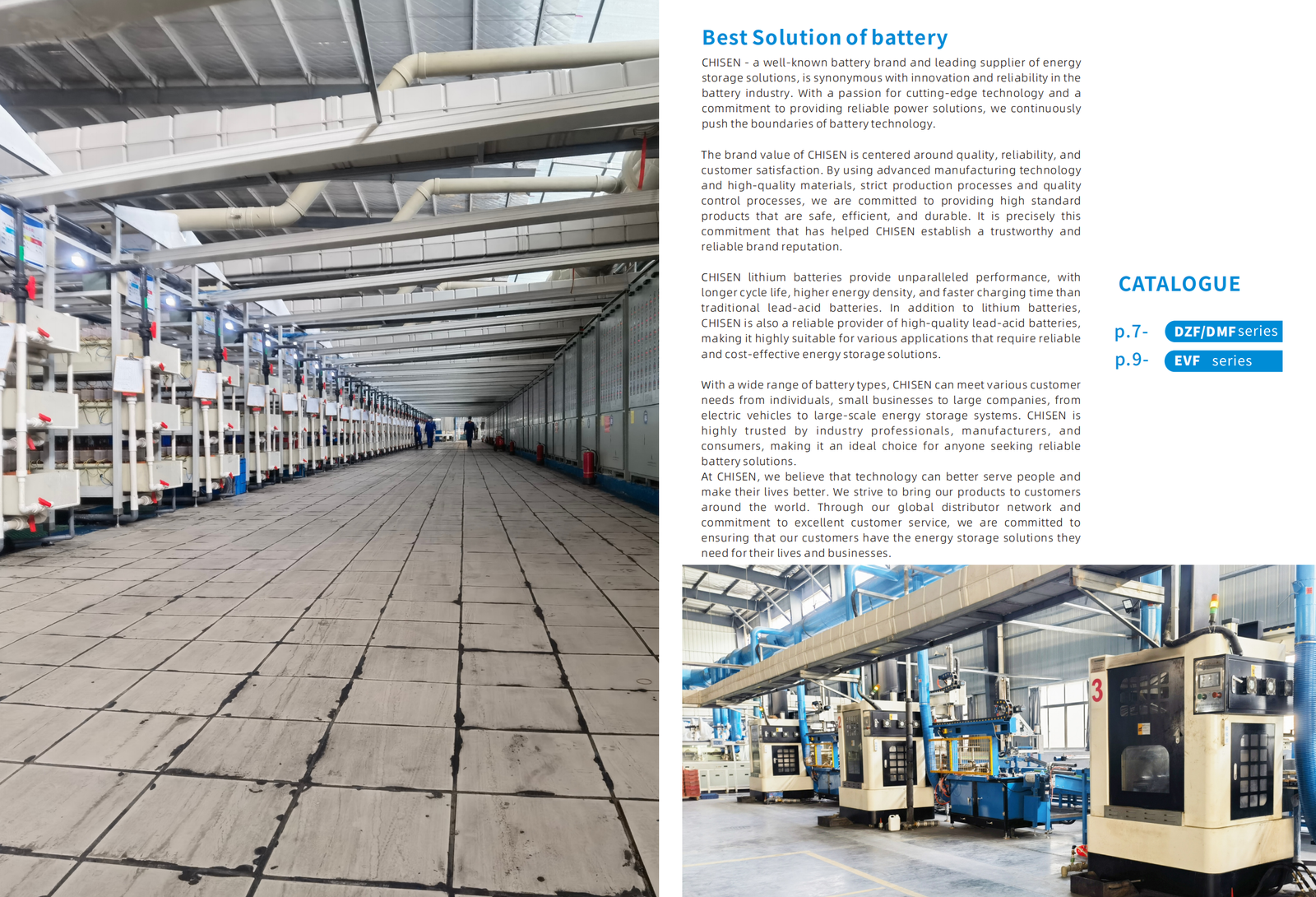
    CHISEN Battery Factory — Professional Manufacturing
    CHISEN Battery Factory — Professional Manufacturing
    CHISEN Battery Manufacturing Facility
    CHISEN Battery Manufacturing Facility

    Proper solar battery maintenance can double or triple your battery bank lifespan — saving thousands in replacement costs. This guide covers essential maintenance tasks for lead-acid (AGM, GEL, OPzV) and lithium batteries.

    KEY STATISTICS

    Regular maintenance extends lead-acid life2–3x longer service life
    Voltage imbalance in 24-cell bankCan reduce capacity by 30%
    Ideal float voltage (AGM 12V)13.5–13.8V per unit
    Temperature impact on lifeEvery 10C above 25C halves float life
    Equalization frequency (flooded)Every 30–60 days

    Monthly Maintenance Checklist

    Solar Battery Maintenance Schedule
    Task Frequency AGM/GEL Flooded LiFePO4
    Visual inspection Monthly Check Check Check
    Terminal cleaning Every 6 months Clean Clean Clean
    Water level top-up As needed N/A Monthly N/A
    Voltage check (resting) Monthly 12.7–12.9V 12.5–12.8V 12.8–13.2V
    Equalization charge 30–60 days Not needed Required N/A
    Terminal anti-corrosion grease Every 6 months Apply Apply Apply
    Temperature check Monthly Log readings Log readings BMS auto

    Common Problems and Solutions

    • Battery wont hold charge
      Cause: Sulfation from chronic undercharging
      Solution: Apply periodic equalization; replace if capacity below 60%
    • Excessive water consumption
      Cause: High float voltage or high ambient temperature
      Solution: Reduce float voltage by 0.1V per 10C above 25C
    • Battery bank undersized
      Cause: Growth in loads without bank upgrade
      Solution: Rebuild bank to new capacity; keep DoD below 50%
    • Intermittent performance
      Cause: Loose terminals or corroded connections
      Solution: Tighten connections; apply terminal grease; check cable gauge

    Frequently Asked Questions

    How often should I check solar battery water levels?

    Check flooded lead-acid batteries monthly. Top up with distilled water to the indicated level (10–15mm above plates) after the battery is fully charged. Never let plates become exposed — this causes permanent damage.

    What voltage indicates a fully charged 12V battery?

    Resting (no charge/discharge for 1+ hours): AGM = 12.7–13.0V. GEL = 12.8–13.1V. OPzV = 12.9–13.2V. LiFePO4 = 13.2–13.4V. Below 12.3V resting = needs immediate charging.

    Do sealed AGM and GEL batteries need maintenance?

    Sealed VRLA (AGM and GEL) requires minimal maintenance compared to flooded, but still benefits from monthly terminal inspection, voltage monitoring, and keeping batteries clean and dry.


    Need a Reliable Battery Supplier?

    CHISEN Battery — 8 global factories, 70M kVAh/year. OPzV tubular GEL, AGM VRLA, front terminal batteries. Trusted by distributors in 60+ countries.

    Factory 8 global factories
    Capacity 70 million kVAh/year
    Certifications CE, ISO9001, ISO14001, TUV Rheinland
    Tel +86 131 2666 8999
    Email jack@chisen.cn
    Web www.chisen.cn

    Request a Quote

  • RV Battery Types: A Complete Guide 2026

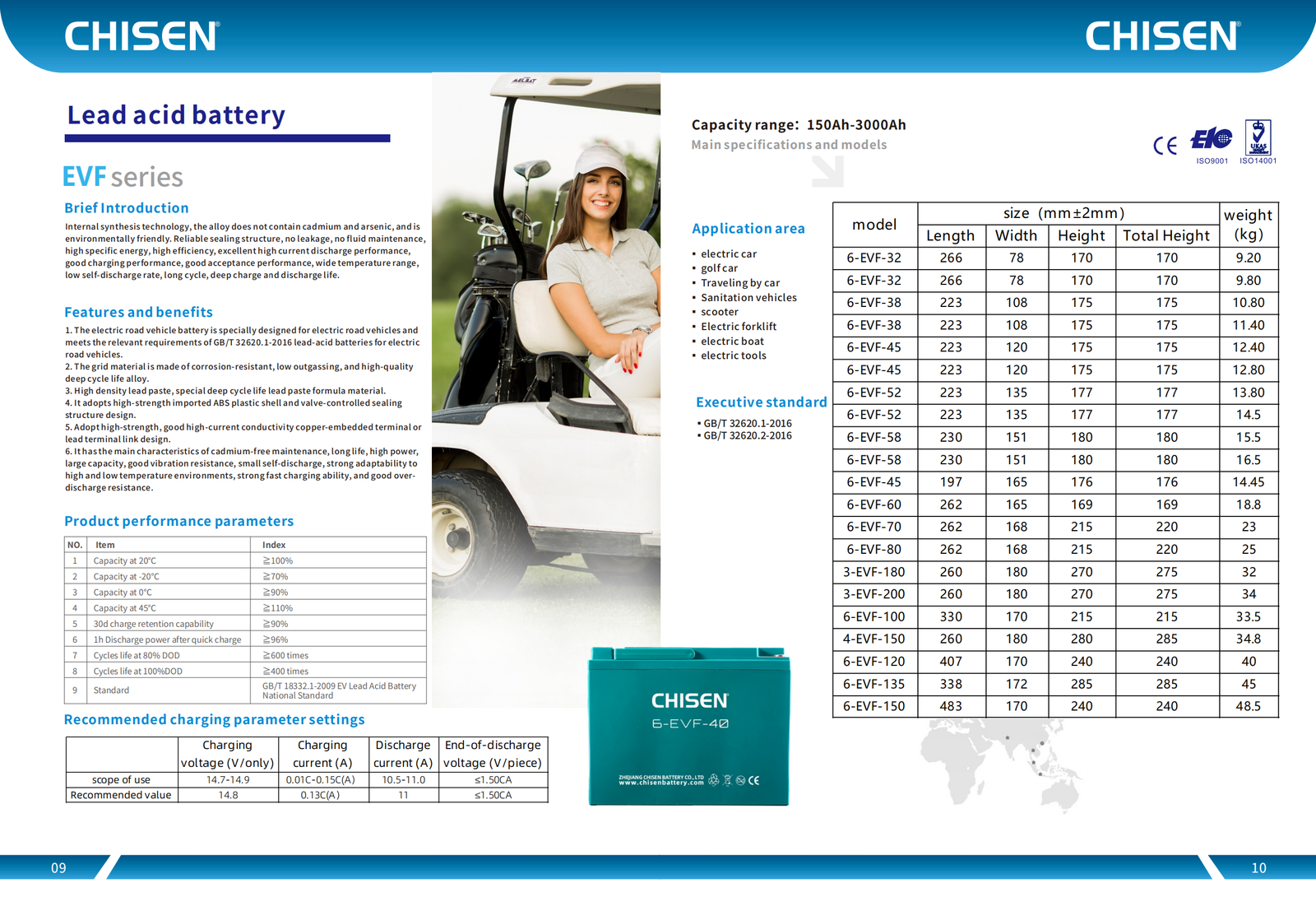
    CHISEN EVF Series Battery for Golf Carts and RVs
    CHISEN EVF Series Battery for Golf Carts and RVs
    CHISEN EVF Series Battery for Golf Carts
    CHISEN EVF Series Battery for Golf Carts

    Choosing the right RV battery affects everything from appliance runtime to how often you need shore power. This 2026 guide covers the best battery types for RVs, motorhomes, and campervans with sizing advice and cost comparisons.

    Best RV Battery Types Compared

    RV Battery Type Comparison 2026
    Battery Type Best For Capacity Cycle Life Maintenance Cost 12V 100Ah
    AGM Deep Cycle Budget RVs, occasional use 100Ah 500–700 @50% None $150–250
    Lithium LiFePO4 Full-time RVers, boondockers 100Ah 3,000–5,000 None $600–1,000
    Flooded Lead-Acid Traditional RVs, budget 100Ah 300–500 @50% Monthly water $100–180
    OPzV Tubular GEL Premium RVs, solar-heavy 100Ah 1,000–1,200 None $250–400

    KEY STATISTICS

    RV refrigerator daily draw1,500–3,000Wh
    Air conditioner (AC) draw1,200–2,500W while running
    Typical boondocking goal3–5 days off-grid
    AGM self-discharge rate1–3% per month
    LiFePO4 round-trip efficiency95–98%

    How to Size Your RV Battery Bank

    • Calculate total daily Wh: Typical RVer uses 2,000–4,000Wh/day including lights, fridge, water pump, fans, laptop, phone chargers.
    • Choose DoD: AGM = 50% max. LiFePO4 = 80% OK. OPzV = 80% OK.
    • Formula: Required Ah = Daily Wh / (12V x DoD x 0.95)
    • Example: 3,000Wh/day / (12 x 0.50 x 0.95) = 526Ah — use 5x 100Ah AGM in parallel
    • Solar recharging: Add 1.3x solar panels of daily discharge to fully recharge each day

    Frequently Asked Questions

    Can I use car starting batteries in my RV for deep cycling?

    No. Starting batteries are designed for brief high-current discharge to start engines. Using them for deep cycling causes rapid failure within weeks. Always use deep cycle batteries for RV house loads.

    How many batteries for RV air conditioning off-grid?

    A typical RV AC draws 1,200–2,500W. Running 4 hours requires 6,000–10,000Wh. At 12V with 50% DoD AGM, this needs 1,000–1,700Ah. Most off-grid RVers use solar + generator + battery combination.

    Do sealed AGM batteries need maintenance?

    Sealed VRLA AGM requires minimal maintenance vs flooded but benefits from monthly terminal inspection, voltage monitoring, and keeping batteries clean and dry.


    Need a Reliable Battery Supplier?

    CHISEN Battery — 8 global factories, 70M kVAh/year. OPzV tubular GEL, AGM VRLA, front terminal batteries. Trusted by distributors in 60+ countries.

    Factory 8 global factories
    Capacity 70 million kVAh/year
    Certifications CE, ISO9001, ISO14001, TUV Rheinland
    Tel +86 131 2666 8999
    Email jack@chisen.cn
    Web www.chisen.cn

    Request a Quote

  • Solar Battery Bank Sizing Calculator: Formula Guide

    CHISEN OPzV 2V 200Ah Battery for Home Solar
    CHISEN OPzV 2V 200Ah Battery for Home Solar
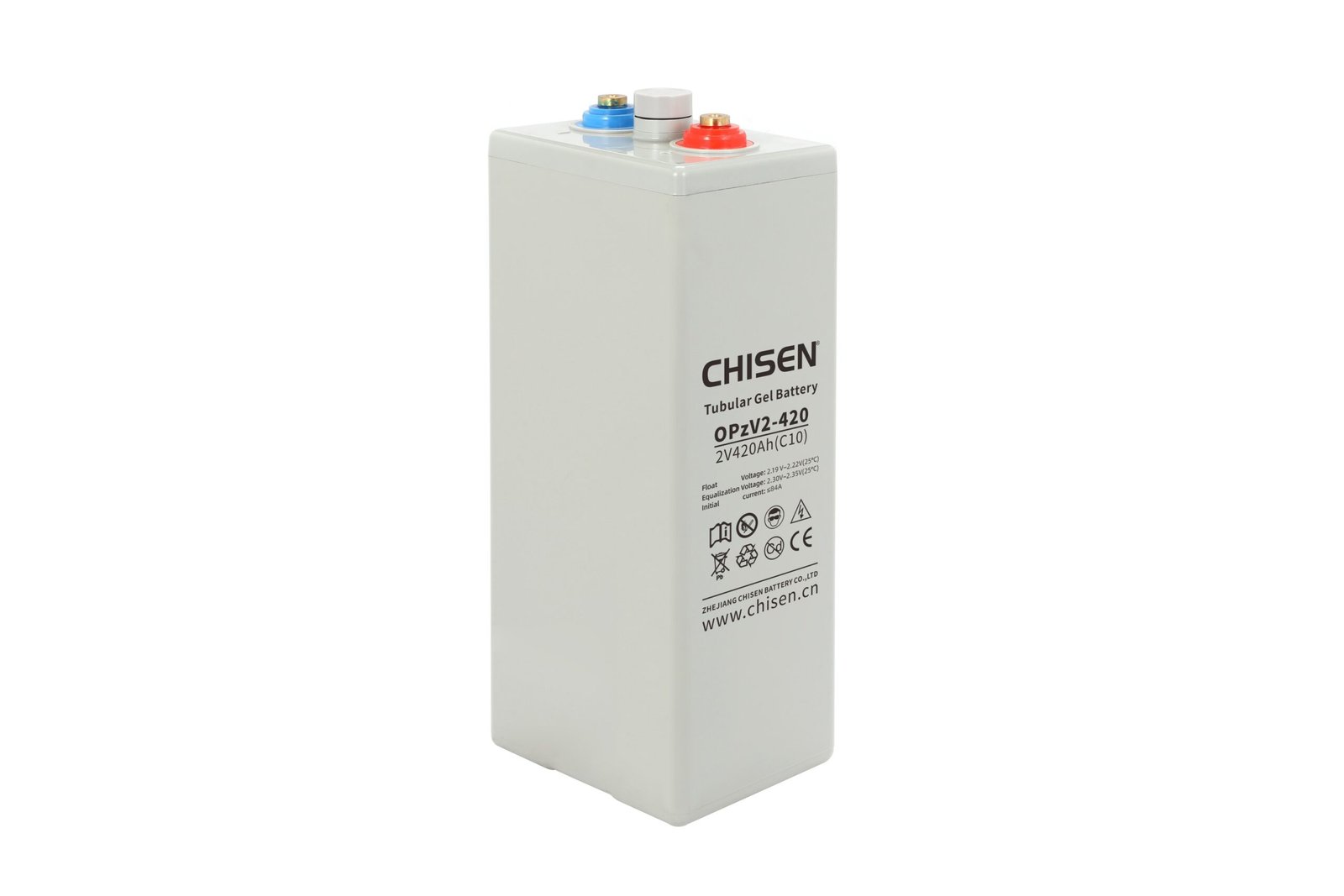
    CHISEN OPzV 2V 420Ah Battery for Solar
    CHISEN OPzV 2V 420Ah Battery for Solar

    Correctly sizing a solar battery bank prevents premature battery failure and ensures your system meets daily energy needs. This step-by-step guide covers the complete formula with worked examples for residential, commercial, and off-grid systems.

    The Solar Battery Sizing Formula

    Battery Bank (Ah) = Daily Wh / (System Voltage x DoD x Inverter Efficiency)

    KEY STATISTICS

    DoD for OPzV (design point)80% (cycle life optimized)
    DoD for AGM (design point)50% (maximum life)
    Inverter efficiency (typical)92–96%
    Days of autonomy (grid-tied)1–2 days
    Days of autonomy (off-grid)3–5 days
    Solar panel oversizing factor1.2–1.3x daily discharge

    Step 1: Calculate Daily Energy Consumption

    • LED lighting: 10 x 10W x 5 hrs = 500Wh
    • Refrigerator: 150W x 24hrs x 0.4 duty cycle = 1,440Wh
    • TV: 50W x 4 hrs = 200Wh
    • Laptop: 30W x 5 hrs = 150Wh
    • Total daily consumption: 2,290Wh/day

    Step 2: Choose System Voltage

    Solar System Voltage Selection
    System Size Voltage When to Use
    < 3kWh/day 12V Small cabins, weekend use, minimal loads
    3–10kWh/day 24V Standard residential solar
    > 10kWh/day 48V Commercial, industrial, large off-grid

    Sizing Examples

    Solar Battery Bank Sizing Examples
    Application Daily Wh Voltage DoD Days Required Ah CHISEN OPzV Config
    Small cabin 2,000Wh 48V 80% 2 104Ah 4x OPzV2-200 (200Ah)
    Residential 5,000Wh 48V 80% 1 130Ah 4x OPzV2-300 (300Ah)
    Small biz 10,000Wh 48V 80% 2 547Ah 4x OPzV2-300 x 4 strings
    Large off-grid 20,000Wh 48V 80% 3 1,563Ah 24x OPzV2-1000

    Frequently Asked Questions

    How many solar panels do I need to recharge a battery bank?

    Solar panels should be sized at 1.2–1.3x daily battery discharge to achieve full recharge. Example: 5,000Wh daily use needs 6,000–6,500Wh of solar output. In practice, location, orientation, and temperature reduce output by 15–25%.

    What happens if the battery bank is undersized?

    An undersized bank discharged beyond design DoD daily dramatically reduces cycle life. A battery rated for 1,200 cycles at 50% DoD may deliver only 200–300 cycles if regularly discharged to 90%.

    Can I add batteries to an existing bank later?

    Yes, but only if new batteries are the same age, type, capacity, and manufacturer. Mixing old and new batteries causes imbalance that shortens all battery life.


    Need a Reliable Battery Supplier?

    CHISEN Battery — 8 global factories, 70M kVAh/year. OPzV tubular GEL, AGM VRLA, front terminal batteries. Trusted by distributors in 60+ countries.

    Factory 8 global factories
    Capacity 70 million kVAh/year
    Certifications CE, ISO9001, ISO14001, TUV Rheinland
    Tel +86 131 2666 8999
    Email jack@chisen.cn
    Web www.chisen.cn

    Request a Quote

  • OPzV Battery Technology: Complete Guide 2026

    CHISEN OPzV 2V 1000Ah Tubular GEL Battery
    CHISEN OPzV 2V 1000Ah Tubular GEL Battery
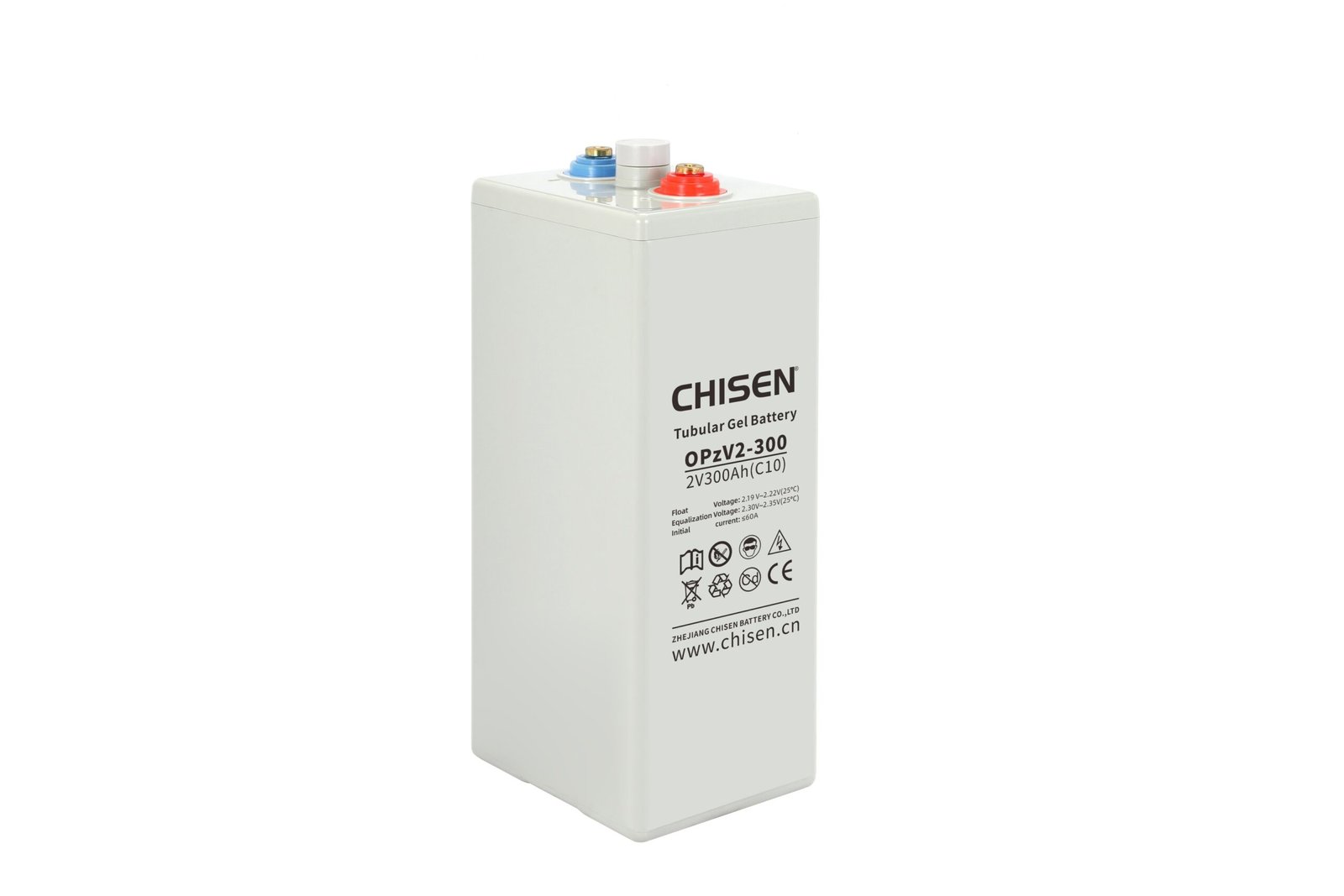
    CHISEN OPzV 2V 300Ah — Tubular GEL Cell
    CHISEN OPzV 2V 300Ah — Tubular GEL Cell

    OPzV (Ortsfest Pastos Vlies) is the most advanced lead-acid technology available. This guide explains how OPzV works, its specifications, and why it outperforms standard AGM and flooded batteries in solar applications.

    What Is OPzV Technology?

    Definition: OPzV batteries feature wound tubular positive plates with gelled electrolyte (silica gel + sulfuric acid). The tubular design prevents active material shedding — the #1 failure mode in flat-plate lead-acid batteries — enabling 3–5x longer cycle life.

    OPzV vs AGM vs Standard GEL: Full Comparison

    OPzV vs AGM vs Standard GEL Comparison
    Feature OPzV Tubular GEL Standard GEL VRLA AGM VRLA
    Plate design Tubular (wound) Flat pasted Flat pasted
    Cycle life @80% DoD 1,200–1,500 600–800 400–600
    Float life @25C 15–20 years 8–12 years 5–8 years
    Best use Daily deep cycling Moderate cycling Float/standby
    Cost per cycle $0.05–0.08 $0.10–0.15 $0.15–0.25
    Temperature range -40C to +60C -20C to +50C -20C to +50C

    KEY STATISTICS

    OPzV cycle life @80% DoD1,200–1,500 cycles
    OPzV float life @25C15–20 years
    OPzV efficiency85–90% round-trip
    Gas recombination rate> 99% (sealed recombinant)
    CHISEN annual OPzV capacity2.4 million cells/year

    CHISEN OPzV Selection Guide

    CHISEN OPzV Battery Configuration Guide
    Application Recommended Model Configuration Backup @ Full Load
    Solar home (2–5kWh/day) CHISEN OPzV2-200 4x 2V 200Ah = 48V 200Ah 4–6 hours
    Commercial solar (10kWh/day) CHISEN OPzV2-300 4x 2V 300Ah = 48V 300Ah 6–8 hours
    Telecom BTS (macro site) CHISEN OPzV2-400 24x 2V 400Ah = 48V 400Ah 8+ hours
    Industrial UPS CHISEN OPzV2-1000 Multiple strings 48V 1000Ah 4–8 hours
    Off-grid microgrid CHISEN OPzV2-800 Parallel strings for required Ah Custom

    Frequently Asked Questions

    What does OPzV stand for?

    OPzV is the IEC international standard designation for tubular GEL VRLA batteries. It comes from German technical designations: Ortsfest (stationary), Pastos (gelled electrolyte), and Vlies (non-woven felt separator).

    How long does an OPzV battery last in a solar system?

    A quality OPzV battery delivers 1,200–1,500 cycles at 80% DoD, or 15–20 years float life at 25C. In daily solar cycling, this translates to 8–12 years of service life.

    Can OPzV batteries be installed indoors?

    Yes. OPzV batteries are recombinant GEL VRLA with over 99% hydrogen recombination efficiency. They emit virtually no gas and are safe for enclosed indoor installation without dedicated ventilation.

    What is the correct charging voltage for OPzV batteries?

    Bulk/absorb: 14.1–14.4V per 12V unit (2.35–2.40V per cell) at 20C. Float: 13.5–13.8V per 12V unit (2.25–2.30V per cell). Temperature compensation: -4mV/degC per cell.


    Need a Reliable Battery Supplier?

    CHISEN Battery — 8 global factories, 70M kVAh/year. OPzV tubular GEL, AGM VRLA, front terminal batteries. Trusted by distributors in 60+ countries.

    Factory 8 global factories
    Capacity 70 million kVAh/year
    Certifications CE, ISO9001, ISO14001, TUV Rheinland
    Tel +86 131 2666 8999
    Email jack@chisen.cn
    Web www.chisen.cn

    Request a Quote

  • Lead Acid Battery vs Lithium: Which Is Better for Solar?

    AGM vs Gel Battery Comparison for Solar Storage
    AGM vs Gel Battery Comparison for Solar Storage
    AGM Deep Cycle Battery — Internal Structure
    AGM Deep Cycle Battery — Internal Structure

    Test update

  • Lead Acid Battery vs Lithium: Which Is Better for Solar?

    This guide compares lead-acid and lithium batteries for solar energy storage across cost, cycle life, safety, and performance — helping you make the right choice for your project in 2026.

    Lead Acid vs Lithium: Side-by-Side Comparison

    Lead-Acid vs Lithium Comparison 2026
    Feature Lead-Acid (OPzV Tubular GEL) Lithium (LiFePO4)
    Upfront cost (per kWh) $150–300 $500–800
    Cycle life @80% DoD 1,200–1,500 cycles 3,000–5,000 cycles
    Round-trip efficiency 80–85% 95–98%
    Energy density 60–90 Wh/kg 120–180 Wh/kg
    Max depth of discharge 50–80% recommended 80–100%
    Operating temperature -40C to +60C 0C to +55C
    Maintenance None (sealed) None
    10-year cost per cycle $0.08–0.12 $0.10–0.17
    Best application Large systems, hot climates Space-constrained, long life

    KEY STATISTICS

    OPzV cycle life @80% DoD1,200–1,500 cycles
    LiFePO4 cycle life @80% DoD3,000–5,000 cycles
    Lead-acid market share (off-grid solar)~68% of global installations
    OPzV float life @25C15–20 years
    Lithium cost reduction since 201582% decrease in $/kWh

    When to Choose Lead-Acid for Solar

    • Large commercial solar installations where space for battery banks is not a constraint
    • Hot climates (Middle East, Africa, South Asia) where ambient temperatures regularly exceed 35C
    • Budget-conscious projects prioritizing lower upfront capital over lifetime cost
    • Remote, unmanned sites where maintenance access is difficult or infrequent
    • Daily cycling applications where 1,200+ cycle life is more than sufficient

    When to Choose Lithium for Solar

    • Space-constrained installations such as residential rooftops with structural weight limits
    • Projects requiring 15–20 year battery service life without replacement
    • Mobile solar applications: vehicles, boats, RVs where weight matters significantly
    • High-depth-of-discharge daily cycling in premium off-grid residential installations

    Total Cost of Ownership: 5kWh System, 10 Years

    Total Cost of Ownership Comparison
    Cost Factor Lead-Acid OPzV Lithium LiFePO4
    Battery purchase $750–1,500 $2,500–4,000
    Replacement @5 years $0 $0
    10-year total cost $750–1,500 $2,500–4,500
    Cycles delivered (1/day) 3,650 cycles 3,650 cycles
    Cost per cycle used $0.08–0.12 $0.11–0.17

    Need a Reliable Battery Supplier?

    CHISEN Battery — 8 global factories, 70M kVAh/year. OPzV tubular GEL, AGM VRLA, front terminal batteries. Trusted by distributors in 60+ countries.

    Factory 8 global factories
    Capacity 70 million kVAh/year
    Certifications CE, ISO9001, ISO14001, TUV Rheinland
    Tel +86 131 2666 8999
    Email jack@chisen.cn
    Web www.chisen.cn

    Request a Quote

  • Lead Acid Battery vs Lithium: Which Is Better for Solar?

    This guide compares lead-acid and lithium batteries for solar energy storage across cost, cycle life, safety, and performance — helping you make the right choice for your project in 2026.

    Lead Acid vs Lithium: Side-by-Side Comparison

    Lead-Acid vs Lithium Comparison 2026
    Feature Lead-Acid (OPzV Tubular GEL) Lithium (LiFePO4)
    Upfront cost (per kWh) $150–300 $500–800
    Cycle life @80% DoD 1,200–1,500 cycles 3,000–5,000 cycles
    Round-trip efficiency 80–85% 95–98%
    Energy density 60–90 Wh/kg 120–180 Wh/kg
    Max depth of discharge 50–80% recommended 80–100%
    Operating temperature -40C to +60C 0C to +55C
    Maintenance None (sealed) None
    10-year cost per cycle $0.08–0.12 $0.10–0.17
    Best application Large systems, hot climates Space-constrained, long life

    KEY STATISTICS

    OPzV cycle life @80% DoD1,200–1,500 cycles
    LiFePO4 cycle life @80% DoD3,000–5,000 cycles
    Lead-acid market share (off-grid solar)~68% of global installations
    OPzV float life @25C15–20 years
    Lithium cost reduction since 201582% decrease in $/kWh

    When to Choose Lead-Acid for Solar

    • Large commercial solar installations where space for battery banks is not a constraint
    • Hot climates (Middle East, Africa, South Asia) where ambient temperatures regularly exceed 35C
    • Budget-conscious projects prioritizing lower upfront capital over lifetime cost
    • Remote, unmanned sites where maintenance access is difficult or infrequent
    • Daily cycling applications where 1,200+ cycle life is more than sufficient

    When to Choose Lithium for Solar

    • Space-constrained installations such as residential rooftops with structural weight limits
    • Projects requiring 15–20 year battery service life without replacement
    • Mobile solar applications: vehicles, boats, RVs where weight matters significantly
    • High-depth-of-discharge daily cycling in premium off-grid residential installations

    Total Cost of Ownership: 5kWh System, 10 Years

    Total Cost of Ownership Comparison
    Cost Factor Lead-Acid OPzV Lithium LiFePO4
    Battery purchase $750–1,500 $2,500–4,000
    Replacement @5 years $0 $0
    10-year total cost $750–1,500 $2,500–4,500
    Cycles delivered (1/day) 3,650 cycles 3,650 cycles
    Cost per cycle used $0.08–0.12 $0.11–0.17

    Need a Reliable Battery Supplier?

    CHISEN Battery — 8 global factories, 70M kVAh/year. OPzV tubular GEL, AGM VRLA, front terminal batteries. Trusted by distributors in 60+ countries.

    Factory 8 global factories
    Capacity 70 million kVAh/year
    Certifications CE, ISO9001, ISO14001, TUV Rheinland
    Tel +86 131 2666 8999
    Email jack@chisen.cn
    Web www.chisen.cn

    Request a Quote

  • How to Install a Solar Battery System: Step-by-Step Guide

    Installing a Solar Battery System: Overview

    Installing a solar battery system is a significant investment that can dramatically reduce your electricity bills, provide backup power during outages, and move you toward energy independence. While the electrical complexity is manageable for a competent DIY installer, careful planning and attention to safety are essential. This guide walks you through every step of a complete solar-plus-battery installation.

    Before You Begin: Planning and Permits

    Assess Your Energy Needs

    Before purchasing any equipment, analyze your electricity usage. Review 12 months of utility bills to identify: Average daily kWh consumption; Peak demand periods (kW); Seasonal variations in usage. This data determines your battery bank size and whether you need a hybrid inverter or a separate battery inverter.

    Check Local Regulations and Permits

    Most jurisdictions require permits for solar-plus-battery installations. Key permits typically include: Electrical permit for the battery and inverter installation; Building permit if structural modifications are needed; Utility interconnection approval for grid-tied systems; HOA approval if applicable. Failure to obtain proper permits can void warranties and create insurance liability issues.

    Select Equipment

    A complete solar-plus-battery system includes: Solar panels (quantity determined by available roof/ground space and energy needs); Solar inverter (converts DC from panels to AC for home use); Battery bank (stores excess solar energy for later use); Battery inverter/charger (manages battery charging and discharging); Charge controller (prevents battery overcharging); Mounting hardware (roof mounts, ground mounts, or ballasted systems); Wiring and conduit (properly sized cables and protective tubing); Combiner box and fuses (electrical safety equipment); Monitoring system (optional but highly recommended).

    Step-by-Step Installation Process

    Step 1: Mount the Solar Panels

    Install panel mounts according to manufacturer instructions, ensuring proper spacing for ventilation and maintenance access. For roof mounts: Position mounts on rafters, not just sheathing; Use proper flashing and sealing to prevent leaks; Maintain a consistent tilt angle (ideally matching your latitude); Ensure south-facing orientation (northern hemisphere). Secure panels to mounts using manufacturer-specified hardware. Double-check torque specifications.

    Step 2: Install Conduit and Wiring

    Run conduit from the solar panel array to the inverter location. Conduit should: Follow the most direct route possible; Maintain minimum bend radius specifications; Be properly secured every 3-4 feet; Be sized at 25% fill capacity to allow future expansion; Be installed at least 18 inches away from roof sheathing (fire code in some areas).

    Step 3: Install the Inverter(s)

    Mount the solar inverter (or hybrid inverter) in a clean, dry, well-ventilated location. Most inverters are rated for indoor installation. For outdoor-rated inverters, ensure proper enclosure ratings (NEMA 3R minimum for outdoor use): Mount on a fire-rated surface if possible; Maintain minimum clearance for ventilation; Install on a dedicated circuit with proper overcurrent protection.

    Step 4: Install the Battery Bank

    Battery installation is the most safety-critical step. Follow these guidelines: Location – Batteries should be installed in a dedicated, ventilated enclosure or battery room. Lead acid batteries should not be installed in living spaces due to potential gas emissions. Temperature – Batteries perform best at 20-25C. Avoid unheated outdoor locations in cold climates and direct sunlight in hot climates. Mounting – Secure batteries to prevent movement. Battery racks or enclosures should be level and sturdy. Ventilation – Lead acid batteries (especially flooded) require adequate ventilation to disperse hydrogen gas.

    Step 5: Wire the Battery Bank

    Connect batteries in the correct series/parallel configuration to achieve your system voltage: Series connection increases voltage (positive of one battery to negative of next); Parallel connection increases capacity/amp-hours (positive to positive, negative to negative); Use appropriate cable size – undersized cables create heat and fire hazards; Torque all connections – loose connections cause arcing and premature failure; Install busbars and fuses – each parallel string should have its own fuse.

    Step 6: Connect to the Inverter

    Connect the battery bank to the battery terminals of your inverter/charger: Double-check polarity before connecting; Install a battery disconnect switch between the battery bank and inverter; Install a DC fuse or breaker sized per inverter manufacturer specifications.

    Step 7: Connect the Solar Panels to the Inverter

    Run panel wiring through the conduit to the solar input terminals of the inverter: Use MC4 connectors (or manufacturer-specified connectors); Verify polarity at the inverter input before connecting; Connect grounding equipment per NEC or local code requirements.

    Step 8: Connect to the Grid (if applicable)

    For grid-tied systems, connect the inverter AC output to a dedicated breaker in your main electrical panel: Install a production meter (required by most utilities for net metering); Have the utility install a bi-directional meter; Install an automatic transfer switch for backup systems.

    Step 9: Commissioning and Testing

    Before powering on: Verify all connections are tight and correct; Check DC voltage at the battery terminals matches expected values; Confirm solar panel open-circuit voltage is within inverter specifications; Check grounding continuity; Power on the system in the correct sequence per manufacturer instructions; Configure inverter settings (battery type, capacity, charge parameters); Test backup transfer (if applicable) by disconnecting grid power.

    Step 10: Monitoring and Optimization

    After installation, monitor your system for the first week to identify any issues: Check daily energy production vs. consumption; Verify battery state of charge cycles correctly; Listen for any unusual sounds from equipment; Verify the monitoring system is tracking all parameters.

    CHISEN Battery: Professional Installation Support

    CHISEN Battery provides comprehensive technical documentation for all our solar batteries, including installation guides, wiring diagrams, and sizing calculators. Our team of solar energy specialists can assist with system design and recommend certified installers in your region.


    Contact CHISEN Battery

    Jack Chen | General Manager | CHISEN Battery
    Tel: +86 131 2666 8999
    Email: jack@chisen.cn | www.chisen.cn
  • Battery C20 vs C100: Understanding Battery Capacity Ratings

    Why Battery Capacity Ratings Can Be Confusing

    If you have ever compared two battery specifications and found that the same battery has two different capacity numbers, you are not alone. The same 100Ah battery might be rated at 80Ah at C20 and 110Ah at C100. Which number is correct? The answer: both – and understanding why is key to choosing the right battery and sizing your system correctly.

    What Do C20 and C100 Mean?

    The “C” rating in battery specifications refers to the discharge rate, specifically the time period over which the battery is discharged to full exhaustion. C20 means the battery is fully discharged in 20 hours. C100 means the battery is fully discharged in 100 hours.

    C20 Capacity: The total energy the battery can deliver when discharged at a constant rate over exactly 20 hours, down to a specified cutoff voltage (typically 10.5V for a 12V battery).

    C100 Capacity: The total energy the battery can deliver when discharged at a constant rate over 100 hours, down to the same cutoff voltage.

    Because of Peukert’s Law (the phenomenon where batteries deliver less total energy when discharged at higher rates), C100 capacity is always higher than C20 capacity for the same physical battery.

    Why C100 Is Higher Than C20

    When a battery is discharged slowly (low current over long time), the chemical reactions inside have more time to proceed evenly across the plate surfaces. When discharged quickly (high current), the chemical reactions concentrate at the plate surfaces, creating resistance and preventing the deeper layers from fully reacting.

    A 100Ah battery rated at C20 delivers: 100Ah / 20h = 5A continuous for 20 hours

    A 100Ah battery rated at C100 delivers: 100Ah / 100h = 1A continuous for 100 hours

    The C100 battery will deliver significantly more total energy because the lower discharge current allows more complete utilization of the active material.

    Understanding Your Actual Use Case

    For Solar Energy Storage Systems

    Solar battery banks typically discharge over 4-12 hours (overnight, from sunset to sunrise). This means C10 to C20 rates are most relevant. Always use the C20 (or C10) rating for sizing solar battery banks – using the C100 rating will result in a significantly undersized battery that runs out of energy faster than expected.

    For Backup/UPS Applications

    UPS systems typically need to provide full power for 15 minutes to several hours. C5 to C10 ratings are most relevant here. UPS batteries are often rated at C10 (10-hour discharge) or C8 (8-hour discharge).

    For Telecom Applications

    Tower backup systems may need to run for 2-24 hours. The telecom industry standardized on C8 and C10 ratings for battery sizing calculations. For long backup durations (24+ hours), C24 or C100 ratings may be more relevant.

    For Recreational/Marine Applications

    Trolling motors and marine house banks typically run at moderate loads over 4-8 hours. C20 or C8 ratings are most appropriate for these applications.

    How to Convert Between C-Ratings

    While exact conversion requires manufacturer data, a reasonable approximation for lead acid batteries:

    • C20 to C100: Multiply C20 by approximately 1.15-1.25
    • C100 to C20: Divide C100 by approximately 1.15-1.25
    • C20 to C10: Multiply C20 by approximately 0.90-0.95
    • C5 to C20: Multiply C5 by approximately 0.80-0.85

    Note: These are rough estimates. For accurate sizing, always use manufacturer-provided discharge curves or tables.

    What About Lithium Batteries?

    Lithium batteries (LiFePO4) are much less affected by Peukert’s Law than lead acid batteries. A quality LiFePO4 battery will deliver nearly the same capacity whether discharged in 20 hours or 5 hours, making the C-rating much less critical for sizing. Most LiFePO4 manufacturers quote a single capacity rating (e.g., 100Ah) that applies across a wide range of discharge rates.

    CHISEN Battery Capacity Specifications

    CHISEN Battery provides comprehensive capacity ratings for all our batteries, including C3, C5, C8, C10, C20, C24, C50, C72, and C100 values where applicable. Our product datasheets include full discharge curves showing capacity at different rates, allowing precise system sizing for any application. Contact our technical team for detailed specifications and sizing support.


    Contact CHISEN Battery

    Jack Chen | General Manager | CHISEN Battery
    Tel: +86 131 2666 8999
    Email: jack@chisen.cn | www.chisen.cn
  • Solar Power Battery Types Compared: A Complete Guide

    Choosing the Right Solar Battery: An Overview

    The solar energy storage market offers more battery technology options than ever before. From traditional flooded lead acid to cutting-edge lithium iron phosphate, each battery type has distinct characteristics that make it better suited for certain applications. This comprehensive guide compares all major solar battery types to help you make the right choice for your project.

    The Main Solar Battery Technologies

    1. Flooded Lead Acid (FLA)

    The oldest rechargeable battery technology, flooded lead acid batteries use liquid electrolyte that submerges the lead plates. They require regular maintenance (water refilling) but offer excellent performance at the lowest cost.

    • Pros: Lowest cost per kWh, proven technology, high surge current
    • Cons: Requires maintenance, must be kept upright, hydrogen gas emissions require ventilation
    • Best for: Budget off-grid systems where maintenance access is available
    • Cycle life: 500-800 cycles at 50% DoD

    2. Sealed Lead Acid – AGM

    Absorbent Glass Mat (AGM) batteries immobilize the electrolyte in a fiberglass mat, eliminating maintenance and allowing any mounting orientation.

    • Pros: Maintenance-free, spill-proof, low self-discharge (1-3%/month)
    • Cons: More expensive than flooded, sensitive to overcharging
    • Best for: Solar systems where maintenance is difficult, indoor installations
    • Cycle life: 600-1,000 cycles at 50% DoD

    3. Sealed Lead Acid – Gel

    Gel batteries use silica to turn the electrolyte into a thick gel substance, offering superior deep cycle performance and high temperature tolerance.

    • Pros: Excellent deep cycle capability, superior high-temperature performance
    • Cons: Slower charging acceptance, sensitive to high charge voltages
    • Best for: Hot climates, off-grid solar with regular deep cycling
    • Cycle life: 700-1,200 cycles at 50% DoD

    4. OPzV Tubular Gel

    OPzV (Ortsfest Panzerplatten Versiegelt) batteries are the premium tier of lead acid technology, featuring tubular positive plates and gel electrolyte.

    • Pros: 1,200-1,500 cycle life, 15-20 year float life, best deep cycle performance in lead acid
    • Cons: Higher upfront cost, heavier than lithium
    • Best for: Professional solar installations, telecom solar, large off-grid systems
    • Cycle life: 1,200-1,500 cycles at 50% DoD

    5. Lithium Iron Phosphate (LiFePO4)

    The current gold standard for residential and commercial solar storage. LiFePO4 offers the best cycle life, highest efficiency, and most compact design available.

    • Pros: 3,000-6,000 cycle life, 95%+ efficiency, 80-100% DoD, compact, lightweight
    • Cons: Higher upfront cost, requires BMS, sensitive to very low temperatures
    • Best for: Daily cycling, limited space, long-term cost optimization
    • Cycle life: 3,000-6,000 cycles at 80% DoD

    6. Lithium NMC (Nickel Manganese Cobalt)

    NMC batteries offer higher energy density than LiFePO4, making them popular in electric vehicles. Less commonly used in stationary solar applications due to thermal sensitivity.

    • Pros: Very high energy density, lighter weight
    • Cons: Thermal sensitivity, shorter calendar life than LiFePO4
    • Best for: Mobile solar applications where weight is critical

    Head-to-Head Comparison Table

    Battery Type Cost ($/kWh) Cycle Life Efficiency DoD Maintenance
    Flooded Lead Acid $100-150 500-800 75-80% 50% High
    AGM $150-250 600-1,000 80-85% 50-70% None
    Gel $200-350 700-1,200 78-82% 50-80% None
    OPzV Tubular Gel $250-400 1,200-1,500 80-85% 50-80% None
    LiFePO4 $500-800 3,000-6,000 92-98% 80-100% None

    Application-Specific Recommendations

    Residential Solar + Backup (Daily cycling): LiFePO4 is the clear winner – the 10+ year lifespan justifies the higher upfront cost.

    Off-Grid Cabin (Seasonal use): AGM or OPzV tubular gel – low self-discharge and maintenance-free operation suit occasional-use scenarios.

    Large Solar Farm (Utility scale): OPzV tubular gel or LiFePO4 depending on cycling requirements and budget.

    Telecom Solar (Off-grid BTS): OPzV 2V cells – the industry standard for solar telecom power globally.

    Budget Off-Grid Project: Flooded lead acid – the lowest cost option if maintenance access is available.

    CHISEN Battery: Your Complete Solar Battery Partner

    CHISEN Battery offers every major solar battery technology in our product range. Our experienced technical team can help you select the optimal battery type and sizing for your specific project requirements and budget. With manufacturing facilities in China and distribution in 60+ countries, CHISEN delivers professional quality at competitive prices.


    Contact CHISEN Battery

    Jack Chen | General Manager | CHISEN Battery
    Tel: +86 131 2666 8999
    Email: jack@chisen.cn | www.chisen.cn