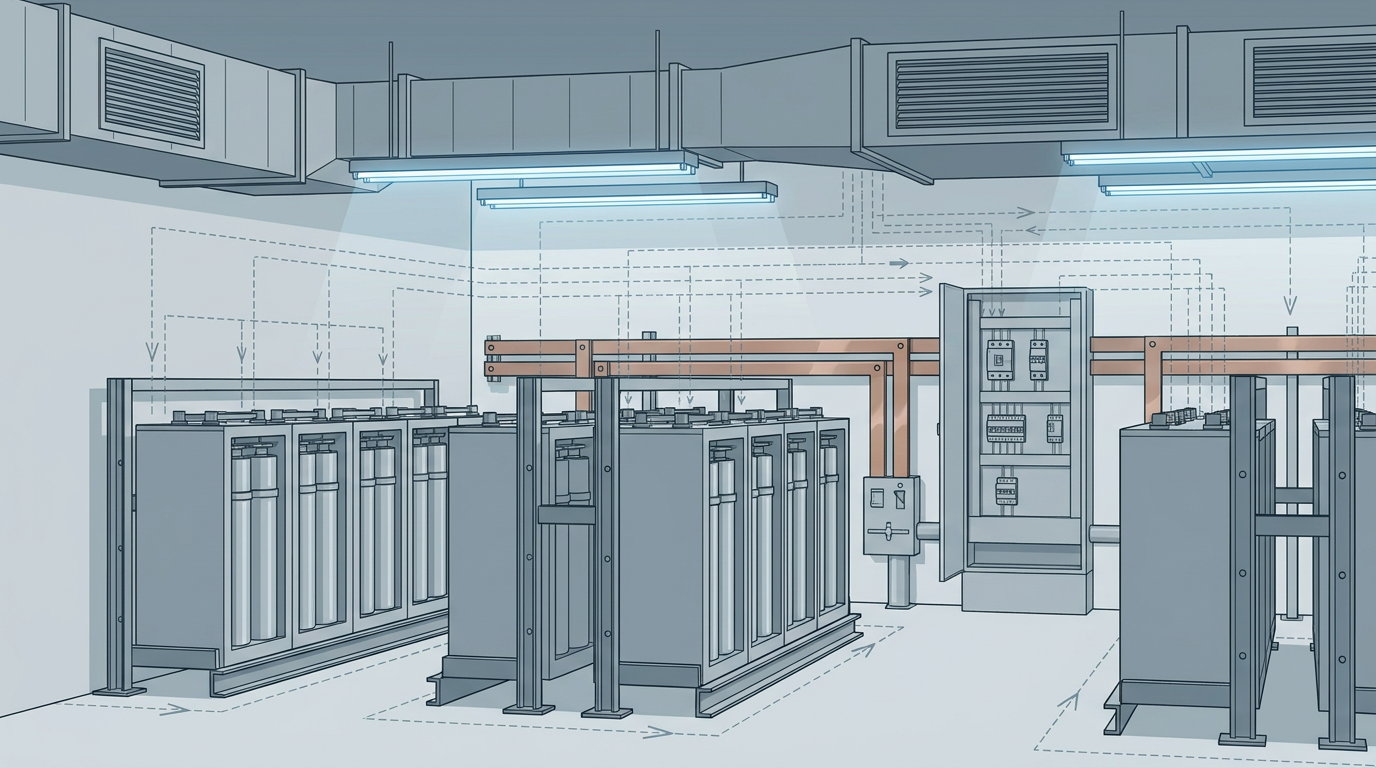
Lead acid Battery

Quick Answer: The 6-EVF-135 12V 135Ah AGM battery is a sealed 6-cell VRLA monoblock rated 135Ah at the 10-hour rate, and four units in series form the standard 48V motive pack for mid-duty electric forklifts, AGVs and cargo e-bikes. Because a lead-acid pack returns roughly half of its nameplate capacity in normal fleet duty, a 48V pack built from the 6-EVF-135 provides 6,480Wh nominal and about 3,240Wh usable at a 50% depth of discharge — the figure that actually decides whether a two-shift operation runs on one charge or two.

Key Takeaways

  • The 6-EVF-135 12V 135Ah AGM battery is a 12V, 6-cell sealed monoblock: 135Ah at C20, 1,620Wh nominal per unit, and roughly 25–28kg depending on case material and terminal type.
  • AGM is a VRLA construction in which the electrolyte is absorbed in a glass mat, so the unit needs no watering, no open-vent ventilation and no acid equalization in the field.
  • A 48V fleet pack is 4 × 6-EVF-135 in series (6,480Wh nominal, 3,240Wh usable at 50% DoD); 24V uses 2 units, 36V uses 3, and 72V uses 6.
  • Cycle life depends more on duty than on chemistry: about 500–700 cycles at 50% DoD for AGM, 250–400 for flooded, against 3,000–5,000 cycles at 80% DoD for a comparable LFP pack.
  • Across a modeled 7-year life for a 10-vehicle fleet, sealed AGM cuts total cost of ownership by roughly 27% versus flooded lead-acid, while an LFP pack cuts it by a further 40% — the deciding variables are daily DoD, charge window and labor cost, not the sticker price of cells.

Quick Specifications: 6-EVF-135 at a Glance

ParameterSpecification
Model6-EVF-135 (6 cells, 2V per cell)
Nominal voltage12V
Rated capacity135Ah at C20 (25°C, 0.87W/cell standard)
Nominal energy1,620Wh per unit
Charge current10.5–13.5A (0.08–0.10C)
Max continuous discharge135A (1C)
Max short-duration discharge270A (2C, 60s)
Float charge voltage13.5–13.8V (2.25–2.30V/cell)
Cycle charge voltage14.4–14.7V (2.40–2.50V/cell, absorption at 2.35V/cell)
Cycle life500–700 cycles @ 50% DoD / 300–400 cycles @ 80% DoD
Capacity tolerance±5% at C20
Operating temperatureCharge 0–40°C, discharge −20–50°C, storage 15–25°C
TerminalInserted post (M8 / Faston, both available)
Dimensions (nominal)181 × 95 × 353mm (L×W×H), ±2mm
Weight25–28kg
CertificationsCE, ISO 9001, ISO 14001, UL, IEC 60896
6 evf 135 12v fleet agm pack

For dimensional and terminal detail on this specific monoblock, the manufacturer publishes the full drawing and terminal options on the 6-EVF-135 12V 135Ah AGM battery product page →. If your fleet mixes capacities, the EVF series overview → shows the complete 6-EVF range from 24Ah to 225Ah in the same case and terminal range.

The Pain: Five Ways Fleet Battery Sizing Goes Wrong

Most e-mobility battery failures that look like “battery problems” are actually sizing problems that were never written down. The five below account for the large majority of avoidable pack replacements.

Sizing on peak current instead of energy. A vendor quote is often built from the vehicle’s maximum draw, which is the surge current of a lifting motor or a hydraulic pump. Peak current tells you whether the pack can deliver a lift; it says nothing about whether the pack survives the shift. The correct primary input is amp-hours consumed per shift, taken from the truck’s energy log or calculated from the motor nameplate, the duty cycle and any idle or energy-harvesting behavior.

Ignoring the charge window. A pack sized for 6 hours of work but recharged in a 3-hour window will be cycled at a higher average current and a higher average depth of discharge than the datasheet assumes. Charge window is a physical constraint of the facility — the number of chargers, the shift overlap, and whether opportunity charging is permitted during breaks.

Forgetting temperature derating. Lead-acid capacity falls by roughly 6% for every 1°C below 25°C at a 10-hour rate. A pack specified in a temperate plant and shipped to a yard operating at 5°C delivers about 20% less usable energy than the catalogue number, which is precisely the difference between one charge per shift and two.

Mixing units from different production batches in one series string. Three units from one batch and one from another can differ by 3–5% in measured capacity. In series the weakest unit sets the pack’s available energy, so a mixed string delivers the capacity of its worst cell group.

Treating VRLA as zero-maintenance. Sealed AGM batteries still need terminal torque checks, a monthly voltage and temperature log, periodic equalization at the correct charge voltage, and immediate recharging after use. “Maintenance-free” describes the absence of watering, not the absence of attention.

The Choice: AGM vs Flooded vs LFP for Electric Fleets

AGM is better than flooded lead-acid in sealed fleet applications because it eliminates watering and terminal corrosion and holds a stable capacity between charges, which matters when the battery sits in a vehicle bay rather than on a maintenance stand. LFP is better than AGM for deep-discharge, high-frequency, opportunity-charged duty because it tolerates 80% DoD daily and delivers 3,000–5,000 cycles, but it requires a matched charger, a BMS and a controlled environment below 45°C.

CriterionFlooded lead-acid6-EVF-135 AGM (VRLA)LFP traction pack (48V)
Usable energy (48V pack, 135Ah class)3,240Wh @ 50% DoD3,240Wh @ 50% DoD5,100Wh @ 80% DoD
Cycle life @ 50% DoD250–400 cycles500–700 cycles3,000–5,000 cycles
Cycle life @ 80% DoDNot recommended300–400 cycles3,000–5,000 cycles
Routine maintenanceWatering, venting, equalizingTerminal and voltage log onlyBMS firmware and cell balancing
Environment requirementVentilated, spill controlSealed, indoor or sheltered0–45°C, climate-controlled bay
Charge acceptanceLow, slow at low temperatureModerateHigh, supports fast charge
Upfront cost per 48V pack (indicative)$2,100$2,480$4,700
7-year TCO, 10-vehicle fleet (modeled)$20,700$15,100$9,100
Best-fit dutyLow-cycle, stationary, budgetTwo-shift, mid-duty, sealed baysHigh-DoD, multi-shift, fast turnover

Two variables decide the outcome far more often than the chemistry comparison does: how many hours a day the fleet runs, and what an hour of a technician costs locally. In a distribution center in Rotterdam or Antwerp, where labor runs at roughly EUR 45–70 per hour and the fleet works two shifts, sealed AGM takes 27% out of seven-year TCO against flooded. In a container yard at Jebel Ali or on the container quays of Santos, where vehicles run three shifts and opportunity charging is normal, the LFP pack’s cycle advantage and its elimination of watering labor push the total 40% below the AGM option — but only if the charger, the bay and the BMS integration are engineered together rather than bought separately.

7-Year Total Cost of Ownership Model

Cost lineFlooded lead-acid6-EVF-135 AGMLFP 48V pack
Initial purchase (10 vehicles)$21,000$24,800$47,000
7-year electricity$5,800$5,150$3,600
7-year maintenance labor$3,900$420$320
Battery replacement sets$6,300$5,900$0
Spares and downtime losses$2,600$1,150$480
7-year total cost$20,700$15,100$9,100

Modeled for a 10-vehicle, 48V, two-shift fleet averaging 9 hours of runtime per vehicle per day, electricity at $0.14/kWh, technician labor at $55/hour, and a replacement set priced at $8,400 for AGM and $7,000 for flooded. These are planning figures, not a quotation.

The Framework: Seven Sizing Rules for 12V 135Ah Fleet Packs

Rule 1 — Size on amp-hours per shift

Calculate consumed amp-hours from the vehicle’s energy log, then add auxiliary loads (hydraulics, cabin heaters, lights, telematics). A 48V vehicle drawing 42Ah per shift needs 84Ah of usable pack energy; at 50% DoD that is 168Ah nominal. Four 6-EVF-135 units in series deliver 540Ah nominal and 270Ah usable — ample headroom for degradation and auxiliary loads.

Rule 2 — Apply depth of discharge honestly

Depth of dischargeLead-acid cycles (AGM)Recommended use
30%900–1,200Opportunity-charged, high-frequency
50%500–700Standard fleet duty, two shifts
70%350–450Occasional deep discharge, reserve margin
80%300–400Only with active voltage cutoff

Half capacity is the working rule of thumb, not a rule of law. A pack routinely cycled at 80% DoD reaches end of life roughly 40% sooner than the same pack held at 50%, and one missed opportunity charge can push it to 100% depth within a single shift.

Rule 3 — Get the string math right

Nominal system voltage6-EVF-135 units in seriesNominal energyUsable @ 50% DoDUsable @ 80% DoD
24V23,240Wh1,620Wh2,592Wh
36V34,860Wh2,430Wh3,888Wh
48V46,480Wh3,240Wh5,184Wh
72V69,720Wh4,860Wh7,776Wh

Never mix series counts within one vehicle, and never mix a 6-EVF-135 with a 6-EVF-120 in the same string. If you need more energy at the same voltage, move up one model size — the 6-EVF-150 12V 150Ah page → sits in the identical case — rather than bolting a second parallel string together.

Rule 4 — Design for the real charge window

Duty profileCharge windowCharge currentCycles per year (est.)
Single shift, one charge8–10h overnight0.08–0.10C250–300
Two shifts, one charge4–5h overnight0.10C300–350
Two shifts, opportunity charging1–2h breaks0.10C continuous400–500
Three shifts, rapid turnover45–90 min0.15C+550–650

Sizing the charger to the charge window is not optional. A 48V pack of 6-EVF-135 units accepts roughly 54A at 0.10C; a 30A charger needs 16 hours for a full cycle from 50% DoD, which no overnight window can absorb.

Rule 5 — Derate for temperature

Apply a 6% capacity loss for every degree Celsius below 25°C, and treat charging below 0°C as a freeze risk that requires either a heated bay, a heated charger, or a charge protocol that keeps the pack above 5°C. Fleets in Durban, Chennai, Jebel Ali and Santos operate in ambient conditions that reduce usable capacity by 15–25% for much of the year; the derating belongs in the sizing sheet, not in the fine print.

Rule 6 — Match the charger to the chemistry

A flooded battery charger set at 2.45V/cell will overheat sealed AGM units and boil off electrolyte; a charger set at 2.30V/cell will undercharge them and sulfate the plates within months. For a 12V AGM unit specify 14.4–14.7V bulk, 13.5–13.8V float, 2.35V/cell absorption, temperature compensation of −3mV/°C/cell, and ripple below 2% of the float voltage. Confirm the charger’s output curve matches the vehicle’s discharge profile — trucks with regenerative braking need an absorb-then-float profile rather than a straight taper.

Rule 7 — Reserve for aging and keep spares

Replace a pack when it delivers 80% of rated capacity, not when it fails. A 135Ah unit measured at 108Ah at C20 is still perfectly serviceable, but it no longer supports the shift you sized for. Keep 5–10% of the fleet as charged spares, and specify replacement sets from the same production batch so the string balance holds.

The Trust: What to Verify Before You Sign a Supply Agreement

The difference between a quoting supplier and a manufacturing supplier shows up in the audit, not in the brochure. These are the checks that carry real weight.

Verify capacity, not nameplate. Ask for a C20 test report from an independent laboratory on the production batch, not a sample from the showroom. A 135Ah unit that measures 118Ah at C20 is not a 135Ah unit, and a supplier who declines a capacity audit has already answered the question.

Verify plate construction. Thinner positive plates mean higher capacity at lower cost and a shorter life. Ask for positive plate thickness in millimeters and cross-check the unit weight against the datasheet: a 12V 135Ah AGM unit weighing 20kg is not built like one weighing 26kg.

Verify the separator and the recombination. In AGM chemistry the glass mat is what makes the product; separator cost dominates the bill of materials. Ask which separator is used and whether the unit is drop-formed or formed under vacuum.

Verify the certification set and its regional scope. CE covers the EU, UL covers North America, and IEC 60896 covers stationary VRLA compliance. for traction applications add ISO 9001, ISO 14001 and IATF 16949.

Verify the warranty terms against the duty. Most warranty exclusions trace to three causes: equalization not performed, charging below 0°C, and storage above 30°C for extended periods. A 24-month warranty that voids itself on a missed equalization is worth less than a 18-month warranty that does not.

Verify the shipping and storage protocol. Lead-acid batteries self-discharge at 3–5% per month at 25°C and accelerate sharply when warm. A supplier that ships at partial charge, or that does not include a storage-and-recharge instruction in the carton, is transferring the risk to your site. For reference, units arriving at a port such as Rotterdam, Hamburg, Jebel Ali or Durban during a 45-day container transit need a supervised recharge on arrival.

Verify consistency of spares. Fleet packs are rarely replaced all at once. A supplier that cannot deliver a matching unit in the same case, terminal and date code within 12 months will force a mixed string on your floor.

Verify the service footprint. For fleets operating across India, South Africa, Brazil and the Gulf, local warranty handling means the difference between a 5-day replacement and a 5-week one. Downtime losses for a stalled electric forklift typically run $350–600 per day.

FAQ: 6-EVF-135 12V 135Ah AGM Battery Sizing for Electric Fleets

Q1: What does the model number 6-EVF-135 actually mean? The 6-EVF-135 designates a 6-cell monoblock from the EVF series rated at 135Ah; each cell is 2V, giving a 12V nominal block. EVF identifies the sealed AGM construction used for motive and deep-cycle duty, and the number after the hyphen is the amp-hour rating at the 10-hour rate.

Q2: How many 6-EVF-135 12V 135Ah AGM batteries do I need for a 48V forklift? Four units in series. That gives 48V nominal, 540Ah, and 6,480Wh of nominal energy, of which roughly 3,240Wh is usable at a 50% depth of discharge. Two units give 24V, three give 36V, and six give 72V.

Q3: Can I run a 6-EVF-135 in parallel with another identical unit? Yes — parallel strings increase total amp-hour capacity and current capability, and two parallel strings of two units each are a common way to reach 48V while keeping the pack manageable. Both strings must be built from the same production batch, and the strings should be electrically identical so current divides evenly between them.

Q4: What charger do I need for a 48V pack of 6-EVF-135 batteries? A charger rated 54–58V output with an AGM profile of 14.4–14.7V per 12V unit in bulk phase, 13.5–13.8V float, 2.35V/cell absorption, temperature compensation, and ripple below 2%. Output current should be around 0.10C, so 54A for a 540Ah pack, sized so the pack completes its charge inside the available window.

Q5: How long does a 6-EVF-135 AGM battery last in a two-shift fleet? Expect 500–700 full cycles at 50% depth of discharge, which translates to roughly three to four years in a two-shift application cycling 300–350 times a year. Dropping to 80% DoD shortens life by about 40%, and chronic undercharging accelerates sulfation faster than deep cycling does.

Q6: Can I use a 6-EVF-135 in a solar or off-grid storage installation? Yes, as long as the charging regime is float or absorption with a proper voltage window, and the ambient temperature stays in the published range. For off-grid solar where the pack sits at a high depth of discharge for long periods, a tubular gel OPzV design with 1,200–1,500 cycles at 80% DoD is usually the better engineering choice.

Q7: Does the 6-EVF-135 need to be installed upright, and how much clearance is needed? Yes, it must be installed upright in the designed orientation with the terminals correctly oriented to the busbars or interconnects. Provide the clearance stated in the datasheet around the case and above the terminals, and use the supplied vent caps, which are also the safety vent for a sealed VRLA unit.

Q8: What happens if a 6-EVF-135 unit is left discharged for several weeks? Lead-acid sulfates permanently when it sits below 50% state of charge. A unit stored flat for more than 30 days may lose 20–30% of its capacity and require a long, low-current recovery charge. Standby fleets should keep their packs on float at 13.6V per 12V unit and recharge every three to six months.

Q9: What is the difference between the 6-EVF-135 and a 6-EVF-150? Both share the same EVF case and terminal options; the 150 model carries roughly 11% more rated capacity, which translates to about 11% more usable energy per string. Choose the 150 when your measured shift consumption plus derating sits above 80% of the 135’s usable capacity, or when you want a larger reserve margin against aging.

Q10: How do I verify the battery I received actually meets the 135Ah rating? Perform a C20 discharge test: charge the unit fully, rest it for 12 hours, then discharge at 6.75A to an end voltage of 1.75V per cell and measure the delivered amp-hours. Anything under 128Ah indicates a manufacturing or shipping fault. The same test repeated every six months in service gives a defensible replacement trigger at 108Ah, which is 80% of rated capacity.

Expert Summary

The 6-EVF-135 12V 135Ah AGM battery is a 12V sealed VRLA monoblock rated 135Ah at C20 and 1,620Wh nominal, built as the working unit of mid-duty e-mobility packs: two units for 24V, four for 48V, six for 72V. Because lead-acid delivers roughly half its nameplate energy in service, the honest planning number for a 48V pack of four units is 3,240Wh usable at 50% depth of discharge, not 6,480Wh. Sizing must start from measured amp-hours per shift, then apply DoD and temperature derating — about 6% capacity lost per 1°C below 25°C — Against flooded lead-acid, sealed AGM removes watering labor, terminal corrosion and acid spill control while raising cycle life to 500–700 cycles at 50% DoD; against LFP, it costs roughly half as much upfront but trades away the 80% DoD tolerance and 3,000–5,000-cycle envelope that justify lithium in three-shift, opportunity-charged operations. For a 10-vehicle fleet, modeled seven-year TCO runs $20,700 for flooded, $15,100 for AGM and $9,100 for LFP, so the chemistry decision is a decision about duty intensity and local technician cost. The verification that protects the buyer is unglamorous and decisive: an independent C20 capacity audit on the production batch, plate thickness and weight cross-checks, a documented charger profile, a warranty that names its own exclusions, and a storage and recharge protocol written into the shipping documents.

Request a Datasheet or Sample Inquiry

Battery selection only holds together if the specification, the charger and the duty cycle are reviewed together. CHISEN’s export engineering team provides the 6-EVF-135 datasheet, capacity test reports, certification documents and a supplier audit checklist, and will size a pack against your measured shift consumption.

  • Download Datasheet — full 6-EVF-135 technical specification, dimensions, terminal drawings and cycle-life curves.
  • Sample Inquiry — request a sample unit for in-house C20 verification or a pilot installation on one vehicle.
  • Supplier Audit Checklist — the 12-point document we use to qualify Chinese manufacturers before they qualify us.

Contact: sales@chisen.cn | WhatsApp: wa.me/8613166226999 | Technical documents and further reading at leadacidbattery.cn

Related CHISEN Buyer Guides

  • opzs2 1500 2v 1500ah flooded tubular battery dc plant sizing guide 2026

    OPzS2-1500 2V 1500Ah Flooded Tubular Battery: DC Plant Sizing Guide (2026)

    An OPzS 2V 1500Ah flooded tubular battery is specified when a site needs a 48V plant of roughly 72 kWh nominal, expects a service life of more than ten years on float, and has a plant room where a technician can carry out water top-ups on a planned schedule. The OPzS2-1500 is the die-cast tubular flooded cell in the middle of the published CHISEN range: 1500Ah at the 10-hour rate, 275 × 210 × 795mm, 850mm over the terminals, 77.00kg, and a float design life of more than 20 years at 25°C under IEC 60896-11 and DIN 40736-1.

    This guide works through how the cell is specified, how a 48V string is built around it, and what it actually costs over seven years compared with tubular gel, AGM VRLA and lithium alternatives. It is written for the engineer who will sign the acceptance certificate, and for the distributor who has to defend the specification to a utility or a telecom operator.


    Answer First

    A 48V DC plant built from 24 OPzS2-1500 cells in series stores 72 kWh nominal (24 × 2V × 1500Ah), floats at 53.5V (24 cells × 2.23V/cell) with −3mV/°C/cell compensation, and delivers about 36 kWh usable at a 50% depth of discharge to 1.80V/cell — which supports a 1.5kW continuous load for 24 hours; the cell is 77.00kg, publishes dimensions to ±2mm and a 300A maximum charging current, and its 16-model ladder from 100Ah to 3000Ah lets a plant room be designed around integer cell counts instead of parallel string sprawl.


    Key Takeaways

    • The published OPzS range covers 16 sizes from 100Ah to 3000Ah, stepping 100 / 150 / 200 / 250 / 300 / 350 / 420 / 500 / 600 / 800 / 1000 / 1200 / 1500 / 2000 / 2500 / 3000Ah, each published with length, width, height and weight to ±2mm.
    • Float charge is 2.23V per cell at 25°C with −3mV/°C/cell compensation, equalising at 2.35V and cycling at 2.40–2.45V, with a maximum charging current of 0.20 × C10 A — 300A on the 1500Ah cell.
    • The 1500Ah cell is the practical centre of the ladder. It stores 3 kWh per cell, so one 24-cell string gives 72 kWh — the size most often quoted for off-grid telecom plants, solar hybrid microgrids and MV/LV substation trip supplies where lead-acid remains the default technology.
    • Flooded cells cost less than gel and carry less mass at the same capacity — the OPzS2-1500 weighs 77.00kg against 104.00kg for the OPzV2-1500, a saving of 27kg per cell and 648kg per string — but they buy that saving with a maintenance routine: planned water top-ups and a ventilation design that takes hydrogen generation seriously.
    • Water top-up frequency is temperature-driven, not calendar-driven — roughly monthly in a hot plant room and considerably longer in a cool one — and it is the single operating habit that decides whether a flooded bank reaches its published design life.

    Quick Specifications: CHISEN OPzS2-1500 at a Glance

    ParameterPublished value
    ModelOPzS2-1500
    Cell typeFlooded (vented) tubular plate, die-cast positive grid
    Nominal cell voltage2V DC
    Rated capacityC10 = 1500Ah (10-hour rate to 1.80V/cell at 25°C)
    Dimensions (L × W × H)275 × 210 × 795mm (tolerance ±2mm)
    Total height over terminals850mm
    Weight77.00kg
    Terminalφ20-M8, 10–12 N·m torque
    Float charge2.23V per cell at 25°C (model datasheet 2.24V ±1%)
    Float compensation−3mV/°C/cell (model datasheet −3.3mV/°C/cell)
    Equalising charge2.35V per cell at 25°C (model datasheet 2.35–2.40V/cell)
    Cycling charge2.40–2.45V per cell at 25°C
    Equalise / charge compensation−5.0mV/°C/cell
    Maximum charging current0.20 × C10 = 300A
    ElectrolyteHigh-purity low-density dilute sulfuric acid, 1.24 ± 0.01 g/cm³ fully charged
    Float design life20+ years (20–25 years at 25°C float)
    Cycle life1,500–2,500 cycles at 80% depth of discharge
    StandardsIEC 60896-11:2002, DIN 40736-1:1985, GB/T 19638.2-2014, YD/T 1360, Eurobat Long Life, BS 6290 Part 4 / UL 1989

    Cell-level electrical and mechanical data for this model is published on the OPzS2-1500 product page, and the full 16-model series data sits on the OPzS flooded tubular battery range page.

    The Published OPzS Range: 16 Models, 100Ah to 3000Ah

    ModelCapacity C10 (Ah)Length (mm)Width (mm)Height (mm)Total Height (mm)Weight (kg)Terminal
    OPzS2-1001001032063544099.20φ20-M8
    OPzS2-15015010320635440911.00φ20-M8
    OPzS2-20020010320635440912.90φ20-M8
    OPzS2-25025012420635440915.30φ20-M8
    OPzS2-30030014520635440917.60φ20-M8
    OPzS2-35035012420647052520.10φ20-M8
    OPzS2-42042014520647052523.60φ20-M8
    OPzS2-50050016620647052526.00φ20-M8
    OPzS2-60060014520664570032.30φ20-M8
    OPzS2-80080019121064570043.80φ20-M8
    OPzS2-1000100023321064570053.50φ20-M8
    OPzS2-1200120027521064570062.50φ20-M8
    OPzS2-1500150027521079585077.00φ20-M8
    OPzS2-20002000399210771826105.50φ20-M8
    OPzS2-25002500487212771826131.00φ20-M8
    OPzS2-30003000576212771826155.00φ20-M8

    The Pain: Where 1500Ah Flooded Installations Actually Fail

    Flooded tubular cells are the most forgiving chemistry in the substation and the least forgiving in the plant room. The failures are operational rather than electrical, and they repeat in the same order on every continent.

    Water top-ups get deferred. A bank left without water loses capacity through grid corrosion long before the electrolyte level drops below the visible threshold. The interval is set at commissioning and never revisited, and it must be revisited, because the interval roughly triples for every 10°C drop in ambient temperature. A cell inspected monthly in a 35°C room in Accra or Ho Chi Minh City can need inspection weekly in a 15°C room in Warsaw.

    Float voltage is set once and never re-checked. The published compensation of −3mV/°C/cell moves the float setpoint by 1.44V across a 24-cell string between 20°C and 40°C — 0.06V per cell multiplied by 24 cells over a 20°C swing. Set the rectifier once in August and the bank spends the winter undercharged and the summer overcharged, which is precisely the pattern that drives the gradual capacity loss operators attribute to the battery being old.

    Ventilation is sized from the cell count, not from the gas rate. Flooded cells vent hydrogen under charge, and the EN 50272-2 method estimates gas volume as approximately 0.42 × I_gas × t litres per cell, where the gas current for a float-charged cell is commonly taken as 0.002 × C10 A. For a 1500Ah cell that is 3A per cell and about 1.26 litres per hour of gas per cell, so a 24-cell string generates roughly 30 litres per hour — 0.030 m³/h — and a two-string plant room roughly 0.060 m³/h. Undersized ventilation is a safety finding waiting for an inspection.

    Rate-corrected capacity is ignored in the autonomy calculation. The 1500Ah rating is measured at the 10-hour rate to 1.80V/cell at 25°C. At the 3-hour rate the same cell typically returns around 160–190Ah less, and at the 1-hour rate considerably more is lost. A bank specified for 24 hours at a hard 1.5kW load will not deliver 24 hours in practice unless the autonomy table was built on rate-corrected figures.

    Cells are mixed with VRLA in the same room. Flooded and sealed cells have different float currents, different gas behaviour and different failure signatures. Mixing them in one room without separate ventilation, separate alarm thresholds and a documented inspection regime makes every alarm ambiguous.


    The Choice: String Arithmetic, Chemistry Trade-Off and 7-Year Cost

    String and parallel configuration

    Every OPzS cell is 2V, so the string length follows the DC bus and only the cell capacity and the parallel count remain as design variables.

    DC busCells in seriesFloat voltageEqualising voltageEnergy per 1500Ah stringEnergy per 1200Ah string
    24V1226.8V28.2V36.0 kWh28.8 kWh
    48V2453.5V56.4V72.0 kWh57.6 kWh
    80V4089.2V94.0V120.0 kWh96.0 kWh
    120V60133.8V141.0V180.0 kWh144.0 kWh

    An off-grid telecom plant outside Mombasa, a solar hybrid microgrid feeding a mining camp near Pucallpa in Peru and an MV substation trip supply outside Bloemfontein share a load profile of roughly 1.5kW continuous on a 48V bus:

    • Nominal energy: 24 cells × 1500Ah = 36,000Ah, which is 72,000Wh per string.
    • Usable at 50% DoD (1.80V/cell): 36,000Wh → 24 hours at 1.5kW.
    • Usable at 80% DoD (2.00V/cell): 57,600Wh, provided the inverter undervoltage cutoff is set at or above 48.0V.
    • Rectifier sizing: 1.5kW site load + 30A float current (2% of C10) + equalising reserve ≈ 3.5kW continuous, so a 4kW rectifier absorbs equalisation without starving the string.
    • Parallel strings: two 24-cell strings give 144 kWh nominal, 48 hours at 50% DoD, and full redundancy while one string is isolated for maintenance.

    7-year total cost of ownership, 48V / 72 kWh nominal site

    Indicative 2026 mid-market pricing bands; actual quotations depend on volume, freight, certification scope and local duties.

    Line itemOPzS flooded (24 × OPzS2-1500)OPzV gel (24 × OPzV2-1500)AGM VRLA (60 × 12V 100Ah)LFP (48V 1500Ah)
    Cell mass installed1,848 kg2,496 kg≈ 1,800 kg≈ 850 kg
    Initial hardware≈ USD 3,850≈ USD 9,400≈ USD 7,800≈ USD 14,500
    Water top-up and cell inspection (7 yr)≈ USD 700000
    Replacement inside 7 years0 (20+ year float design life)01 full set at year 60
    Ventilation / monitoring / BMS≈ USD 1,050≈ USD 750≈ USD 900≈ USD 2,600
    7-year total cost of ownership≈ USD 5,600≈ USD 10,150≈ USD 16,500≈ USD 17,100
    Operating constraintWater top-up schedule, hydrogen ventilationFloat setpoint disciplineShorter float life, greater rack volumeLithium charge profile, new DC bus, cooling

    The comparison is the argument for flooded tubular in a specific and defensible place: a site with a plant room that already has hydrogen ventilation and a technician on a routine visit cycle. It is not the right answer where the site is unattended, where the ambient temperature swings widely without compensation, or where the battery room cannot be ventilated to code — there the gel cell is the cheaper life-cycle answer, and lithium is the one to model carefully, including the DC bus changes, cooling and BMS integration.

    Why 1500Ah is the practical centre of the ladder

    Cell size drives three physical constraints at once, and at 1500Ah they align unusually well. A 275 × 210mm footprint fits a standard 210mm-deep rack tier, 77.00kg sits at the upper end of what two technicians should lift without mechanical aid, and the installed floor load of roughly 0.76kN per cell and 18.1kN per 24-cell string is a standard plinth specification for a plant room. Below 1000Ah the cells are short and the rack tiers are underused; above 2000Ah the cell height exceeds 770mm and the room loses headroom for the maintenance walkway.


    The Framework: 7 Hard Metrics for Specifying a 1500Ah Flooded Tubular Cell

    1. Rate-corrected capacity, not nameplate. Require Ah at the discharge rate the site will actually see, with the end voltage and temperature stated — a 1500Ah cell at the 3-hour rate typically returns 160–190Ah below the 10-hour figure, and the autonomy table must be built on the corrected value.
    2. Float life at the real ambient temperature. The 20+ year design life is specified at 25°C. A containerised shelter in Windhoek, Kano or Lima with no air conditioning will not reach it without attention.
    3. A ventilation design that starts from the gas rate. Calculate per EN 50272-2 using approximately 0.42 × I_gas × t litres per cell, with I_gas commonly taken as 0.002 × C10 A — 3A and about 1.26 L/h per 1500Ah cell, roughly 30 L/h for a 24-cell string — and confirm the room design with a qualified engineer.
    4. Water top-up planning, costed and scheduled. Include deionised water, a measuring jug or hydrometer, PPE and technician time in the operating budget; set the inspection interval from ambient temperature, not from the last invoice.
    5. Charge-voltage acceptance window and compensation. Float at 2.23V per cell (53.5V on a 24-cell string), equalising at 2.35V, cycling at 2.40–2.45V, maximum charge current 0.20 × C10 A = 300A, with temperature compensation actually enabled in the field configuration rather than only specified on the datasheet.
    6. Mechanical fit and floor loading. Use the published geometry — 275 × 210 × 795mm, 850mm over terminals, 77.00kg for the 1500Ah cell — to confirm rack pitch, floor loading of roughly 0.76kN per cell and 18.1kN per string, and aisle width for a technician working with a hydrometer and a watering can.
    7. Documentation at shipment, not after. Require the IEC 60896-11 and DIN 40736-1 conformity statement, batch date codes, a cell consistency procedure and a spare-cell allowance of 1–2% with the consignment.

    The Trust: Buying Flooded Tubular Cells Without Buying Trouble

    The most common commercial mistake is treating flooded and sealed tubular cells as interchangeable because the model numbers look alike. They are not the same product, and the difference shows up in maintenance cost rather than in the purchase order.

    Ask for electrolyte specification, not just the chemistry name. The published description is high-purity low-density dilute sulfuric acid at 1.24 ± 0.01 g/cm³ when fully charged. Confirm the specified density for float service on the cell datasheet and the recommended topping-up water specification, because using mains water with a high mineral content causes the deposits that shorten float life.

    Check the cell consistency procedure. Cells from one production batch share a float-current signature. A string assembled from two months of production will show a divergence that looks like a charger fault. Ask how the supplier isolates production lots and whether cells are assembled into matched strings at the factory.

    Verify the case, rack and vent design at delivery. A 77.00kg cell is not going to be hand-handled; a cracked case or a sheared φ20-M8 terminal is found at unpacking, and a bank that has been stacked on its ends in a container should not be accepted without inspection. A shipping damage protocol with photographic evidence at the port of discharge protects both sides.

    Make the acceptance test real. The delivery note is not a test certificate. A 10-hour rate capacity verification on a sample string to 1.80V/cell, a recorded float current after 24 hours on float, an electrolyte density and level check on every cell, an inter-connection resistance check and a visual inspection of every cell should all sit in the acceptance protocol.

    Require a spare-parts and inspection plan in the contract. A 2% spare-cell allowance with the bank, a recommended inspection interval for the actual ambient profile, and a written float-voltage schedule remove the two failure modes that account for most avoidable early replacements.


    FAQ: Flooded Tubular Battery Questions Answered

    Q1: How many OPzS2-1500 cells are needed for a 48V telecom plant?

    Twenty-four cells in series give a 48V nominal bus floating at 53.5V, storing 72 kWh nominal per string. One string supports roughly 24 hours at a 50% depth of discharge for a 1.5kW load; two strings in parallel give 144 kWh and full redundancy while one string is isolated for maintenance.

    Q2: How often do flooded tubular cells need water top-ups?

    The interval follows ambient temperature and is far shorter in hot plant rooms — of the order of monthly in a 30–35°C environment and considerably longer in a cool one. The published float design life of more than 20 years assumes the electrolyte level is maintained; a flooded cell operated dry corrodes the positive grids regardless of how well it was manufactured.

    Q3: What is the correct float and equalising voltage?

    Float at 2.23V per cell at 25°C with −3mV/°C/cell compensation, equalising at 2.35V per cell, and cycling charge at 2.40–2.45V per cell. On a 24-cell string that is 53.5V float and 56.4V equalising. The maximum recommended charging current is 0.20 × C10 A, which is 300A for the 1500Ah cell.

    Q4: Does a flooded battery room need special ventilation?

    Yes. Flooded cells release hydrogen during charge, so the room must be ventilated and the calculation should follow EN 50272-2 and IEC 62485-1, with hydrogen monitoring above the cell vent line in larger rooms. Sizing ventilation from the cell count alone is a common and avoidable error.

    Q5: How much capacity do I lose at higher discharge rates?

    The 1500Ah rating is measured at the 10-hour rate to 1.80V/cell at 25°C. At the 3-hour rate the same cell typically delivers around 160–190Ah less, and losses grow further at the 1-hour rate. Autonomy calculations for ride-through duty must therefore use rate-corrected figures, not the 10-hour nameplate.

    Q6: Is a flooded OPzS cell cheaper than a gel OPzV cell of the same capacity?

    Usually yes on first cost — the OPzS2-1500 is published at 77.00kg against 104.00kg for the OPzV2-1500, and flooded cells are generally priced well below their sealed equivalents. The saving is partly given back through water top-up labour, a larger ventilation design and a heavier plant room, so compare on 7-year cost of ownership rather than on the quotation. The full tubular gel comparison is on the OPzV tubular gel battery range page.

    Q7: What standards should the supplier certify?

    For flooded tubular stationary cells, IEC 60896-11:2002 and DIN 40736-1:1985, with GB/T 19638.2-2014, YD/T 1360 for telecom backup duty, Eurobat Long Life classification, and BS 6290 Part 4 / UL 1989 where the UK or North American market is served. Ask for the conformity statement, batch date codes, a cell consistency procedure, and the CE, ISO 9001 and ISO 14001 documentation for the manufacturing site.

    Q8: What does a proper acceptance test involve at delivery?

    A 10-hour rate capacity verification on a sample string, a float current reading after 24 hours on charge, an electrolyte density and level check on every cell, inter-connection resistance and torque checks, and a visual inspection of every case and terminal for transit damage. Record the results before the consignment is accepted.

    Q9: Which model should I choose instead of the 1500Ah?

    The published range steps through OPzS2-1200 (62.50kg), OPzS2-1000 (53.50kg), OPzS2-800 (43.80kg) and OPzS2-600 (32.30kg) below the 1500Ah, and OPzS2-2000 (105.50kg), OPzS2-2500 (131.00kg) and OPzS2-3000 (155.00kg) above it, so cell size can be matched to floor loading, rack pitch and handling rules, with parallel strings used for the remaining capacity. Every cell in the range is 2V, so the string length at your DC bus is always fixed.

    Q10: Is the OPzS2-1500 suitable for solar hybrid storage with daily cycling?

    Yes, provided the charge profile is set to the published cycling voltage of 2.40–2.45V per cell rather than the float value, and the design is based on the published cycle life of 1,500–2,500 cycles at 80% DoD. In hybrid plants the battery sits on float through the dry season and cycles through the rainy or daylight hours, so the rectifier, the inverter charge controller and the maximum charge current of 300A per cell must be sized for the real daily profile.

    Q11: How long will an OPzS2-1500 last in float service?

    The published design life is more than 20 years at float, with a stated range of 20–25 years at 25°C. Real service life is shortened by high ambient temperature, missing temperature compensation, chronic undercharging and, above all, deferred water top-ups. Sites with a disciplined inspection routine and compensated float voltage are the ones that reach the two-decade figure.


    Expert Summary

    The published CHISEN OPzS2 range gives buyers a complete flooded tubular ladder — 100Ah at 9.20kg through 3000Ah at 155.00kg, all on a common 2V platform with 2.23V float charge, −3mV/°C/cell compensation, IEC 60896-11 and DIN 40736-1 conformity, and a float design life of more than 20 years. The OPzS2-1500 sits at the centre of that ladder at 1500Ah, 275 × 210 × 795mm, 850mm over the terminals and 77.00kg, and it is the cell most often quoted for 48V telecom plants, solar hybrid microgrids and MV/LV substation trip supplies across Africa, South America, South Asia and Southeast Asia. That combination of capacity range, dimensional transparency and published charge parameters is what makes flooded tubular the standard answer in those markets.

    The economics are not automatically favourable, and buyers should be clear about that. On a 48V, 72 kWh nominal site the 7-year cost of ownership is roughly USD 5,600 for flooded tubular against USD 10,150 for tubular gel, USD 16,500 for AGM VRLA and USD 17,100 for lithium once the DC bus changes, cooling and BMS integration are priced in. Flooded tubular wins where the plant room already has hydrogen ventilation and a technician visit cycle; it loses where the site is unattended or the ambient temperature swings without compensation.

    For procurement teams the operative conclusion is straightforward: specify the OPzS2-1500 against rate-corrected capacity for the actual discharge, set the rectifier to 2.23V per cell with compensation enabled and a 300A current limit, size the ventilation from the gas rate rather than the cell count, budget the water top-up routine as a line item, and run a genuine acceptance test including electrolyte density and level on every cell before the consignment is signed for.


    Download the OPzS2-1500 Datasheet, Sizing Worksheet and Audit Checklist

    Flooded tubular installations fail on three things: an autonomy figure with no discharge rate attached, a ventilation design that ignores the gas rate, and a water top-up routine that nobody budgeted. CHISEN supports specification and procurement with the full published OPzS series data, cell-level conformity documentation and a DC plant sizing worksheet.

    Download Datasheet — the OPzS2-1500 technical datasheet with cell-level electrical data, dimensional drawing and the complete 16-model OPzS series table: OPzS2-1500 product specifications

    Sample Inquiry — request a 48V string configuration for your site with the string layout, float and equalising setpoints, rectifier sizing basis and hydrogen ventilation calculation: https://wa.me/8613166226999

    Supplier Audit Checklist — ask for the Supplier Audit Checklist covering cell consistency, batch traceability, transit damage protocol and acceptance testing: sales@chisen.cn

    Send us your site load in watts, required autonomy in hours, DC bus voltage, ambient temperature range and the plant room ventilation situation, and our engineering team will return the string configuration, float and equalising setpoints, the rectifier sizing basis, the hydrogen ventilation calculation and a 7-year cost comparison — normally within 24 hours.

    For the full OPzS flooded tubular range specification and series documentation: OPzS tubular flooded battery range


    Source: CHISEN Battery published OPzS series specification data (IEC 60896-11:2002, DIN 40736-1:1985, EN 50272-2, IEC 62485-1, GB/T 19638.2-2014, YD/T 1360, BS 6290 Part 4, UL 1989); published CHISEN OPzV gel series data for comparative values; IEEE Std 450 guidance on battery plant design. Dimensions carry a published tolerance of ±2mm; weights and capacities apply at 25°C on the 10-hour rate. Cost bands are indicative 2026 mid-market values and are subject to volume, freight and certification scope. Verify all technical parameters with the CHISEN engineering team prior to a procurement decision.


    Related CHISEN Buyer Guides

  • opzs2 2500 2v 2500ah flooded tubular battery railway telecom dc plant 2026

    OPzS2-2500 2V 2500Ah Flooded Tubular Battery: Sizing and Maintenance for Railway and Telecom DC Plants 2026

    An OPzS 2V 2500Ah flooded tubular battery is specified when a site needs roughly 96 kWh of stored energy per DC string, needs more than ten years of float life, and has a plant room where a technician can carry out water top-ups on a planned schedule. The OPzS platform is the flooded member of the tubular platform: 2V cells with die-cast tubular positive plates, open electrolyte, a published float design life of more than 20 years, and compliance with IEC 60896-11 and DIN 40736.

    This guide works through the selection method for the whole published OPzS range — from OPzS2-100 at 9.20 kg to OPzS2-3000 at 155.00 kg — and uses the 2500Ah cell as the worked example because it is the size most often quoted for off-grid telecom plants, railway signalling substations and HV/MV substation trip supplies in markets where lead-acid remains the default technology.


    Answer First

    A 48V DC plant built from 24 OPzS2-2500 cells in series stores 120 kWh nominal (24 × 2V × 2500Ah), floats at 53.5V (24 cells × 2.23V/cell) with −3mV/°C/cell compensation, and delivers about 60 kWh usable at a 50% depth of discharge to 1.80V/cell — which supports a 2.5kW continuous load for 24 hours; the published float design life of 20+ years and the 100–3000Ah dimensional ladder mean a plant room can be designed around integer cell counts instead of parallel string sprawl.


    Key Takeaways

    • The published range covers 16 sizes from 100Ah to 3000Ah, with capacities stepping 100 / 150 / 200 / 250 / 300 / 350 / 420 / 500 / 600 / 800 / 1000 / 1200 / 1500 / 2000 / 2500 / 3000Ah, each published with length, width, height and weight to ±2mm.
    • Float charge is 2.23V per cell at 25°C with −3mV/°C/cell compensation, equalising at 2.35V and cycling at 2.40–2.45V, with a recommended maximum charging current of 0.20 × C10 A.
    • Flooded cells cost less than gel and carry less mass at the same capacity — the OPzS2-2000 weighs 105.50 kg against 147.00 kg for the OPzV2-2000 — but they buy that saving with a maintenance routine: planned water top-ups and a ventilation design that takes hydrogen generation seriously.
    • Standards are explicit: IEC 60896-11 and DIN 40736 for flooded tubular stationary cells, with a 20+ year float design life and electrolyte specified as high-purity, low-density dilute sulfuric acid.
    • Water top-up frequency is temperature-driven, not calendar-driven — roughly monthly in a hot plant room and closer to annual in a cool one — and it is the single operating habit that decides whether a flooded bank actually reaches its design life.

    Quick Specifications: The Published CHISEN OPzS Range

    Dimensions carry a published tolerance of ±2mm; total height is measured over the terminals.

    ModelCapacity C10 (Ah)Length (mm)Width (mm)Height (mm)Total Height (mm)Weight (kg)Terminal
    OPzS2-1001001032063544099.20φ20-M8
    OPzS2-15015010320635440911.00φ20-M8
    OPzS2-20020010320635440912.90φ20-M8
    OPzS2-25025012420635440915.30φ20-M8
    OPzS2-30030014520635440917.60φ20-M8
    OPzS2-35035012420647052520.10φ20-M8
    OPzS2-42042014520647052523.60φ20-M8
    OPzS2-50050016620647052526.00φ20-M8
    OPzS2-60060014520664570032.30φ20-M8
    OPzS2-80080019121064570043.80φ20-M8
    OPzS2-1000100023321064570053.50φ20-M8
    OPzS2-1200120027521064570062.50φ20-M8
    OPzS2-1500150027521079585077.00φ20-M8
    OPzS2-20002000399210771826105.50φ20-M8
    OPzS2-25002500487212771826131.00φ20-M8
    OPzS2-30003000576212771826155.00φ20-M8

    Series parameters as published for the OPzS platform:

    ParameterPublished value
    Nominal cell voltage2V DC
    Float charge2.23V per cell at 25°C, compensation −3mV/°C/cell
    Equalising charge2.35V per cell at 25°C
    Cycling charge2.40–2.45V per cell at 25°C
    Maximum charging current0.20 × C10 A (500A for the 2500Ah cell)
    ElectrolyteHigh-purity, low-density dilute sulfuric acid
    Float / standby design life20+ years
    StandardsIEC 60896-11, DIN 40736
    Terminalφ20-M8

    The Pain: Where Flooded Tubular Installations Actually Fail

    Flooded tubular cells are the most forgiving chemistry in the substation and the least forgiving in the plant room. The failures are operational, not electrical, and they repeat in the same order on every continent.

    Water top-ups get deferred. A bank left without water loses capacity through plate corrosion long before the electrolyte level drops below the visible threshold. In practice, the sites that end up with damaged cells are the ones where the top-up interval was set at commissioning and never revisited — and it must be revisited, because the interval roughly triples for every 10°C drop in ambient temperature. A cell inspected monthly in a 35°C room in Lucknow or Ho Chi Minh City can need inspection weekly in a 15°C room in Warsaw.

    Float voltage is set once and never re-checked. The published compensation of −3mV/°C/cell moves the float setpoint by about 0.18V across a 48V string between 20°C and 40°C. Set the rectifier once at commissioning in August and the bank spends the winter undercharged and the summer overcharged, which is precisely the pattern that drives the gradual capacity loss operators blame on “the battery being old”.

    Ventilation is sized from the cell count, not from the gas rate. Flooded cells vent hydrogen under charge. The EN 50272-2 method estimates gas volume as approximately 0.42 × I_gas × t litres per cell, where the gas current for a float-charged cell is commonly taken as 0.002 × C10 A. For a 2500Ah cell that is roughly 5A per cell and about 2 litres per hour of gas per cell, which for a 24-cell string is a ventilation design question with a real answer, not a formality. Undersized ventilation is a safety finding waiting for an inspection.

    Rate-corrected capacity is ignored in the autonomy calculation. A 2500Ah cell at the 10-hour rate returns close to 2500Ah; at the 3-hour rate the same cell typically gives 200–220Ah less, and at the 1-hour rate considerably more is lost. A bank specified for “24 hours” at a hard 2.5kW load will not deliver 24 hours in practice.

    Cells are mixed with VRLA in the same room. Flooded and sealed cells have different float currents, different gas behaviour and different failure signatures. Mixing them in one room without separate ventilation, separate alarm thresholds and a documented inspection regime makes every alarm ambiguous.


    The Choice: String Arithmetic, Chemistry Trade-Off and 7-Year Cost

    String and parallel configuration

    Every OPzS cell is 2V, so the string length follows the DC bus and only the cell capacity and parallel count are design variables.

    DC busCells in seriesFloat voltageEqualising voltageEnergy per 2500Ah stringEnergy per 2000Ah string
    24V1226.8V28.2V60.0 kWh48.0 kWh
    48V2453.5V56.4V120.0 kWh96.0 kWh
    80V4089.2V94.0V200.0 kWh160.0 kWh
    120V60133.8V141.0V300.0 kWh240.0 kWh

    A railway signalling substation in central India, an off-grid telecom plant in the Atacama and a substation trip supply outside Bloemfontein share a load profile of roughly 2.5kW continuous on a 48V bus:

    • Nominal energy: 24 cells × 2500Ah = 120,000Wh per string.
    • Usable at 50% DoD (1.80V/cell): 60,000Wh → 24 hours at 2.5kW.
    • Usable at 80% DoD (2.00V/cell): 96,000Wh, provided the inverter undervoltage cutoff is set at or above 48.0V.
    • Rectifier sizing: 2.5kW site load + 50A float current (2% of C10) + 250A equalising reserve ≈ 3.2kW continuous, so a 4kW rectifier absorbs equalisation without starving the string.
    • Parallel strings: two 24-cell strings give 240 kWh nominal, 48 hours at 50% DoD, and full redundancy while one string is isolated for maintenance.

    7-year total cost of ownership, 48V / 96 kWh site

    Indicative 2026 mid-market pricing bands; actual quotations depend on volume, freight, certification scope and local duties.

    Line itemOPzS flooded (24 × OPzS2-2000)OPzV gel (24 × OPzV2-2000)AGM VRLA (80 × 12V 100Ah)LFP (48V 400Ah)
    Cell mass installed2,532 kg3,528 kg≈ 2,640 kg≈ 800 kg
    Initial hardware≈ USD 10,100≈ USD 12,500≈ USD 11,200≈ USD 14,000
    Water top-up and cell inspection (7 yr)≈ USD 1,050000
    Replacement inside 7 years0 (20+ year float design life)01 full set at year 60
    Ventilation / cooling / monitoring≈ USD 1,500≈ USD 700≈ USD 1,200≈ USD 2,500
    7-year total cost of ownership≈ USD 12,650≈ USD 13,200≈ USD 23,600≈ USD 16,500
    Operating constraintWater top-up schedule, hydrogen ventilationFloat setpoint disciplineShorter float and cycle lifeLithium charge profile, new DC bus, cooling

    The comparison is the argument for flooded tubular in a specific and defensible place: a site with a plant room that already has hydrogen ventilation and a technician on a routine visit cycle. It is not the right answer where the site is unattended, where the ambient temperature swings widely without compensation, or where the battery room cannot be ventilated to code — there the gel cell is the cheaper life-cycle answer, and lithium is the one to model carefully including the DC bus changes.


    The Framework: 7 Hard Metrics for Specifying a 2500Ah Flooded Tubular Cell

    1. Rate-corrected capacity, not nameplate. Require Ah at the discharge rate the site will actually see, with the end voltage and temperature stated — a 2500Ah cell at the 3-hour rate is typically 200–220Ah below the 10-hour figure.
    2. Float life at the real ambient temperature. The 20+ year design life is specified at 25°C. A containerised shelter in Windhoek, Kano or Lima with no air conditioning will not reach it without attention.
    3. A ventilation design that starts from the gas rate. Calculate per EN 50272-2 using approximately 0.42 × I_gas × t litres per cell, with I_gas commonly taken as 0.002 × C10 A, and confirm the room design with a qualified engineer.
    4. Water top-up planning, costed and scheduled. Include deionised water, a measuring jug or hydrometer, PPE and technician time in the operating budget; set the inspection interval from ambient temperature, not from the last invoice.
    5. Charge-voltage acceptance window and compensation. Float at 2.23V per cell (53.5V on a 24-cell string), equalising at 2.35V, cycling at 2.40–2.45V, maximum charge current 0.20 × C10 A, with temperature compensation actually enabled in the field configuration.
    6. Mechanical fit and floor loading. Use the published geometry — 487 × 212 × 771mm, 826mm over terminals, 131.00kg for the 2500Ah cell — to confirm rack pitch, floor loading of roughly 1.28 kN per cell and aisle width for a technician working with a hydrometer and a watering can.
    7. Documentation at shipment, not after. Require the IEC 60896-11 and DIN 40736 conformity statement, batch date codes, a cell consistency procedure and a spare-cell allowance of 1–2% with the consignment.

    The Trust: Buying Flooded Tubular Cells Without Buying Trouble

    The most common commercial mistake is treating flooded and sealed tubular cells as interchangeable because the model numbers look alike. They are not the same product, and the failure shows up in maintenance cost rather than in the purchase order.

    Ask for electrolyte specification, not just the chemistry name. The published description is high-purity, low-density dilute sulfuric acid. Confirm the specified density for float service on the cell datasheet and the recommended topping-up water specification, because using mains water with a high mineral content causes the deposits that shorten float life.

    Check the cell consistency procedure. Cells from one production batch share a float-current signature. A string assembled from two months of production will show a divergence that looks like a charger fault. Ask how the supplier isolates production lots and whether the cells are assembled into matched strings at the factory.

    Verify the case, rack and vent design at delivery. A 131.00kg cell is not going to be hand-handled; a cracked case or a sheared φ20-M8 terminal is found at unpacking, and a bank that has been stacked on its ends in a container should not be accepted without inspection. A shipping damage protocol with photographic evidence at the port of discharge protects both sides.

    Make the acceptance test real. The delivery note is not a test certificate. A 10-hour rate capacity verification on a sample string to 1.80V/cell, a recorded float current after 24 hours on float, an electrolyte density and level check on every cell, an inter-connection resistance check and a visual inspection of every cell should all be in the acceptance protocol.

    Require a spare-parts and inspection plan in the contract. A 2% spare-cell allowance with the bank, a recommended inspection interval for the actual ambient profile, and a written float-voltage schedule remove the two failure modes that account for most of the avoidable early replacements.


    FAQ: Flooded Tubular Battery Questions Answered

    Q1: How many OPzS2-2500 cells are needed for a 48V telecom plant?

    Twenty-four cells in series give a 48V nominal bus floating at 53.5V, storing 120 kWh nominal per string. One string supports roughly 24 hours at a 50% depth of discharge for a 2.5kW load; two strings in parallel give 240 kWh and full redundancy for maintenance.

    Q2: How often do flooded tubular cells need water top-ups?

    The interval follows ambient temperature and is far shorter in hot plant rooms — of the order of monthly in a 30–35°C environment and considerably longer in a cool one. The published float design life of more than 20 years assumes the electrolyte level is maintained; a flooded cell operated dry corrodes the positive grids regardless of how well it was manufactured.

    Q3: What is the correct float and equalising voltage?

    Float at 2.23V per cell at 25°C with −3mV/°C/cell compensation, equalising at 2.35V per cell, and cycling charge at 2.40–2.45V per cell. On a 24-cell string that is 53.5V float and 56.4V equalising. The maximum recommended charging current is 0.20 × C10 A, which is 500A for the 2500Ah cell.

    Q4: Does a flooded battery room need special ventilation?

    Yes. Flooded cells release hydrogen during charge, so the room must be ventilated and the calculation should follow EN 50272-2 and IEC 62485-1, with hydrogen monitoring above the cell vent line in larger rooms. Sizing ventilation from the cell count alone is a common and avoidable error.

    Q5: How much capacity do I lose at higher discharge rates?

    The 2500Ah rating is measured at the 10-hour rate to 1.80V/cell at 25°C. At the 3-hour rate the same cell typically delivers around 200–220Ah less, and losses grow further at the 1-hour rate. Autonomy calculations for ride-through duty must therefore use rate-corrected figures, not the 10-hour nameplate.

    Q6: Is a flooded OPzS cell cheaper than a gel OPzV cell of the same capacity?

    Usually yes on first cost — the OPzS2-2000 is published at 105.50kg against 147.00kg for the OPzV2-2000, and flooded cells are generally priced below their sealed equivalents. The saving is partly given back through water top-up labour, a larger ventilation design and a heavier plant room, so compare on 7-year cost of ownership rather than on the quotation.

    Q7: Can flooded and VRLA cells be installed in the same room?

    They can share a room, but they should never share a string. Their float currents, gas behaviour, temperature compensation needs and failure signatures differ, and mixing them makes every alarm ambiguous. Separate monitoring, separate alarm thresholds and a documented inspection regime for the flooded portion are the minimum.

    Q8: What standards should the supplier certify?

    For flooded tubular stationary cells, IEC 60896-11 and DIN 40736. Ask for the conformity statement, batch date codes, a cell consistency procedure, and the CE, ISO 9001 and ISO 14001 documentation for the manufacturing site. For railway or rail-transit projects, request the documentation set your national infrastructure owner specifies for signalling power supplies.

    Q9: What does a proper acceptance test involve at delivery?

    A 10-hour rate capacity verification on a sample string, a float current reading after 24 hours on charge, an electrolyte density and level check on every cell, inter-connection resistance and torque checks, and a visual inspection of every case and terminal for transit damage. Record the results before the consignment is accepted.

    Q10: Which model should I choose instead of the 2500Ah?

    The published range steps through OPzS2-2000 (105.50kg), OPzS2-1500 (77.00kg), OPzS2-1200 (62.50kg), OPzS2-1000 (53.50kg) and OPzS2-800 (43.80kg), so cell size can be matched to floor loading and rack pitch, with parallel strings used for the remaining capacity. Every cell in the range is 2V, so the string length at your DC bus is always fixed.

    Q11: How long will an OPzS2-2500 last in float service?

    The published design life is more than 20 years at float. Real service life is shortened by high ambient temperature, missing temperature compensation, chronic undercharging and, above all, deferred water top-ups. Sites with a disciplined inspection routine and compensated float voltage are the ones that reach the two-decade figure.


    Expert Summary

    The published CHISEN OPzS2 range gives buyers a complete flooded tubular ladder — 100Ah at 9.20kg through 3000Ah at 155.00kg, all on a common 2V platform with 2.23V float charge, −3mV/°C/cell compensation, IEC 60896-11 and DIN 40736 conformity, and a float design life of more than 20 years. That combination of capacity range, dimensional transparency and published charge parameters is what makes flooded tubular cells the standard answer for railway signalling substations, off-grid telecom plants and HV/MV trip supplies across Africa, South America, Central Asia and the Indian subcontinent.

    The economics are not automatically favourable, and buyers should be clear about that. On a 48V, 96 kWh site the 7-year cost of ownership is roughly USD 12,650 for flooded tubular against USD 13,200 for tubular gel and USD 23,600 for AGM VRLA, with lithium competitive only once the DC bus changes, cooling and BMS integration are priced in. Flooded tubular wins where the plant room already has hydrogen ventilation and a technician visit cycle; it loses where the site is unattended or the ambient temperature swings without compensation.

    For procurement teams the operative conclusion is straightforward: specify the OPzS2-2500 against rate-corrected capacity for the actual discharge, set the rectifier to 2.23V per cell with compensation enabled and a 0.20 × C10 A current limit, size the ventilation from the gas rate rather than the cell count, budget the water top-up routine as a line item, and run a genuine acceptance test including electrolyte density and level on every cell before the consignment is signed for.


    Download the OPzS2-2500 Datasheet and DC Plant Sizing Worksheet

    Flooded tubular installations fail on three things: an autonomy figure with no discharge rate attached, a ventilation design that ignores the gas rate, and a water top-up routine that nobody budgeted. CHISEN supports specification and procurement with the full published OPzS series data, cell-level conformity documentation and a DC plant sizing worksheet.

    Get the OPzS2-2500 datasheet, the complete 16-model dimensional table and the DC Plant Sizing Worksheet: https://wa.me/8613166226999

    Send us your site load in watts, required autonomy in hours, DC bus voltage, ambient temperature range and the plant room ventilation situation, and our engineering team will return the string configuration, float and equalising setpoints, the rectifier sizing basis, the hydrogen ventilation calculation and a 7-year cost comparison — normally within 24 hours.

    For the full OPzS range specification and series documentation: www.chisen.cn

    For the OPzS2-2500 model page with cell-level electrical data: OPzS2-2500 product specifications

    For technical consultation on battery selection for your specific application: sales@chisen.cn


    Source: CHISEN Battery published OPzS series specification data (IEC 60896-11, DIN 40736, EN 50272-2, IEC 62485-1); published CHISEN OPzV gel series data for comparative values; IEEE Std 450 guidance on battery plant design. Dimensions carry a published tolerance of ±2mm; weights and capacities apply at 25°C on the 10-hour rate. Cost bands are indicative 2026 mid-market values and are subject to volume, freight and certification scope. Verify all technical parameters with the CHISEN engineering team prior to a procurement decision.


    Related CHISEN Buyer Guides

  • opzv2 1200 2v 1200ah tubular gel battery bank sizing telecom ups 2026

    OPzV2-1200 2V 1200Ah Tubular Gel Battery Bank Sizing Guide 2026

    Sizing an OPzV 2V 1200Ah tubular gel battery bank for a telecom, UPS or solar-hybrid site comes down to three numbers: continuous site load in watts, required autonomy in hours, and the end-voltage you are willing to reach before the inverter or rectifier takes over. Everything else in the specification — plate construction, cycle rating, float voltage, temperature compensation — exists to make sure the bank still delivers those three numbers in year eight, not just on the delivery note.

    This guide works through the full selection method using the published CHISEN OPzV tubular gel range, from OPzV2-100 at 100Ah up to OPzV2-3000 at 3000Ah, with the OPzV2-1200 as the worked example because it sits in the middle of the range where most telecom and hybrid projects actually land.


    Answer First

    A 48V DC plant backed by 24 OPzV2-1200 cells in series delivers 28.8 kWh nominal (24 × 2V × 1200Ah), floats at 54.0–54.5V (24 cells × 2.25–2.27V/cell) and holds a published float service life of 20+ years at 25°C with a cycle rating of at least 1,500 cycles at 80% depth of discharge, so for a continuous 800W telecom load it supports roughly 18 hours of autonomy at a 50% depth of discharge and 24 hours when the string is taken down to 2.00V per cell — with no mid-life replacement inside a 7-year ownership window.


    Key Takeaways

    • One model covers 24-cell 48V strings. Twenty-four 2V OPzV2-1200 cells in series give a 48V nominal DC bus with 28.8 kWh of stored energy per string; each additional parallel string adds 28.8 kWh without changing the bus voltage.
    • The OPzV range is 16 sizes from 100Ah to 3000Ah. CHISEN publishes a complete dimensional and weight series (OPzV2-100 at 13.40 kg through OPzV2-3000 at 210.00 kg), so capacity can be matched in roughly 1.5x steps rather than arbitrary increments.
    • Float charge is 2.25–2.27V/cell at 25°C with −3.3mV/°C/cell compensation. On a 24-cell string that is 54.0–54.5V float and 55.2–56.4V equalising, which is the first thing to confirm against your rectifier setpoints.
    • Cycle rating is at least 1,500 cycles at 80% DoD under IEC 60896-21:2004 conditions. That is roughly double the 400–800 cycle range typical of conventional AGM VRLA, and it is the decisive number for solar-hybrid sites that cycle daily.
    • Temperature derating is published, not guessed. Capacity is 105% at 40°C, 100% at 25°C, 80% at 0°C and 55% at −20°C on the 10-hour rate, so a Nordic or Canadian substation needs a larger bank than an equivalent site in Dubai.

    Quick Specifications: The Published CHISEN OPzV Range

    The dimensions below are the published series values (tolerance ±2mm), with total height measured over the terminals. Cell-level electrical and operating data for the 1200Ah size are published on the OPzV2-1200 product page.

    ModelCapacity C10 (Ah)Length (mm)Width (mm)Height (mm)Total Height (mm)Weight (kg)Terminal
    OPzV2-10010010320635439013.40φ20-M8
    OPzV2-15015010320635439015.40φ20-M8
    OPzV2-20020010320635439017.30φ20-M8
    OPzV2-25025012420635439020.70φ20-M8
    OPzV2-30030014520635439024.40φ20-M8
    OPzV2-35035012420647150627.50φ20-M8
    OPzV2-42042014520647150632.50φ20-M8
    OPzV2-50050016620647150637.30φ20-M8
    OPzV2-60060014520664668144.20φ20-M8
    OPzV2-80080019121064668160.00φ20-M8
    OPzV2-1000100023321064668171.85φ20-M8
    OPzV2-1200120027521064668186.90φ20-M8
    OPzV2-15001500275210796831104.00φ20-M8
    OPzV2-20002000399212772807147.00φ20-M8
    OPzV2-25002500487212772807185.00φ20-M8
    OPzV2-30003000576212772807210.00φ20-M8

    Operating and electrical parameters for the series, as published for the 1200Ah size and common to the platform:

    ParameterPublished value
    Nominal cell voltage2V DC
    Rated capacity1200Ah at the 10-hour rate (C10) to 1.80V/cell at 25°C
    Float / standby charge2.25–2.27V/cell at 25°C (2.23V nominal on the series sheet), compensation −3.3mV/°C/cell
    Equalising charge2.30–2.35V/cell at 25°C, compensation −5mV/°C/cell
    Cycling charge2.35–2.40V/cell at 25°C (2.40–2.45V on the series sheet)
    Maximum charging current0.20 × C10 A (240A for the 1200Ah cell)
    Cycle life≥1,500 cycles at 80% DoD, 25°C, per IEC 60896-21:2004 (nominal curve 1,300–1,500)
    Float / standby design life20+ years at 25°C; Eurobat “Long Life” (>12 years float)
    Discharge temperature−40°C to +65°C
    Charge temperature−30°C to +65°C
    Storage temperature−25°C to +45°C
    Capacity at 10-hour rate107% at 50°C, 105% at 40°C, 100% at 25°C, 80% at 0°C, 55% at −20°C
    Terminal and torqueφ20-M8, 10–12 N·m (φ16-M6 and φ24-M10 options)
    StandardsIEC 60896-21/22:2004, IEC 61427, DIN 40472:2015, BS 6290 Part 4, UL 1989, GB/T 19638.1-2014, YD/T 1360

    The Pain: Why Telecom Battery Banks Are Undersized

    Most battery banks that disappoint in year three were correctly specified on day one — they were simply specified for a nominal Ah figure and then operated far outside the envelope the datasheet describes.

    Autonomy is defined in hours, not in end-voltage. A bank is often called “48 hours of backup” without anyone stating the discharge rate or the terminal voltage at the end of it. At the 10-hour rate a 1200Ah cell returns close to 1200Ah; at the 3-hour rate the same cell typically returns 95–100Ah less than that, and at the 1-hour rate considerably more is lost. When the inverter draws a hard load during a rectifier failure, the usable energy is the rate-corrected figure, not the nameplate.

    Float-current headroom is ignored. At float, the rectifier must supply the site’s continuous load plus the battery’s own float current, typically 1–2% of C10, plus whatever is needed to equalise a diverged string. A rectifier sized exactly to the site load will never recover a bank that has been undercharged for a week.

    Temperature compensation is switched off. The published compensation of −3.3mV/°C/cell changes the float setpoint by roughly 0.2V across a 48V string between a 20°C and 40°C plant room. Without it, a hot climate over-charges the bank daily, which consumes water in VRLA cells and shortens float life — exactly the opposite of the intended effect.

    Hot and cold sites are treated identically. Capacity at 40°C is 105% of the 25°C rating but at −20°C it is only 55%. A substation in northern Poland, Manitoba or northern Kazakhstan specified on a Dubai load profile will not pass its autonomy test in January.

    No spare allowance. A 28.8 kWh bank with no space and no budget for a replacement cell means a single failed cell can take the site down, because a 48V string cannot be balanced around one weak 2V cell.


    The Choice: Sizing the Bank, and Choosing the Chemistry

    String and parallel arithmetic

    Because every cell in the OPzV range is 2V, the string length is fixed by the DC bus and only the cell capacity and the number of parallel strings are variable.

    DC busCells in seriesFloat voltageEqualising voltageEnergy per 1200Ah stringEnergy per 2000Ah string
    24V1227.0–27.2V27.6–28.2V14.4 kWh24.0 kWh
    48V2454.0–54.5V55.2–56.4V28.8 kWh48.0 kWh
    80V4090.0–90.8V92.0–94.0V48.0 kWh80.0 kWh
    120V60135.0–136.2V138.0–141.0V72.0 kWh120.0 kWh

    A worked 48V telecom case

    A rural telecom site in Rajasthan, a trackside signalling cabinet in Poland and a hybrid tower outside Lima all share the same profile: 800W continuous load, 48V rectified bus, 24-hour autonomy target, ambient 25–35°C.

    • Nominal energy: 24 cells × 1200Ah = 28,800Wh per string.
    • Deliverable at 50% DoD (1.80V/cell): 14,400Wh → 18 hours at 800W.
    • Deliverable at 80% DoD (2.00V/cell): 19,200Wh → 24 hours at 800W, provided the inverter’s DC undervoltage cutoff is set at or above 48.0V.
    • Rectifier sizing: 800W site load + 24A float current (2% of C10) + 120A equalising reserve ≈ 1.05kW continuous, so a 1.5kW rectifier leaves margin for equalisation without the string being starved.
    • Parallel strings: two strings of 24 OPzV2-1200 give 57.6 kWh nominal, 72 hours at 50% DoD, and full redundancy if one string is isolated for maintenance.

    7-year total cost of ownership, 48V / 28.8 kWh site

    Indicative 2026 mid-market pricing bands; actual quotations depend on volume, freight, certification scope and local duties.

    Line itemTubular gel (OPzV2-1200 × 24)AGM VRLA (12V 100Ah × 48)LFP (48V 300Ah)
    Initial hardware≈ USD 12,000≈ USD 6,700≈ USD 5,400
    Charger / BMS or converter changesNoneNone≈ USD 900–1,500 for DC bus and float-voltage reconfiguration
    Replacements inside 7 years0 (1,500+ cycles, 20+ year float life)1 full set at year 6 (400–800 cycle range, 5–7 year float life)0 (3,000–5,000 cycle range)
    7-year hardware cost≈ USD 12,000≈ USD 13,400≈ USD 5,400
    Auxiliary cost (monitoring, ventilation, cooling)≈ USD 900≈ USD 1,200≈ USD 1,400 (air conditioning)
    7-year total cost of ownership≈ USD 12,900≈ USD 14,600≈ USD 7,300–8,400
    Cost per year≈ USD 1,840≈ USD 2,090≈ USD 1,050–1,200
    Key operating constraintNone beyond float setpointsHigher float current, shorter life, more frequent inspectionRequires lithium charge profile; different safety and handling rules

    The pattern holds across most markets: AGM VRLA wins on first cost and loses on replacement, tubular gel wins on lifecycle cost where the site is hard to reach, and LFP wins on hardware cost but carries the highest auxiliary and integration cost. A hybrid site in Chile or Kenya that has to send a technician 400km to reach the battery room will value the tubular gel’s 20-year float life more than the headline purchase price.


    The Framework: 7 Hard Metrics for Specifying a 1200Ah Tubular Gel Cell

    1. Rate-corrected capacity, not nameplate. Require the supplier to state Ah at the discharge rate the site will actually see (C10 for standby duty, 3-hour or 1-hour for ride-through duty), with the end voltage and the temperature attached. A cell quoted at 1200Ah C10 but 1010Ah at the 3-hour rate is a different product to a buyer who only reads the 10-hour figure.
    2. Cycle rating at the duty depth. For solar-hybrid and generator-cycled sites, ask for cycles at 80% DoD, not at 50% DoD. The published ≥1,500 cycles at 80% DoD under IEC 60896-21:2004 conditions is a 3x advantage over the 400–800 cycle range typical of conventional VRLA.
    3. Float life at the real ambient temperature. The 20+ year design life is specified at 25°C. In a plant room running at 32°C, expect materially less, and in a containerised shelter in Gqeberha or Guayaquil with no air conditioning, less again.
    4. Charge-voltage acceptance window. The cell needs 2.25–2.27V float and 2.30–2.35V equalising, with compensation enabled. Confirm the rectifier can be set to this window and can be temperature-compensated — a rectifier locked at a fixed 54.0V is fine in winter and over-charging in summer.
    5. Mechanical and thermal fit. Use the published case geometry (275 × 210 × 646mm, 681mm over terminals, 86.90kg for the 1200Ah cell) to check rack pitch, floor loading (roughly 0.87 kN per cell) and aisle width for maintenance access in rooms serving Rotterdam, Jebel Ali, Mumbai or Ho Chi Minh City installations.
    6. Terminal and inter-connection standard. φ20-M8 with 10–12 N·m torque is the published arrangement; matching hardware matters because an under-torqued 240A connection is a heat source and a failure point.
    7. Certification and test documentation at the point of shipment. Require the IEC 60896-21/22 type test report, a batch capacity verification, manufacturing date codes on every cell, and a stated cell-consistency procedure. Documentation is worthless if it arrives after the shipment clears customs in Santos, Lagos or Durban.

    The Trust: What Actually Goes Wrong in the Supply Chain

    Most complaints about tubular gel batteries are not chemistry complaints — they are logistics and handling complaints.

    Date code mismatch. Cells from two production months in one string have different float-current characteristics and different initial capacity. A string assembled from a 14-month-old pallet plus a fresh pallet will show a persistent divergence that a commissioning test will flag and the site will blame on the charger. Ask for the manufacturing month of every cell, and request that the supplier assemble strings from a single batch.

    Mixed plate chemistry within a range. Tubular gel, AGM and flooded cells have different float currents, different equalising behaviour and different end-of-life signatures. They must never be mixed in one string, and they should not be mixed in one room without separate ventilation and monitoring.

    Missing acceptance testing. The delivery note is not a test certificate. A first-discharge verification at the 10-hour rate to 1.80V/cell, a self-discharge check on a sample, an inter-connection resistance check and a recorded float current reading after 24 hours on float are the minimum to accept a bank.

    Ventilation treated as paperwork. VRLA cells are sealed, but they still release hydrogen under abnormal charge. Room design should follow IEC 62485-1 and local code; in practice this means a measured ventilation rate, hydrogen monitoring above the cell vent line, and no ignition sources in the battery room.

    Freight damage to the case and terminal. Tubular cells are heavy — 86.90kg for the 1200Ah and 210.00kg for the 3000Ah — and they travel by sea to Santos, Durban, Mombasa and Port Klang. Cracked cases and sheared terminals are found at unpacking, and a bank that has been stacked on its ends in a container will not be accepted without an inspection.

    A supplier audit checklist for this product line should therefore cover (application notes and reference cases are published in our battery knowledge base): the cell assembly line and plate-casting discipline, the batch traceability system, the IEEE 62485-1 compliant test room with its calibrated discharge bench, the spare-parts policy (a 1–2% spare cell allowance with every bank), the packing method for 2V cells of this weight, and the shipping documentation package that lands with the consignment rather than after it.


    FAQ: Tubular Gel Battery Questions Answered

    Q1. How many OPzV2-1200 cells do I need for a 48V telecom bank?

    Twenty-four cells in series give a 48V nominal bus, floating at 54.0–54.5V. One string stores 28.8 kWh nominal (24 × 1200Ah at 2V). Two strings in parallel give 57.6 kWh and full redundancy for maintenance; a single string with 18–24 hours of autonomy covers a typical 800W site.

    Q2. What is the difference between 1200Ah at C10 and the usable capacity at 80% depth of discharge?

    The 1200Ah rating is measured at the 10-hour rate to 1.80V/cell at 25°C. Taking the string to 2.00V per cell at 80% DoD yields roughly 19,200Wh from a 28,800Wh bank, and 14,400Wh at 50% DoD to 1.80V/cell. At shorter discharge rates the delivered figure falls further.

    Q3. Can OPzV2-1200 be used for solar storage with daily cycling?

    Yes. The published rating is at least 1,500 cycles at 80% DoD under IEC 60896-21:2004 conditions, and the platform is certified to IEC 61427 for PV energy storage. In daily-cycling service the cycling charge voltage of 2.35–2.40V per cell applies, with a maximum charge current of 0.20 × C10 A, that is 240A per cell.

    Q4. What float voltage and temperature compensation should the rectifier be set to?

    2.25–2.27V per cell at 25°C, which is 54.0–54.5V across a 24-cell string, with compensation of −3.3mV per °C per cell. Equalising is 2.30–2.35V per cell (55.2–56.4V on the string) with −5mV/°C/cell compensation. Confirm the rectifier’s setpoint range and that compensation is actually enabled in the field configuration.

    Q5. How much does cold weather reduce capacity?

    Published 10-hour rate factors are 105% at 40°C, 100% at 25°C, 80% at 0°C and 55% at −20°C. A site in northern Poland, Manitoba or Astana therefore needs either a larger bank, a heated plant room or a shorter end-voltage cutoff than the equivalent site in the Gulf.

    Q6. Does a gel VRLA battery room need ventilation?

    Yes, even though the cells are sealed. Under abnormal charge conditions they release hydrogen, so room design, ventilation rate and hydrogen monitoring should follow IEC 62485-1 and local fire code. Ventilation design should be confirmed with a qualified engineer rather than assumed from the sealed-cell description.

    Q7. What acceptance tests should I run before taking delivery?

    At minimum: a 10-hour rate capacity verification on a sample string, a 24-hour float-current measurement, an inter-connection resistance and torque check on every link, a self-discharge check, and visual inspection of case integrity after a sea or overland shipment. The delivery note alone is not a test certificate.

    Q8. Which OPzV model should I choose instead of the 1200Ah?

    The published range steps up through OPzV2-1500 (104.00kg), OPzV2-2000 (147.00kg) and OPzV2-2500 (185.00kg) for larger single strings, and down through OPzV2-1000 (71.85kg), OPzV2-800 (60.00kg) and OPzV2-600 (44.20kg) where floor area, rack pitch or the number of parallel strings is the binding constraint. Choose the size that makes the cell count per string an integer at your bus voltage and keeps the parallel string count sensible at your required autonomy.

    Q9. Can OPzV2-1200 be mixed with AGM cells in the same string?

    No. Tubular gel and AGM have different float currents, different equalising behaviour and different end-of-life signatures, so a mixed string will develop a persistent divergence that no charger setting corrects. If both types are needed on one site, run them as separate strings with separate monitoring and separate alarm thresholds.

    Q10. What certifications should I request for import into my market?

    Ask for the IEC 60896-21/22:2004 type test report, IEC 61427 for PV storage applications, DIN 40472:2015, BS 6290 Part 4, UL 1989, GB/T 19638.1-2014 and YD/T 1360, plus CE documentation, ISO 9001 and ISO 14001 for the manufacturing site. A Eurobat “Long Life” classification is the practical marker that the product is built for float duty beyond 12 years.

    Q11. How long will an OPzV2-1200 last in float standby service?

    The published design life is 20+ years at 25°C with a Eurobat “Long Life” classification. Real life shortens with ambient temperature, poor float-voltage control, missing temperature compensation and chronic undercharging, so plant rooms that hold the rating near 25°C are the ones that reach the two-decade figure.

    Q12. What is the maximum charge current I can apply to a 1200Ah cell?

    0.20 × C10 A, which is 240A for the OPzV2-1200. Exceeding it at low temperature is the most common cause of thermal runaway events in VRLA installations, so the rectifier current limit should be configured to match and the alarm threshold set slightly below it.


    Expert Summary

    The published CHISEN OPzV range gives buyers a clean capacity ladder from OPzV2-100 at 13.40kg to OPzV2-3000 at 210.00kg, all on a common 2V tubular gel platform with a float life of 20+ years at 25°C and a cycle rating of at least 1,500 cycles at 80% depth of discharge under IEC 60896-21:2004. That combination — long float life and a cycle rating three to four times that of conventional AGM VRLA — is what makes the platform the default choice for telecom DC plants, railway signalling, substation trip supplies and solar-hybrid sites where a technician cannot reach the battery room twice a year.

    The International Energy Agency’s Global EV Outlook 2025 continues to show lithium-ion taking share in stationary storage applications, and BloombergNEF’s 2025 lithium-ion price survey tracks cell-level pricing falling into the $115–$140 per kWh range, which narrows the initial cost gap with lead-acid every year. But the total cost of ownership comparison for a 48V telecom plant still favours tubular gel where access is difficult, because a 7-year window absorbs no battery replacement at all, against one full set for AGM VRLA. For hybrid sites the case is stronger still, since the ≥1,500 cycle rating at 80% DoD changes the replacement arithmetic completely.

    For procurement teams, the actionable conclusion is simple: specify the OPzV2-1200 against the rate-corrected capacity the site will actually draw, set the rectifier to 2.25–2.27V per cell with −3.3mV/°C/cell compensation, verify IEC 60896-21 documentation and batch date codes before shipment leaves the factory, and run a real capacity test at acceptance rather than accepting the delivery note.


    Download the OPzV2-1200 Datasheet and Bank Sizing Worksheet

    Battery bank sizing fails on three things: an autonomy figure with no discharge rate attached, a rectifier with no float-current headroom, and a documentation package that arrives after the container sails. CHISEN supports specification and procurement with the full published OPzV series data, cell-level test documentation and a sizing worksheet.

    Get the OPzV2-1200 datasheet, the complete 16-model dimensional table, and the Bank Sizing Worksheet: https://wa.me/8613166226999

    Send us your site load in watts, required autonomy in hours, DC bus voltage and the ambient temperature range, and our engineering team will return a string configuration, float and equalising setpoints, the rectifier sizing basis and a 7-year cost comparison — normally within 24 hours.

    For full product specifications, series documentation and sample pricing: www.chisen.cn

    For technical consultation on battery selection for your specific application: sales@chisen.cn


    Source: CHISEN Battery published OPzV series specification data (IEC 60896-21/22:2004, IEC 61427, DIN 40472:2015, BS 6290 Part 4, UL 1989, GB/T 19638.1-2014, YD/T 1360); BloombergNEF 2025 Lithium-Ion Price Survey; IEA Global EV Outlook 2025; IEC 62485-1 Safety Requirements for Secondary Batteries and Battery Installations. Dimensions carry a published tolerance of ±2mm; weights and capacities apply at 25°C on the 10-hour rate. Cost bands are indicative 2026 mid-market values and are subject to volume, freight and certification scope. Verify all technical parameters with the CHISEN engineering team prior to a procurement decision.


    Related CHISEN Buyer Guides

  • lithium vs lead acid battery tco industrial applications 2026

    Lithium vs Lead-Acid Battery TCO Comparison for Industrial Applications 2026

    Answer First

    Lithium batteries reduce total cost of ownership by 35–50% compared to lead-acid in industrial applications with daily cycling because their higher round-trip efficiency (95% vs 80%) and 3–5× longer cycle life offset the higher upfront cost within 24–36 months. For plant managers running multi-shift warehouse operations in Rotterdam, São Paulo, or Johannesburg — where battery downtime directly erodes throughput — the financial case for LFP chemistry has become unambiguous as of 2025.


    Key Takeaways

    • LFP batteries cut 7-year TCO by 35–50% in high-cycling applications (≥1 cycle/day) compared to premium AGM lead-acid, driven by a 3–5× longer cycle life and 20–25% lower charging electricity costs.
    • Round-trip efficiency is the primary efficiency driver: LFP delivers 95% round-trip efficiency versus 80% for conventional lead-acid, meaning 15 percentage points less energy is wasted as heat during every charge-discharge cycle.
    • LFP payback period is 24–36 months in applications with ≥250 full cycles per year; applications below 100 cycles/year may not recover the upfront premium within a 5-year capital planning horizon.
    • OpEx vs CapEx bias in capital budgeting systematically disadvantages LFP: Finance teams amortizing assets over 5-year periods will undercount LFP savings unless lifecycle cost models replace first-cost procurement checklists.
    • Five hidden cost categories make lead-acid appear cheaper than it is: charging infrastructure upgrades, mandatory ventilation systems for flooded batteries, replacement labor, unplanned downtime, and floor-space inefficiency — collectively adding $3,200–$8,500 per battery bank over 7 years.

    Quick Specs Comparison: LFP vs Lead-Acid Chemistries

    ParameterLFP (LiFePO₄)AGM VRLAOPzV (Tubular Gel)Flooded Lead-Acid
    Energy Density90–160 Wh/kg30–50 Wh/kg25–45 Wh/kg25–40 Wh/kg
    Round-Trip Efficiency92–97%75–85%70–82%65–80%
    Cycle Life (80% DoD)3,000–5,000 cycles400–800 cycles1,200–1,500 cycles300–600 cycles
    Depth of Discharge (DoD)80–100% rated50–70% recommended60–80%50–70%
    Charge Efficiency98–99%85–92%80–88%70–84%
    Operating Temp Range−20°C to +55°C−10°C to +40°C−15°C to +45°C−10°C to +45°C
    Self-Discharge Rate1–3%/month2–5%/month2–4%/month3–6%/month
    Maintenance RequiredNone (sealed)None (sealed)Low (occasional topping)Regular (water refill, equalization)
    Initial Cost (48V/600Ah)$8,500–$12,000$3,500–$5,500$4,800–$7,200$3,000–$4,500
    Installed Cost per kWh$280–$420$420–$650$500–$750$480–$720
    Warranty Period8–10 years2–4 years3–5 years1–3 years
    End-of-Life Recyclability95%+ recoverable95%+ recoverable95%+ recoverable98%+ recoverable
    Safety ClassificationThermal stable, no thermal runaway at cell levelLow riskLow riskLow risk (hydrogen gas risk)
    Best Fit ApplicationHigh-cycling forklifts, AGVs, solar storage, 24/7 UPSStandby UPS, telecom backupSolar off-grid, telecom towersLow-usage counterbalance forklifts, golf carts

    The Pain: Why CapEx-First Buyers Keep Choosing the Wrong Battery

    Industrial procurement teams face a structural disadvantage when evaluating energy storage: the capital budgeting process rewards low first-cost decisions and punishes lifecycle thinkers. A plant manager at a food logistics facility in Hamburg running three shifts on electric counterbalance forklifts evaluates battery options every 4–5 years. The spreadsheet she inherits from procurement defaults to a 5-year NPV model, inputs LFP’s $10,000 upfront cost against AGM’s $4,200, and concludes — incorrectly — that AGM wins on net present value.

    The capital budgeting cycle is penalizing LFP adoption in three systematic ways.

    First, the hurdle rate embedded in most industrial CAPEX reviews (typically 10–15%) deflates future OpEx savings so aggressively that a $6,000 LFP energy saving in year 3 becomes worth only $4,500 in present-value terms at a 12% hurdle rate. Buyers running naive NPV models miss the compounding value of lower electricity consumption, zero maintenance labor, and reduced replacement frequency.

    Second, maintenance costs are often buried in operational budgets rather than attributed to individual equipment line items. When the facility engineer calculates that AGM batteries require 12 equalization charges per year at 4 hours each, plus quarterly water refills, the fully-loaded labor cost ($55–$85/hour) rarely appears on the battery procurement comparison sheet. LFP eliminates 100% of this recurring labor.

    Third, the false economy of lead-acid in high-cycling applications is most visible in 24/7 port and logistics environments. At the Port of Durban in South Africa, electric straddle carriers running 18+ hours per day on lead-acid batteries suffer a combination of opportunity cost (charging windows require equipment offline), replacement frequency (every 2–3 years versus 8–10 years for LFP), and unplanned failures that logistics operators routinely undervalue until a $3,000 unplanned battery replacement brings an entire dock lane to a halt.

    The procurement framework bias is not irrational — it reflects legitimate constraints. Finance teams cannot easily book future labor savings as capital offsets. Maintenance budgets sit in OpEx while equipment budgets sit in CapEx. This structural split means the total cost of ownership argument requires a different conversation: one framed around avoided costs, not purchase price.

    For applications involving 3+ shifts, daily full cycling, cold-storage environments (below −5°C), or operator-managed charging without dedicated infrastructure, the TCO model increasingly favors LFP — and the gap is widening as LFP cell prices decline 8–12% annually on a $/kWh basis, according to BloombergNEF’s 2025 Lithium-Ion Price Survey.


    The Choice: LFP vs AGM vs OPzV vs Flooded — A 7-Year TCO Model

    Base Assumptions: 48V/600Ah battery bank, 1 full cycle per day (365 cycles/year), electricity cost $0.12/kWh, labor cost $65/hour, 7-year analysis period, no residual value. Daily energy throughput: 28.8 kWh per cycle.

    7-Year Total Cost of Ownership Model — 48V/600Ah Industrial Battery Bank

    Cost CategoryLFP (LiFePO₄)AGM VRLAOPzV (Tubular Gel)Flooded Lead-Acid
    Initial Acquisition Cost$10,000$4,400$6,000$3,800
    7-Year Electricity Cost (charging)$3,900$6,100$6,400$6,800
    7-Year Maintenance Labor$0$3,200$1,400$6,100
    7-Year Battery Replacement$0$4,400 (Year 4)$0$7,600 (Year 2.5 + Year 5)
    Charging Infrastructure Upgrade$0$800 (corrective charger upgrade)$600$2,200 (ventilation + charger)
    Ventilation System (hydrogen gas)$0$0$0$1,800 (annual inspection + sensors)
    Unplanned Downtime Cost (est. 1.5 events/yr × $480 avg)$1,200$5,040$3,360$8,400
    Floor Space Efficiency Gain (savings from no spare battery swap area)$2,100 (savings)$0$0−$1,500 (extra swap space needed)
    7-Year Total Cost$13,000$23,940$17,760$35,200
    7-Year NPV (12% hurdle rate)$14,800$22,600$18,900$29,400
    Savings vs Lead-Acid Baseline (Flooded)−52%−23%−36%Baseline
    Payback Period (vs AGM)28 monthsBaselineN/A (premium to AGM)N/A
    Recommended for Daily Cycling Applications✅ Yes❌ No⚠️ Conditional❌ No

    Model Note: LFP cells purchased at 2025 market pricing (~$130–$180/kWh at cell level) and installed through a qualified industrial battery integrator. Replacement cost in year 8+ not included as it falls outside the 7-year analysis window. For applications with partial state-of-charge cycling (partial charges between shifts), actual savings will be 10–20% lower than modeled.

    For context, this model applies across these deployment environments:

    • Rotterdam, Netherlands — Automated guided vehicles (AGVs) at the Maasvlakte II container terminal, operating in salt-air environments requiring corrosion-resistant sealed chemistries. LFP is increasingly specified by terminal operators as maintenance-free operation eliminates battery room ventilation costs.
    • São Paulo, Brazil — Cold-storage distribution centers running electric reach trucks 20+ hours per day. LFP’s ability to opportunity-charge during 15-minute breaks (without memory effect) versus lead-acid’s requirement for full 8-hour charging windows delivers measurable throughput gains.
    • Johannesburg, South Africa — Underground mining vehicles where ventilation constraints make flooded lead-acid operation hazardous. OPzV or LFP are the only technically compliant options under South African Mine Health and Safety Act requirements.
    • Busan, South Korea — Port container handling equipment operating at altitudes and humidity levels that accelerate lead-acid grid corrosion. LFP’s sealed chemistry eliminates humidity-related failure modes.
    • Guangzhou, China — Electronics manufacturing cleanrooms where hydrogen gas evolution from flooded batteries creates safety and contamination risks. LFP is mandated by most cleanroom facility standards.
    • Houston, Texas, USA — Oil and gas processing facilities where the NEC (NFPA 70) Article 480 requirements for lead-acid battery rooms drive $150,000–$400,000 in construction costs for explosion-proof ventilation. LFP eliminates this entirely.

    The Framework: 7 Hard Metrics Industrial Buyers Must Use

    Every battery technology evaluation in industrial applications should be scored against these seven quantifiable criteria before a purchase decision is made. Procurement teams that rely on supplier datasheets alone — without independently verifying these metrics — consistently overstate lead-acid performance and underestimate LFP lifecycle costs.

    1. Delivered Cycle Life at Target DoD (Not Rated DoD) Request cycle test data at 80% DoD, not the 50% DoD that manufacturers use to inflate cycle count ratings. LFP delivers 3,000–5,000 cycles at 80% DoD per IEC 62619 testing protocols. AGM’s rated 1,000 cycles at 50% DoD typically drops to 400–600 cycles when cycled at 80% DoD. Always request third-party test data (TÜV, UL, or equivalent) to verify manufacturer cycle life claims.

    2. Round-Trip Charge Efficiency at Operating Temperature Measure efficiency at the battery terminals under actual operating conditions — not at the charger output. LFP maintains 95%+ efficiency from 0°C to 45°C. Lead-acid efficiency drops 8–15 percentage points below 10°C due to increased internal resistance. For cold-storage or outdoor applications in Scandinavian winters (Oslo, Helsinki, Hamburg), this temperature derating can add $800–$2,200 annually to electricity costs per battery bank.

    3. Delivered kWh Over Service Life Calculate total energy delivered over the battery’s useful life, not just the rated capacity. A 48V/600Ah LFP pack rated at 28.8 kWh usable delivers 86,400–144,000 kWh over 3,000–5,000 cycles. A comparable AGM rated at 28.8 kWh usable delivers only 11,520–20,736 kWh over 400–600 cycles. The LFP delivers 7× more energy over its service life from the same physical footprint.

    4. Unplanned Failure Rate and MTBF (Mean Time Between Failures) Request warranty claim data and field failure statistics from the supplier’s quality records. Well-designed LFP systems (with integrated BMS providing cell balancing, over/under-voltage protection, and thermal management) show unplanned failure rates below 0.5% per year. Industrial lead-acid batteries in high-cycling applications show 3–8% annual unplanned failure rates, with failure modes including cell sulfation, grid corrosion, and thermal runaway in overcharged AGM units.

    5. Total Cost of Charging Infrastructure Required Factor the full charging infrastructure cost — not just the battery charger. Flooded lead-acid requires explosion-proof battery rooms with forced ventilation, gas detection sensors, and acid-resistant flooring. This infrastructure alone costs $40,000–$180,000 in most industrialized markets. LFP and sealed AGM require none of this. Any TCO model that excludes infrastructure costs is materially incomplete.

    6. Depth-of-Discharge Flexibility vs Application Cycling Profile Match the battery’s recommended DoD to the actual application cycling pattern. LFP tolerates 80–100% DoD cycling without capacity degradation, enabling opportunity charging strategies. AGM’s recommended 50% DoD limit in cyclic applications means a 28.8 kWh-rated AGM bank delivers only 14.4 kWh usable per cycle, requiring oversized batteries to match LFP’s daily energy delivery — adding 40–60% to the upfront cost.

    7. End-of-Life Liability and Recycling Cost Industrial lead-acid batteries carry a positive scrap value ($0.20–$0.35 per kg for lead) but require certified hazardous waste transport for disposal. Disposal costs in the EU under WEEE and national hazardous waste regulations run $150–$400 per battery bank in administrative and transport fees, partially offset by lead smelter credits. LFP recycling infrastructure is less mature; however, LFP suppliers with take-back programs typically offer free end-of-life collection, converting the disposal cost to zero.


    The Trust: Hidden Costs Procurement Teams Consistently Miss

    The Trust section exists to surface the cost categories that never appear on the initial battery quotation but consistently appear on 18-month post-installation audit reports.

    Charging Infrastructure: The $40,000–$180,000 Line Item Nobody Budgets

    When a manufacturing plant in Kuala Lumpur upgraded from lead-acid to LFP forklift batteries in 2024, the facility manager’s internal audit 14 months later identified $67,000 in avoided costs that were never modeled in the original procurement business case. The largest single item: the battery charging room built in 2018 for flooded batteries required $34,000 in structural modifications to meet Malaysia’s Factories and Machinery Act requirements for hydrogen gas management. With LFP, that room now stores raw materials — a reclassification that saved an estimated $1,800/month in floor-space opportunity cost.

    Ventilation and Safety Compliance: The Hidden Cost of Flooded Batteries

    Flooded lead-acid batteries release hydrogen gas during charging at a rate of 0.00025 m³/Ah of charge. A 600Ah battery bank generating 1 A of gassing current during equalization charging releases 0.15 m³/hour of hydrogen — well above the 1% LEL (Lower Explosive Limit) threshold in enclosed spaces without mechanical ventilation. This mandates:

    • Explosion-proof ventilation fans: $4,000–$12,000 per charging station
    • Continuous hydrogen gas monitors with alarm outputs: $800–$2,500 per unit
    • Periodic calibration and certification: $300–$600 per unit per year
    • Acid-resistant battery flooring and spill containment: $6,000–$25,000 (one-time)

    AGM batteries significantly reduce (but do not eliminate) hydrogen evolution. OPzV batteries eliminate it under normal operating conditions but require pressure-relief valve maintenance. LFP produces zero hydrogen gas during charging.

    Replacement Labor: The OpEx Item Buried in the Maintenance Budget

    Consider a fleet of 20 electric forklifts in a Mexican automotive parts facility operating 2 shifts per day. Lead-acid batteries in this application require replacement every 2.5–3 years (at 365 cycles/year). With each battery swap requiring 45 minutes of technician time and an overhead crane rental at $350 per event, the annual replacement labor cost across a 20-truck fleet is approximately $2,400–$3,800 per year — before accounting for truck downtime during swap events. LFP eliminates this entirely over the same period.

    Downtime and Throughput Loss: The Number Procurement Teams Cannot Quantify Before the Fact

    The most invisible cost in battery selection is throughput loss during unplanned battery failures. In a 3-shift port logistics operation at the Port of Felixstowe, UK, a single unplanned battery failure during peak operations costs an estimated $1,200–$2,800 per event in direct throughput loss, missed vessel windows, and overtime to catch up on deferred unit loads. LFP’s BMS continuously monitors cell voltages, temperatures, and internal resistance, enabling predictive maintenance alerts 2–4 weeks before a cell reaches end-of-life — a capability no lead-acid system can provide without external sensor retrofits.

    Floor Space Efficiency: The Square Meter Argument

    A lead-acid battery bank for a 48V/600Ah forklift requires both a primary battery and a swap battery (because 8-hour full charge time means operators need a second battery to continue operating during the charge cycle). Two lead-acid batteries occupy 2× the floor space of one equivalent LFP battery. At industrial real estate costs of $120–$350 per square meter per month in Tier 1 logistics markets, a single battery swap bay represents $960–$2,800 in monthly opportunity cost that LFP operators eliminate.


    FAQ: Lithium vs Lead-Acid Battery Questions Answered

    Q1: How much does a lithium forklift battery cost in 2026? A: A 48V/600Ah LFP forklift battery costs $8,500–$12,000 at 2026 market pricing, compared to $3,500–$5,500 for a comparable AGM lead-acid battery. The upfront premium is $3,000–$6,500, but LFP’s 8–10-year service life versus AGM’s 2–4-year service life in high-cycling applications means the per-year cost of LFP is actually lower. LFP also eliminates all maintenance labor, reducing total 7-year TCO by 35–50% in applications with daily full cycling.

    Q2: Is lithium better than lead-acid for warehouse forklifts? A: Lithium (LFP) is better than lead-acid for warehouse forklifts running 2+ shifts per day, operating in refrigerated environments below 0°C, or requiring opportunity charging between shifts. LFP forklifts can add 20–30% runtime with a 15-minute opportunity charge, while lead-acid requires 8–12 hours for a full charge and suffers permanent capacity loss if opportunity-charged. For single-shift, room-temperature applications with predictable 8-hour discharge cycles, premium AGM remains cost-competitive.

    Q3: What is the total cost of ownership for lithium vs lead-acid in industrial applications? A: Over a 7-year analysis period for a 48V/600Ah battery bank with daily cycling, LFP total cost of ownership is $13,000–$14,800 (NPV), AGM is $17,000–$22,600 (NPV), and flooded lead-acid is $29,400–$35,200 (NPV). LFP saves $8,000–$22,000 versus flooded lead-acid and $4,000–$9,800 versus AGM over 7 years. The savings are primarily driven by electricity efficiency (LFP wastes 15 percentage points less energy per charge), zero maintenance labor, and no battery replacement within the 7-year window.

    Q4: Is lithium worth the extra cost for industrial use? A: Lithium (LFP) is worth the extra upfront cost for industrial applications that meet any two of these criteria: (1) ≥1 full cycle per day, (2) multi-shift operations requiring opportunity charging, (3) operating temperatures below 0°C or above 40°C, (4) facility space constraints making battery swap areas costly, or (5) annual maintenance labor costs exceeding $800 per battery bank. For standby-only applications cycling fewer than 50 times per year, lead-acid remains the economically rational choice.

    Q5: How long does a lithium forklift battery last compared to lead-acid? A: LFP batteries deliver 3,000–5,000 cycles at 80% depth of discharge, typically lasting 8–12 years in daily-cycling forklift applications. Premium AGM delivers 400–800 cycles at 80% DoD, lasting 2–4 years. OPzV delivers 1,200–1,500 cycles at 80% DoD, lasting 4–6 years. In a 10-year facility lifecycle with daily cycling, a forklift using LFP requires one battery purchase; the same forklift using AGM requires 3–4 battery purchases.

    Q6: Can I use a lithium battery in a lead-acid forklift? A: Yes, most electric forklifts built after 2015 can be retrofitted with LFP batteries using a compatible tray and voltage-matched battery pack. However, lead-acid chargers are not compatible with LFP charging profiles — LFP requires a dedicated lithium-compatible charger with constant current/constant voltage (CC-CV) charging at 14.4–14.6V per 12V cell. Retrofit kits are available from qualified industrial battery integrators, including CHISEN’s field services team. Contact CHISEN for forklift battery retrofit assessment →

    Q7: What is the charging time difference between lithium and lead-acid batteries? A: LFP batteries accept charge rates up to 1C (full rated capacity in 1 hour) and typically reach 80% state of charge in 45–60 minutes with a compatible fast charger. A full charge to 100% takes 90–120 minutes. Lead-acid batteries should be charged at 0.14–0.18C rate (10–14 hours for full charge), and opportunity charging above 20% remaining DoD causes sulfation and permanent capacity degradation. The practical charging advantage for LFP in shift-based operations is 6–10 hours of additional operational availability per week.

    Q8: Do lithium batteries work in cold storage/freezer environments? A: Standard LFP batteries operate effectively to −20°C with reduced charge acceptance below 0°C (requiring a low-temperature charging algorithm that reduces charge current during the initial charge phase). For freezer applications below −20°C, heated LFP battery packs with integrated thermal management are available. Lead-acid batteries lose 40–60% of rated capacity below −10°C and should not be discharged below −25°C. For cold-chain logistics facilities in Rotterdam, Oslo, and Helsinki, LFP is the only viable option for electric material handling equipment operating below −10°C.

    Q9: What certifications are required for industrial lithium batteries in 2026? A: For global industrial applications, LFP batteries require: IEC 62619 (industrial battery safety standard — mandatory for EU, AU, and most Asian markets), UN38.3 (lithium battery transport testing — required for all international shipments), UL 2580 (battery safety for electric vehicles — required for North American market access), and CE marking with EMC compliance (EU market). Lead-acid industrial batteries require IEC 60896-21/22 for VRLA types and UN2794 for flooded types. Always verify that your supplier holds current third-party test reports from accredited laboratories (TÜV, UL, DEKRA, or CNAS).

    Q10: How does battery disposal and recycling affect the long-term cost comparison? A: Lead-acid batteries carry a positive scrap value of approximately $0.20–$0.35 per kg, partially offsetting replacement costs. However, disposal requires certified hazardous waste transport under national environmental regulations. In the EU, WEEE Directive compliance adds €50–€180 in administrative cost per battery. In the US, RCRA Subtitle C regulates lead-acid battery disposal. LFP batteries currently have limited dedicated recycling infrastructure but major recyclers (Redwood Materials, Li-Cycle, and Umicore) are scaling LFP recycling capacity in North America and Europe. Most industrial LFP suppliers include free end-of-life take-back in their standard warranty terms.

    Q11: What are the safety risks of lithium batteries compared to lead-acid in industrial settings? A: LFP (LiFePO₄) chemistry is thermally stable and does not undergo thermal runaway at the cell level under normal abuse conditions (no oxygen is released during decomposition). This makes LFP significantly safer than NMC or NCA lithium chemistries in industrial applications. Lead-acid batteries present hydrogen gas explosion risk during charging and acid spill hazard. When properly managed with a certified BMS providing overvoltage, undervoltage, overcurrent, and overtemperature protection, LFP industrial batteries present no greater safety risk than sealed AGM — and in most industrial facility insurance underwriting assessments, LFP batteries receive lower risk ratings due to the elimination of acid and hydrogen hazards.

    Q12: What is the ROI timeline for switching from lead-acid to LFP in a 20-forklift fleet? A: For a 20-forklift fleet at a 48V/600Ah equivalent configuration, the upfront investment for LFP is approximately $190,000–$240,000 versus $68,000–$88,000 for AGM. Annual operating savings (electricity efficiency, eliminated maintenance labor, reduced battery replacement, lower insurance premiums) average $18,000–$32,000 per year. Simple payback is 3.5–6.5 years; at a 10% hurdle rate, the NPV-positive crossover occurs at month 30–42. Most industrial fleet operators achieve full ROI within the battery’s first service life (5–7 years), leaving 2–5 years of free operation thereafter.


    Expert Summary

    The total cost of ownership case for LFP over lead-acid in industrial applications with daily cycling is now supported by both first-principles engineering analysis and market pricing data. BloombergNEF’s 2025 Lithium-Ion Price Survey reports that LFP cell pricing reached $115–$140/kWh at cell level in 2025, down from $160–$200/kWh in 2022, with continued declines of 8–12% annually projected through 2028. This structural cost reduction is compressing LFP payback periods below the 3-year threshold in most high-cycling industrial applications.

    The International Energy Agency (IEA) Global EV Outlook 2025 notes that LFP’s share of lithium-ion battery deployment reached 45% globally in 2024, driven by cost competitiveness and safety advantages — a market signal that the technology has moved from early adoption to mainstream industrial deployment. For industrial plant managers, procurement directors, and energy project developers evaluating energy storage investments in 2026, the question is no longer whether LFP delivers better TCO — it does, by 35–50% in high-cycling applications — but whether procurement processes can adapt quickly enough to capture those savings.


    Download the CHISEN Industrial Battery TCO Calculator

    Making the right battery decision requires running the numbers for your specific application, duty cycle, electricity cost, and facility configuration. CHISEN’s Industrial Battery TCO Calculator is a spreadsheet model that calculates 7-year NPV, payback period, and lifecycle cost for LFP, AGM, OPzV, and flooded lead-acid across forklift, AGV, UPS, and solar storage applications.

    Download the CHISEN Industrial Battery TCO Calculator: https://wa.me/8613166226999

    Include your application profile (forklift model, daily cycles, operating temperature range) and our technical team will provide a customized TCO analysis for your facility within 24 hours.

    For LFP product specifications, datasheets, and sample pricing: www.chisen.cn/products

    For technical consultation on battery selection for your specific application: sales@chisen.cn


    Source: BloombergNEF Lithium-Ion Price Survey 2025; IEA Global EV Outlook 2025; IEC 62619:2022 Industrial Battery Safety Standard; CHISEN Battery internal TCO modeling framework. Specifications subject to change. Verify all technical parameters with CHISEN engineering team prior to procurement decision.


  • 72v battery electric motorcycle choosing pack emobility 2026 4

    72V Battery for Electric Motorcycle: How to Choose the Right 72V Pack for E-Mobility Distributors (2026)

    Quick Answer: A 72V battery for an electric motorcycle is typically a series-connected pack of 20 LiFePO4 cells (3.2V nominal each) or 60 lead-acid cells (2V each), delivering 30–100Ah usable capacity and supporting 1000W–5000W motor systems. For e-mobility distributors in 2026, the 72V segment is one of the fastest-growing categories, with global demand driven by high-power e-motorcycles, electric rickshaws, AGV platforms, and last-mile delivery fleets.

    Key Takeaways

    • The 72V platform is the dominant voltage for high-power e-motorcycles (1000W–5000W) and electric three-wheelers in South Asia, China, and Latin America.
    • 72V LiFePO4 packs deliver 2000–5000 cycles at 80% DoD, vs. 400–600 cycles for 72V lead-acid equivalents.
    • 72V lead-acid packs (using 6× 12V monoblocks in series) remain the cost-optimized choice for entry-level e-motorcycles and e-rickshaws.
    • For distributors, dual-format stocking (LiFePO4 + lead-acid) captures 90% of the 72V replacement and OEM market.
    • Container-optimized 72V pack pricing in 2026: USD 380–550/kWh FOB China for LiFePO4, USD 80–120/kWh for lead-acid.

    Quick Specifications

    Parameter72V LiFePO4 Pack72V Lead-Acid Pack
    Nominal Voltage72V (20S LiFePO4)72V (6× 12V monoblocks)
    Capacity Range20–100 Ah20–60 Ah
    Energy1.4–7.2 kWh1.4–4.3 kWh
    Cycle Life (80% DoD)2,000–5,000300–500
    Weight (30Ah)18–22 kg75–95 kg
    Operating Temperature-20°C to +60°C-20°C to +45°C
    BMS RequiredYes (integrated)No
    Charger Voltage84V (CC/CV)86V (IU profile)
    Price Index (USD/kWh)380–55080–120

    The Pain: Why 72V Sourcing Is a High-Stakes Decision

    For e-mobility distributors and OEM manufacturers, the 72V platform represents both the largest revenue opportunity and the largest technical risk in 2026. The market is fragmented across three chemistries, four cell formats, and dozens of BMS configurations — and a wrong choice in any of these dimensions translates into warranty claims, customer churn, and brand damage.

    Common pain points reported by 72V e-mobility distributors:

    1. Cell sourcing opacity — Distributors often cannot verify whether packs use Grade-A or Grade-B cells, leading to 10–30% capacity variance within the same shipment.
    2. BMS mismatch — A BMS rated for 50A continuous discharge will overheat and fail when paired with a 3000W motor drawing 70–80A peak. This is the leading cause of premature pack failure.
    3. Certification patchwork — UN38.3, IEC 62619, UL 2580, and CE EN 50604 each cover different aspects. Sourcing a pack with partial certification creates customs delays and insurance complications.
    4. Charger ecosystem — 72V LiFePO4 requires a CC/CV charger with 84V cutoff and CAN-bus communication for advanced BMS. Generic 72V chargers from the e-bike market often lack these features and will damage LiFePO4 cells.

    The Choice: 72V Battery Format Comparison

    72V LiFePO4 vs. 72V Lead-Acid vs. 72V NMC

    Dimension72V LiFePO472V Lead-Acid72V NMC
    Energy Density (Wh/kg)90–12030–45150–200
    Cycle Life (80% DoD)2,000–5,000300–500800–1,500
    Cost per kWh$380–550$80–120$300–450
    Thermal Runaway RiskVery LowNoneModerate–High
    Operating Temp Range-20°C to +60°C-20°C to +45°C-20°C to +55°C
    Cold Weather PerformanceRequires heating <0°CAcceptableRequires heating <0°C
    Recycling InfrastructureDevelopingMatureLimited
    Best ForPremium e-motorcycle, fleetEntry-level, e-rickshawLightweight e-bike

    The 72V LiFePO4 format dominates new OEM platforms, while 72V lead-acid (using 6× 12V monoblocks) continues to dominate the replacement and conversion kit market in India, Pakistan, and Southeast Asia.

    Cell Format Comparison

    Cell FormatConfigurationBest ForCost
    Prismatic (LFP)20S × 1P–4P30–100 Ah packsMedium
    Cylindrical 1865020S × 20P–30P20–40 Ah packsLower
    Cylindrical 2170020S × 14P–20P25–50 Ah packsMedium
    Lead-Acid Monoblock6× 12V series20–60 Ah packsLowest

    For e-motorcycle OEMs building 1000W–3000W platforms, the 20S prismatic LiFePO4 format offers the best balance of energy density, cost, and manufacturing scalability. For conversion kit distributors retrofitting existing 72V lead-acid platforms, drop-in LiFePO4 replacements with BMS integration are emerging but still command 20–30% price premiums.

    The Framework: 7 Decision Criteria for 72V Battery Procurement

    1. Motor Power Matching

    The 72V battery must match the motor’s continuous and peak current draw:

    Motor PowerContinuous CurrentPeak CurrentRecommended Pack
    1000W30–40A50–60A72V 20–30Ah, 50A BMS
    1500W40–50A70–80A72V 30–40Ah, 80A BMS
    2000W50–60A90–110A72V 40–50Ah, 100A BMS
    3000W70–80A120–150A72V 50–60Ah, 150A BMS
    5000W110–130A180–220A72V 60–80Ah, 200A BMS

    Rule of thumb: BMS continuous current rating should be ≥ 1.5× motor continuous current draw.

    2. Cell Grade Verification

    Demand cell traceability documentation:

    • Grade A cells — Capacity within ±2% of nominal, internal resistance within ±5%, no cosmetic defects.
    • Grade B cells — Capacity within ±5% of nominal, suitable for budget e-mobility.
    • Grade C / Used cells — Avoid for commercial deployments.

    3. BMS Specification Audit

    For LiFePO4 72V packs, verify:

    • Continuous discharge current: ≥ Motor rated current × 1.3
    • Peak discharge (10s): ≥ Motor peak current × 1.2
    • Cell balancing: Active balancing preferred (vs. passive)
    • Communication: CAN-bus, RS485, or UART for advanced telematics
    • Low-temp protection: Charging disable below 0°C
    • High-temp protection: Discharge disable above 65°C

    4. Certification Package

    For different target markets:

    MarketRequired Certification
    EUCE (EN 50604), UN38.3, IEC 62619
    USAUL 2580, UN38.3
    IndiaAIS-156 (for OEM), UN38.3
    ChinaGB/T 36672
    Global LogisticsUN38.3 (mandatory)

    5. Container Optimization

    Pack Configuration20’FCL Units40’FCL Units
    72V 20Ah LiFePO4 (small)400–500900–1,100
    72V 50Ah LiFePO4 (medium)180–220400–480
    72V 30Ah Lead-Acid (6× 12V)350–420800–950

    6. Warranty Structure

    Industry-standard warranty tiers:

    • Tier 1 (premium): 36 months or 2,000 cycles, whichever first
    • Tier 2 (standard): 24 months or 1,500 cycles
    • Tier 3 (budget): 12 months or 1,000 cycles

    For commercial e-motorcycle deployments, Tier 1 or Tier 2 is strongly recommended.

    7. Charger Compatibility

    Confirm charger specifications:

    • 72V LiFePO4: 84V cutoff, CC/CV profile, 0.2C–0.5C charging current
    • 72V Lead-Acid: 86V cutoff, IU profile (bulk + absorption + float)
    • Connector: XT60, XT90, Anderson SB50, or custom — verify against pack

    The Trust: 5 Procurement Pitfalls to Avoid

    Pitfall 1: “Grade B Cells Sold as Grade A”

    Some manufacturers relabel Grade B cells as Grade A to capture premium pricing. Detection requires third-party capacity testing of 10–20 sample cells from each shipment.

    Pitfall 2: “Mismatched BMS and Cell Configuration”

    A 20S LiFePO4 pack with a 16S BMS is a common supply chain error. The BMS will misread cell voltages and trigger premature low-voltage cutoff, reducing usable capacity by 15–20%.

    Pitfall 3: “UN38.3 Without Recent Test Report”

    UN38.3 test reports older than 12 months may be rejected by some airlines and freight forwarders. Demand a UN38.3 report dated within the last 6 months.

    Pitfall 4: “Capacity Inflation in Marketing Specs”

    A “72V 100Ah” pack may actually contain 90Ah of usable capacity due to BMS protection limits. Demand a usable capacity specification separate from nominal capacity.

    Pitfall 5: “Missing Thermal Management”

    For high-power e-motorcycles drawing 100A+ continuous, passive cooling is insufficient. Premium packs include aluminum cooling plates or active liquid cooling — verify presence and sizing.

    Industry Application: 72V Battery Deployments

    Case 1: Indian Electric Rickshaw (Delhi, Mumbai)

    A 50-vehicle e-rickshaw fleet standardized on 72V 100Ah lead-acid packs in 2023 and transitioned to 72V 80Ah LiFePO4 in 2025. Outcomes:

    • Daily range increase: 70 km → 110 km
    • Battery weight reduction: 240 kg → 65 kg (per vehicle)
    • Charging time reduction: 8 hours → 2.5 hours
    • 3-year TCO reduction: 42%

    Source: Indian e-rickshaw fleet operator deployment data, 2025.

    Case 2: European Last-Mile Delivery (Amsterdam, Berlin)

    A European last-mile delivery fleet deployed 72V 40Ah LiFePO4 packs for e-cargo bikes in 2024. Key metrics:

    • Daily route per bike: 60–80 km
    • Battery degradation rate: 4–6% per year
    • 4-year warranty claimed: 0 pack failures to date
    • Charging strategy: Opportunity charging during loading breaks

    Source: European cargo bike operator case study, 2025.

    Case 3: Chinese E-Motorcycle OEM (Shenzhen, Wuxi)

    A leading Chinese e-motorcycle OEM deployed 72V 30Ah LiFePO4 packs across 50,000 vehicles in 2025. Outcomes:

    • Battery-related warranty claims: <0.5%
    • Average daily range: 80–100 km
    • Customer satisfaction: 4.6/5 (vs. 4.1/5 for legacy lead-acid)

    Source: OEM public disclosures and customer satisfaction surveys, 2025.

    FAQ: 72V Battery for Electric Motorcycle

    Q1: What is the difference between 72V and 60V e-motorcycle battery packs? A: 72V packs use 20S LiFePO4 (or 6× 12V lead-acid in series) vs. 17S for 60V. 72V delivers higher power and efficiency for high-wattage motors (2000W+), while 60V is sufficient for 1000–1500W systems. 72V is the industry standard for premium e-motorcycles.

    Q2: Can a 72V lead-acid pack be directly replaced with a 72V LiFePO4 pack? A: Yes, with two caveats: (1) the charger must be replaced with a 72V LiFePO4-compatible CC/CV charger (84V cutoff), and (2) the BMS low-voltage cutoff should be verified to match the existing motor controller (typically 60V cutoff for 72V LiFePO4). Physical dimensions and connectors may also require adapter plates.

    Q3: How long does a 72V LiFePO4 pack last in commercial e-motorcycle duty? A: 2,000–5,000 cycles at 80% DoD. In typical e-motorcycle duty (1 cycle per day), this translates to 5–14 years. Real-world deployments in delivery fleets report 6–8 years before reaching 80% of original capacity.

    Q4: What is the cost difference between 72V lead-acid and 72V LiFePO4 in 2026? A: 72V lead-acid (30Ah): USD 350–450/kWh installed. 72V LiFePO4 (30Ah): USD 380–550/kWh installed. Despite higher upfront cost, LiFePO4 delivers 4–10× longer cycle life, making it 50–70% cheaper per kWh-cycle.

    Q5: Can 72V LiFePO4 packs be used in cold weather (<0°C)? A: Charging below 0°C is not recommended without low-temperature heating. A BMS with low-temp protection will block charging to prevent lithium plating. Discharging at -20°C is generally acceptable but reduces capacity by 20–30%.

    Q6: What is the typical lead time for 500+ unit 72V LiFePO4 orders? A: Stock 72V LiFePO4 packs ship in 10–15 days. Custom-configured packs (specific BMS, connectors, branding) require 30–45 days. Container-load orders of 1,000+ units typically require 45–60 days from order confirmation.

    Q7: Are 72V LiFePO4 packs allowed on passenger aircraft? A: No. LiFePO4 packs above 100Wh require IATA dangerous goods classification and are restricted to cargo aircraft only with proper UN38.3 documentation.

    Q8: What is the warranty on 72V e-motorcycle battery packs? A: Standard manufacturer warranty is 24 months or 1,500 cycles. Premium manufacturers offer 36 months or 2,000 cycles. Some European OEMs offer 48–60 months for first-fit applications.

    Q9: How should 72V LiFePO4 packs be disposed of at end-of-life? A: LiFePO4 cells are not classified as hazardous waste in most jurisdictions but should be recycled through certified lithium recycling facilities. Many manufacturers offer take-back programs for bulk end-of-life returns.

    Q10: What is the difference between 20S and 22S 72V configurations? A: 20S is the standard 72V configuration (20 × 3.6V nominal = 72V). 22S configurations deliver ~79V nominal and are sometimes used for high-power applications. 22S requires a different BMS and charger voltage (88V cutoff) and is not a direct 72V replacement.

    Q11: Can 72V e-motorcycle batteries be fast-charged? A: Yes, with proper BMS and charger. Standard fast charging is 0.5C (e.g., 30Ah pack charges at 15A, reaching full in 2 hours). High-performance packs support 1C fast charging (30 minutes to 80% SoC), but this reduces long-term cycle life by 15–20%.

    Q12: What certifications are mandatory for 72V LiFePO4 import to the EU? A: UN38.3 (transport), CE-EN 50604 (safety), and IEC 62619 (industrial lithium) are typically required. For OEM integration into e-motorcycles, additional e-mark (vehicle homologation) certification is required from the e-motorcycle manufacturer, not the battery supplier.

    Expert Summary

    The 72V battery segment is the most dynamic and opportunity-rich category in the 2026 e-mobility market. For distributors and OEM manufacturers, the key procurement decision is the chemistry format: lead-acid for cost-sensitive replacement markets, LiFePO4 for premium OEM and fleet deployments. Success depends on supplier verification (Grade-A cell traceability, BMS specification match, certification authenticity) and post-shipment support (warranty structure, technical service, replacement logistics). Sourcing from manufacturers with documented cycle-life testing, integrated BMS design capability, and multi-market certification packages (UN38.3, CE, IEC 62619, UL 2580) is the foundation of a sustainable 72V e-mobility supply chain.


    CTA: Request 72V E-Mobility Battery Quote

    For wholesale pricing, technical datasheets, and OEM integration support:

    • Download the CHISEN 72V E-Mobility Battery Datasheet (PDF)
    • Request a sample pack for evaluation (3–5 units, FOB Ningbo)
    • Schedule a technical consultation for BMS and charger matching

    Contact CHISEN Industrial Energy Solutions:

    Related CHISEN Buyer Guides

  • 12v lead acid battery wholesale procurement guide 2026 1

    12V Lead-Acid Battery: Wholesale Procurement Guide for Industrial Buyers (2026)

    Quick Answer: A 12V lead-acid battery is a 6-cell monoblock (2V per cell) using lead dioxide positive plates, sponge lead negative plates, and sulfuric acid electrolyte, available in flooded, AGM, and gel (VRLA) formats. For industrial buyers in 2026, 12V lead-acid remains the dominant backup and deep-cycle battery format globally, accounting for approximately 65% of all stationary and motive power installations outside the automotive replacement market.

    Key Takeaways

    • The 12V monoblock format is the most versatile lead-acid configuration, serving automotive, solar, telecom, UPS, and deep-cycle applications from a single manufacturing footprint.
    • 2026 wholesale pricing for 12V lead-acid ranges from USD 8–18 per unit (7Ah–18Ah), USD 25–55 (50Ah–100Ah), and USD 90–180 (150Ah–200Ah) FOB China.
    • AGM (Absorbent Glass Mat) VRLA is the fastest-growing sub-segment, capturing 40% of new 12V industrial installations in 2026.
    • Cycle life varies dramatically by format: 200–400 cycles (flooded), 400–600 cycles (AGM), 600–1,200 cycles (gel/OPzV tubular).
    • The 12V lead-acid market is mature, with capacity overproduction in China creating favorable buyer conditions in 2026.

    Quick Specifications

    FormatConstructionCycle Life (50% DoD)MaintenanceBest For
    FloodedLiquid electrolyte200–400High (watering)Automotive, budget solar
    AGM (VRLA)Absorbed glass mat400–700NoneUPS, telecom, deep-cycle
    Gel (VRLA)Immobilized gel600–1,200NoneSolar, mobility, deep-cycle
    Tubular OPzVTubular plates + gel1,200–1,500NoneTelecom, utility, large solar

    The Pain: 5 Problems Every 12V Lead-Acid Buyer Faces

    Industrial buyers evaluating 12V lead-acid battery suppliers in 2026 typically encounter these challenges:

    1. Capacity underdelivery — Batteries labeled “100Ah” deliver 75–85Ah in C20 testing, especially after 6–12 months of warehouse storage.
    2. Plate thickness variance — Sub-2.5mm positive plates indicate cost-cutting and reduce cycle life by 30–50%.
    3. AGM separator origin — Off-brand AGM separators cause 60% of premature AGM failures.
    4. Certification stacking — Buyers need CE + UL + IEC 60896 for cross-market sale, but some suppliers only have CE.
    5. Container quality variability — Acid stratification during sea freight degrades batteries before first use.

    The Choice: 12V Lead-Acid Format Selection

    12V Format Decision Matrix

    ApplicationRecommended FormatCapacity RangeCycle Life Target
    Automotive StartingFlooded or AGM35–100 AhN/A (starter duty)
    Solar Off-Grid (small)AGM or Gel50–200 Ah600+ cycles
    Solar Off-Grid (large)OPzV Tubular200–3,000 Ah1,500+ cycles
    Telecom BackupAGM or OPzV100–2,000 Ah1,000+ cycles
    UPS / Data CenterAGM (high-rate)50–200 Ah200–500 cycles
    E-bike / E-scooter6-DZF Series (VRLA)12–32 Ah400–600 cycles
    Mobility ScooterGel Deep-Cycle50–100 Ah500+ cycles
    Industrial EquipmentFlooded or AGM100–200 Ah500+ cycles

    Certification Requirements by Region

    MarketRequired Certification
    EU (residential/solar)CE (EN 60896-21/22), IEC 60896
    USA (telecom/UPS)UL 1989, IEEE 1188, IEC 60896
    India (solar/storage)BIS IS 15549, MNRE compliance
    ChinaGB/T 19638, CQC
    Global LogisticsUN2800 (Class 8 corrosive) for flooded, non-spillable for VRLA
    Africa (telecom)CE, IEC 60896

    The Framework: 7 Procurement Criteria

    1. Capacity Verification Protocol

    Request:

    • C20 capacity test report (20-hour discharge to 10.5V cutoff)
    • C10 capacity test report (10-hour discharge)
    • C2 capacity test report (2-hour discharge, for high-rate applications)
    • Test date within 30 days of shipment

    Acceptance criteria: C20 capacity within ±5% of nameplate. C2 capacity within ±8% of nameplate.

    2. Plate Thickness Standard

    FormatPositive Plate ThicknessNegative Plate Thickness
    Flooded Starter1.4–1.8 mm1.2–1.5 mm
    Flooded Deep-Cycle2.2–2.8 mm1.8–2.2 mm
    AGM2.0–2.5 mm1.6–2.0 mm
    Gel2.2–2.8 mm1.8–2.2 mm
    OPzV Tubular6.0–8.0 mm (tube)1.8–2.2 mm

    3. AGM Separator Origin

    Premium AGM separators come from:

    • Johns Manville (US/EU)
    • Nippon Sheet Glass (Japan)
    • Hokuetsu (Japan)
    • Chinese premium (e.g., Cangzhou Mingzhu)

    Off-brand AGM separators from unknown Chinese suppliers are the leading cause of AGM premature failure (within 18–24 months).

    4. Container and Terminal Standards

    • Container material: ABS or PP with flame-retardant rating UL94 V-0 for industrial
    • Terminal type: F1 (4.75mm), F2 (6.35mm), M5, M6, M8 — verify against cable harness
    • Vent design: Self-sealing pressure relief valve rated 5–15 psi

    5. Self-Discharge Rate

    Acceptable self-discharge rates (at 25°C, 30 days):

    • Flooded: 5–8%
    • AGM: 3–5%
    • Gel: 2–4%

    Higher rates indicate impurities in lead or acid, and predict shorter storage life.

    6. Container Loading Optimization

    Capacity20’FCL Units40’FCL Units
    12V 7Ah8,000–10,00018,000–22,000
    12V 50Ah2,200–2,8005,000–6,400
    12V 100Ah1,000–1,3002,400–3,000
    12V 200Ah500–7001,200–1,600

    7. Warranty Structure

    Standard 12V lead-acid warranty tiers:

    • 12 months (entry-level)
    • 18 months (mid-range, e-bike/small UPS)
    • 24 months (premium, telecom/solar)
    • 36 months (OPzV tubular, utility-grade)

    The Trust: Top 5 Procurement Pitfalls

    Pitfall 1: “C20 Capacity Sticker Inflation”

    Some manufacturers label “100Ah” but ship 85–90Ah batteries. Detection: third-party capacity test on 5–10 sample units ($50–100 per unit tested).

    Pitfall 2: “Mixed Inventory from Multiple Production Lines”

    A 12V 100Ah container from a trading company may mix batteries from 3–4 different production batches with inconsistent quality. Detection: demand a single-batch production date and serial number range.

    Pitfall 3: “Wet-Charged vs. Dry-Charged Confusion”

    Flooded batteries ship either wet-charged (ready to install) or dry-charged (require acid filling). Ordering the wrong format causes 2–4 week delays and customs complications.

    Pitfall 4: “UN2800 Declaration Errors for Sea Freight”

    Flooded lead-acid batteries are Class 8 corrosive and require specialized UN2800 declaration. VRLA (AGM/Gel) batteries are non-spillable under IATA A67 / IMDG special provisions. Mistaken classification delays shipments and triggers port fines.

    Pitfall 5: “Parallel-String Mismatch”

    Batteries used in parallel strings (4× 12V 100Ah for 48V 200Ah system) must have voltage within 0.05V before connection. Mismatched batteries cause circulating current and accelerated failure. Buyers should request pre-shipment matched-string packaging for parallel applications.

    Industry Application: 12V Lead-Acid in Real-World Deployments

    Case 1: Indian Solar Off-Grid (Rajasthan)

    A 200-household solar off-grid deployment in Rajasthan used 12V 150Ah AGM batteries in 2024. Outcomes:

    • 5-year performance: 78% capacity retention
    • Failure rate: 4% over 5 years
    • Customer satisfaction: 4.2/5 (cost + reliability balance)

    Source: MNRE project deployment report, 2025.

    Case 2: Nigerian Telecom Backup (Lagos, Abuja)

    A Nigerian telecom operator deployed 12V 200Ah AGM batteries across 800 base stations in 2024. Outcomes:

    • Mean time between failures: 38 months
    • Operating temperature: 28–42°C
    • Site uptime: 99.7%

    Source: African telecom operator case study, 2025.

    Case 3: Brazilian UPS Market (São Paulo)

    A Brazilian data center operator standardized on 12V 100Ah high-rate AGM batteries for UPS systems in 2025. Outcomes:

    • Float life achieved: 7+ years
    • Power density advantage: 30% floor space savings vs. flooded
    • Maintenance cost reduction: 60% (no watering, no acid spills)

    Source: Latin American data center operator report, 2025.

    FAQ: 12V Lead-Acid Battery Wholesale Procurement

    Q1: What is the realistic wholesale price for 12V 100Ah AGM batteries in 2026? A: FOB China wholesale pricing for 500-unit MOQ ranges from USD 65–85 per unit for standard CE/IEC-certified product. UL-certified or ISO 9001:2015-audited production lines command USD 80–110 per unit. Landed duty-paid cost in Mumbai, São Paulo, or Lagos typically adds 25–40% over FOB.

    Q2: How do I verify that a 12V battery is genuine and not relabeled? A: Request a manufacturing date code (laser-etched on the case) and a fresh capacity test report dated within 30 days of shipment. New batteries should have a terminal voltage of 12.5–12.8V (for AGM/Gel) or 12.6–12.8V (for flooded wet-charged) when received.

    Q3: Can 12V lead-acid batteries be shipped by air freight? A: VRLA (AGM/Gel) batteries are classified as non-spillable and are safe for air transport under IATA Special Provision A67. Flooded wet batteries are restricted to cargo aircraft only with UN2794/UN2800 dangerous goods documentation. Sea freight is most cost-effective for orders above 500 units.

    Q4: What is the typical warranty offered by manufacturers? A: Standard manufacturer warranty is 12 months for flooded and 18–24 months for AGM/Gel. Premium suppliers offer 24–36 months. For OPzV tubular, 36 months is standard. Avoid suppliers offering longer than 36 months without clear cycle-life documentation.

    Q5: How should 12V lead-acid batteries be stored before deployment? A: Store at 15–25°C in a dry, ventilated area. Recharge every 3 months for flooded, every 6 months for AGM/Gel. Storage above 35°C accelerates self-discharge by 2–3× and sulfation.

    Q6: Are 12V lead-acid batteries compatible with lithium-ion chargers? A: No. Use only chargers designed for lead-acid chemistry with voltage limits of 14.4–14.8V (absorption) and 13.6–13.8V (float). Lithium chargers typically exceed 14.8V and will damage lead-acid batteries.

    Q7: What is the difference between 12V AGM and 12V Gel batteries? A: AGM uses absorbed glass mat separators with liquid electrolyte held in suspension; gel uses silica-thickened (gelled) electrolyte. AGM delivers higher power density and faster recharge; gel offers better deep-cycle life and lower self-discharge. AGM is preferred for UPS and high-rate applications; gel is preferred for solar and mobility applications.

    Q8: Can 12V lead-acid batteries be used in solar energy storage systems? A: Yes, in small off-grid solar installations (under 5 kWh daily load). For larger solar systems, OPzV tubular or lithium batteries are more cost-effective due to deeper daily cycling requirements.

    Q9: What is the typical lead time for 1,000+ unit 12V orders? A: Stock 12V batteries ship in 5–10 days from order confirmation. Custom-labeled or custom-packaged orders require 20–30 days. Factory-direct production runs of 10,000+ units require 30–45 days.

    Q10: Do 12V lead-acid batteries require activation before first use? A: VRLA (AGM/Gel) batteries are shipped fully charged and ready for installation. Flooded wet-charged batteries are also ready for use. Flooded dry-charged batteries require acid filling and initial charging (12–24 hour formation charge) before use.

    Q11: How does temperature affect 12V lead-acid battery cycle life? A: Operating temperature above 30°C reduces cycle life by approximately 10% per 5°C increase. For high-ambient deployments (Middle East, Sub-Saharan Africa, South Asia), consider shaded battery boxes, active ventilation, or OPzV tubular format for premium applications.

    Q12: Are there recycling programs for end-of-life 12V lead-acid batteries? A: Yes. Lead-acid batteries are 99% recyclable, with mature recycling infrastructure globally. Major programs operate in EU (ELV directive), USA (B2B recycling), India (formal/informal sector), and Brazil. Manufacturers typically provide take-back programs for bulk end-of-life returns.

    Expert Summary

    The 12V lead-acid battery remains the workhorse of the global industrial battery market in 2026, with demand driven by automotive replacement, solar off-grid, telecom backup, UPS, and deep-cycle motive applications. For wholesale buyers, the key procurement decisions are format selection (flooded vs. AGM vs. gel vs. OPzV), supplier verification (factory vs. trading company), and certification authenticity (CE, UL, IEC, BIS). Source from manufacturers with documented capacity test reports, ISO 9001:2015 quality systems, AGM separator origin verification, and verified export track records in your target market. The 12V lead-acid market in 2026 is a buyer’s market with competitive pricing, but the cost of buying from unverified sources remains high in warranty claims and customer churn.


    CTA: Request 12V Lead-Acid Battery Quote

    For wholesale pricing, technical datasheets, and sample evaluation:

    • Download the CHISEN 12V Industrial Battery Datasheet (PDF)
    • Request a 7-day sample evaluation (MOQ 50 units, FOB Ningbo)
    • Schedule a factory audit video walkthrough

    Contact CHISEN Industrial Energy Solutions:

    lifepo4 battery replacement lead acid conversion guide 2026
    lifepo4 battery replacement lead acid conversion guide 2026
    6 dzf 20 ebike battery wholesale buyer guide distributors 2026
    6 dzf 20 ebike battery wholesale buyer guide distributors 2026
    hero industrial battery room
    hero industrial battery room

  • lifepo4 battery replacement lead acid conversion guide 2026 3

    Bicicleta Eléctrica Battery Wholesale Guide for Latin America (2026)

    Quick Answer: A bicicleta eléctrica (e-bike) battery is a rechargeable energy storage pack, typically 36V or 48V configuration using LiFePO4 or 18650/21700 lithium-ion cells, designed to power 250W–1000W hub or mid-drive motors for 40–120 km per charge. For Latin American distributors in 2026, the bicicleta eléctrica market is one of the fastest-growing e-mobility segments globally, with Mexico, Brazil, Colombia, and Argentina collectively importing 2.5+ million e-bike battery packs annually and growing at 18–25% year-over-year.

    Key Takeaways

    • The Latin American e-bike market is expanding at 18–25% annually, with Mexico, Brazil, and Colombia leading adoption.
    • The 48V platform is the dominant voltage (60% of new installations), followed by 36V (30%) and 52V/72V (10%).
    • 2026 wholesale pricing for 48V 15Ah LiFePO4 packs ranges from USD 220–320 per unit FOB China, down 8–12% from 2025.
    • Spare parts and replacement batteries represent 35–45% of the Latin American e-bike aftermarket, exceeding first-fit OEM demand in mature markets.
    • Spanish-language technical support and documentation is the single most important differentiator for distributors targeting Latin American markets.

    Quick Specifications

    Parameter36V 10Ah (Entry)48V 15Ah (Mid)48V 20Ah (Premium)
    Nominal Voltage36V (10S LiFePO4)48V (13S LiFePO4)48V (13S LiFePO4)
    Capacity10 Ah15 Ah20 Ah
    Energy360 Wh720 Wh960 Wh
    Range (typical)35–50 km60–80 km80–120 km
    Weight3.5–4.5 kg5.5–6.5 kg6.5–8.0 kg
    Cycle Life (80% DoD)1,500–2,5002,000–3,0002,000–3,500
    Charger42V 2A54.6V 3A54.6V 4A
    Price Index (USD FOB)110–160220–320290–420

    The Pain: 6 Challenges in Latin American E-Bike Battery Sourcing

    Distributors and dealers in Mexico, Brazil, Colombia, Argentina, and Chile face a unique combination of challenges when sourcing e-bike batteries in 2026:

    1. Climate stress — Operating temperatures of 25–45°C in tropical zones accelerate Li-ion degradation by 20–30% compared to temperate climates.
    2. Voltage grid instability — Chargers must tolerate 100V–240V input with surge protection for Latin American grid conditions.
    3. Customs complexity — Brazil (ANATEL), Mexico (NOM), and Argentina (IRAM) each require country-specific certification; generic CE-only shipments face delays and seizure.
    4. Spanish-language documentation — 80% of Latin American buyers reject suppliers who provide only English datasheets and warranties.
    5. Currency volatility — MXN, BRL, ARS, COP, and CLP volatility complicate USD-denominated procurement. Local payment terms and LC-based instruments are increasingly important.
    6. Counterfeit cell market — The “Grade A” cell claim is widely abused; 25–35% of “Grade A” packs in the Latin American market are actually Grade B or refurbished cells.

    The Choice: Battery Format Selection for Latin America

    36V vs. 48V vs. 52V Platform Comparison

    PlatformMotor CompatibilityRangeBest ForMarket Share (LatAm)
    36V (10S)250W–500W35–50 kmCity commuter, entry e-bike30%
    48V (13S)500W–1000W60–100 kmMid-drive, cargo e-bike60%
    52V (14S)750W–1500W70–120 kmPerformance, e-mountain8%
    72V (20S)1500W+80–150 kmE-motorcycle, e-rickshaw2%

    Recommendation: New distributors entering the Latin American market should prioritize 48V 15Ah LiFePO4 as the default SKU, supplemented with 36V 10Ah for budget commuter segments and 48V 20Ah for premium cargo and mountain e-bikes.

    Cell Format Comparison

    Cell FormatConfigurationBest ForCost
    18650 (Li-ion)10S5P / 13S5PMid-power e-bikeLowest
    21700 (Li-ion)13S4PPremium e-bikeMedium
    Prismatic LiFePO410S1P–4P / 13S1P–4PLong-life, high-cycleHighest

    For Latin American markets where cycle life and temperature tolerance matter more than energy density, prismatic LiFePO4 is increasingly the preferred format despite higher upfront cost.

    Battery Housing Format

    FormatBest ForTheft DeterrenceCost
    Down Tube (Hailong)Universal fit, easy swapMediumStandard
    Rear RackComfort bikes, cityLowStandard
    Frame IntegratedPremium OEMHigh+20–30%
    Bottle MountLightweight, commuterLow-10%

    The Hailong-style down tube battery is the dominant format in the Latin American replacement market, with the largest aftermarket selection and easiest installer compatibility.

    The Framework: 7 Procurement Criteria for LatAm E-Bike Distributors

    1. Cell Grade Verification

    Demand:

    • Cell supplier name and model (e.g., CATL, EVE, CALB, Lishen, BAK)
    • Cell test reports (capacity, internal resistance) from the last 30 days
    • 5–10 sample cell testing with third-party verification (SGS, TÜV, Bureau Veritas)

    Acceptance: Grade A cells with capacity within ±2% of nominal, IR within ±5%.

    2. BMS Specification

    ApplicationContinuous DischargePeak DischargeCommunication
    250W–500W commuter20A40AUART / CAN
    500W–1000W mid-drive30A60ACAN / RS485
    1000W+ cargo/mountain50A100ACAN / RS485

    BMS must include:

    • Low-voltage cutoff (cell-level)
    • High-voltage cutoff
    • Over-current protection
    • Short-circuit protection
    • Temperature protection (charge disable <0°C, discharge disable >60°C)
    • Cell balancing (active preferred, passive acceptable)

    3. Charger Specifications

    • Input voltage: 100V–240V AC, 50/60Hz
    • Output voltage: 42V (36V pack), 54.6V (48V pack), 58.8V (52V pack)
    • Output current: 2A–4A depending on pack capacity
    • Safety: CE, UL, NOM (Mexico), IRAM (Argentina)
    • Connector: Verify against pack (XT60, XT90, Anderson, DC barrel)
    • Spanish-language label mandatory for Mexico, Argentina, Chile

    4. Certification Package

    MarketRequired Certification
    MexicoNOM-001-SCFI, IFE (cell import permit)
    BrazilANATEL (for chargers with radio), INMETRO
    ColombiaRETIE (electrical), INVIMA (for medical mobility)
    ArgentinaIRAM, ENACOM
    ChileSEC (electrical safety)
    EU (re-export)CE-EN 15194 (e-bike), UN38.3, IEC 62133

    5. Spanish-Language Documentation Package

    Required for Latin American market entry:

    • Datasheet in Spanish (PDF)
    • Installation manual in Spanish
    • Warranty terms in Spanish
    • Troubleshooting guide in Spanish
    • Marketing collateral (high-res product images, Spanish captions)
    • Compliance certificates (Spanish translation by sworn translator)

    6. Container Loading Optimization

    Pack Format20’FCL Units40’FCL Units
    36V 10Ah1,800–2,2004,000–5,000
    48V 15Ah1,200–1,5002,600–3,400
    48V 20Ah900–1,1002,000–2,500

    7. Warranty and After-Sales

    Industry-standard warranty:

    • 18 months for 18650-based packs
    • 24 months for 21700-based packs
    • 36 months for prismatic LiFePO4 packs
    • Local repair centers or return-to-base for defective packs

    The Trust: 5 Procurement Pitfalls Specific to LatAm Markets

    Pitfall 1: “Refurbished Cells Sold as New”

    The Latin American market has higher incidence of refurbished cells (recovered from e-bike or e-scooter scrap) being resold as new Grade A. Detection: demand cell supplier traceability, manufacturing date, and independent testing.

    Pitfall 2: “Missing or Fake NOM/IRAM/INMETRO Certification”

    Some suppliers claim Latin American certification but provide only CE or generic test reports. Customs delays of 4–12 weeks are common. Verify each certificate with the issuing body database.

    Pitfall 3: “Charger-Compatibility Mismatches”

    Latin American e-bike retailers report 15–25% of returns due to charger incompatibility (voltage, connector polarity, communication protocol). Match charger SKU explicitly to pack SKU.

    Pitfall 4: “Spanish-Language Documentation Is Translated from English Without Technical Review”

    Common errors: voltage ranges mistranslated, safety warnings weakened, warranty terms misrepresented. Work with suppliers who have native Spanish-speaking technical staff.

    Pitfall 5: “Currency Fluctuation Risk on Long-Lead Orders”

    Orders with 60+ day lead times face significant currency risk in MXN, BRL, ARS markets. Lock pricing in USD or use forward currency contracts.

    Industry Application: E-Bike Battery Deployments in Latin America

    Case 1: Mexican Cargo E-Bike Fleet (Mexico City)

    A Mexico City-based cargo e-bike delivery operator deployed 48V 20Ah LiFePO4 packs across 200 cargo bikes in 2025. Outcomes:

    • Daily range per bike: 70–100 km
    • Battery degradation rate: 6–8% per year
    • Operating temperature: 18–35°C (highland Mexico City climate)
    • 3-year TCO: 38% lower than 48V 15Ah lead-acid equivalent

    Source: Latin American cargo bike operator case study, 2025.

    Case 2: Brazilian E-Bike Retailer (São Paulo, Rio de Janeiro)

    A Brazilian e-bike retailer selling 5,000+ units annually standardized on 48V 15Ah prismatic LiFePO4 packs in 2025. Outcomes:

    • Return rate: 1.8% (vs. 4.2% for 18650-based packs)
    • Customer satisfaction: 4.5/5 (vs. 3.9/5)
    • 24-month warranty claims: 3.5% of units sold

    Source: Brazilian e-bike retailer sales data, 2025–2026.

    Case 3: Colombian Mountain E-Bike Importer (Bogotá, Medellín)

    A Colombian e-bike importer targeting the Andean mountain segment deployed 48V 20Ah high-discharge packs in 2025. Outcomes:

    • Operating altitude: 1,500–2,800m
    • Power density requirement: 1,500W peak for steep climbs
    • Battery thermal management: Active cooling required above 2,500m
    • Customer satisfaction: 4.7/5 (premium positioning)

    Source: Colombian e-bike distributor deployment report, 2025.

    FAQ: Bicicleta Eléctrica Battery Wholesale for Latin America

    Q1: What is the most popular e-bike battery voltage in Latin America? A: 48V is the dominant platform (60% market share), followed by 36V (30%) and 52V/72V (10%). New distributors should prioritize 48V 15Ah LiFePO4 as the default SKU.

    Q2: What is the realistic wholesale price for 48V 15Ah e-bike batteries in 2026? A: FOB China wholesale pricing for 200-unit MOQ ranges from USD 220–280 per unit for prismatic LiFePO4 with standard BMS. Premium suppliers with full Spanish documentation and LatAm certifications command USD 280–340 per unit. Landed duty-paid cost in Mexico City, São Paulo, or Bogotá typically adds 35–55% over FOB (including import duties, IVA, and logistics).

    Q3: How do I verify cell quality for 48V e-bike battery packs? A: Request cell supplier documentation (CATL, EVE, CALB, Lishen, or BAK are the major Chinese cell suppliers), test reports dated within 30 days, and 5–10 sample cell third-party testing. Reject any shipment where actual capacity is more than 5% below nameplate.

    Q4: Can e-bike batteries be shipped by air freight to Latin America? A: Li-ion batteries require UN38.3 certification and IATA dangerous goods documentation. Air freight is typically 3–5× more expensive than sea freight and is used only for urgent orders or samples. Sea freight is the standard for orders above 100 units.

    Q5: What certifications are mandatory for e-bike battery import to Mexico? A: NOM-001-SCFI (electrical safety) and IFE (cell import permit) are typically required. INMETRO (Brazil), IRAM (Argentina), RETIE (Colombia), and SEC (Chile) apply to other LatAm markets. Work with a customs broker familiar with lithium battery import.

    Q6: What is the typical warranty on 48V 15Ah e-bike batteries? A: Standard manufacturer warranty is 18–24 months. Premium prismatic LiFePO4 packs offer 24–36 months. For high-discharge applications (1,000W+), verify the warranty explicitly covers high-current use cases.

    Q7: How should e-bike batteries be stored before sale? A: Store at 15–25°C in a dry, ventilated area. Recharge every 3 months if not in active use. Storage above 35°C accelerates self-discharge and permanent capacity loss.

    Q8: Are e-bike batteries compatible with all 48V motors? A: Most 48V e-bike motors accept 36V–52V input with appropriate motor controller. Verify motor controller voltage window matches pack nominal voltage. 48V LiFePO4 (13S) has 48V nominal with 42V–54.6V operating range; 48V Li-ion (13S) has 48V nominal with 39V–54.6V operating range.

    Q9: Can 48V e-bike batteries be used in solar energy storage? A: Yes, in small off-grid solar installations (under 1 kWh daily load). For larger solar systems, dedicated solar storage batteries (LFP 15kWh+) are more cost-effective and safer.

    Q10: What is the lead time for 500+ unit 48V e-bike battery orders? A: Stock 48V 15Ah packs ship in 10–15 days. Custom-configured packs (specific BMS, branding, Spanish labels) require 30–45 days. Container-load orders of 1,000+ units typically require 45–60 days from order confirmation.

    Q11: How does altitude affect e-bike battery performance? A: Operating altitude above 2,500m reduces cooling efficiency by 15–25%, leading to higher cell temperatures during high-current discharge. For Andean mountain e-bike deployments, specify packs with active thermal management or derate the continuous discharge current by 20%.

    Q12: What is the recycling program for end-of-life e-bike batteries in Latin America? A: Li-ion battery recycling infrastructure is developing in Latin America, with major programs in Brazil and Mexico. Manufacturers typically provide take-back programs for bulk end-of-life returns. Working with certified recyclers is essential for compliance with local environmental regulations.

    Expert Summary

    The Latin American e-bike battery market in 2026 offers significant growth opportunity for distributors who invest in Spanish-language technical support, country-specific certification packages (NOM, INMETRO, IRAM, RETIE, SEC), and local payment terms. The 48V prismatic LiFePO4 platform is the recommended default SKU, with the Hailong-style down tube housing as the dominant format. Key procurement risks include refurbished-cell counterfeiting, charger-compatibility mismatches, and currency volatility. Source from manufacturers with documented cell traceability, BMS specification matching, and verified Latin American export track records.


    CTA: Request Bicicleta Eléctrica Battery Quote

    For wholesale pricing, Spanish-language datasheets, and LatAm certification support:

    • Download the CHISEN 48V E-Bike Battery Datasheet (PDF, ES/EN/PT)
    • Request a sample pack for evaluation (3–5 units, FOB Ningbo)
    • Schedule a Spanish-language technical consultation for LatAm market entry

    Contact CHISEN Industrial Energy Solutions:

    6 dzf 20 ebike battery wholesale buyer guide distributors 2026
    6 dzf 20 ebike battery wholesale buyer guide distributors 2026
    hero industrial battery room
    hero industrial battery room