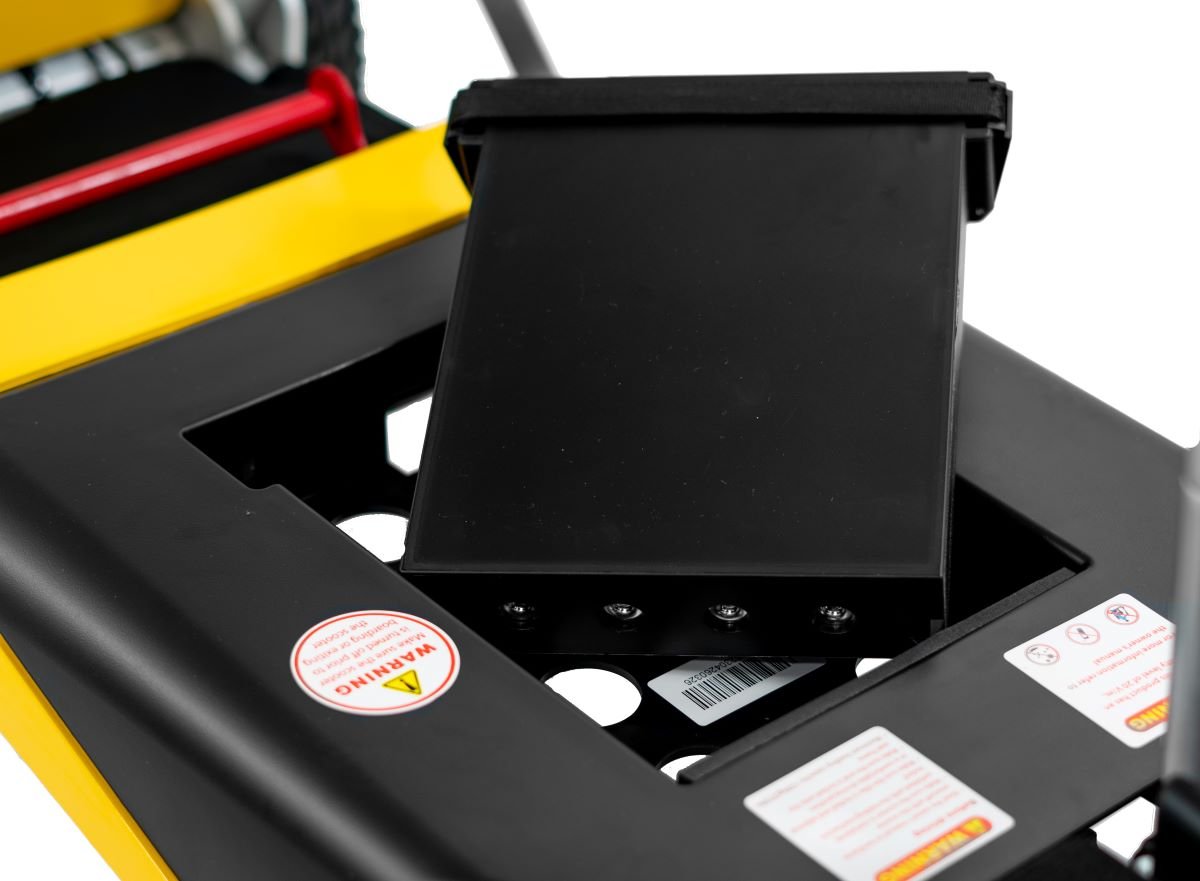
Electric Scooter Battery Lifespan: 300–500 Cycles Explained for Everyday Riders
If you’ve ever been told your electric scooter battery will last “300 to 500 cycles,” you probably had questions. What exactly counts as a cycle? Does charging it twice from 50% down to 0% equal one cycle or two? And what does this mean in practical terms — how far can I actually ride before replacing the battery? These are exactly the right questions to ask, and the answers are more nuanced than the spec sheet suggests.
Understanding battery cycles is essential for anyone who wants to budget for battery replacements, maximize their scooter’s resale value, or simply know when to start shopping for a new battery. In this article, we’ll break down what a cycle actually is, how depth of discharge changes the math, and what CHISEN’s factory-quality lead-acid batteries bring to the table.
What Exactly Is One Battery Cycle — And Why Does It Matter?
A battery cycle is one complete discharge of the battery’s rated capacity, followed by one complete recharge. But here’s the critical detail most people miss: partial discharges count proportionally. If you use 25% of your battery today and charge it back to 100%, that’s only one-quarter of a cycle. Four such partial discharges in a week add up to one full cycle — not four.
This matters because lead-acid batteries are extremely sensitive to how deeply they are discharged each cycle. A battery that consistently undergoes 100% depth of discharge (DoD) — running from full to empty every time — will deliver far fewer total cycles than one that is cycled to only 50% DoD. This is why the “300–500 cycles” specification is always given at a specific test DoD, typically 50% or 80%.
To make this concrete: if you have a 48V 12Ah lead-acid battery pack and you run it from 100% down to 0% every single day, you might get 300–350 usable cycles before capacity drops below 60% of the original rating — effectively end-of-life for most electric scooter applications. But if you instead run it from 100% down to 50% (using only half its capacity per ride) and recharge each night, you could stretch that same battery to 500–700 cycles. That’s roughly double the total energy delivered, simply by managing depth of discharge.
The DoD Math: Why 50% DoD Cycles Are Worth Twice What You Think
The relationship between depth of discharge and cycle life is not linear — it’s exponential. Battery research and manufacturer cycle-life curves for sealed lead-acid (SLA) batteries consistently show that halving the DoD roughly doubles the cycle count. At 100% DoD, expect 300–400 cycles. At 80% DoD, 400–500 cycles. At 50% DoD, 600–900 cycles. At 25% DoD, some premium lead-acid batteries can exceed 1,200 cycles.
What does this mean in practical distance? Let’s use a real example. A 12V 10Ah lead-acid battery (120Wh capacity) powering a scooter that averages 15 km per full charge. At 80% DoD: 300 cycles × 12 km average = 3,600 km total. At 50% DoD: 600 cycles × 7.5 km average = 4,500 km total. The rider using half the battery per trip actually gets 25% more total range from the same battery over its lifetime.
For commuters who ride the same route daily, this translates directly into years of service. A rider doing 10 km per day (round trip) on a 20 km range scooter recharges when the battery hits 50% — one 50% DoD cycle per day. At 50% DoD cycling, a quality lead-acid battery delivers approximately 600 cycles, which means roughly 1,640 days of commuting — or about 4.5 years of weekday commuting. That same rider running to empty daily might need a new battery in under two years.
Lead-Acid vs. Lithium: The Honest Comparison for Electric Scooter Battery Cycles
Lithium-ion batteries typically offer 500–1,000 cycles at 80% DoD, and some premium cells claim 2,000+ cycles at shallow depths. By the raw numbers, lithium seems to win decisively. But there’s more to the story for everyday electric scooter riders.
Cost is the primary factor. A quality lead-acid battery pack for an electric scooter typically costs $50–$150 depending on voltage and capacity. A comparable lithium replacement can cost $200–$500 or more. For many riders — especially casual users, students, and daily commuters on a budget — lead-acid delivers more cycles per dollar than any other technology. A $100 lead-acid battery delivering 500 cycles at 50% DoD is genuinely excellent value.
Weight is another consideration. Lead-acid batteries are heavier — a 48V 12Ah lead-acid pack might weigh 15–18 kg, while a lithium equivalent could be 3–5 kg. For portable scooters that need to be carried upstairs, lithium’s advantage is real. But for fixed-route commuters who leave their scooter parked, the weight difference is irrelevant. CHISEN’s lead-acid batteries use optimized grid designs and AGM technology to maximize energy density within the lead-acid format, giving riders the best possible balance of cost, performance, and cycle life.
How CHISEN’s Factory Quality Translates Into Real-World Cycle Performance
Not all lead-acid batteries are created equal. The difference between a premium factory-manufactured CHISEN battery and a budget generic equivalent can be 100–200 additional cycles — a full 30–40% longer lifespan. CHISEN’s manufacturing process controls several variables that directly impact cycle life: plate thickness (thicker plates resist corrosion longer), electrolyte specific gravity (precisely calibrated for the application), grid alloy composition (affecting grid corrosion rate), and cell equalization (ensuring all cells age at the same rate).
Each CHISEN battery undergoes formation charging at the factory — a controlled first charge that conditions the active materials and establishes the battery’s baseline performance. This process, sometimes skipped by lower-cost manufacturers, makes a measurable difference in initial capacity and long-term stability. The result is a battery that not only meets its rated cycle specification but often exceeds it under real-world conditions.
!electric-scooter-lithium-battery-pack-close-up.jpg

Putting It All Together: Planning Your Electric Scooter Battery Investment
For most urban electric scooter riders, a quality lead-acid battery delivers 400–600 full equivalent cycles with good care — that’s 1.5 to 3 years of typical use. The key variables are within your control: keep discharge depth below 50% per charge cycle, charge after every ride rather than waiting for low battery, store at 50% SoC if not riding for weeks, and use a properly regulated charger.
CHISEN produces a full range of sealed lead-acid and AGM electric scooter batteries in certified manufacturing facilities. Whether you need a direct replacement or want to stock up for fleet operations, the team can provide technical specifications, cycle-life data, and volume pricing. Reach out via email or WhatsApp for a fast response.

发表回复