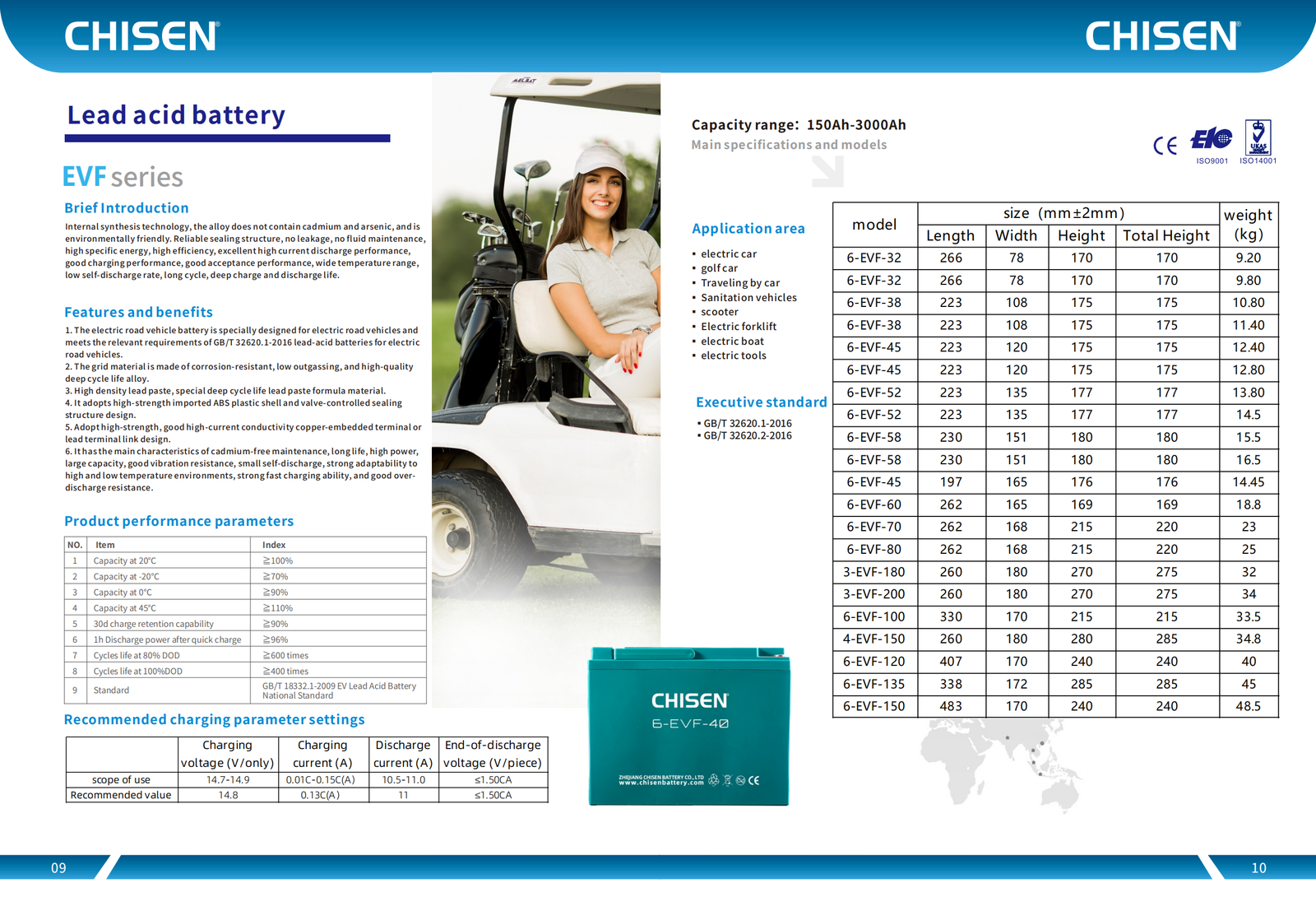
Lead acid Battery

  • RV Battery Types: A Complete Guide 2026

    CHISEN EVF Series Battery for Golf Carts and RVs
    CHISEN EVF Series Battery for Golf Carts and RVs
    CHISEN EVF Series Battery for Golf Carts
    CHISEN EVF Series Battery for Golf Carts

    Choosing the right RV battery affects everything from appliance runtime to how often you need shore power. This 2026 guide covers the best battery types for RVs, motorhomes, and campervans with sizing advice and cost comparisons.

    Best RV Battery Types Compared

    RV Battery Type Comparison 2026
    Battery TypeBest ForCapacityCycle LifeMaintenanceCost 12V 100Ah
    AGM Deep CycleBudget RVs, occasional use100Ah500–700 @50%None$150–250
    Lithium LiFePO4Full-time RVers, boondockers100Ah3,000–5,000None$600–1,000
    Flooded Lead-AcidTraditional RVs, budget100Ah300–500 @50%Monthly water$100–180
    OPzV Tubular GELPremium RVs, solar-heavy100Ah1,000–1,200None$250–400

    KEY STATISTICS

    RV refrigerator daily draw1,500–3,000Wh
    Air conditioner (AC) draw1,200–2,500W while running
    Typical boondocking goal3–5 days off-grid
    AGM self-discharge rate1–3% per month
    LiFePO4 round-trip efficiency95–98%

    How to Size Your RV Battery Bank

    • Calculate total daily Wh: Typical RVer uses 2,000–4,000Wh/day including lights, fridge, water pump, fans, laptop, phone chargers.
    • Choose DoD: AGM = 50% max. LiFePO4 = 80% OK. OPzV = 80% OK.
    • Formula: Required Ah = Daily Wh / (12V x DoD x 0.95)
    • Example: 3,000Wh/day / (12 x 0.50 x 0.95) = 526Ah — use 5x 100Ah AGM in parallel
    • Solar recharging: Add 1.3x solar panels of daily discharge to fully recharge each day

    Frequently Asked Questions

    Can I use car starting batteries in my RV for deep cycling?

    No. Starting batteries are designed for brief high-current discharge to start engines. Using them for deep cycling causes rapid failure within weeks. Always use deep cycle batteries for RV house loads.

    How many batteries for RV air conditioning off-grid?

    A typical RV AC draws 1,200–2,500W. Running 4 hours requires 6,000–10,000Wh. At 12V with 50% DoD AGM, this needs 1,000–1,700Ah. Most off-grid RVers use solar + generator + battery combination.

    Do sealed AGM batteries need maintenance?

    Sealed VRLA AGM requires minimal maintenance vs flooded but benefits from monthly terminal inspection, voltage monitoring, and keeping batteries clean and dry.


    Need a Reliable Battery Supplier?

    CHISEN Battery — 8 global factories, 70M kVAh/year. OPzV tubular GEL, AGM VRLA, front terminal batteries. Trusted by distributors in 60+ countries.

    Factory8 global factories
    Capacity70 million kVAh/year
    CertificationsCE, ISO9001, ISO14001, TUV Rheinland
    Tel+86 131 2666 8999
    Emailjack@chisen.cn
    Webwww.chisen.cn

    Request a Quote

  • Solar Battery Bank Sizing Calculator: Formula Guide

    CHISEN OPzV 2V 200Ah Battery for Home Solar
    CHISEN OPzV 2V 200Ah Battery for Home Solar
    CHISEN OPzV 2V 420Ah Battery for Solar
    CHISEN OPzV 2V 420Ah Battery for Solar

    Correctly sizing a solar battery bank prevents premature battery failure and ensures your system meets daily energy needs. This step-by-step guide covers the complete formula with worked examples for residential, commercial, and off-grid systems.

    The Solar Battery Sizing Formula

    Battery Bank (Ah) = Daily Wh / (System Voltage x DoD x Inverter Efficiency)

    KEY STATISTICS

    DoD for OPzV (design point)80% (cycle life optimized)
    DoD for AGM (design point)50% (maximum life)
    Inverter efficiency (typical)92–96%
    Days of autonomy (grid-tied)1–2 days
    Days of autonomy (off-grid)3–5 days
    Solar panel oversizing factor1.2–1.3x daily discharge

    Step 1: Calculate Daily Energy Consumption

    • LED lighting: 10 x 10W x 5 hrs = 500Wh
    • Refrigerator: 150W x 24hrs x 0.4 duty cycle = 1,440Wh
    • TV: 50W x 4 hrs = 200Wh
    • Laptop: 30W x 5 hrs = 150Wh
    • Total daily consumption: 2,290Wh/day

    Step 2: Choose System Voltage

    Solar System Voltage Selection
    System SizeVoltageWhen to Use
    < 3kWh/day12VSmall cabins, weekend use, minimal loads
    3–10kWh/day24VStandard residential solar
    > 10kWh/day48VCommercial, industrial, large off-grid

    Sizing Examples

    Solar Battery Bank Sizing Examples
    ApplicationDaily WhVoltageDoDDaysRequired AhCHISEN OPzV Config
    Small cabin2,000Wh48V80%2104Ah4x OPzV2-200 (200Ah)
    Residential5,000Wh48V80%1130Ah4x OPzV2-300 (300Ah)
    Small biz10,000Wh48V80%2547Ah4x OPzV2-300 x 4 strings
    Large off-grid20,000Wh48V80%31,563Ah24x OPzV2-1000

    Frequently Asked Questions

    How many solar panels do I need to recharge a battery bank?

    Solar panels should be sized at 1.2–1.3x daily battery discharge to achieve full recharge. Example: 5,000Wh daily use needs 6,000–6,500Wh of solar output. In practice, location, orientation, and temperature reduce output by 15–25%.

    What happens if the battery bank is undersized?

    An undersized bank discharged beyond design DoD daily dramatically reduces cycle life. A battery rated for 1,200 cycles at 50% DoD may deliver only 200–300 cycles if regularly discharged to 90%.

    Can I add batteries to an existing bank later?

    Yes, but only if new batteries are the same age, type, capacity, and manufacturer. Mixing old and new batteries causes imbalance that shortens all battery life.


    Need a Reliable Battery Supplier?

    CHISEN Battery — 8 global factories, 70M kVAh/year. OPzV tubular GEL, AGM VRLA, front terminal batteries. Trusted by distributors in 60+ countries.

    Factory8 global factories
    Capacity70 million kVAh/year
    CertificationsCE, ISO9001, ISO14001, TUV Rheinland
    Tel+86 131 2666 8999
    Emailjack@chisen.cn
    Webwww.chisen.cn

    Request a Quote

  • OPzV Battery Technology: Complete Guide 2026

    CHISEN OPzV 2V 1000Ah Tubular GEL Battery
    CHISEN OPzV 2V 1000Ah Tubular GEL Battery
    CHISEN OPzV 2V 300Ah — Tubular GEL Cell
    CHISEN OPzV 2V 300Ah — Tubular GEL Cell

    OPzV (Ortsfest Pastos Vlies) is the most advanced lead-acid technology available. This guide explains how OPzV works, its specifications, and why it outperforms standard AGM and flooded batteries in solar applications.

    What Is OPzV Technology?

    Definition: OPzV batteries feature wound tubular positive plates with gelled electrolyte (silica gel + sulfuric acid). The tubular design prevents active material shedding — the #1 failure mode in flat-plate lead-acid batteries — enabling 3–5x longer cycle life.

    OPzV vs AGM vs Standard GEL: Full Comparison

    OPzV vs AGM vs Standard GEL Comparison
    FeatureOPzV Tubular GELStandard GEL VRLAAGM VRLA
    Plate designTubular (wound)Flat pastedFlat pasted
    Cycle life @80% DoD1,200–1,500600–800400–600
    Float life @25C15–20 years8–12 years5–8 years
    Best useDaily deep cyclingModerate cyclingFloat/standby
    Cost per cycle$0.05–0.08$0.10–0.15$0.15–0.25
    Temperature range-40C to +60C-20C to +50C-20C to +50C

    KEY STATISTICS

    OPzV cycle life @80% DoD1,200–1,500 cycles
    OPzV float life @25C15–20 years
    OPzV efficiency85–90% round-trip
    Gas recombination rate> 99% (sealed recombinant)
    CHISEN annual OPzV capacity2.4 million cells/year

    CHISEN OPzV Selection Guide

    CHISEN OPzV Battery Configuration Guide
    ApplicationRecommended ModelConfigurationBackup @ Full Load
    Solar home (2–5kWh/day)CHISEN OPzV2-2004x 2V 200Ah = 48V 200Ah4–6 hours
    Commercial solar (10kWh/day)CHISEN OPzV2-3004x 2V 300Ah = 48V 300Ah6–8 hours
    Telecom BTS (macro site)CHISEN OPzV2-40024x 2V 400Ah = 48V 400Ah8+ hours
    Industrial UPSCHISEN OPzV2-1000Multiple strings 48V 1000Ah4–8 hours
    Off-grid microgridCHISEN OPzV2-800Parallel strings for required AhCustom

    Frequently Asked Questions

    What does OPzV stand for?

    OPzV is the IEC international standard designation for tubular GEL VRLA batteries. It comes from German technical designations: Ortsfest (stationary), Pastos (gelled electrolyte), and Vlies (non-woven felt separator).

    How long does an OPzV battery last in a solar system?

    A quality OPzV battery delivers 1,200–1,500 cycles at 80% DoD, or 15–20 years float life at 25C. In daily solar cycling, this translates to 8–12 years of service life.

    Can OPzV batteries be installed indoors?

    Yes. OPzV batteries are recombinant GEL VRLA with over 99% hydrogen recombination efficiency. They emit virtually no gas and are safe for enclosed indoor installation without dedicated ventilation.

    What is the correct charging voltage for OPzV batteries?

    Bulk/absorb: 14.1–14.4V per 12V unit (2.35–2.40V per cell) at 20C. Float: 13.5–13.8V per 12V unit (2.25–2.30V per cell). Temperature compensation: -4mV/degC per cell.


    Need a Reliable Battery Supplier?

    CHISEN Battery — 8 global factories, 70M kVAh/year. OPzV tubular GEL, AGM VRLA, front terminal batteries. Trusted by distributors in 60+ countries.

    Factory8 global factories
    Capacity70 million kVAh/year
    CertificationsCE, ISO9001, ISO14001, TUV Rheinland
    Tel+86 131 2666 8999
    Emailjack@chisen.cn
    Webwww.chisen.cn

    Request a Quote

  • Lead Acid Battery vs Lithium: Which Is Better for Solar?

    AGM vs Gel Battery Comparison for Solar Storage
    AGM vs Gel Battery Comparison for Solar Storage
    AGM Deep Cycle Battery — Internal Structure
    AGM Deep Cycle Battery — Internal Structure

    Test update

  • Lead Acid Battery vs Lithium: Which Is Better for Solar?

    This guide compares lead-acid and lithium batteries for solar energy storage across cost, cycle life, safety, and performance — helping you make the right choice for your project in 2026.

    Lead Acid vs Lithium: Side-by-Side Comparison

    Lead-Acid vs Lithium Comparison 2026
    FeatureLead-Acid (OPzV Tubular GEL)Lithium (LiFePO4)
    Upfront cost (per kWh)$150–300$500–800
    Cycle life @80% DoD1,200–1,500 cycles3,000–5,000 cycles
    Round-trip efficiency80–85%95–98%
    Energy density60–90 Wh/kg120–180 Wh/kg
    Max depth of discharge50–80% recommended80–100%
    Operating temperature-40C to +60C0C to +55C
    MaintenanceNone (sealed)None
    10-year cost per cycle$0.08–0.12$0.10–0.17
    Best applicationLarge systems, hot climatesSpace-constrained, long life

    KEY STATISTICS

    OPzV cycle life @80% DoD1,200–1,500 cycles
    LiFePO4 cycle life @80% DoD3,000–5,000 cycles
    Lead-acid market share (off-grid solar)~68% of global installations
    OPzV float life @25C15–20 years
    Lithium cost reduction since 201582% decrease in $/kWh

    When to Choose Lead-Acid for Solar

    • Large commercial solar installations where space for battery banks is not a constraint
    • Hot climates (Middle East, Africa, South Asia) where ambient temperatures regularly exceed 35C
    • Budget-conscious projects prioritizing lower upfront capital over lifetime cost
    • Remote, unmanned sites where maintenance access is difficult or infrequent
    • Daily cycling applications where 1,200+ cycle life is more than sufficient

    When to Choose Lithium for Solar

    • Space-constrained installations such as residential rooftops with structural weight limits
    • Projects requiring 15–20 year battery service life without replacement
    • Mobile solar applications: vehicles, boats, RVs where weight matters significantly
    • High-depth-of-discharge daily cycling in premium off-grid residential installations

    Total Cost of Ownership: 5kWh System, 10 Years

    Total Cost of Ownership Comparison
    Cost FactorLead-Acid OPzVLithium LiFePO4
    Battery purchase$750–1,500$2,500–4,000
    Replacement @5 years$0$0
    10-year total cost$750–1,500$2,500–4,500
    Cycles delivered (1/day)3,650 cycles3,650 cycles
    Cost per cycle used$0.08–0.12$0.11–0.17

    Need a Reliable Battery Supplier?

    CHISEN Battery — 8 global factories, 70M kVAh/year. OPzV tubular GEL, AGM VRLA, front terminal batteries. Trusted by distributors in 60+ countries.

    Factory8 global factories
    Capacity70 million kVAh/year
    CertificationsCE, ISO9001, ISO14001, TUV Rheinland
    Tel+86 131 2666 8999
    Emailjack@chisen.cn
    Webwww.chisen.cn

    Request a Quote

  • Lead Acid Battery vs Lithium: Which Is Better for Solar?

    This guide compares lead-acid and lithium batteries for solar energy storage across cost, cycle life, safety, and performance — helping you make the right choice for your project in 2026.

    Lead Acid vs Lithium: Side-by-Side Comparison

    Lead-Acid vs Lithium Comparison 2026
    FeatureLead-Acid (OPzV Tubular GEL)Lithium (LiFePO4)
    Upfront cost (per kWh)$150–300$500–800
    Cycle life @80% DoD1,200–1,500 cycles3,000–5,000 cycles
    Round-trip efficiency80–85%95–98%
    Energy density60–90 Wh/kg120–180 Wh/kg
    Max depth of discharge50–80% recommended80–100%
    Operating temperature-40C to +60C0C to +55C
    MaintenanceNone (sealed)None
    10-year cost per cycle$0.08–0.12$0.10–0.17
    Best applicationLarge systems, hot climatesSpace-constrained, long life

    KEY STATISTICS

    OPzV cycle life @80% DoD1,200–1,500 cycles
    LiFePO4 cycle life @80% DoD3,000–5,000 cycles
    Lead-acid market share (off-grid solar)~68% of global installations
    OPzV float life @25C15–20 years
    Lithium cost reduction since 201582% decrease in $/kWh

    When to Choose Lead-Acid for Solar

    • Large commercial solar installations where space for battery banks is not a constraint
    • Hot climates (Middle East, Africa, South Asia) where ambient temperatures regularly exceed 35C
    • Budget-conscious projects prioritizing lower upfront capital over lifetime cost
    • Remote, unmanned sites where maintenance access is difficult or infrequent
    • Daily cycling applications where 1,200+ cycle life is more than sufficient

    When to Choose Lithium for Solar

    • Space-constrained installations such as residential rooftops with structural weight limits
    • Projects requiring 15–20 year battery service life without replacement
    • Mobile solar applications: vehicles, boats, RVs where weight matters significantly
    • High-depth-of-discharge daily cycling in premium off-grid residential installations

    Total Cost of Ownership: 5kWh System, 10 Years

    Total Cost of Ownership Comparison
    Cost FactorLead-Acid OPzVLithium LiFePO4
    Battery purchase$750–1,500$2,500–4,000
    Replacement @5 years$0$0
    10-year total cost$750–1,500$2,500–4,500
    Cycles delivered (1/day)3,650 cycles3,650 cycles
    Cost per cycle used$0.08–0.12$0.11–0.17

    Need a Reliable Battery Supplier?

    CHISEN Battery — 8 global factories, 70M kVAh/year. OPzV tubular GEL, AGM VRLA, front terminal batteries. Trusted by distributors in 60+ countries.

    Factory8 global factories
    Capacity70 million kVAh/year
    CertificationsCE, ISO9001, ISO14001, TUV Rheinland
    Tel+86 131 2666 8999
    Emailjack@chisen.cn
    Webwww.chisen.cn

    Request a Quote

  • The True Cost of Battery Failure: Why Quality Batteries Save Money Long-Term

    Most buyers evaluate batteries on upfront purchase price alone. When you factor in total cost of ownership — replacement costs, downtime losses, labor, and performance degradation — the cheapest battery is almost never the most economical choice.

    The Iceberg Model of Battery Cost

    For a commercial application, the purchase price typically represents only 20-35% of the total cost of ownership. The remaining 65-80% is invisible at purchase: replacement labor, downtime, efficiency losses, and premature disposal costs.

    Total Cost of Ownership: A Real Example

    Consider a 48V e-rickshaw operating 365 days/year:

    • Budget VRLA: $160 upfront, 300 cycles = 1.5 years, $208 cost over 2 years
    • Quality EVF: $240 upfront, 700 cycles = 3.2 years, $240 cost over 2 years
    • Premium LFP: $480 upfront, 3000 cycles = 8+ years, $480 over 2 years, no replacement

    Downtime: The Hidden Profit Killer

    For commercial operators, battery downtime has direct revenue cost. An e-rickshaw idle 3 days costs the driver $100-200 in lost income. For a 20-vehicle fleet, a single failure during peak season could cost thousands.

    Evaluating True Quality

    Request cycle test data (not just specs), buy from ISO 9001 manufacturers with batch traceability, evaluate warranty from companies with 10+ year track records, and factor total landed cost including shipping and duties.

    For TCO analysis for your application: sales@chisen.cn

  • The Future of Energy Storage: Trends and Innovations 2026

    The Future of Energy Storage: 2026 Trends and Innovations

    The global energy storage market is undergoing a transformation that will reshape how we generate, store, and consume electricity. From utility-scale battery farms to home energy systems, 2026 marks a pivotal year in which several converging trends are accelerating the deployment and evolution of energy storage technology.

    1. The Rapid Scaling of Grid-Scale Storage

    In 2026, global installed grid storage capacity is expected to exceed 400 GWh, driven by renewable energy integration requirements, grid stabilization needs, and declining battery costs. Utilities are deploying massive battery systems to store excess solar and wind generation, provide frequency regulation, replace peaking power plants, and reduce transmission congestion. Lead-acid batteries remain significant in grid storage applications, particularly in developing markets where the combination of lower cost and established recycling infrastructure makes economic sense.

    2. Lithium-Ion Cost Curves Continue to Decline

    Battery pack prices have fallen from $1,200/kWh in 2010 to under $100/kWh in 2026. However, the economics of energy storage are more nuanced than raw battery prices. Balance-of-system costs, installation complexity, and battery longevity factor into the total cost of a storage project. This is why lead-acid batteries continue to dominate in cost-sensitive applications — the total system cost matters more than the battery price alone.

    3. The Rise of Vehicle-to-Grid (V2G) Technology

    Electric vehicles are increasingly recognized as distributed energy storage assets. V2G technology allows EV batteries to feed power back to the grid during peak demand. This accelerates battery cycling, which favors batteries with excellent cycle life — a key strength of OPzV and advanced lead-acid technologies.

    4. Long-Duration Energy Storage (LDES) Emerges

    While lithium-ion excels at short-duration storage (2–4 hours), the industry increasingly recognizes the need for long-duration energy storage (8–100+ hours). Emerging technologies include iron-air batteries, vanadium flow batteries, zinc-bromide systems, hydrogen storage, and compressed air energy storage. Lead-acid continues to serve the mid-duration range (4–12 hours) that many micro-grid and rural electrification projects require.

    5. AI and Machine Learning Optimize Battery Systems

    Modern battery installations increasingly use AI-powered systems to predict battery degradation, optimize charging patterns based on weather forecasts, balance cells in real-time to maximize battery life, detect faults before they cause system failures, and optimize grid services revenue for utility-scale installations.

    6. Sustainable Battery Manufacturing Gains Priority

    Environmental responsibility is moving up the agenda for battery manufacturers. All major lead-acid manufacturers have transitioned to cadmium-free formulations. Major factories are transitioning to solar-powered production. Improved water recycling and reduced water usage in production are becoming standard.

    7. Developing World Drives Battery Storage Growth

    The most significant trend in 2026 is the explosion of energy storage deployment in developing economies. Rural electrification programs across Africa, Southeast Asia, and the Pacific are deploying solar+battery systems at an unprecedented pace. For these applications — cost-sensitive, maintenance-limited, extreme-climate, local-technical-capacity-challenged — reliable, affordable, maintenance-free lead-acid batteries (sealed VRLA and OPzV) remain the dominant choice.


    About CHISEN Battery

    CHISEN Battery is a professional lead-acid battery manufacturer with 8 global production facilities and an annual output capacity exceeding 70 million kVAh. Our product range includes OPzV tubular GEL batteries, VRLA batteries, and cadmium-free industrial batteries — all certified to CE, ISO9001, and TUV standards. Trusted by distributors and system integrators in over 60 countries, CHISEN supports projects from residential off-grid systems to utility-scale energy storage installations.

    Jack Chen | General Manager | CHISEN Battery
    Tel: +86 131 2666 8999 | Email: jack@chisen.cn | www.chisen.cn

  • Off-Grid Solar System Design: Battery and Panel Sizing

    Off-Grid Solar System Design: The Complete 2026 Guide

    Designing an off-grid solar system is both a science and an art. The science lies in calculating energy requirements, sizing components, and accounting for seasonal variations. The art lies in balancing technical requirements against budget constraints, available space, and future expansion needs. This guide walks you through the complete process, with particular focus on battery and panel sizing.

    Step 1: Calculate Your Energy Requirements

    Before sizing any component, understand exactly how much energy you consume. List every electrical load and estimate daily usage hours. Example daily calculation: Lights (6 x 10W x 5 hours = 300 Wh), Refrigerator (150W x 24 hours x 0.4 duty cycle = 1,440 Wh), Laptop (50W x 4 hours = 200 Wh), Water pump (200W x 1 hour = 200 Wh), Total: approximately 2,500 Wh/day (2.5 kWh/day).

    Step 2: Determine System Voltage

    12V: Small systems under 1kWp, camping/RV applications. 24V: Medium systems 1–5kWp, common in residential off-grid. 48V: Large systems over 3kWp, preferred for efficiency and reduced current. For most residential off-grid systems, 48V provides the best balance of efficiency, component availability, and safety.

    Step 3: Size Your Battery Bank

    Battery sizing determines your days of autonomy — how many days of power you can sustain without solar generation. Formula: Battery Bank Capacity (Ah) = (Daily Energy Use x Days of Autonomy) / (System Voltage x Maximum Depth of Discharge). Example for 48V system, 2.5 kWh/day, 2 days autonomy, 50% DoD: Capacity = 2,500 x 2 / (48 x 0.50) = 208 Ah. Battery Type Selection: OPzV Tubular GEL is best for daily cycling with long design life. Flooded Lead-Acid offers lower cost but requires maintenance. AGM is maintenance-free. Lithium offers highest performance at premium cost.

    Step 4: Size Your Solar Array

    Formula: Array Size (Wp) = Daily Energy Use / Peak Sun Hours / System Efficiency Factor. Example: 2,500 Wh / 5 hours / 0.65 = 769 Wp — round up to 1,000 Wp minimum. Always oversize by 20–30% to account for panel soiling, aging, temperature effects, and battery charging inefficiencies.

    Step 5: Select Your Inverter and Charge Controller

    Inverter Sizing: Continuous rating should exceed your total simultaneous load by 25%. Surge capacity must handle motor starting loads (typically 2–3x continuous rating). For a 2.5 kWh/day home with 1.5kW peak load, a 3kW inverter provides comfortable headroom. Charge Controller Sizing: PWM: Controller amps = Array watts / Battery voltage. MPPT controllers are more efficient — for 48V systems, 60A MPPT controllers are common for 2–5kWp arrays.

    Step 6: Plan for Seasonal Variation

    Never design an off-grid system for average conditions — design for the worst month. In many regions, winter produces only 30–50% of summer solar output. Solutions: larger battery bank, oversizing the array, backup generator, or hybrid grid connection.


    About CHISEN Battery

    CHISEN Battery is a professional lead-acid battery manufacturer with 8 global production facilities and an annual output capacity exceeding 70 million kVAh. Our product range includes OPzV tubular GEL batteries, VRLA batteries, and cadmium-free industrial batteries — all certified to CE, ISO9001, and TUV standards. Trusted by distributors and system integrators in over 60 countries, CHISEN supports projects from residential off-grid systems to utility-scale energy storage installations.

    Jack Chen | General Manager | CHISEN Battery
    Tel: +86 131 2666 8999 | Email: jack@chisen.cn | www.chisen.cn

  • Solar Battery Warranty: What Every Buyer Should Know

    Understanding Solar Battery Warranties: A Buyer Complete Guide

    A solar battery warranty is more than just a document — it is your primary protection against manufacturing defects, premature capacity loss, and unexpected failures. Yet solar battery warranties are often misunderstood. This guide demystifies solar battery warranties and helps you understand exactly what protection you are getting when you invest in solar energy storage.

    Why Solar Battery Warranties Are Different

    Unlike most consumer electronics, solar batteries are expected to degrade gradually over time. A warranty for a solar battery must address both sudden failures AND gradual capacity loss. Product Warranty covers manufacturing defects and sudden physical failures — typically 2–5 years. Performance Warranty guarantees the battery will retain a minimum percentage of its rated capacity over time — typically 5–10 years.

    Key Solar Battery Warranty Terms Explained

    Capacity Retention Guarantee

    The performance warranty guarantees a minimum capacity percentage at the end of the warranty period. Industry standard is 60–80% of rated capacity after 10 years. Premium products offer 80–90% of rated capacity after 10 years. A battery rated at 100Ah that guarantees 80% after 10 years must still deliver 80Ah after a decade of use.

    Cycle Warranty

    Some warranties are expressed as a maximum number of cycles rather than years. Flooded Lead-Acid: 500–1,000 cycles at 50% DoD. AGM: 400–800 cycles at 50% DoD. OPzV Tubular GEL: 1,200–1,500 cycles at 80% DoD. Lithium: 3,000–5,000 cycles.

    Prorated vs. Full Replacement

    Full Replacement: Manufacturer replaces the failed battery with a new unit at no cost — the most favorable warranty type. Prorated Replacement: Manufacturer provides a replacement at reduced cost proportional to how long you have used the battery. Hybrid: Full replacement during the product warranty period, then prorated coverage for the performance warranty period.

    What Void a Solar Battery Warranty

    • Incorrect charging — using wrong voltage or non-approved charger
    • Over-discharge — repeatedly discharging below minimum DoD
    • Physical damage from impact, water intrusion, or unauthorized modifications
    • Improper installation by non-certified personnel
    • Unauthorized repair or modification of the battery
    • Operating outside the specified temperature range without proper thermal management

    What to Ask Before You Buy

    • Is the warranty backed by the manufacturer directly, or only by the dealer?
    • Does the warranty apply globally, or only in certain regions?
    • Is there a local authorized service center, or must batteries be shipped internationally for warranty service?
    • What documentation must I keep to maintain warranty coverage?
    • What are the exact charge controller settings required to maintain warranty?

    About CHISEN Battery

    CHISEN Battery is a professional lead-acid battery manufacturer with 8 global production facilities and an annual output capacity exceeding 70 million kVAh. Our product range includes OPzV tubular GEL batteries, VRLA batteries, and cadmium-free industrial batteries — all certified to CE, ISO9001, and TUV standards. Trusted by distributors and system integrators in over 60 countries, CHISEN supports projects from residential off-grid systems to utility-scale energy storage installations.

    Jack Chen | General Manager | CHISEN Battery
    Tel: +86 131 2666 8999 | Email: jack@chisen.cn | www.chisen.cn